

Europe Cell Culture Media Market Growth, Shares, Forecast and Industry Reports 2025-2034

Europe Cell Culture Media Market Size
2025 Market Value – USD 948.32 million; reflects growing R&D in biologics and vaccines manufacturing.
2034 Market Value – USD 1,642.05 million; robust expansion due to biopharma advancements and stem cell research funding.
CAGR (2025–2034) – 6.29%; steady growth driven by serum-free formulations and automation integration in cell culture systems.
Dominant Type Segment (2024) – Liquid media; accounts for the largest market share owing to ease in sterility and transport.
Fastest-Growing Type Segment – Semi-solid and solid media; supported by drug development and microbiology research demand.
Leading Product Segment (2024) – Serum-free media; preferred for animal-component-free formulations enhancing reproducibility.
Fastest-Growing Product Segment – Stem culture media; fueled by regenerative medicine and chronic disease management initiatives.
End-Use Leader (2024) – Pharmaceutical & biotechnology companies; attributed to advanced infrastructure and capital strength.
Fastest-Growing End-Use Segment – Hospitals & diagnostic laboratories; due to increasing biomarker identification and patient testing.
Regional Leader – France dominates the Europe market due to strong biotech ecosystem and government support for gene therapy.
Europe Cell Culture Media Market Trends
Massive Investments in R&D Infrastructure –
Merck’s €300 million investment (April 2024) to build an Advanced Research Center in Germany strengthens mRNA and antibody manufacturing.
Novartis’ €500 million investment (March 2024) to construct new cell culture facilities in Austria enhances microbial and monoclonal antibody production.
Transition to Serum-Free & Chemically Defined Media – Industry shifts from animal serum to defined, consistent media formulations for reproducibility and regulatory compliance.
Rise in 3D Cell Culture Techniques – Enables better physiological and morphological simulation, improving gene expression and cell-cell communication.
Expansion in Biopharmaceutical Manufacturing – Over 16.5 million liters of biopharmaceutical capacity globally depend on cell culture media inputs.
Emergence of Sustainable Media Components – Focus on plant-derived and recombinant proteins to replace animal-based ingredients.
Integration of AI in Media Optimization – AI tools enhance predictive modeling of nutrient needs and optimize bioreactor media formulations.
Increase in Regenerative Medicine Applications – Cell culture media used for stem cell expansion in tissue regeneration and therapy.
Regulatory Support for Clinical Trials in Europe – France and the UK easing regulatory frameworks for gene and cell therapy accelerates media demand.
EXCiPACT GMP Certification Trend – Merck’s 2024 certification establishes quality leadership in excipient manufacturing for media products.
Collaborative Networks for Innovation – Evonik’s 2024 global competence network integrates cross-continental expertise in cell culture solutions.
10 AI Impacts or Roles in the Europe Cell Culture Media Market
AI-Driven Media Composition Optimization – Algorithms predict optimal nutrient ratios for specific cell types, improving yield and consistency.
Automation in Media Formulation – Machine learning automates ingredient selection and batch preparation, reducing manual error and cycle time.
Predictive Quality Control Systems – AI detects potential contamination or deviation trends early, ensuring sterile and stable production environments.
Digital Twin Models for Bioreactors – AI simulates growth conditions virtually, allowing predictive adjustments for temperature, pH, and nutrient supply.
AI in Personalized Media Design – Machine learning algorithms can suggest customized formulations for specific stem cell lines or patient-derived cultures.
Optimization of Scale-Up Processes – AI helps in modeling nutrient diffusion and gas exchange for large-scale production, reducing experimental time.
Cost-Reduction via Predictive Analytics – AI optimizes resource utilization, minimizing reagent wastage and reducing production costs.
AI-Guided Biopharmaceutical Yield Forecasting – Predictive modeling estimates monoclonal antibody yield under varying media formulations.
Enhanced Data Management – AI organizes experimental data from thousands of culture runs for pattern recognition and R&D insights.
Automated Decision Support Systems – AI-enabled dashboards guide researchers on ideal media selection and timing for feeding or harvesting.
Regional Insights
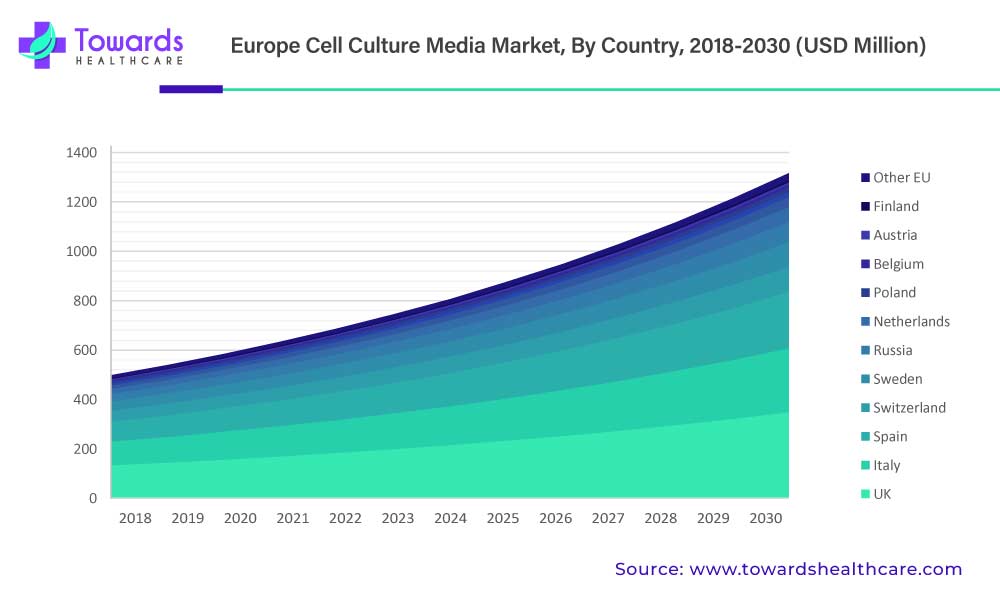
France: Market Leader in Europe
Strong Biotech Ecosystem: Home to advanced cell and gene therapy research hubs.
Government Incentives: France supports R&D collaborations between hospitals and private firms to accelerate cell therapy research.
Regulatory Ease: The French government promotes faster clinical trial approvals for gene therapy applications.
United Kingdom: Second-Largest Market
High Biopharma GVA: UK’s biopharma R&D adds ~£20 billion annually.
Government Funding: Over £100 million invested under the “Synthetic Biology for Growth” program.
Start-Up Ecosystem: Rapid growth of small biotech firms driving demand for consistent media.
Germany: Key Growth Engine
Merck’s €300 Million Center: Focused on mRNA and antibody manufacturing innovations.
Advanced Infrastructure: Strong base for chemical and bioprocess engineering, ensuring quality production of media.
Sweden:
Innovative Materials Research: Development of recombinant spider silk hydrogel for 3D media (Karolinska Institute, 2023).
High Research Quality: Integrating synthetic materials for cell culture applications.
Austria:
Novartis Investments: Building facilities in Kundi and Schaftenau for monoclonal and bispecific antibody production.
Spain & Italy:
Expanding Biopharma Facilities: Increased collaboration with global suppliers for vaccine media development.
Nordic Countries (Denmark & Norway):
Focus on Sustainable Media Sources: Use of eco-friendly materials and synthetic nutrients in culture formulations.
Market Dynamics
Drivers
Emergence of Cell-Based Vaccines: Faster, scalable production compared to egg-based methods for polio, rotavirus, and influenza vaccines.
Rise in Biopharmaceutical R&D: Increased adoption of serum-free media for monoclonal antibody and vaccine manufacturing.
Growing Investment in Research Centers: Merck and Novartis driving European expansion in biomanufacturing infrastructure.
AI & Automation Integration: Enhances media formulation precision and cost efficiency.
Restraints
High Cost of Regenerative Medicine: Limited supplier competition inflates prices for tissue engineering materials.
Complexity in Media Formulation: Challenges in balancing nutrient compositions for diverse cell types.
Opportunities
Evolution of 3D Cell Culture: Enables superior physiological modeling and advanced drug discovery.
Increased Government Funding: France, UK, and Germany supporting local biomanufacturing hubs.
Global Network Collaborations: Evonik’s initiative connects multi-continental R&D to boost innovation.
Top 10 Companies
Merck KGaA
Products: EXCiPACT-certified cell culture media, reagents, and bioprocess solutions.
Strength: Strong global footprint and certified GMP-compliant production sites.
Novartis AG
Products: Biopharma-grade cell media for antibody and vaccine production.
Strength: €500M investment in Austria facilities for microbial and mAb production expansion.
Sartorius AG
Products: Media filtration and bioreactor-integrated solutions.
Strength: Expertise in upstream bioprocess optimization.
FUJIFILM Irvine Scientific
Products: Advanced cell culture solutions for life sciences, IVF, and regenerative medicine.
Strength: Global innovation network and recent business expansion through Astorg acquisition.
Miltenyi Biotec B.V. & Co. KG
Products: Cell separation kits and custom culture media.
Strength: German biotechnology leader with strong immunotherapy applications.
denovoMATRIX
Products: Biomimetic matrices supporting serum-free 3D cultures.
Strength: Innovation in engineered scaffolds for enhanced stem cell culture.
PL BioScience
Products: Human platelet lysate-based media alternatives.
Strength: Pioneering xeno-free growth supplements replacing fetal bovine serum.
PAN-Biotech
Products: Specialty and classical media for academic and industrial R&D.
Strength: Strong product diversity and cost-effective manufacturing.
Eurobio Laboratories
Products: Classical media and custom media formulations.
Strength: Long-standing expertise in European laboratory reagent production.
Cherwell Laboratories Ltd.
Products: Microbiology media, ready-to-use culture plates, and media systems.
Strength: Reliable supplier for diagnostics and hospitals across Europe.

Get a Sample of this Report
Europe Cell Culture Media Market
