

Gene-Editing Therapeutics Market Growth, Shares and Latest Insights 2025

Market size
Market scale statement
The provided estimate: the market is expected to accumulate “hundreds of millions” of revenue across 2025–2034. That phrasing signals a market currently in early commercial expansion (clinical-stage to initial approvals) rather than a multi-billion, fully mature pharmaceutical market in that timeframe.
Market structure (what the size reflects)
The market size figure (hundreds of millions) aggregates value created across: discovery, clinical development, manufacturing/CDMO services for gene editors, delivery systems (viral vectors, LNPs, non-viral), and early commercialization/payer arrangements for curative one-time therapies.
Concentration of value
Value is concentrated in: (a) therapeutic developers (CRISPR/advanced editors); (b) CDMO and advanced therapy manufacturing (single-batch personalized processes); (c) platform & delivery providers (AAV, LNP, electroporation) and (d) specialized patient-support services (financial/logistical programs for one-time curative therapies).
Temporal growth implication
The language and the listed shifts (base/prime editing rising fastest; in-vivo growth; Asia-Pacific acceleration) imply a multi-phase growth curve: near-term revenue from ex-vivo programs and early in-vivo readouts, mid-term uplift as LNP/non-viral delivery matures, and long-term expansion if base/prime editing achieve broader clinical success.
Data caveat / transparency
No single absolute dollar figure beyond “hundreds of millions” was provided; percentages (shares) supplied (CRISPR 48%, North America 48%, ex-vivo shares 53/55%) should be used to interpret relative distribution of that aggregate market value.
Market trends
CRISPR dominance but shifting modality mix
CRISPR/Cas 48% market share (2024): CRISPR remains the largest single modality because of ease of use and breadth of clinical pipeline (ex-vivo and in-vivo).
Base/prime editing fastest growth: newer template-based/single-base repair modalities are expected to scale faster (higher CAGR) due to improved safety and single-base correction capability.
Ex-vivo strength and in-vivo acceleration
Ex-vivo edited cell therapies 53% (2024): controlled manufacturing and safety checks keep ex-vivo dominant initially.
In-vivo fastest growth forecast: less invasive routes (LNP/AAV) aimed at liver, eye, CNS, and muscle will drive next phase of expansion.
Delivery technology transition
Ex-vivo delivery 55% (2024) dominance for cell processing/infusion.
LNP & non-viral systems expected fastest growth — due to manufacturability, lower immunogenicity, and tissue targeting potential.
Indication distribution and shifts
Genetic & rare diseases 40% (2024): primary near-term market because of defined genetic targets and high unmet need (e.g., hemoglobinopathies, retinal dystrophies).
Cardiovascular (fastest growth forecast): in-vivo editing targeting lipid/cholesterol pathways (e.g., PCSK9) is a major growth vector.
Regional reshaping
North America 48% share (2024): concentrated sponsor base, clinical sites, and funding.
Asia-Pacific fastest growth: increasing R&D, clinical trials, and manufacturing capacity will shift some growth eastwards.
Commercial enablers and ecosystem development
Investments, acquisitions (e.g., Eli Lilly/Verve mention), CDMO build-outs, and collaborations with cloud/compute providers (ElevateBio + AWS) accelerate translation and scale.
AI integration as a systemic trend
AI/genAI is beginning to be embedded across target discovery, gRNA design, off-target prediction, and discovery of novel CRISPR enzymes — a cross-cutting trend that improves success rates and shortens lead times.
AI impact / role in gene-editing therapeutics
Target discovery and prioritization
AI systems can ingest genomic, transcriptomic, and phenotypic datasets to prioritize causal variants and therapeutic targets for editing. This reduces time spent on wet-lab target triage and focuses preclinical efforts on higher-probability targets.
Guide RNA (gRNA) design and on/off-target prediction
Machine-learned models predict on-target efficiency and off-target profiles for candidate gRNAs, scoring and ranking designs to minimize unintended edits and toxicity. This is crucial for clinical safety, especially in in-vivo contexts.
Algorithmic design for base & prime editors
For single-base editors and prime editors, AI helps design pegRNAs and editing templates to optimize editing window, efficiency, and minimize bystander edits — enabling therapeutic single-nucleotide corrections (e.g., sickle cell).
De novo discovery of editing enzymes
Generative and contrastive models can scan genomic/metagenomic data to identify novel CRISPR-associated proteins or nuclease variants with desirable PAM specificities, smaller sizes for AAV packaging, or altered specificity.
Predictive safety modeling and immunogenicity forecasting
Integrated models combine sequence, structural, and population HLA data to estimate immunogenicity risks of editors/viral capsids and forecast adverse immune responses in target patient groups.
In silico clinical trial simulation & stratification
AI can model patient heterogeneity, simulate probable response distributions, and help design enriched or stratified trial cohorts to increase the probability of observing clinical benefit with fewer patients.
Manufacturing optimization and quality control (CDMO)
ML models optimize bioprocess parameters (cell culture conditions, vector yield), detect early signs of batch failure from sensor data, and help standardize complex small-batch manufacturing for personalized therapies.
Regulatory and evidence generation support
AI-assisted synthesis of real-world evidence and automated adverse-event signal detection can streamline post-market surveillance and support regulatory dossiers for curative therapies.
Clinical decision support & patient support tools
AI-powered patient identification algorithms find eligible patients for rare-disease trials; chatbots and logistics platforms personalize patient support around one-time curative treatments.
Efficiency multiplier across the value chain
Collectively, AI reduces cycle time (discovery → clinic), increases safety confidence, improves manufacturability, and helps scale precision editing modalities — materially improving expected ROI and accelerating market growth.
Regional insights
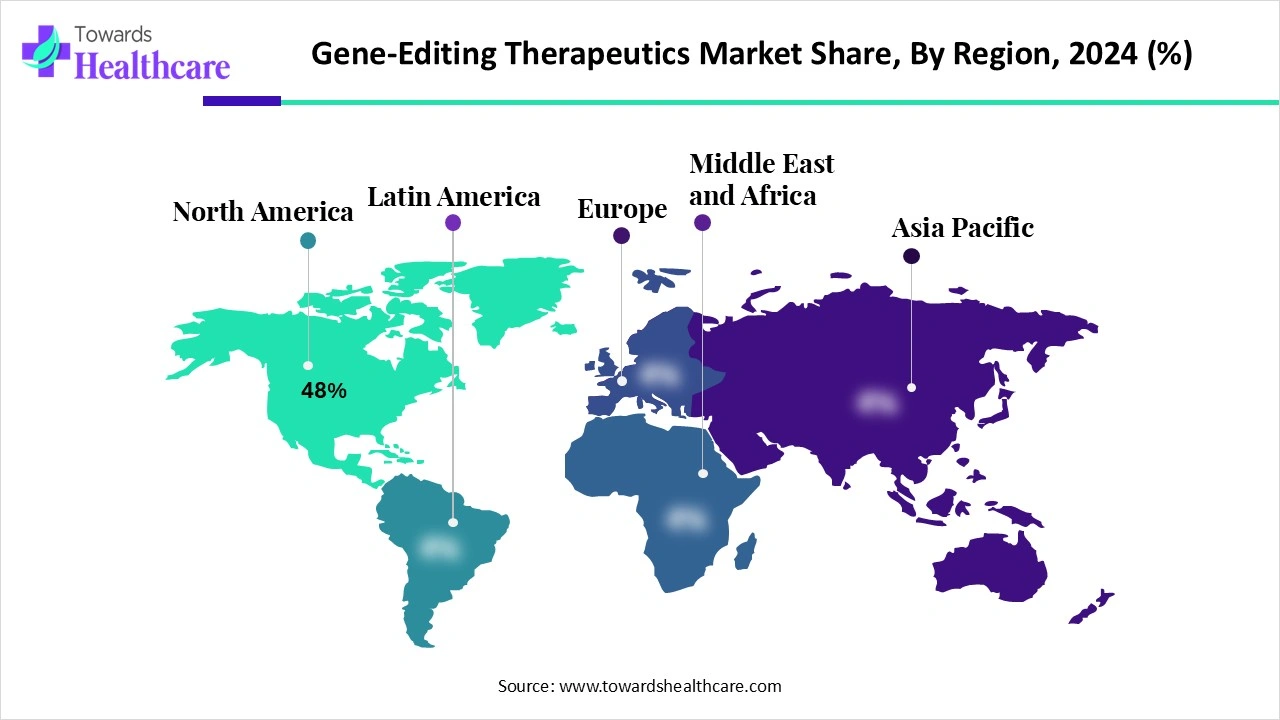
North America (dominant; 48% share in 2024)
Sponsor & capital concentration
High density of biotech sponsors (CRISPR Therapeutics, Intellia, Beam, Editas, Verve, etc.) leads to large clinical pipelines and investor activity — concentrating early revenues here.
Clinical trial infrastructure
Numerous clinical sites and experienced investigators accelerate patient recruitment, enabling faster time-to-readout for early proof-of-concept studies.
CDMO & manufacturing capabilities
Advanced cell-therapy and viral vector manufacturing capacity and specialized service providers support ex-vivo programs and personalized product runs.
Regulatory & payer engagement
The U.S. regulatory environment (FDA) and emerging payer-discussion frameworks for durable, one-time curative therapies create commercialization pathways — though reimbursement remains complex.
Asia-Pacific (fastest-growing forecast)
Expanding R&D & trial activity
Governments and industry investments are increasing clinical trials and local discovery programs — enabling faster trial scaling and lower per-patient costs.
Manufacturing scale and cost arbitrage
Growth in contract manufacturing (e.g., biologics/CDMO hubs) offers capacity for vector and LNP manufacturing at competitive cost, enabling more global supply options.
Regulatory modernization & market access
Regulatory agencies in APAC are modernizing pathways for advanced therapies; harmonization and accelerated approvals could speed regional commercialization.
Talent & collaboration networks
Academic centers and startups form collaborative clusters that reduce translation friction and supply regional innovation pipelines.
Europe
Strong academic translational centers and consortiums
Europe contributes mechanistic science, early translation, and niche clinical expertise (rare disease centers), supporting specialized programs.
Manufacturing and regulatory ecosystems
EU CDMOs and advanced therapy frameworks provide regional manufacturing and regulatory support, though fragmented markets across EU countries can complicate rollout.
Latin America / MEA / Other
Nascent market presence with targeted adoption
These regions may adopt later, often through partnerships and licensing, but face hurdles: infrastructure, regulatory harmonization, and payer constraints.
Market dynamics
Drivers
Growing CRISPR-based ex-vivo programs (explicit driver)
Ex-vivo editing provides controlled editing, better safety validation and higher editing efficiency — fueling the segment that already held 53% share in 2024.
Clinical proof-of-concept readouts in rare diseases and hemoglobinopathies
Positive clinical signals lower technical and commercial risk, spur investment, and enable partnerships/acquisitions (example: Eli Lilly/Verve referenced).
Improved delivery systems (LNP, AAV, non-viral)
Better in-vivo delivery expands treatable tissues (liver, eye, CNS, muscle), underpinning forecasted in-vivo growth.
Investment, M&A and strategic collaborations
Increased funding rounds, acquisitions, and strategic tech partnerships (e.g., ElevateBio + AWS, Eli Lilly + Verve) accelerate pipeline progression and platform scaling.
Restraints
Intricate manufacturing (explicit restraint)
Need for specialized instruments, sterile facilities, multi-step processes and small batch personalization raises cost, risk of batch failure, and constrains throughput.
Safety and off-target risk
Off-target editing and potential immunogenicity remain technical and regulatory hurdles that slow adoption and increase required evidentiary burden.
Reimbursement & value recognition
One-time curative pricing models challenge traditional payer structures; long-term outcome data are needed to justify high upfront costs.
Opportunities
Expanding indication set (genetic, cardiovascular, CNS, oncology)
While genetic & rare diseases held 40% in 2024, cardiovascular is expected to be the fastest growing as lipid-targeted in-vivo edits mature.
AI-driven acceleration and risk reduction
AI improves design, safety prediction, and manufacturability — thereby lowering time and cost to clinic and increasing probability of regulatory success.
CDMO scaling & standardization
Investment in manufacturing capacity and quality systems can reduce unit costs and enable commercialization at scale, particularly for LNP/non-viral systems.
Top companies
CRISPR Therapeutics
Product / focus: CRISPR/Cas-based therapeutics across ex-vivo and in-vivo programs.
Overview: Major CRISPR platform developer with deep clinical pipeline.
Strengths: Leadership in CRISPR modality (CRISPR/Cas segment ~48% share), extensive partnerships, and clinical-stage breadth.
Editas Medicine
Product / focus: Genome editing therapies (CRISPR and related tech).
Overview: Early mover in therapeutic genome editing.
Strengths: Platform expertise and clinical program depth.
Intellia Therapeutics
Product / focus: In-vivo and ex-vivo CRISPR programs.
Overview: Developer of in-vivo editing approaches (AAV/LNP delivery).
Strengths: In-vivo focus aligns with fastest-growing modality expectations.
Beam Therapeutics
Product / focus: Base editing technologies (single-base corrections).
Overview: Platform centered on base editors and potentially prime editing.
Strengths: Positioned for fastest-growing modality (base/prime editing); safety advantages.
Verve Therapeutics
Product / focus: Gene-editing biotech with cardiovascular ambitions (lipid targets).
Overview: Developer of in-vivo edits targeting cholesterol/lipid pathways.
Strengths: Aligned with cardiovascular fast-growth theme; acquisition interest from large pharmas (e.g., Eli Lilly planned acquisition).
Sangamo Therapeutics / Precision BioSciences / Caribou Biosciences / Graphite Bio / Poseida
Product / focus: Various nuclease platforms (ZFN, ARCUS, CRISPR derivatives) and cell therapy programs.
Overview & strengths: Diverse modality portfolio, niche technical strengths (e.g., ZFN legacy, alternative nucleases).
Vertex Pharmaceuticals / Novartis / Regeneron / Roche / Pfizer
Product / focus: Large pharma sponsors investing in gene-editing and cell therapy commercialization & patient support.
Strengths: Development and commercialization muscle, payer negotiation capability, and global franchises.
Manufacturing & service providers (Lonza, Catalent, Thermo Fisher, WuXi Advanced Therapies/WuXi STA, Vineti/TrakCel)
Product / focus: CDMO and supply-chain systems for cell/GMO manufacturing and patient logistics.
Strengths: Scale manufacturing expertise, supply-chain orchestration, IT systems for personalized therapy logistics.
Academic & clinical centers
Role: Essential translational hubs, clinical trial sites, and discovery engines.
Strengths: Deep mechanistic science and patient access for rare disease trials.

Get a Sample of this Report
Gene-Editing Therapeutics Market
