

Healthcare Biometrics Market Trends, Growth and Insights 2025

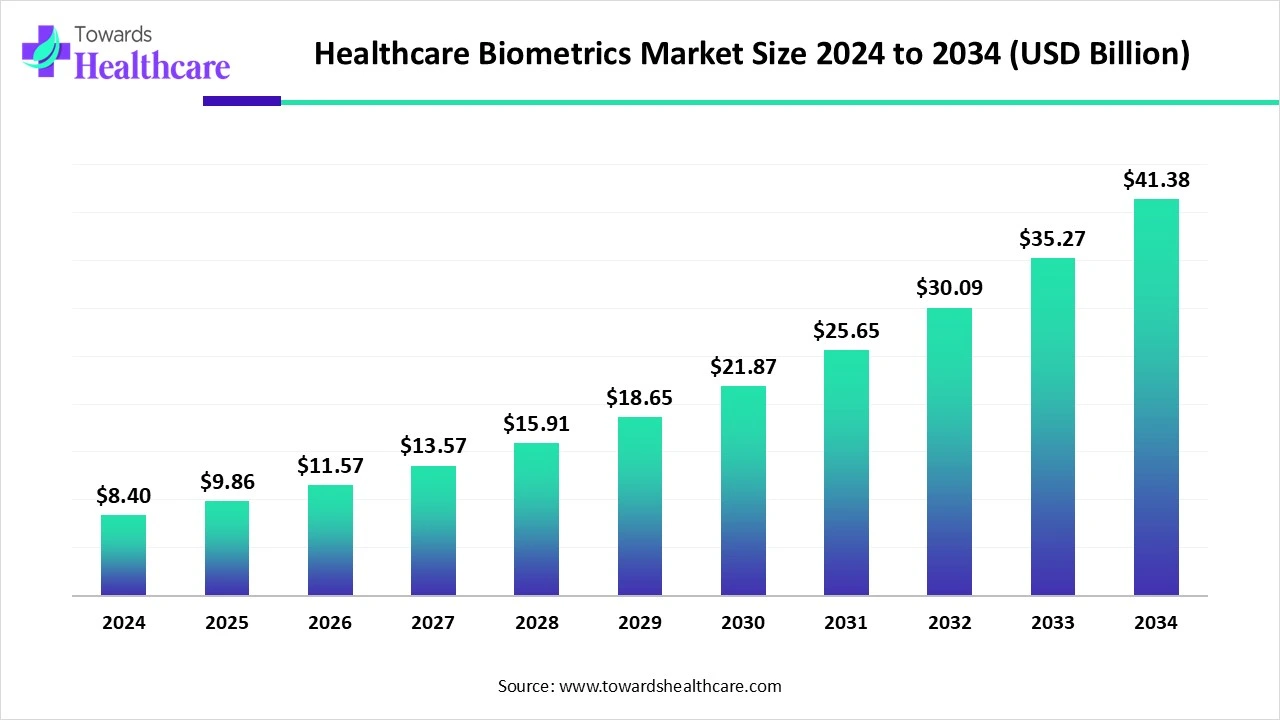
Market Size
◉2024 Market Size → USD 8.4 billion
◉2025 Market Size → USD 9.86 billion
◉2034 Market Size (Forecast) → USD 41.38 billion
◉CAGR (2025–2034) → 17.34%
Regional Share (2024):
◉North America → 42% (largest)
◉Asia Pacific → Fastest CAGR (accelerated adoption in digital health & smart hospitals)
Market Share by End User (2024):
◉Hospitals & Health Systems → 52% (largest revenue share)
Deployment Mode (2024):
◉On-premises/Enterprise → 58% (largest share)
Biometric Type (2024):
◉Fingerprint Recognition → 30% (dominant)
Market Trends
Rising Demand for Secure Authentication
◉Increase in medical data breaches → hospitals adopting biometrics for secure patient data.
◉Example: Change Healthcare cyberattack (April 2024) pushed rapid adoption.
Integration with Digital Health
◉Growth of EHR (Electronic Health Records) and HIS integration drives demand.
◉HER/HIS integration is the largest and fastest-growing segment.
Telemedicine & Remote Healthcare Expansion
◉Biometric verification for virtual patient care and remote monitoring.
◉Example: Imprivata (Feb 2024) launched Biometric Patient Identity (facial recognition) for hospitals.
AI-Enabled Biometrics
◉Smarter, anti-spoofing recognition algorithms improving system reliability.
◉Example: BIO-key International (Jan 2025) AI-powered biometric authentication system.
Shift Toward Non-Contact Biometrics
◉Facial and palm vein recognition gaining traction due to hygiene and convenience.
Software & Algorithms Domination
◉46% revenue share in 2024, due to scalability, integration with cloud, and multi-modal capabilities.
Regional Adoption Gaps
◉North America leads with early adoption.
◉Asia Pacific growing fastest due to smart hospitals & government initiatives.
Role of AI in Healthcare Biometrics
1. Improved Accuracy & Speed
◉Deep Learning Models: CNNs (Convolutional Neural Networks) used in facial recognition to detect subtle feature variations.
◉False Match/Reject Rate Reduction: AI algorithms optimize thresholds dynamically based on patient demographics.
◉Clinical Impact: Faster patient authentication at admission desks → reduces wait times.
◉Example: NEC’s AI facial engine achieving >99% accuracy in real-world hospital settings (2024 trials).
2. Adaptive Recognition (Dynamic Biometric Profiles)
◉Problem: Patient identifiers change (aging, injuries, weight fluctuations, facial hair, surgical scars).
◉AI Solution: Continuous retraining of biometric models → adaptive learning without re-enrollment.
◉Healthcare Use Case: Long-term patients in oncology/geriatric care maintain reliable biometric identities.
◉Trend: AI-driven “progressive enrollment” → system updates the template after every interaction.
3. Predictive Security & Fraud Detection
◉AI Analytics: Detects unusual biometric usage (e.g., login from two hospitals in different cities within an hour).
◉Insurance & Billing: Prevents duplicate patient identities, ghost claims, or fraudulent prescription pickups.
◉Threat Intelligence: AI integrates with IAM systems to flag insider misuse (staff credential sharing).
◉Example: U.S. insurers piloting AI biometric verification in claims processing (2025 rollouts).
4. Real-Time Integration with EHR/HIS
◉Challenge: EHR systems are massive, with latency risks.
◉AI Role: Parallel processing + fuzzy matching algorithms → instant cross-checking with millions of records.
◉Outcome: Clinicians get real-time patient identity confirmation during check-in, lab testing, or imaging.
◉Impact: Reduces medical errors caused by patient misidentification.
5. Scalable Cloud Integration
◉AI Advantage: Distributed machine learning enables multi-hospital biometric networks.
◉Example: A hospital chain can authenticate a patient across 20 branches in milliseconds.
◉Security Layer: Federated learning ensures models improve across sites without sharing raw biometric data (GDPR/HIPAA compliance).
◉Future: Cloud AI + blockchain for tamper-proof biometric audit trails.
6. Remote Patient Monitoring & Telemedicine
◉Voice Biometrics: AI analyzes pitch, tone, breathing irregularities for both authentication + health signals (e.g., respiratory stress).
◉Behavioral Biometrics: Keystroke dynamics & touchscreen patterns used in mental health monitoring apps.
◉Telehealth Security: AI ensures that the patient logging in remotely is the real person, not a proxy.
◉Example: AI-enhanced biometric authentication in schizophrenia monitoring devices (Athelas, 2024).
7. AI in Contactless Biometrics
◉Palm Vein Recognition: AI enhances vein pattern matching, even if blood flow varies (cold hands, dehydration).
◉Iris Recognition: Deep learning improves accuracy under poor lighting or partial occlusion (masks, glasses).
◉Facial Recognition: AI compensates for masks, PPE, and changing hospital lighting conditions.
◉Future Trend: AI-driven 3D biometrics (structured light, depth sensing) replacing 2D image-based systems.
8. Continuous Authentication & Ambient Monitoring
◉Beyond one-time login: AI monitors ongoing presence of the authenticated user (useful in telehealth, ICU access).
◉Methods: Passive face scans via camera, gait monitoring in hospital corridors.
◉Benefit: Reduces risk if a session/device is hijacked mid-use.
9. Personalization of Healthcare Using Biometrics + AI
◉Linking Biometrics & Health Data: AI can correlate biometric changes (voice stress, gait instability) with clinical deterioration.
◉Example: Voice biometrics used not just for login, but to flag Parkinson’s or depression.
◉Future Possibility: “Dual-purpose biometrics” → authentication + diagnostic insight.
10. Ethical & Regulatory Layer (AI Governance in Biometrics)
◉Bias Reduction: AI models being tuned for racial, gender, and age inclusivity.
◉Explainability: Hospitals need AI decisions to be auditable (why was a patient rejected?).
◉Compliance: HIPAA, GDPR, and India’s Digital Personal Data Protection Act (2023) shaping AI biometrics frameworks.
Regional Insights
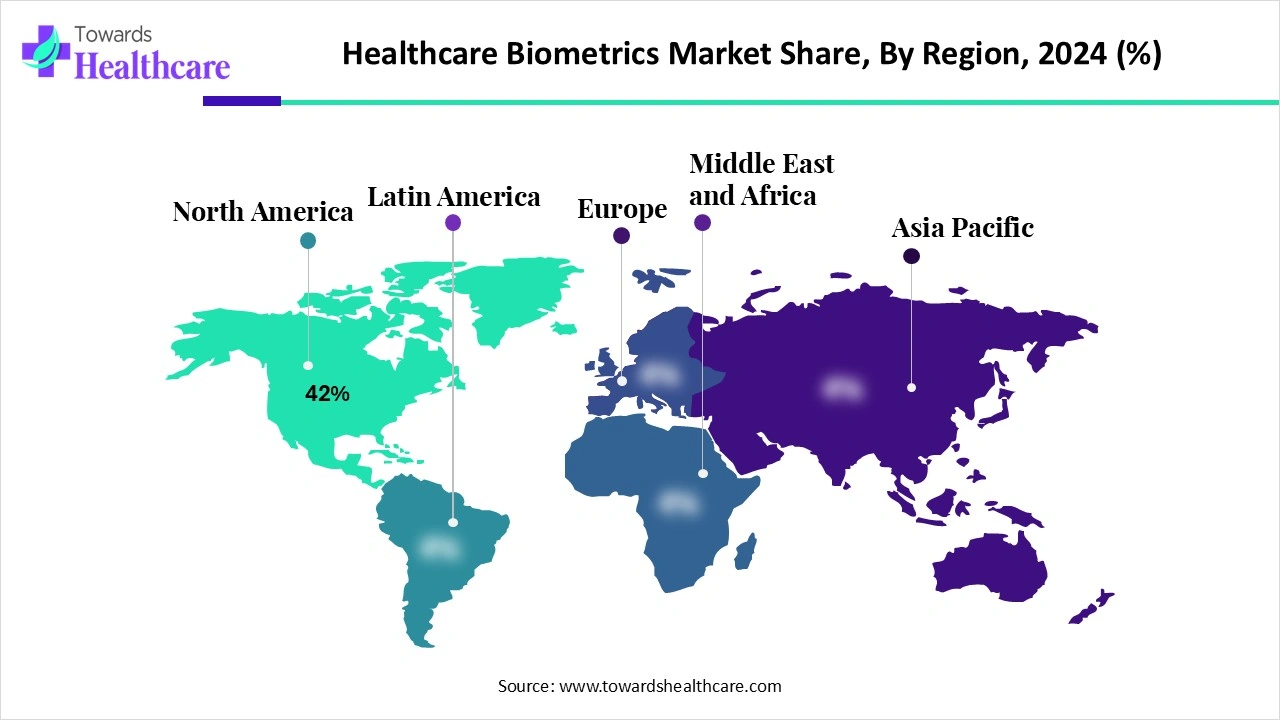
1 North America (42% Market Share in 2024)
◉North America dominated the global healthcare biometrics market in 2024 due to early digital transformation in healthcare and regulatory emphasis on patient data protection.
Drivers
◉Strong EHR adoption across hospitals and clinics.
◉Cybersecurity compliance regulations (HIPAA, HITECH) mandate secure patient identity management.
◉High healthcare IT investments enable rapid deployment of biometric solutions.
U.S. Market
◉Growing demand for contactless authentication (face, iris, and palm recognition).
◉Integration of biometrics into mobile health apps for seamless patient experience.
◉Presence of leading biometric companies (Imprivata, BIO-key, NEC partnerships).
Canada Market
◉Focus on reducing medical identity fraud and duplicate patient records.
◉Expanding adoption of fingerprint and facial recognition in public health programs.
◉Government initiatives support EHR standardization with biometric integration.
2 Asia-Pacific (Fastest CAGR, 2025–2034)
◉Asia-Pacific is projected to grow at the fastest rate, driven by smart hospital initiatives, digital health investments, and rapid adoption of contactless identity systems.
China
◉Government-led smart hospital programs promoting biometric security.
◉Adoption of facial and vein recognition systems for patient check-ins.
◉Rising patient volumes drive hospitals to adopt workflow automation biometrics.
India
◉Large patient population creates a need for accurate identification systems.
◉Strong push from government digital health initiatives (e.g., Ayushman Bharat Digital Mission).
◉Demand for touchless biometric authentication in private and multi-specialty hospitals.
Japan & South Korea
◉Advanced hospital infrastructure integrates iris recognition and multimodal systems.
◉Emphasis on AI-powered biometrics for elderly care and chronic disease monitoring.
◉Early adoption of robotics + biometric integration in clinical workflows.
3 Europe (Strong Growth Forecast)
◉Europe is witnessing consistent growth due to strict compliance regulations and rapid adoption of digital health records.
UK
◉Wide adoption of biometrics for telemedicine, fraud reduction, and patient safety.
◉Supported by NHS digital transformation initiatives.
◉Hospitals are using facial recognition kiosks for faster patient check-in.
Germany
◉Investment in smart hospitals drives biometric deployment in multiple departments.
◉Preference for touchless authentication methods to reduce errors.
◉Integration of EHR and HIS with biometric verification enhances efficiency.
France, Italy, Spain
◉Adoption driven by EU-wide data protection regulations (GDPR).
◉Hospitals focusing on secure authentication for cross-border health programs.
◉Growth in cloud-based biometrics to link regional hospital networks.
4 Middle East & Africa (Emerging Market)
◉MEA is an emerging region with strong pilot projects in biometric healthcare systems.
UAE
◉Amazon + ICP collaboration (March 2025): Palm vein + facial biometrics for healthcare check-ins and payments.
◉Rapid adoption in smart hospitals and government healthcare programs.
Saudi Arabia
◉Investments in next-generation hospitals under Vision 2030.
◉Biometric solutions deployed for patient identity management and access control.
5 Latin America (Moderate Growth)
◉Adoption is moderate due to infrastructure challenges but rising demand in public health programs.
Brazil & Mexico
◉Increasing biometric use in government-led health ID programs.
◉Focus on fraud prevention in insurance claims.
◉Adoption of fingerprint and multimodal systems in urban hospitals.
Market Dynamics
Drivers
◉Rising cases of data breaches and fraud risks push hospitals to adopt secure biometrics.
◉Example: Change Healthcare cyberattack (April 2024) exposed vulnerabilities, triggering rapid biometric adoption.
◉Growing reliance on EHRs and telemedicine platforms requires secure patient authentication.
Restraints
◉High implementation costs for biometric hardware (scanners, sensors, cameras).
◉Ongoing maintenance and software updates add to operational costs.
◉Smaller facilities hesitate due to integration complexity and IT staff requirements.
Opportunities
◉Expansion in telemedicine & remote patient monitoring.
◉Biometric systems for virtual identity verification and remote medication dispensing.
◉Example: Athelas Clozapine monitoring (Nov 2024) → Biometric-enabled device for schizophrenia patients improved remote care and safety.

Get a Sample of this Report
Healthcare Biometrics Market
