

India Breast Pumps Market to Grow 2.6X by 2033 – Is This the Future of Modern Motherhood?

India’s Birth Rate and Breastfeeding Reality
India sees around 24–25 million births every year, making it one of the largest maternal care markets in the world.
At the same time, awareness around breastfeeding has improved.
- About 58% of infants are exclusively breastfed for the first six months
- However, continuation rates drop due to work pressure and lifestyle challenges
- Nearly 9 out of 10 working mothers lack proper breastfeeding support at workplaces
This gap between intention and reality is exactly where breast pumps are becoming essential.
Working Women Are Reshaping Demand
The role of women in India’s workforce is evolving rapidly.
More women are choosing to return to work soon after childbirth.
- Female workforce participation has seen a noticeable rise in recent years
- Many urban women resume work within 3–6 months after delivery
- Dual-income households are becoming more common in metro cities
This shift has directly increased demand for breast pumps, as mothers look for flexible solutions.
Global Breast Pump Market
The global breast pump market size is calculated at USD 3.23 billion in 2024, grew to USD 3.52 billion in 2025, and is projected to reach around USD 7.58 billion by 2034. The market is expanding at a CAGR of 8.63% between 2025 and 2034. The growing number of infants and technological advancements drive the market.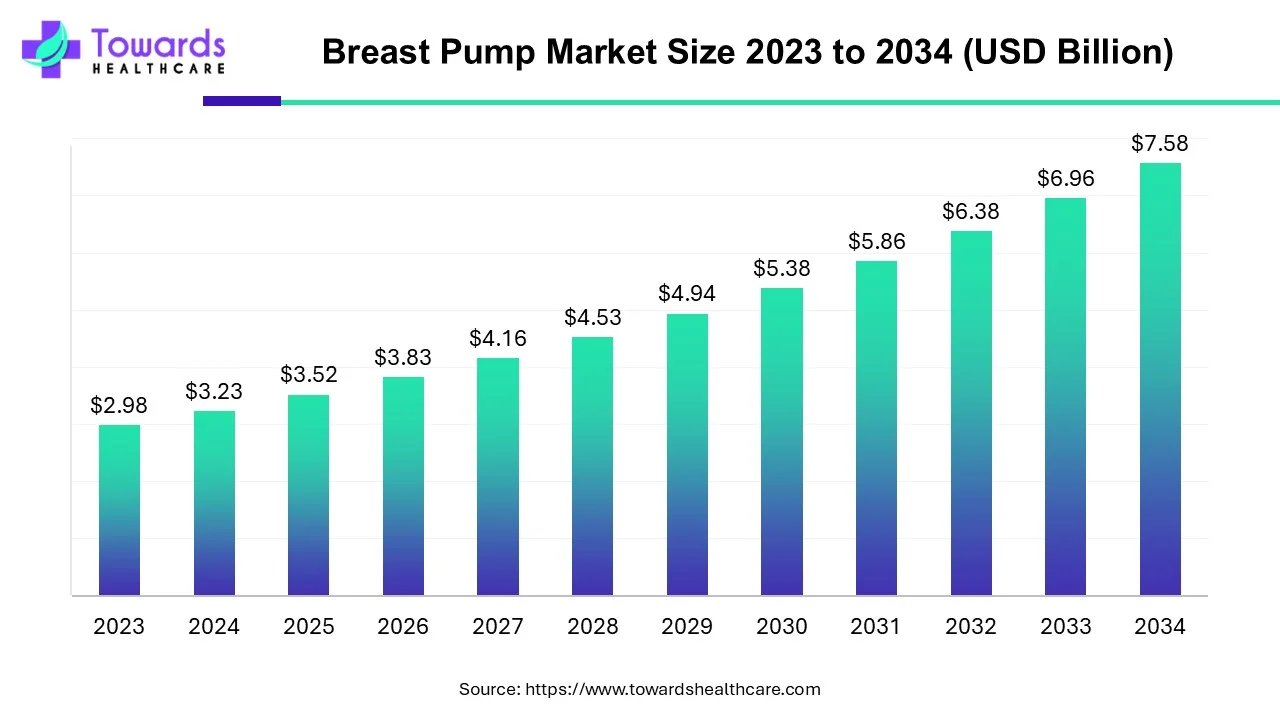
Feeling stuck with too many options? Let’s simplify it for you; Contact us [https://www.towardshealthcare.com/contact-us]
Market Segments Are Evolving Fast
The Indian breast pumps market is no longer basic—it is becoming segmented and advanced.
By product type:
- Closed-system pumps are gaining popularity due to better hygiene
- They are becoming the preferred choice among urban consumers
By technology:
- Manual pumps still exist due to lower cost
- Electric pumps are growing rapidly
- Wearable pumps are emerging as a premium category
- The electric breast pump segment is expected to cross $66 million by 2030
- Wearable pumps are projected to nearly double from $12.7 million to $24.4 million by 2030
This clearly shows a shift toward comfort, efficiency, and convenience.
Urban Dominance vs Rural Opportunity
Currently, demand is concentrated in urban India.
Cities like Mumbai, Delhi, Bangalore, and Pune lead adoption.
Urban growth is driven by:
- Better awareness of maternal health
- Higher purchasing power
- Easy access to online platforms
However, India contributes only about 2.2% to the global breast pump market, despite its population size.
This highlights a massive untapped opportunity in rural and semi-urban regions.
Consumer Preferences Are Changing
Indian mothers today are more informed and practical.
They are actively choosing products that balance baby care with personal convenience.
Key preferences include:
- Lightweight and portable designs
- Quiet operation for discreet use
- Easy cleaning and hygienic systems
- Online availability with fast delivery
E-commerce has played a major role in making these products accessible across cities.

Get a Sample of this Report
India Breast Pumps Market
