

IoT Medical Devices Market Overview, Growth and Latest Insights 2025

Market Size Insights
Market Valuation Growth
◉2024: USD 82.45 billion
◉2025: USD 105.54 billion
◉2034: USD 971.27 billion
◉CAGR: 28% (2025–2034)
Regional Market Share (2024)
◉North America: 38% share (dominant region)
◉Asia Pacific: fastest CAGR due to healthcare digitization & patient base expansion
◉Europe: steady adoption of IoT-based remote monitoring
◉Latin America & MEA: emerging adoption, driven by telemedicine expansion
Device Type Share (2024)
◉Wearable Devices: 45% market share (dominant)
◉Implantable Devices: fastest growth (biochips, smart pacemakers, glucose implants)
◉Stationary/Bedside Devices: widely used in hospitals
◉Remote Monitoring Devices: high adoption for chronic disease & elderly care
Connectivity Share (2024)
◉Bluetooth: 35% market share (dominant)
◉Wi-Fi: strong adoption for hospital-based devices
◉Cellular (3G/4G/5G): fastest CAGR, supported by 5G-enabled healthcare solutions
◉LPWAN, Zigbee, others: niche adoption in specific hospital/home settings
End-User Share (2024)
◉Hospitals & Clinics: 50% share (dominant)
◉Home Healthcare: fastest CAGR (driven by patient preference & self-monitoring adoption)
Market Trends
Rising Technology Adoption in Healthcare
◉IoT integrated with AI, ML, and predictive analytics for personalized care.
◉Remote diagnostics & chronic illness monitoring on the rise.
Virtual Care & IoT Partnerships
◉MediBuddy + ELECOM (Feb 2025): Development of IoT health devices for preventive care & personalized health plans.
Remote Patient Monitoring Growth
◉Remote monitoring accounted for 40% share in 2024.
◉Elderly care & assisted living projected as fastest-growing application due to aging populations.
Wearable Device Dominance
◉Smartwatches, ECG monitors, glucose trackers led 45% share in 2024.
◉Preventive healthcare & aging population driving adoption.
Connectivity Advancements
◉Bluetooth dominates 35% share, but cellular (5G & beyond) expected to transform telehealth, brain-computer interfaces, and remote surgery.
AI’s Role in IoT Medical Devices
Real-Time Data Processing
◉IoT devices generate massive real-time datasets.
◉AI processes and translates into actionable insights for doctors & caregivers.
Predictive Healthcare & Early Diagnosis
◉AI detects anomalies in vital signs, glucose levels, heart rhythm before critical escalation.
◉Predictive models prevent hospital readmissions.
Personalized Medicine
◉AI integrates patient lifestyle, genomic & IoT data to deliver customized care plans.
AI-Powered Remote Patient Monitoring
◉Combines IoT sensors with AI for continuous disease tracking.
◉Enhances elderly care with fall detection, medication reminders, & emergency alerts.
Pandemic & Aging Population Solutions
◉AI+IoT reduces doctor-patient contact while ensuring care continuity.
◉Addresses growing burden of elderly care globally.
Regional Insights
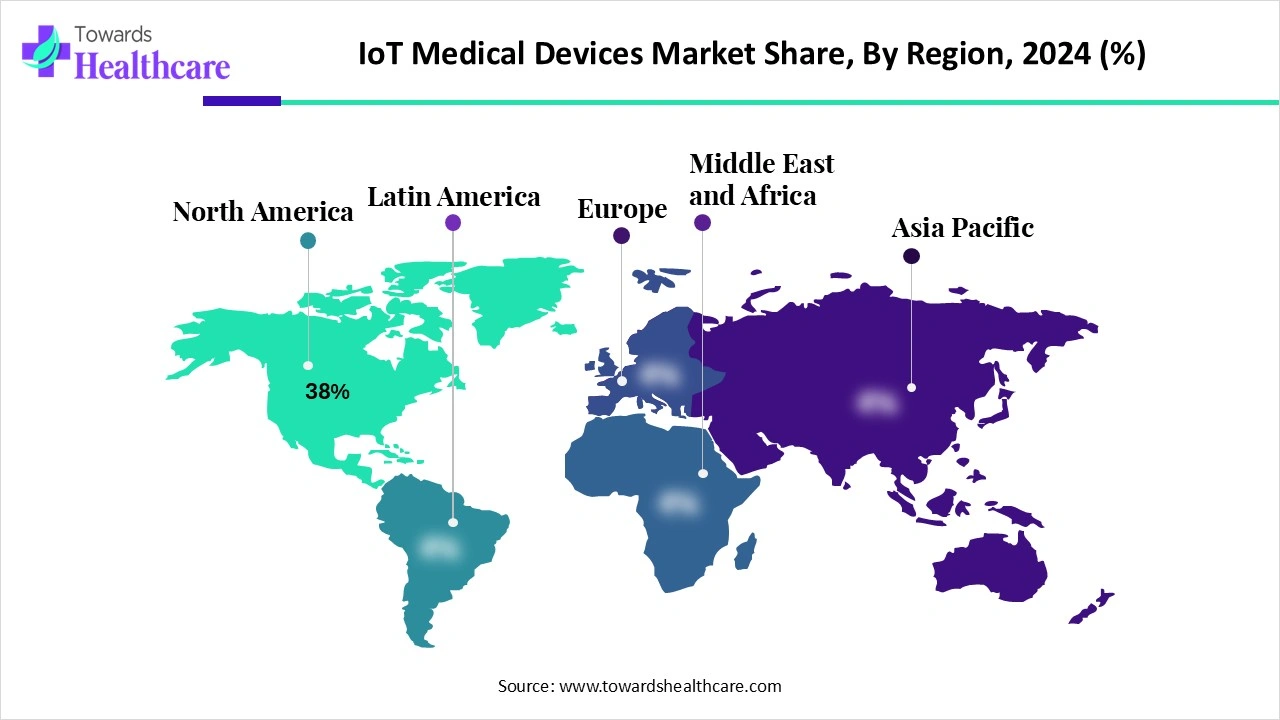
1) North America — (38% share in 2024)
Structural advantages
◉Large healthcare R&D ecosystem (major med-tech hubs, academic medical centers) that accelerates prototyping, clinical validation, and commercialization of IoT medical devices.
◉Sophisticated payor and provider networks willing to pilot remote monitoring and digital therapeutics, enabling scale beyond pilot projects.
Regulatory & standards environment
◉Active regulatory approvals for AI/ML-enabled devices (your data: ~950 AI/ML devices approved in the U.S. by Aug 2024) — this both de-risked clinical acceptance and encouraged industry investments.
◉Federal strategy alignment (Federal Health IT Strategy 2024–2030) provides funding, interoperability focus and a policy roadmap for telehealth/IoT integration — this reduces adoption friction at scale.
Commercial & clinical pull
◉Large hospital systems (IDNs) and integrated care networks are primary buyers of advanced bedside/diagnostic IoT equipment; their procurement drives economies of scale.
◉Consumer health market (wearables) rapidly feeds clinical workflows via patient-generated data (Apple, Fitbit ecosystems).
Key risks specific to region
◉High regulatory bar means longer time-to-market for invasive or high-risk implantables despite large addressable market.
◉Data governance & state/federal privacy laws add compliance complexity for vendors.
2) Asia Pacific — (Fastest projected CAGR)
Demand fundamentals
◉Large and aging patient populations plus rising chronic disease prevalence create a strong need for remote care and continuous monitoring.
◉Rapidly improving healthcare access in urban & semi-urban areas drives demand for connected devices.
Policy & national programs
◉China’s national health planning (Healthy China initiatives) actively encourages digital health investments and telemedicine scaling — platforms & IoT vendors can find large domestic demand and supportive policy.
◉India: government-led initiatives and funding (Rs 500 crore plan — your input) plus digital ID/records programs (Ayushman Bharat / PM Digital Health Mission) create a foundation for device data integration into national health stacks.
Infrastructure & tech adoption
◉Mobile penetration is high; smartphone + low-cost wearables act as a delivery channel for home healthcare services.
◉5G rollouts and improvements in broadband capacity support higher-bandwidth IoT uses (teleconsultation, imaging transfer, remote diagnostics).
Commercial implications
◉Opportunity to localize lower-cost wearables & remote monitoring solutions for mass markets.
◉Partnerships between telehealth platforms and device OEMs (example: MediBuddy + ELECOM in your content) reflect a platform + device go-to-market play.
3) Europe — (steady adoption, privacy-centric)
Drivers
◉High prevalence of chronic conditions (cardio, respiratory) and strong public healthcare systems drive procurement of remote patient monitoring and preventive devices.
◉Consumers show high demand for self-management tools (wearables, home monitors).
Regulatory & data rules
◉Strong data protection emphasis (GDPR + national rules) forces device and cloud providers to architect privacy-by-design systems and often onshore data processing — this raises vendor compliance costs but increases patient trust.
◉Example: Germany’s new stricter specs for cloud processing of health data (2024) forces tighter vendor certification and may favor large, established suppliers or certified cloud partners.
Clinical adoption patterns
◉Public tenders by national health services prioritize validated devices that integrate with existing EHRs and care pathways, favoring mature vendors and interoperable solutions.
4) Latin America & MEA — (emerging, opportunistic)
Market character
◉Mixed public/private systems: adoption pockets in urban centers and private hospitals; rural areas still underserved but telemedicine is bridging gaps.
◉Brazil & Mexico: largest market opportunities due to population size and increasing digital health projects.
Adoption drivers
◉Telemedicine programs and remote monitoring devices provide cost-effective ways to expand access to specialists.
◉Gulf states (UAE, Saudi) — heavy investments in “smart hospital” projects and digital transformation create demand for advanced bedside IoT and remote monitoring solutions.
Barriers
◉Variable regulatory clarity and limited reimbursement frameworks in many countries restrict rapid enterprise scale unless vendors pursue private payor channels or direct-to-consumer models.
Market Dynamics
Drivers
Continuous monitoring improves outcomes & reduces cost
◉IoT devices enable longitudinal data capture (vs. snapshot clinic vitals), allowing earlier intervention and reduced readmissions.
Telemedicine + home healthcare growth
◉Patient preference for at-home care and payer incentives push adoption of home monitoring kits and remote triage.
Platform economics & data monetization
◉Large device fleets + cloud platforms enable SaaS/recurring revenue models (device + data + analytics).
Technology convergence
◉5G, edge computing, AI, and secure cloud stacks together enable higher-value use cases (real-time imaging transfer, remote surgery assist).
Restraints
Security & privacy are systemic blockers
◉Lack of global standards and inconsistent regional rules increase device certification burdens and liability exposure.
Data ownership & interoperability
◉Fragmented data silos (device vendors, EHRs, payers) slow clinical integration; vendors must invest in APIs, HL7/FHIR compatibility.
Clinical validation & reimbursement
◉Payers require clinical outcomes evidence; proving ROI for remote monitoring can be costly and time-consuming.
Opportunities
IoT-assisted robotic & telesurgery
◉Low-latency networks + haptics can enable remote surgical assistance and multiplexed robot control — long-term high TAM use case.
Edge AI for on-device triage
◉Embedding ML models at the edge reduces latency and bandwidth needs and improves privacy by filtering sensitive data before cloud upload.
Cyber-resilient devices
◉Post-quantum and PKI advances (your SEALSQ note) open a vendor differentiation path: certified quantum-resistant devices for high-security customers.
Top Companies
Medtronic
◉Products: Connected pacemakers, insulin pumps, implantable cardiac devices with telemetry.
◉Overview/Strengths: Leader in implantable market; regulatory experience and global clinical footprint; strong hospital relationships for device lifecycle services.
Abbott Laboratories
◉Products: IoT-enabled glucose monitoring systems (continuous glucose monitors), cardiac monitors.
◉Strengths: Well-established diabetes care ecosystem; clinician trust; large installed base for software updates and new features.
Philips Healthcare
◉Products: Hospital-grade patient monitoring systems, connected imaging solutions, telehealth platforms.
◉Strengths: Deep relationships with hospitals and health systems; integrated hardware + software solutions; focus on acute care IoT.
GE Healthcare
◉Products: Diagnostic imaging (connected CT/MRI), enterprise imaging platforms with device telemetry.
◉Strengths: Imaging leadership + AI partnerships that allow higher margin, value-added services (AI reads, triage).
Apple (Health Devices)
◉Products: Apple Watch (ECG, fall detection, oxygen, heart health features).
◉Strengths: Mass consumer reach, strong UX, clinical validation studies that enable consumer-to-clinic data flow.
Dexcom
◉Products: Continuous glucose monitoring systems integrated to smartphone apps & cloud.
◉Strengths: Specialized diabetes focus, tight clinician workflows, proven adherence benefits.
Siemens Healthineers / Johnson & Johnson / Boston Scientific
◉Products: Imaging, diagnostics, implantables (respectively).
◉Strengths: Enterprise contracts with hospitals, strong regulatory and servicing capabilities.
Emerging OEMs & software vendors (Withings, AliveCor, ResMed, Validic, Qualcomm Life)
◉Focus: Consumer & clinical wearable devices, remote patient management platforms, IoT connectivity modules.
◉Strengths: Niche solutions and platform partnerships (e.g., cloud marketplaces and integration play).

Get a Sample of this Report
IoT Medical Devices Market
