

Medical Devices Market Trends, Size, Shares and Growth 2025

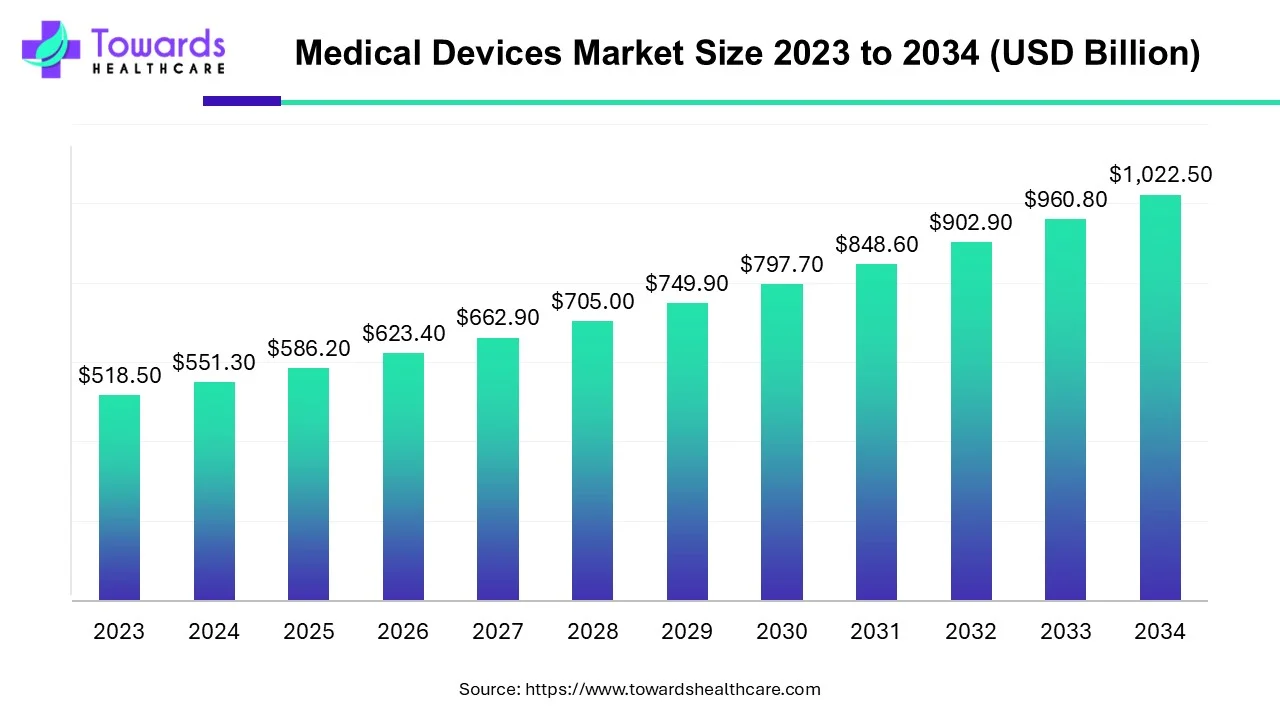
Market size
Key headline figures
◉Global (total): USD 551.3B (2024) → USD 586.2B (2025) → USD 1,022.5B (2034).
◉The provided forecasted CAGR (2025–2034) = 6.34% (user data).
◉If measured 2024 → 2034, the CAGR implied by the 2024 and 2034 figures ≈ 6.37% (10-year basis).
◉Device-type traction (selected 2024 → 2034) (figures from the provided type table):
◉In vitro Diagnostics: USD 88.0B (2024) → USD 144.4B (2034) (implied 10-yr CAGR ≈ 5.08%).
◉Cardiovascular Devices: USD 67.3B → USD 120.4B (CAGR ≈ 5.99%).
◉Diabetes Care: USD 58.0B → USD 97.3B (CAGR ≈ 5.31%).
◉Orthopedic Devices: USD 56.0B → USD 100.5B (CAGR ≈ 6.02%).
◉Dental Devices: USD 39.8B → USD 69.4B (CAGR ≈ 5.72%).
◉End-user split (2024 — absolute):
◉Hospitals & ASCs: USD 307.53B (2024) — largest end-user by far.
◉Clinics: USD 165.01B (2024).
◉Others: USD 78.76B (2024).
◉Regional totals (2024) — these sum to the global total:
◉North America: USD 197.8B
◉Europe: USD 139.8B
◉Asia-Pacific: USD 138.7B
◉Latin America: USD 40.9B
◉Middle East & Africa: USD 34.1B
◉Regional implied growth (2024 → 2034, 10-yr CAGRs) from the provided regional tables:
◉North America: 197.8 → 348.4 (CAGR ≈ 5.82%).
◉Europe: 139.8 → 251.4 (CAGR ≈ 6.04%).
◉Asia-Pacific: 138.7 → 253.4 (CAGR ≈ 6.21%).
◉Latin America: 40.9 → 87.1 (CAGR ≈ 7.85%).
◉Middle East & Africa: 34.1 → 79.2 (CAGR ≈ 8.79%).
→ Takeaway: faster relative expansion is expected in LATAM and MEA (from smaller bases), while North America remains the largest single market.
Market trends
Macro trends and facts
◉MedTech revolution & technological pull: AI, robotics, wearables, telemedicine, 3D printing, nanotech, AR/VR, and smart implants are repeatedly highlighted as market accelerants.
◉Screening & IVD dominance: IVD is the single largest type segment in 2024 (USD 88.0B) driven by screening programs, point-of-care adoption, and public health screening policies (estimated 40,000 IVDs available).
◉Fastest growth area: Diabetes care devices are flagged as the fastest-growing type segment (rising adoption of CGM, insulin pumps, smart pens and connected systems).
◉Hospitals & ASCs leadership: Hospitals and ambulatory surgery centers dominated end-user spend in 2024 (USD 307.53B) due to infrastructure and reimbursement incentives.
◉Regulatory & approval activity:
◉FDA approvals: 33 medical devices were approved in 2024 (user data).
◉AI approvals: the U.S. FDA has approved 1,000 AI-powered medical devices from 1995 through Aug 2024 (user data), indicating rapid adoption of algorithmic tools.
Global trade & manufacturing shifts:
◉China exported USD 11.6B of medical instruments from Mar 2024 → Feb 2025; Feb 2025 alone = USD 688M (user data).
Policy & events:
◉Japan launched “Japan Health” (Aug 2023), starting at EXPO 2025 Osaka and annual thereafter — a marker of national strategic emphasis on MedTech.
Concrete company / product developments (selected items from your supplied content)
◉Jan 2025 – SpineGuard: strengthened partnership with Omnia Medical to expand product collaboration, reallocate SpineGuard resources to support Omnia’s U.S. product launches (e.g., PsiFGuard).
◉Jan 2025 – Harsoria Healthcare Pvt. Ltd.: raised USD 20M (led by Tata Capital Healthcare Fund II) to scale manufacturing and R&D.
◉Feb 2025 – FDA approvals: SPN-830 (subcutaneous apomorphine infusion device for advanced Parkinson’s) — availability expected Q2 2025 (linked to the TOLEDO trial).
◉Feb 2025 – Chinese NMPA: MediBeacon TGFR Monitor and TGFR Sensor approved for kidney-function assessment (user data).
◉Jan 2025 – Sequana Medical NV: PMA granted for Alfapump for recurrent/refractory ascites; U.S. patient base estimated 70,000 and an addressable market opportunity > USD 2B in 2025 (user data).
◉Mar 2025 – Archimedic: launched OpenQMS, an open-access web platform to help companies with Quality Management through the device life cycle.
◉Dec 2024 – University Medical Devices: launched MicroWash, a less-invasive nasal lavage specimen collection device (pilot rollout planned).
AI role & impact in the medical devices market
Diagnostic intelligence
◉Faster detection and triage: AI models integrated into IVD and imaging streamline interpretation, flag urgent findings, and triage patients faster — amplifying the clinical value of the large IVD installed base (IVDs = USD 88.0B in 2024).
◉Point-of-care AI: on-device ML for POCT (point-of-care tests) reduces lab turnaround; this increases adoption in clinics and decentralized settings.
Therapeutic automation & closed-loop devices
◉Closed-loop insulin systems & implant adjustment: AI/ML algorithms embedded in insulin pumps and implant firmware allow automated dosing adjustments (the provided content explicitly cites automatic dose adjustments from implants as a use case). This drives demand in Diabetes Care (fastest-growing segment).
◉Infusion devices with smarter control: devices such as the SPN-830 class (infusion devices) can incorporate smarter dosing schedules and predictive alerts.
Surgical assistance & robotics
◉Precision augmentation: AI augments robotic systems and navigation devices to reduce human error and improve outcomes in cardiovascular, orthopedic, and minimally invasive surgery segments.
◉Decision support in OR: real-time analytics (anomaly detection, blood-loss prediction) can be fused with surgical consoles.
Device lifecycle, safety & regulatory pipelines
◉Automated QA/QC & QMS: AI tools are being integrated to streamline quality management (example: Archimedic’s OpenQMS addresses regulatory/QMS workflow — AI could augment defect detection and documentation).
◉Regulatory acceleration: a rising wave of AI-enabled submissions is reflected in the historical approval tally (1,000 AI devices approved to Aug 2024). Regulators are evolving pathways for “adaptive” algorithm updates — this is both an enabler and a complexity for manufacturers.
Real-time monitoring, remote care & value-based care
◉Continuous remote monitoring: AI converts continuous telemetry (wearables, CGM, implant signals) into actionable alerts and predictive care pathways, lowering hospital readmissions and improving chronic disease management.
◉Reimbursement & outcomes measurement: AI enables more precise outcomes metrics which payers can use for reimbursement models tied to performance and value.
R&D acceleration and synthetic data
◉Faster product design: AI accelerates prototyping (simulation, in silico trials), reduces bench cycles, and helps optimize materials and device ergonomics.
◉Synthetic datasets: used to train ML when clinical datasets are scarce — helpful for rarer conditions (e.g., advanced Parkinson’s infusion systems).
Economic & operational impacts
◉Cost reduction: automation reduces manual interpretation labor and increases throughput (IVD & diagnostic imaging).
◉Revenue expansion: value-added AI features (subscription updates, analytics dashboards) open recurring revenue models for device vendors.
Risks & constraints (AI-specific)
◉Bias & validation: real-world performance must be validated across populations—critical in global markets with diverse patient profiles.
◉Cybersecurity & data privacy: connected AI devices increase attack surface — lifecycle security and secure OTA updates are essential.
◉Regulatory burden for adaptive algorithms: continuous learning systems raise oversight complexity.
Regional insights — deep points with subpoints & explanation
North America (overview + subpoints)
◉Market size & role: largest market in 2024 (USD 197.8B) — home to advanced R&D, deep reimbursement frameworks, and large MedTech adoption.
Drivers:
◉State-of-the-art R&D centers and venture/PE funding.
◉Favorable reimbursement and high public/private healthcare spend accelerate uptake of advanced devices (hospitals lead adoption).
Regulatory & approvals:
◉The U.S. FDA’s heavy approval pipeline (including 1,000 AI device approvals historically) drives commercialization and global regulatory leadership.
◉Implication: companies that secure U.S. regulatory approval get market credibility and export advantage.
U.S. specifics
◉Exports & trade: U.S. is the largest exporter of medical instruments in 2023 (USD 34.8B per user data) — testament to manufacturing and high-value device exports.
◉Clinical pipeline: presence of NCI-designated cancer centers (72 in the U.S.) creates a strong market for diagnostic and oncology-related devices.
Canada specifics
◉Strengths: cluster of ~89 MedTech firms and rising healthcare spend (USD 344B in 2023 — user data) supports clinical adoption; public funding enables scale.
Asia-Pacific
◉Rising manufacturing hub: manufacturing infrastructure and incentives encourage foreign OEMs to set up plants in the region — cost advantage and scale.
◉Growth trajectory: Asia-Pacific shows rapid growth (138.7 → 253.4 by 2034) and is forecast to be one of the fastest-growing regional markets.
Country notes:
◉China: NMPA reforms and export strength (USD 11.6B mar-2024→feb-2025) make China both a manufacturing powerhouse and an increasingly innovative market (e.g., MediBeacon approval in China).
◉India: “Make in India” + 100% FDI in medical devices + PLI scheme (Rs 3,420 crore) support domestic manufacturing ramp-up and import substitution.
◉Japan: aging population (36.25M aged 65+) makes Japan a high-demand market for diagnostic, chronic care and high-end devices; national events (Japan Health) promote MedTech competitiveness.
Europe
◉Market maturity & innovation: strong presence of major OEMs (Siemens Healthineers, etc.), EU regulatory framework (EU MDR) shapes compliance and market access.
◉Germany: third-largest MedTech market globally — major patent activity and large device & IVD catalog (500,000 types estimated in Germany).
◉Implication: Europe is a mix of high-value demand and complex regulation — attractive for mid/late-stage MedTech players.
Latin America
◉Faster relative growth: higher percentage CAGRs (≈7.85%) from smaller bases — growth driven by rising access, increasing healthcare spend, and expanding private clinics.
◉Challenges: affordability and heterogenous regulation across countries.
Middle East & Africa (MEA)
◉High relative growth (≈8.8% CAGR): driven by investments, public health initiatives, and rising chronic disease burden.
Country highlights:
◉UAE: significant public budgets for health (e.g., AED 71.5B Federal Budget for health in 2025) and high chronic disease prevalence (1 in 3 people with chronic conditions).
◉South Africa: large disease burden (e.g., diabetes prevalence) but reliance on imports — creates opportunities for local manufacturing incentives.
Market dynamics (drivers, restraints, opportunities; point-wise)
Drivers
◉Rising prevalence of chronic & acute disorders → steady demand for diagnostic and therapeutic devices (aging populations amplify this).
◉Increasing accessibility & policy support: WHO priority programs and national policies to expand device access.
◉Technological convergence: AI, connected devices, and minimally invasive tools boost value-per-device and willingness to pay.
◉Investments & partnerships: public and private capital inflows (VC, PE, government PLI schemes) accelerate product development.
Restraints
◉Regulatory gaps in developing markets: many regions (notably parts of Africa) lack robust regulatory frameworks, increasing compliance uncertainty and risk.
◉High compliance & reimbursement complexity: cost of clinical validation and regulatory approval is high — slowing smaller company entry.
◉Supply chain & manufacturing constraints: localization needs, quality control, and geopolitical trade issues can create friction.
Opportunities
◉Technological advances (AI, robotics, point-of-care) create new device classes and recurring-revenue services (analytics/subscriptions).
◉Localization of manufacturing: India/China incentives and LATAM/MEA growth spur onshore production and export hubs.
◉Unmet clinical needs: devices addressing chronic disease management (diabetes, cardiovascular, renal) have large addressable markets (Sequana Alfapump, kidney TGFR sensors, diabetes care devices).

Get a Sample of this Report
Medical Devices Market
