

Medical Imaging Market Size, Trends, Top Key Players and Latest Insights 2025

Market Size & Forecast Trajectory (In-Depth)
2024 (Base Year):
The global market stood at USD 41.64 billion. This year marks the foundation of the forecast period, with North America holding the largest regional share (37%).
2025 (Next Year):
The market expanded to USD 43.72 billion, reflecting an early growth momentum supported by strong hospital adoption and technological advances.
Forecast Horizon (2025–2034):
The market is projected to advance at a CAGR of 4.99%, sustaining steady year-on-year growth.
2034 (Long-Term Projection):
By the end of the forecast period, the global market is expected to reach USD 67.87 billion, adding more than USD 24 billion in incremental opportunity over 10 years.
Year-Wise Growth Trend (Key Milestones)
| Year | Market Size (USD Billion) | Growth Observation |
|---|---|---|
| 2024 | 41.64 | Base year, market leadership by MRI & hospitals |
| 2025 | 43.72 | Early growth, +2.08 billion from 2024 |
| 2030 | 55.6 (estimated) | Mid-term benchmark, steady CAGR progress |
| 2034 | 67.87 | End of forecast, +26.23 billion from 2024 |
Market Trends & Technological Drivers
1. AI Integration and Workflow Transformation
● Generative AI for Reporting & Communication
Radiologists increasingly use generative AI (e.g. ChatGPT-like models) to draft reports and handle administrative tasks, freeing them up for complex image interpretation.
● AI Adoption Per Gaps & Risks
Overreliance on AI may degrade clinician skills—one study found colonoscopy detection rates dropped when doctors operated without AI assistance.
● Widespread Clinical Use with Human Oversight
Over 340 AI imaging tools have FDA approval, aiding in detecting strokes, tumors, and breast cancer. Two-thirds of US radiology departments already employ AI, while maintaining human oversight.
● Regulatory Scrutiny & Transparency
Regulatory authorities (e.g., FDA, MHRA, EMA) are tightening oversight in 2025, demanding greater model explainability and rigorous validation of AI tools.
2. Personalized & Patient-Centric Imaging
● Adaptive Scan Protocols with AI
Imaging protocols are becoming more personalized—tailored based on patient history, risk profiles, and even genetic information for diseases like cancer, neurology, and cardiology.
● Radiomics & Predictive Modeling
Quantitative imaging data (radiomics) is driving precision medicine, enabling tumors and diseases to be characterized and predicted more accurately.
3. Portable, Point-of-Care & Rural Imaging Expansion
● Handheld & Mobile Devices
Handheld ultrasound and portable X-ray devices are becoming more advanced and affordable—especially useful for rural and emergency settings.
● Teleradiology Advancements
Cloud-based platforms enable image sharing and remote interpretation. Specialists can access studies from anywhere, improving care in underserved areas.
4. Advanced Imaging Technologies
● Photon-Counting CT & Digital SPECT
Photon-counting CT offers higher resolution and lower radiation; digital SPECT improves nuclear imaging accuracy.
● 3D, 4D, AR/VR, Fusion Imaging
3D/4D imaging is revolutionizing surgical planning, fetal monitoring, and joint/neurosurgical precision. AR overlays imaging data during surgery; fusion imaging (e.g., PET/CT or MRI/US) delivers combined anatomical-functional insights.
5. Cloud, AI-Driven IT, and Teleimaging
● AI-Powered Cloud Platforms
AI-enhanced cloud imaging improves real-time diagnostics, collaboration, and integration with EHRs.
● Evolving from PACS to Intelligent IT Systems
Traditional PACS are transitioning into advanced, AI-integrated, cloud-based platforms offering analytics and teleimaging.
6. Emerging Technologies & Approaches
● In-Silico Clinical Trials
Simulation of imaging outcomes via digital patient models is being increasingly accepted by regulatory bodies, accelerating R&D.
● Theranostics (Theranostic Imaging + Treatment)
Combining imaging (e.g., PET/SPECT) with targeted therapy—especially for oncology, neurology, and cardiology—is gaining traction for precision intervention.
● Quantum & Next-Gen Imaging
Quantum tech is entering imaging—from quantum sensors mapping magnetic fields without radiation to image-enhancing technologies using quantum light—especially relevant to future diagnostics.
7. Accessibility, Preventive Health & Full-Body Scans
● Private Preventive Imaging
Full-body MRIs are increasingly used for proactive diagnostics (e.g., Prenuvo, Prenuvo study detected cancers not typically screened).
● Public-Private Integration
In the UK, the NHS deployed AI (like the “Edith” platform) for large-scale breast screening. Private startups (e.g., Neko, Scan.com) are complementing public systems.
8. Economic, Regulatory & Sustainability Considerations
● Budget Constraints & ROI-focused Procurement
Economic pressures are moving investments toward cost-effective diagnostics (e.g. coronary CTA), while delaying large capital purchases.
● Security & Data Privacy
As imaging goes cloud-based, cybersecurity becomes paramount to protect patient data.
● Eco-conscious & Sustainable Imaging
Trends include low-radiation imaging, energy-efficient devices, and equipment recycling practices.
Market Dynamics (Drivers, Restraints, Opportunities)
◉ Drivers
● Early Disease Detection: Escalating NCD burden pushes demand for early, accurate imaging. ● Aging Demographics: Elderly populations amplify need for musculoskeletal, cardiovascular, and neurological imaging. ● Technological Innovation: Transformative breakthroughs—AI, photon-counting CT, portable devices—enhance image quality and workflow. ● Healthcare Infrastructure Expansion: Investments in hospitals and diagnostic centers increase equipment procurement. ● Policy & Reimbursement Support: Government incentives, favorable reimbursement (seen in North America/Europe) accelerate adoption.
◉ Restraints
● Data Quality & Standardization: Incomplete or low-quality imaging data may impair diagnostics. ● High Costs & Budget Constraints: Cutting-edge modalities like MRIs and CTs require significant capital. ● Regulatory & Ethical Challenges: AI deployments face liability, privacy, and validation roadblocks. ● Digital Infrastructure Gaps: Cloud/PACS migration demands robust IT capabilities, which may lag in emerging markets.
◉ Opportunities
● 3D/4D Imaging Expansion: Enhanced anatomical visualization and functional insights. ● AI-Augmented Workflows: Boost diagnostic accuracy, reduce radiologist burden, enable predictive analytics (radiogenomics). ● Portable & Remote Solutions: Enabling point-of-care access in rural/low-resource areas. ● Asia-Pacific Growth: Rapid infrastructure rollout, favorable demographics, and government funding open emerging markets. ● Interoperable, Cloud-based Platforms: Seamless data sharing, real-time collaboration, and cost-efficient storage.
Role of AI in the Medical Imaging Market
Enhanced Diagnostic Accuracy
● AI systems can identify subtle patterns and variations in medical images that might be too small or complex for the human eye to detect. ● This capability helps radiologists and clinicians catch diseases at earlier stages, such as detecting small tumors, microfractures, or early signs of degenerative disorders.
Automation of Image Analysis
● AI and machine learning (ML) automate repetitive, time-consuming tasks like image segmentation, lesion detection, and measurement. ● This reduces the burden on healthcare professionals and allows them to focus more on decision-making and patient care.
Handling Large Volumes of Data
● Medical imaging produces vast datasets (e.g., MRI, CT scans, X-rays). ● AI algorithms can rapidly process these datasets, ensuring quicker turnaround times while maintaining consistency and precision in results.
Integration with Patient Data
● AI doesn’t just analyze imaging data in isolation. It can combine imaging information with patient history, lab results, and even genetic information. ● This integration enables precision medicine, where treatment and diagnosis are tailored to the unique profile of each patient.
Error Reduction and Consistency
● Human interpretation of images may vary between experts. AI delivers standardized, reproducible results, reducing diagnostic errors caused by fatigue, oversight, or subjective interpretation. ● This improves patient safety and ensures uniform quality of care across healthcare centers.
Workflow Optimization
● By automating reporting and flagging urgent cases, AI optimizes radiology workflows. ● It helps prioritize patients who need immediate attention, reducing delays in diagnosis and treatment.
Improved Patient Outcomes
● Faster detection and greater accuracy mean patients receive timely interventions. ● This leads to improved prognosis, reduced complications, and overall better healthcare outcomes.
Regional Segments & Insights
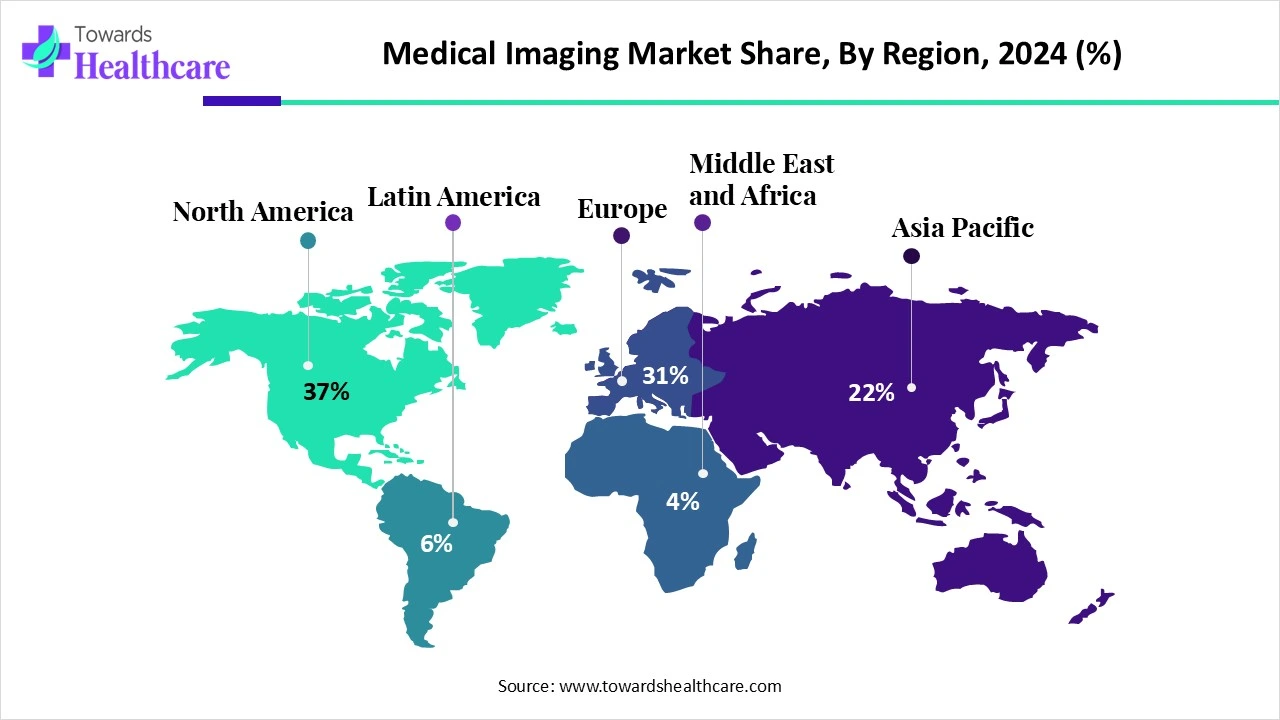
North America 37% Market Share (Dominant Region)
Market Leadership:
● North America captured 37% of the global market in 2024, making it the leading region. ● The region’s dominance is fueled by robust healthcare infrastructure, strong adoption of advanced imaging tools, and government support.
Key Growth Drivers:
● Presence of leading global players such as GE Healthcare and Sectra Medical. ● High adoption of technological innovations in imaging modalities. ● Substantial investments and partnerships between academia and industry to advance imaging research. ● Government efforts to increase access to medical imaging through funding and streamlined regulations.
U.S. Market Trends:
● 40 million MRI scans performed annually, showcasing very high utilization. ● 129 million Americans live with at least one chronic disorder, driving imaging demand for early and frequent diagnosis. ● In March 2024, ARPA-H and CDRH partnered to improve access to affordable, high-quality imaging data.
Canada Market Trends:
● Government-backed initiatives to standardize and track imaging usage. ● The Canadian Medical Imaging Inventory (CMII), managed by the Canada Drug Agency, documents: ● Supply and distribution of imaging equipment. ● Technical operations and usage. ● Clinical and research practices. ● This provides clear visibility into national imaging resources and ensures better allocation.
2. Asia-Pacific – Fastest Growing Region
Growth Outlook:
● Expected to be the fastest-growing region during 2025–2034. ● Factors include rapid expansion of healthcare infrastructure, rising investments, and growing geriatric population.
Key Growth Drivers:
● Increasing prevalence of chronic disorders. ● Government screening and early-diagnosis initiatives. ● Funding support for advanced imaging device adoption in hospitals. ● Growing private sector and public-private collaborations.
China Market Trends:
● Government action plan for dementia by 2030, spanning prevention, early diagnosis, treatment, rehabilitation, and care.
Widespread cognitive functional screenings for the elderly to detect dementia risk early.
● Focus on integrating imaging into national dementia strategy, boosting demand for advanced scanners.
India Market Trends:
● 4,500 MRI machines installed across healthcare organizations. ● The PLI Scheme for Medical Devices promotes domestic manufacturing of imaging equipment. ● Investment commitment of ₹3,420 crore (2020–2028) to strengthen radiology, imaging, oncology, and implant technologies. ● This positions India as both a large consumer market and an emerging manufacturing hub for medical imaging.
3. Europe – Significant Growth Region
Growth Outlook: ● Europe is a highly promising region due to increasing adoption of imaging tools, healthcare sector growth, and supportive government policies. ● Government and private institutions organize seminars, conferences, and workshops to educate people on the importance of early disease diagnosis.
Key Growth Drivers:
● Universal healthcare systems encourage access to imaging. ● Growing healthcare expenditure on modernization of equipment. ● Favorable regulatory policies for adoption of innovative imaging devices.
Germany Market Trends:
● 32.5 MRI machines per million people – one of the highest densities worldwide, ranking fifth among universal healthcare nations ● Home to 37,000+ medical technology companies, creating a dense industrial ecosystem for imaging. ● Major companies like Siemens Healthineers and SternMed dominate equipment supply and exports.
UK Market Trends:
● Government investments to reduce waiting lists: ● £1.5 billion for new surgical hubs and scanners. ● £70 million for radiotherapy machines. ● Context: Over 7.6 million people were waiting for appointments, scans, or surgeries in August 2024, highlighting urgent imaging demand.
5. Segment Highlights by Category
1. By Technology
◉ X-ray Devices
● Radiography: Uses X-rays or gamma rays to visualize internal structures in a static 2D image—commonly used for diagnosing fractures, chest conditions, and dental imaging. ● Fluoroscopy: A dynamic imaging technique using continuous X-ray to produce real-time moving images—useful in guiding procedures like catheter insertion and monitoring contrast passage through the GI tract. ● Mammography: A specialized low-dose X-ray technique to detect breast cancer—often considered a subset of radiography.
◉ Ultrasound
● Leverages acoustic (sound) waves to create real-time moving images. Commonly used in obstetrics (e.g., fetal imaging), cardiology (echocardiography), and general diagnostics. It’s radiation-free and safe in sensitive cases like pregnancy.
◉ Computed Tomography (CT)
● Produces cross-sectional “slice” images by rotating an X-ray source and detectors around the patient; reconstructed by computer algorithms. Particularly useful in detailed bone, lung, and brain imaging, or when MRI is contraindicated (e.g., metallic implants).
Subtypes (as per your segmentation):
● High-end slice CT ● Mid-range slice CT ● Low-end slice CT ● Cone Bone CT
◉ Magnetic Resonance Imaging (MRI)
● Utilizes strong magnetic fields and radio waves to generate high-contrast images of soft tissues without ionizing radiation—ideal for brain, spinal cord, muscles, tendons, and breast tissues.
● Closed System: Traditional design where the patient lies inside a tunnel-like magnet.
● Open System: Designed to reduce claustrophobia, featuring more space and open architecture.
◉ Nuclear Imaging
● Focuses on physiological and metabolic insights using radioactive tracers—not just anatomical images. ● SPECT (Single Photon Emission Computed Tomography): Uses gamma rays from injected isotopes to create 3D functional images; useful when combined with CT (SPECT-CT) for anatomical context. ● PET (Positron Emission Tomography): Leverages positron-emitting tracers to visualize metabolic processes (e.g., FDG for tumor imaging); often merged with CT or MRI in hybrid devices (PET-CT/PET-MRI).
2. By Application
From your segmentation list, typical application areas include:
Cardiology Oncology Neurology Orthopedics Gastroenterology Gynecology Others
3. By End-Use
● Hospitals: Major users for comprehensive imaging diagnostics. ● Diagnostic Imaging Centers & Others: Recognized industry segments, though not elaborated in Wikipedia.
4. By Region
You listed a wide geographic segmentation—covering:
North America (US, Canada)
Asia Pacific (China, Japan, India, South Korea, Thailand)
Europe (Germany, UK, France, Italy, Spain, Sweden, Denmark, Norway)
Latin America (Brazil, Mexico, Argentina)
Middle East & Africa (MEA) (South Africa, UAE, Saudi Arabia, Kuwait)

Get a Sample of this Report
Medical Imaging Market
