

Medical Membrane Market Size, Growth and Latest Updates and Insights 2025

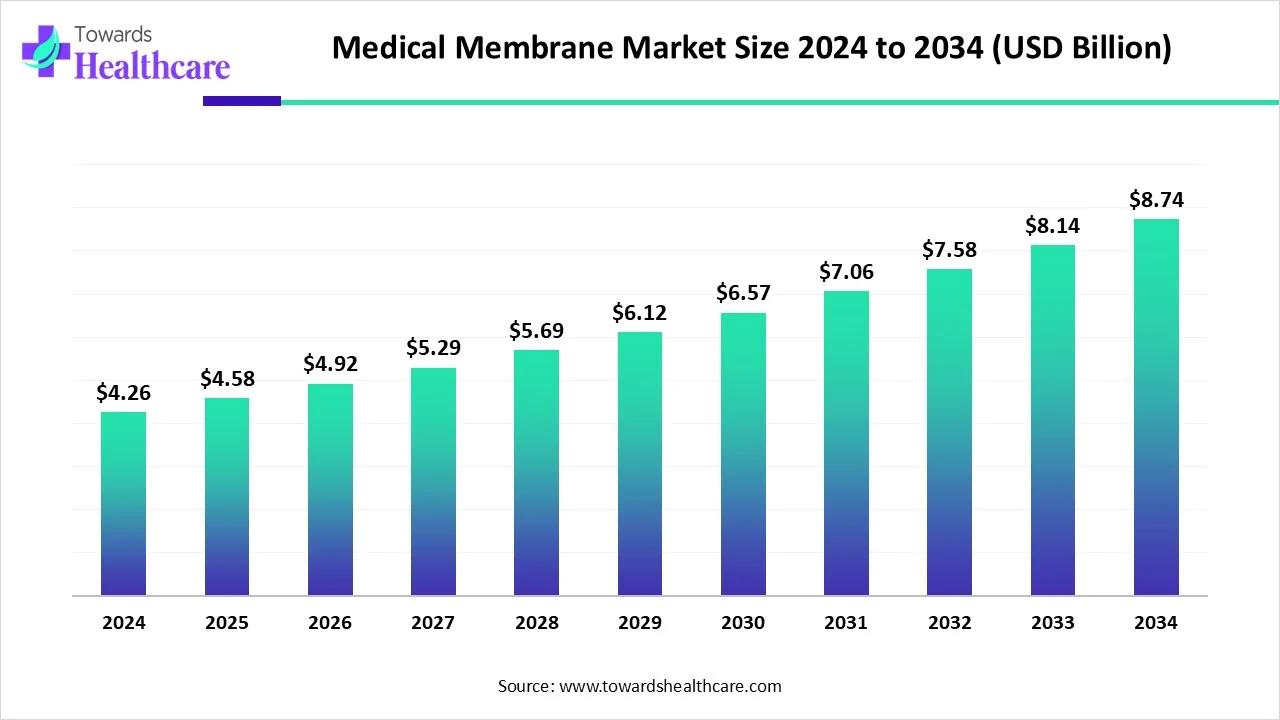
Market Size
◈2024: USD 4.26 billion – baseline year, with Europe as the leading regional market.
◈2025: USD 4.58 billion – steady expansion with rising demand in pharmaceutical and healthcare sectors.
◈2030 (mid-term): Market likely to cross ~USD 6.2 billion, backed by increasing use of ultrafiltration and nanofiltration technologies.
◈2034: USD 8.74 billion – nearly double the 2024 valuation, driven by demand for advanced biopharmaceutical and infusion therapies.
◈CAGR (2025–2034): 7.45% – indicating a consistent long-term growth pattern rather than sharp short-term spikes.
Market Trends
Funding in Membrane Startups
◈Feb 2024: Insamo raised $12M to advance membrane-permeable cyclic peptides (Playground Global, venBio, MRL Ventures).
◈Mar 2023: TeraPore Technologies secured $10M for nanofiltration systems for biomanufacturing.
Technological Shifts
◈Nanofiltration dominated in 2024 due to advantages at room temperature purification.
◈Ultrafiltration projected fastest growth, especially in pharma for plasma processing and fermentation recovery.
Application Shift
◈Pharmaceutical filtration largest segment in 2024 due to purity and safety needs.
◈IV infusion & sterile filtration growing rapidly as infusion therapies become routine in clinical practice.
Regional Patterns
◈Europe leads with strong regulations, aging population, and ESRD cases.
◈North America grows via R&D, specialty drug production, and stringent purity regulations.
◈Asia Pacific shows fastest growth due to manufacturing expansion in China & India.
◈Latin America gains from rising organ donations and medical R&D.
AI Role in Medical Membrane Market
Design & Material Development
◈AI models like Generative Adversarial Networks (GANs) used to design new polymer structures with desired porosity and chemical stability.
◈Simulation-driven AI accelerates discovery of next-gen polysulfone, polypropylene, and PVDF membranes.
Optimization of Filtration Systems
◈Machine learning algorithms tune flow dynamics in Reverse Osmosis (RO) and Ultrafiltration (UF) systems.
◈Predictive analytics optimize energy use, pressure gradients, and minimize membrane fouling.
Real-Time Monitoring
◈AI integrated with sensor technologies enables real-time monitoring of filtration efficiency, contamination, and sterilization.
◈Automated detection of micro-leaks or biofilm formation reduces downtime.
Smart Maintenance & Predictive Replacement
◈AI forecasts membrane lifespan and schedules replacements to avoid failures in dialysis machines, infusion systems, and pharma filtration units.
Process Innovation in Biopharma
◈AI-guided process control ensures purity in vaccine manufacturing, biologics, and biosimilars.
◈Enables adaptive filtration to meet dynamic regulatory requirements.
Regional Insights
1 Europe (Leading in 2024)
Drivers:
◈Aging population leading to rising cases of chronic diseases and ESRD (End-Stage Renal Disease).
◈Strong regulatory framework emphasizing sterility in pharmaceuticals and biologics.
◈High investment in healthcare infrastructure and biopharmaceutical manufacturing.
Germany:
◈Largest market in Europe due to heavy reliance on water treatment, wastewater treatment, and pharmaceutical production.
◈Germany’s focus on patient safety and drug purity drives adoption of high-grade membranes.
◈Strong presence of local and multinational pharma companies boosts demand.
United Kingdom (UK):
◈Biopharma sector contributes over £15 billion GVA annually, supporting more than 70,000 jobs.
◈Home to global pharma giants like GSK and AstraZeneca, alongside smaller innovative biotech firms.
◈Increasing emphasis on R&D and biopharma research ensures steady demand for filtration systems.
2 North America (High Growth)
United States (U.S.):
◈Strong focus on specialty drugs and biosimilars as drivers of filtration demand.
◈In 2024, the FDA’s CDER approved 50 novel drugs and 18 biosimilars, increasing the need for advanced sterile filtration membranes.
◈High healthcare spending and strict regulatory guidelines reinforce membrane adoption.
Canada:
◈Supported by Innovative Medicines Canada (IMC), ensuring advanced treatments and biopharma availability nationwide.
◈Government backing for clinical trials and innovative therapies promotes consistent adoption of membrane technologies.
3 Asia Pacific (Fastest Growth)
China:
◈Approved 228 new drug applications (NDAs) in 2024, indicating a strong pharma pipeline.
◈Multinational pharma firms are increasingly launching drugs directly into China, accelerating adoption of sterile membranes.
India:
◈CDSCO approved 19 new drugs in 2024, including advanced therapies for cancer and chronic illnesses.
◈Indian pharma leaders (Sun Pharma, Dr. Reddy’s, Cipla, Lupin, Zydus) actively partner with global players, boosting demand for purification membranes.
Japan & South Korea:
◈Mature pharma ecosystems with heavy investments in biomanufacturing and biologics.
◈High reliance on dialysis membranes and ultrafiltration technologies due to aging populations.
4 Latin America (Emerging)
Mexico:
◈Approximately 186 pharma companies employing 65,000+ people.
◈Government-led biotech initiatives and increasing local drug production foster membrane adoption.
Brazil:
◈7th largest global pharma market with heavy government incentives under the “Greater Brazil Plan.”
◈Strong domestic production of biologics driving local demand for high-purity membrane solutions.
5 Middle East & Africa (Niche but Growing)
◈Growth primarily driven by UAE, Saudi Arabia, and South Africa.
◈Rising healthcare investments to build world-class hospitals and biopharma infrastructure.
◈Demand concentrated in specialized applications like dialysis, organ transplants, and infusion therapies.
Market Dynamics
Drivers
Stringent Regulatory Standards:
◈Biopharma, vaccines, and pharmaceutical industries require extreme purity.
◈Regulations in Europe and North America push adoption of high-performance membranes.
Growing Global Aging Population:
◈Increasing demand for dialysis, infusion systems, and advanced therapies.
◈Membranes are indispensable for plasma filtration, blood processing, and infusion drug delivery.
Restraints
High Cost of Membrane Technologies:
◈Advanced membranes require high R&D and production investments.
◈Adoption slower in low-income and underfunded healthcare systems.
Opportunities
Organ Transplants & Wound Care:
◈Advanced regenerative therapies and artificial organ systems rely on specialized membranes.
Biopharma Manufacturing:
◈High demand for sterile water, drug purification, and biologic manufacturing.
Infusion Therapy Expansion:
◈Shift from IV to subcutaneous drug delivery improves patient convenience and requires advanced sterile filtration.

Get a Sample of this Report
Medical Membrane Market
