

Microbiology Testing Market Trends, Growth, Companies and Updates 2025

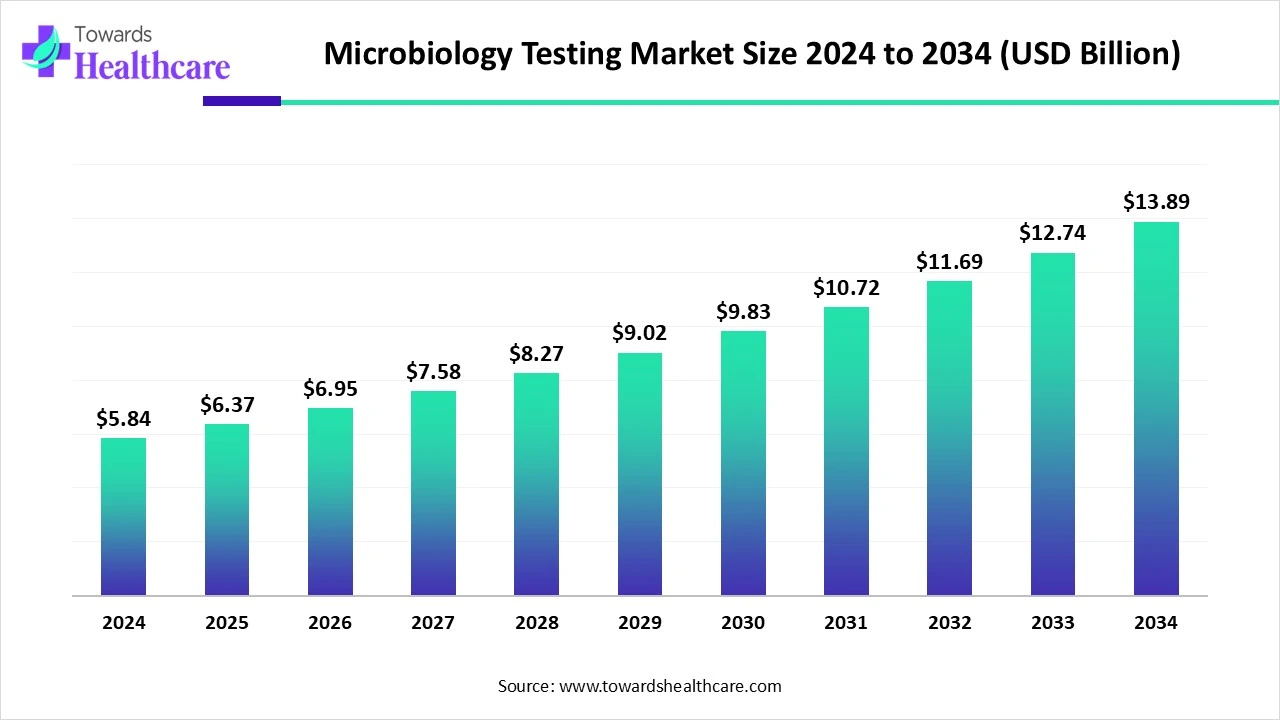
Market Size
◈2024 Market Value: USD 5.84 billion.
◈2025 Market Value: USD 6.37 billion (YoY growth driven by hospital testing and advanced instrument adoption).
◈2034 Projection: USD 13.89 billion.
◈CAGR (2025–2034): 9.04% — steady mid-high growth due to demand in healthcare, food safety, and pharma.
◈Regional Leader (2024): North America at 46% share.
◈Fastest Growing Region: Asia Pacific due to healthcare expansion, population size, and public health investments.
◈Dominant Product (2024): Instruments (PCR machines, autoclaves, incubators, etc.).
◈Fastest-Growing Product Segment: Reagents (used in microbial classification, identification, antibiotic testing).
Market Trends (Deep Analysis)
R&D & Grants Boosting Microbiome Research
◈Feb 2025: Zymo Research launched the Master the Microbiome Grant ($5,000 credits) to advance metagenomics and microbiome sciences.
AI-driven Innovations in Factory Quality Control
◈Feb 2025: Spore.Bio raised €22M Series A to scale AI-based microbial testing for industrial quality control.
Growing Role of Rapid Diagnostics
◈Rapid testing (PCR, biosensors, molecular diagnostics) gaining ground for infectious disease containment and hospital decision-making.
Food Safety as a Global Driver
◈WHO: 600M people fall ill annually, 420,000 deaths from foodborne illness → increasing global adoption of microbiology testing.
Emerging Disease Threats Driving Demand
◈Rising viral outbreaks (COVID-19, influenza variants) and antibiotic resistance push demand for bacterial/viral diagnostics.
Technological Advancement
◈Biosensors, metagenomics, and automation in microbiology labs expanding test accuracy and speed.
AI’s Impact on the Microbiology Testing Market (Deep-Dive)
Accelerated Diagnostics
◈From Days to Hours: Traditional culture-based bacterial identification takes 24–72 hours; AI-powered image recognition and machine learning algorithms can analyze growth patterns, MALDI-TOF spectra, or genomic signatures in minutes.
Clinical Relevance:
◈Early detection of sepsis-causing pathogens reduces mortality by 30–40%.
◈AI-aided MALDI-TOF platforms identify rare pathogens that standard protocols may miss.
◈Market Implication: Hospitals see reduced ICU stays and costs, fueling adoption of AI-powered platforms despite high upfront investment.
Antibiotic Resistance Prediction
◈Problem: AMR is projected to cause 10 million deaths annually by 2050. Traditional AST (antibiotic susceptibility testing) takes 2–3 days.
AI Edge:
◈Deep learning models interpret whole-genome sequencing (WGS) and metagenomic data to forecast resistance even before cultures show results.
◈AI platforms like PathAI and IBM’s Deep Genomics are exploring predictive AMR surveillance.
Public Health Angle:
◈Early warning systems for carbapenem-resistant Enterobacteriaceae (CRE) and MRSA outbreaks.
◈Data integration with global surveillance networks (WHO’s GLASS, CDC’s NARMS).
◈Market Implication: Pharma companies can design narrow-spectrum, precision antibiotics targeting predicted resistance profiles.
Drug Development Support
AI + Microbiome:
◈The human microbiome influences drug metabolism, immune response, and efficacy of antibiotics or cancer immunotherapies.
◈AI maps microbe–host interactions to identify new therapeutic targets.
Applications:
◈Screening billions of microbial metabolites for novel antibiotic candidates.
◈Identifying microbiome markers predicting patient response to checkpoint inhibitors in oncology.
◈Strategic Implication: Biopharma pipelines shorten by years, lowering R&D costs while improving trial success rates.
Epidemiological Monitoring
AI-Driven Surveillance:
◈Real-time analysis of hospital lab data, EHRs, and wastewater sequencing to detect outbreak signals.
◈Machine learning models predict spread dynamics of influenza, TB, and COVID-19 variants.
◈Case Example: During COVID-19, AI models helped forecast ICU demand and detect emerging Omicron clusters before traditional surveillance caught up.
◈Market Implication: Governments and NGOs fund AI-backed platforms for biosecurity and global health preparedness.
Automation in Testing Labs
◈Challenge: Global shortage of clinical microbiologists and skilled technicians.
AI Role:
◈Automated plate reading, colony picking, and slide interpretation.
◈Smart analyzers integrate robotics + AI to handle high-volume testing with minimal human intervention.
Examples:
◈BD Kiestra™ total lab automation system.
◈Copan WASPLab with AI-assisted plate reading.
◈Impact: Efficiency gains up to 40% reduction in turnaround time; scalability without proportionally increasing workforce.
Industrial Applications
◈Food & Beverage: AI systems scan microbial genomic data to detect contaminants (Listeria, Salmonella, E. coli) in real time during production.
Pharmaceutical Manufacturing:
◈AI-enabled environmental monitoring in cleanrooms → prevents contamination before batch loss.
◈Predictive models identify contamination risk hotspots in supply chains.
Regulatory Compliance:
◈Faster, AI-backed QC aligns with FDA’s Quality by Design (QbD) and EMA’s Annex 1 guidelines for sterile manufacturing.
◈Market Implication: Adoption in F&B and pharma QC labs ensures not just safety but also cost savings from avoiding recalls.
Regional Insights
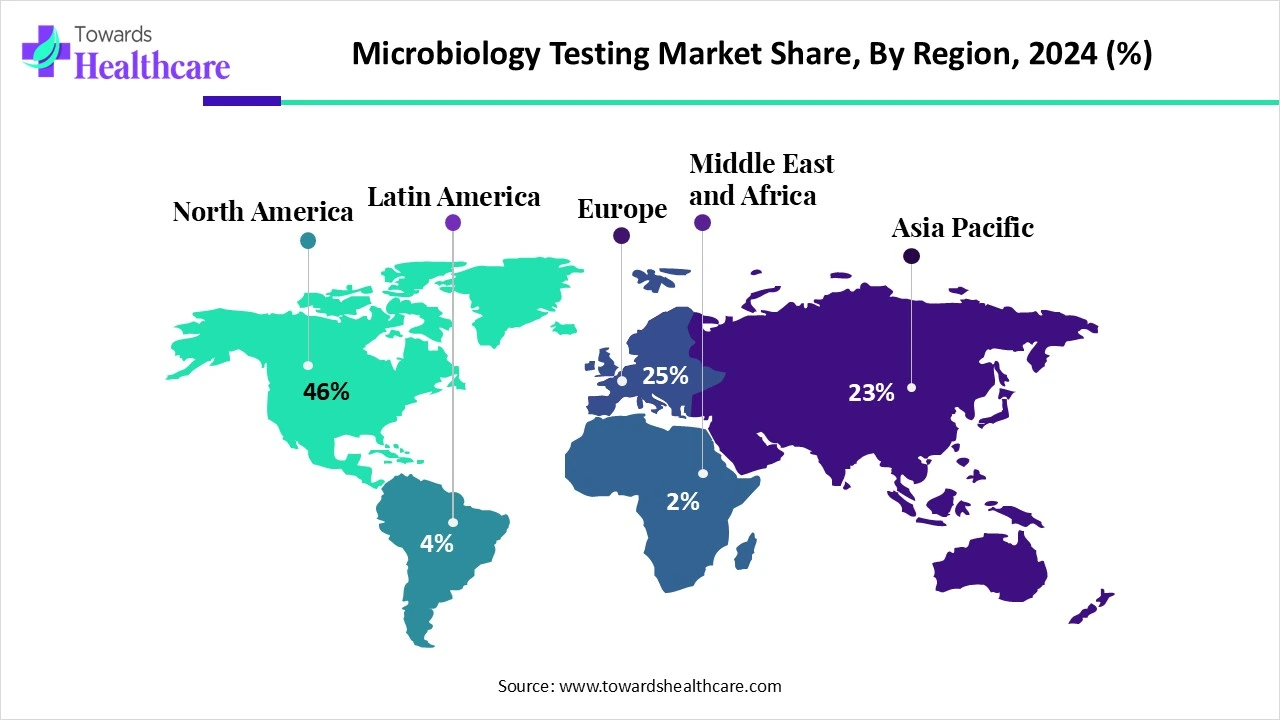
1. North America (46% Market Share in 2024)
◈North America remains the global leader in microbiology testing, driven by advanced healthcare infrastructure, robust funding, and a concentration of leading global diagnostic companies.
Strengths
◈Advanced healthcare infrastructure with well-established diagnostic laboratories.
◈Presence of leading players such as BD, Thermo Fisher, Abbott, and Roche, ensuring early adoption of cutting-edge technologies.
◈Strong regulatory framework (FDA, CDC, NIH) that enforces stringent food and clinical safety testing standards.
Key Drivers
◈High prevalence of infectious diseases including TB, influenza, HIV, and hospital-acquired infections.
◈Adoption of microbiology testing as a core hospital diagnostic service — diagnostics guide 60–70% of medical decisions in the region.
◈Strong government investments into pandemic preparedness and antibiotic resistance management.
United States
◈The Global Health Security and Diplomacy Bureau (GHSD) leads international collaboration to prevent, detect, and respond to infectious diseases.
◈Heavy investment in AI-driven and rapid diagnostic technologies to manage drug resistance and pandemics.
Canada
◈Focus on enteric infections linked to international travel.
◈Expansion of HIV and STBBI (sexually transmitted and blood-borne infections) testing, with emphasis on Indigenous and rural populations.
◈Government allocated $26.5M (2022–2024) for HIV self-testing kits and community programs.
2. Asia Pacific (Fastest Growing Region)
◈Asia Pacific is expected to outpace other regions in growth, driven by rapid healthcare modernization, population growth, and increasing food safety regulations.
China
◈Target by 2030: establish world-leading epidemic monitoring systems and early warning labs.
◈Heavy investment in laboratory networks across ministries for infectious disease control.
India
◈Longstanding CDC partnerships enhance outbreak response, epidemiological surveillance, and lab infrastructure.
◈Focus on combating vector-borne and water-borne infections with microbiology testing expansion.
Japan
◈Significant investments in modernizing healthcare labs and scaling up infectious disease preparedness.
◈High adoption of automation and AI-driven microbiology instruments in hospitals and research centers.
Overall Regional Drivers
◈Expansion of healthcare facilities in both public and private sectors.
◈Growing focus on food safety regulations amid rising export and domestic consumption.
◈Strong pharmaceutical and biotechnology presence fueling demand for drug safety and microbial monitoring.
3. Europe (Strong Growth)
◈Europe’s market is driven by strict regulations, an aging population vulnerable to infections, and rising antibiotic resistance concerns.
Germany
◈Leads antimicrobial resistance (AMR) management via DART 2030 strategy.
◈Focus on cross-sector collaboration across agriculture, veterinary medicine, and healthcare to limit AMR.
United Kingdom
◈20-year National Action Plan (NAP) against AMR, aiming to reduce overuse of antibiotics in humans and livestock.
◈Investment in next-gen diagnostic tools for early infection detection and antibiotic stewardship.
Key Drivers
◈Stringent food safety and healthcare regulations boosting microbiology testing demand.
◈Aging population driving higher demand for hospital-based microbiology diagnostics.
◈Rising cases of drug-resistant pathogens prompting stronger lab investments.
4. Latin America
◈Latin America shows strong growth potential due to rising healthcare spending, infectious disease prevalence, and increased collaborations with global testing companies.
Brazil
◈Listed in two WHO high TB-burden lists (general TB and HIV-associated TB).
◈TB prevalence: >150 cases per 100,000 annually.
◈Government prioritizes advanced diagnostic technologies to manage TB/HIV dual burden.
Mexico
◈TB prevalence: 23 cases per 100,000 population (2023).
◈Presence of global testing service providers such as SGS SA, Intertek, and Mérieux NutriSciences.
◈Rising demand for food safety and clinical diagnostics to support export and healthcare goals.
Key Driver
◈Rising infectious disease prevalence, coupled with growing healthcare spending and adoption of advanced testing technologies.
5. Middle East & Africa (MEA)
◈MEA is emerging as a growth hub, supported by government investments, expansion of diagnostic labs, and adoption of AI-based testing solutions.
United Arab Emirates (UAE)
◈2024: Smart Salem launched AI-powered metagenomic WGS microbiome test for comprehensive microbial diversity analysis.
◈Strong emphasis on AI and personalized medicine integration in diagnostics.
South Africa
◈High TB burden: 280,000 TB cases and 55,000 deaths (2023).
◈National SDG goal: eradicate TB by 2030 (80% reduction in infections, 90% reduction in deaths).
◈Increased funding into public health diagnostic infrastructure.
Key Drivers
◈Rising prevalence of infectious diseases across the region.
◈Strong government support for healthcare modernization and lab expansion.
◈Growing demand for point-of-care testing in rural and underserved areas.
Market Dynamics
Drivers
Food Safety Awareness
◈WHO: 600M people fall ill, 420,000 deaths annually due to contaminated food.
◈Drives adoption of rapid microbial testing in food and beverage industries.
Infectious Disease Prevalence
◈Growing cases of TB, HIV, influenza, COVID-19 variants increasing demand for bacterial and viral tests.
Technological Advancements
◈Adoption of PCR, biosensors, AI-based diagnostics, and molecular testing across clinical and industrial settings.
Restraints
Lack of Skilled Workforce
◈Advanced clinical microbiology testing requires highly trained professionals, limiting adoption in low-resource regions.
High-Tech Complexity
◈Sophisticated equipment (PCR, metagenomics platforms) face real-time technical issues and cost barriers.
Opportunities
AI & Automation
◈Automated microbiology platforms reducing turnaround times and reliance on human expertise.
Expanding Applications
◈Environmental monitoring, pharmaceutical testing, and food safety creating new revenue streams.
Government Investments
◈National strategies in China, India, EU, and Africa expanding lab infrastructure and epidemic monitoring systems.

Get a Sample of this Report
Microbiology Testing Market
