

Neurovascular Devices Market Size, Key Players and Updated Regional Insights 2026

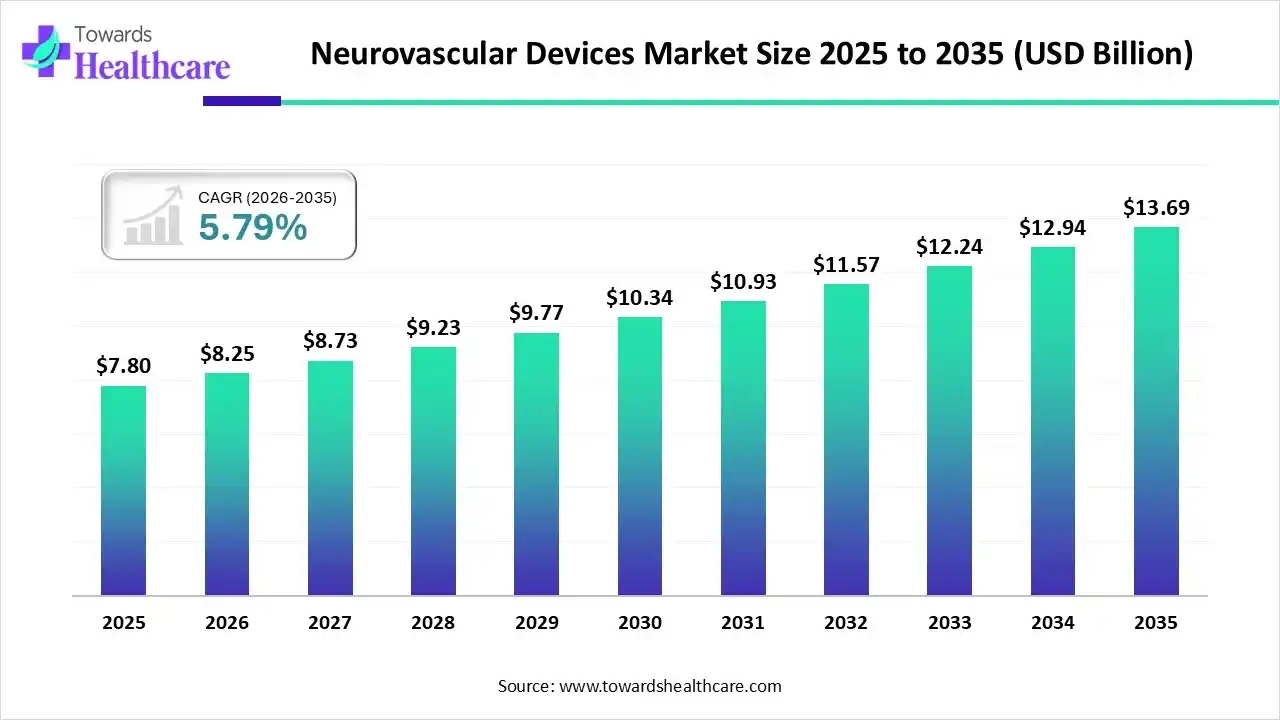
Market Size
A. Historical & Current Market Valuation
-
2025 Market Size – USD 7.80 Billion
Shows strong recovery post-pandemic and increasing adoption of neurointerventional tools. -
2026 Market Size – USD 8.25 Billion
Driven by rising stroke incidence, geriatric population, and new clinical device introductions.
B. Long-Term Growth Projection
-
2035 Market Size – USD 13.69 Billion
Represents long-term investment in flow diverters, thrombectomy devices, and imaging-guided interventions. -
Overall CAGR (2026–2035): 5.79%
Stable growth supported by endovascular innovation and broader clinician adoption globally.
C. Regional Revenue Contributions
-
North America – 28% share in 2024
Largest region due to advanced healthcare systems, insurance support, and high disease burden. -
Asia-Pacific – Fastest CAGR
Demand boosted by aging population, stroke prevalence, and new government health initiatives.
D. Market Structure Volume
-
High device approvals
FDA approved 320 neuroendovascular devices (2000–2022), indicating a large competitive device pipeline.
E. Patient Pool Size Driving Revenue
-
Stroke prevalence – 93.8 million globally (2021)
Continuously expanding patient population increases demand for neurointervention devices.
F. Neurovascular Mortality & Burden
-
15 million affected yearly and 5 million deaths globally
High disease burden increases device adoption for prevention and treatment.
G. Cost Distribution & Procedure Volume
-
High-value procedures
Neurovascular surgeries often involve devices costing thousands of dollars, improving market value per procedure.
Market Trends
A. Growing Disease Burden
-
Sharp rise in stroke incidence, aneurysm cases, and AVMs driving device adoption.
-
Increasing cardiovascular issues among ages 18–64 pushing neurothrombectomy demand.
B. Strong Push Toward Minimally Invasive Surgery
-
Industry shift from open neurosurgery to microcatheters, coils, flow diverters, and aspiration catheters.
-
Lower trauma, faster recovery, and reduced hospital stay increase procedure acceptance.
C. Technological Advancement & Miniaturization
-
Miniaturized coils, flexible microcatheters, and soft-metal devices improve navigation in cerebral vessels.
-
Emergence of deflectable access platforms for advanced neurointerventional reach.
D. Strategic Collaborations and Acquisitions
-
Kaneka acquiring ESM (96.8% shares) to expand aneurysm treatment portfolio (Nautilus).
-
Philips x Sim&Cure partnership to integrate Sim&Size into image-guided platforms.
E. High R&D Investment
-
Leading companies expanding R&D for next-gen thrombectomy, stenting, and embolization systems.
-
Government funding (U.S., Canada, EU, China, India) encouraging medical device innovation.
F. Imaging & Precision Navigation Integration
-
More devices are being designed for AI-enabled imaging, precision stent placement, and vessel mapping.
AI Impacts on the Neurovascular Devices Market
1. AI-Enhanced Neurovascular Imaging
AI can automatically detect aneurysms, clots, stenosis, and vessel malformations on CT/MRI.
2. Automated Measurement & Vessel Segmentation
AI outlines vessel boundaries, clot lengths, aneurysm dome/neck ratios—reducing clinician effort.
3. Procedure Planning & Navigation
AI algorithms simulate catheter pathways, select ideal access routes, and reduce navigation errors.
4. Predictive Patient Outcome Modeling
AI predicts likelihood of rupture, re-bleeding, thrombosis, and treatment success for individual patients.
5. Implant Compatibility Assessment
AI systems evaluate biocompatibility to minimize immune reactions and select optimal implants.
6. Real-Time Intraoperative Support
AI overlays real-time guidance during coiling, clot retrieval, or stent deployment.
7. Remote Monitoring & Early Alerts
Wearables and smart systems track neuro signs in post-op patients and trigger alerts for complications.
8. Workflow Optimization for Hospitals
AI integrates with image-guided therapy systems (e.g., Philips Azurion + Sim&Size).
9. Automated Data Capture for Clinical Trials
AI reduces trial time by analyzing device performance, reducing manual documentation.
10. Robotics & AI-Assisted Endovascular Surgery
Future systems will combine micro-robotics + AI to navigate ultrathin catheters through cerebral arteries.
Regional Insights
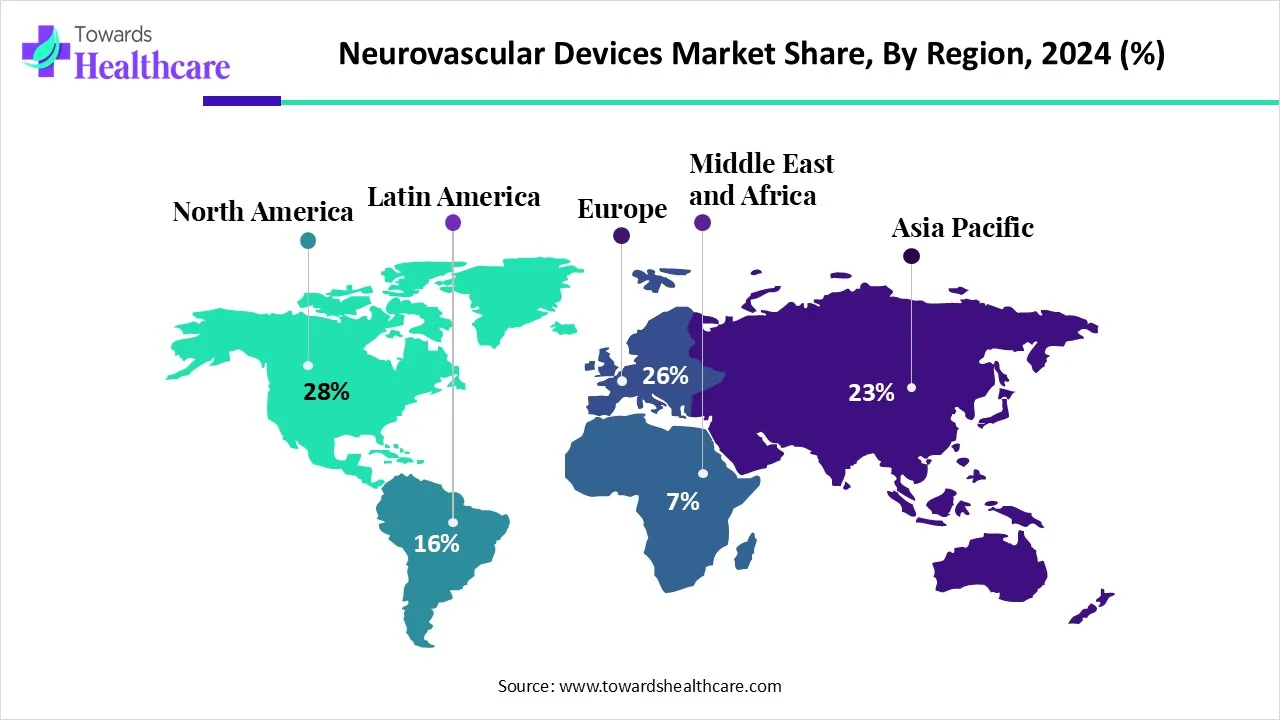
North America – 28% Market Share (Leader)
Key Drivers
High prevalence of aneurysms (6.8M U.S. citizens).
30,000 ruptures annually → massive clinical need.
Strong insurance support for high-cost surgeries.
Government Support
U.S. BRAIN Initiative – $740M (FY2025) for neurological innovation.
Strong FDA approval ecosystem (320 neuroendovascular devices approved 2000–2022).
B. Asia-Pacific – Fastest Growing Region
Why Fastest?
Highest global stroke burden.
Rapidly aging population (China, Japan, South Korea).
High adoption of minimally invasive care.
Government Initiatives
China Stroke Prevention Program under Healthy China 2030.
India establishing 500 stroke care units and mobile stroke centers.
Industry Attraction
NMPA incentives encouraging foreign device manufacturing in China.
C. Europe – Strong Growth
Key Factors
Mature healthcare systems, strong reimbursements.
Large presence of major players (Medtronic, Heraeus Medevio, iVascular).
Government Support
Germany’s National Health Alliance (NHA) for CVD prevention.
Pilot programs for early detection of hypercholesterolemia and heart failure.
D. Middle East & Africa – Growing Awareness
Drivers
Rising neurological disorders and increased screening culture.
Expanding private healthcare investments.
Notable Initiative
UAE MOHAP’s “National Framework for Healthy Ageing 2025–2031” supports neuro care for elderly.
Market Dynamics
A. Driver – Rising Prevalence of Neurovascular Disorders
15M people affected and 5M deaths annually worldwide.
Stroke prevalence in 2021: 93.8M; incidence: 11.9M.
Increasing diabetes, hypertension, obesity worsen risks.
B. Restraint – High Device & Procedure Cost
Neurovascular surgeries require expensive coils, stents, aspiration catheters.
Limited affordability in low- and middle-income groups.
C. Opportunity – Minimally Invasive Surgery Boom
Reduced trauma, faster recovery, lower infection risk.
Increasing patient preference → higher device demand.
New materials increase biocompatibility and device safety.

Get a Sample of this Report
Neurovascular Devices Market
