

Ophthalmology Drugs Market Overview, Trends and Insights 2025

Market Size
Current Size & Forecast
◉2024 → USD 43.22 billion
◉2025 → USD 45.52 billion
◉2034 → USD 72.59 billion
◉CAGR (2025–2034) → 5.33%
Growth Drivers Behind Size Expansion
◉Rising elderly population → Higher risk of AMD, glaucoma, cataracts.
◉Increase in diabetes prevalence → Expanding diabetic retinopathy & DME cases.
◉Innovation in gene therapies → Transforming retinal disorder treatment.
◉Better screening & diagnostic access → Higher patient pool identification.
Innovation Impact on Size
◉Intravitreal injections dominate currently (48% share in 2024).
◉Sustained-release implants expected to grow fastest due to convenience and adherence.
◉Strong pipeline of biologics & small molecule therapies → ensures long-term growth.
Market Trends
Funding & Investment Growth
◉SpyGlass Pharma (June 2025) → Raised $75M Series D for glaucoma drug delivery systems.
◉Orasis Pharma (Oct 2024) → Raised $78M to launch Qlosi™ for presbyopia.
◉PolyActiva (June 2025) → Raised AUD $40M for biodegradable ocular implants.
◉Beacon Therapeutics (July 2024) → Secured $170M for retinal gene therapy.
Shift Towards Long-Acting Therapies
◉Sustained-release implants (months/years of delivery).
◉Nanocarrier-based systems improving bioavailability & patient adherence.
AI-Powered R&D
◉Accelerating drug discovery by analyzing huge datasets.
◉Used for predictive toxicity, target identification, chemical screening.
Biologics vs. Small Molecules
◉Biologics (42% share in 2024) dominate → Anti-VEGF biologics like Eylea, Lucentis.
◉Small molecules expected to grow fastest (due to topical & oral formulations).
Indication-Based Growth
◉Retinal disorders → Largest share in 2024 (34%).
◉Dry eye disease (DED) → Fastest-growing due to screen usage, prevalence up to 70% in some regions.
Role of AI in Ophthalmology Drugs Market
Drug Discovery & Development
◉AI accelerates identification of novel molecules.
◉Reduces R&D cycle time by predicting drug efficacy & toxicity earlier.
Precision Medicine
◉AI helps in patient stratification → identifying subgroups for retinal disorders, glaucoma.
◉Enables personalized dosing schedules → reduces side effects.
Clinical Trial Optimization
◉Predicts patient recruitment & retention patterns.
◉Enhances trial efficiency by simulating drug–patient interactions.
Post-Market Surveillance
◉AI tools monitor adverse drug reactions from EHRs & real-world data.
◉Provides early warning signals for drug safety updates.
Drug Delivery Innovation
◉AI-based modeling helps design nanocarriers and implant release profiles.
◉Predicts intraocular absorption & efficacy outcomes.
Regional Insights
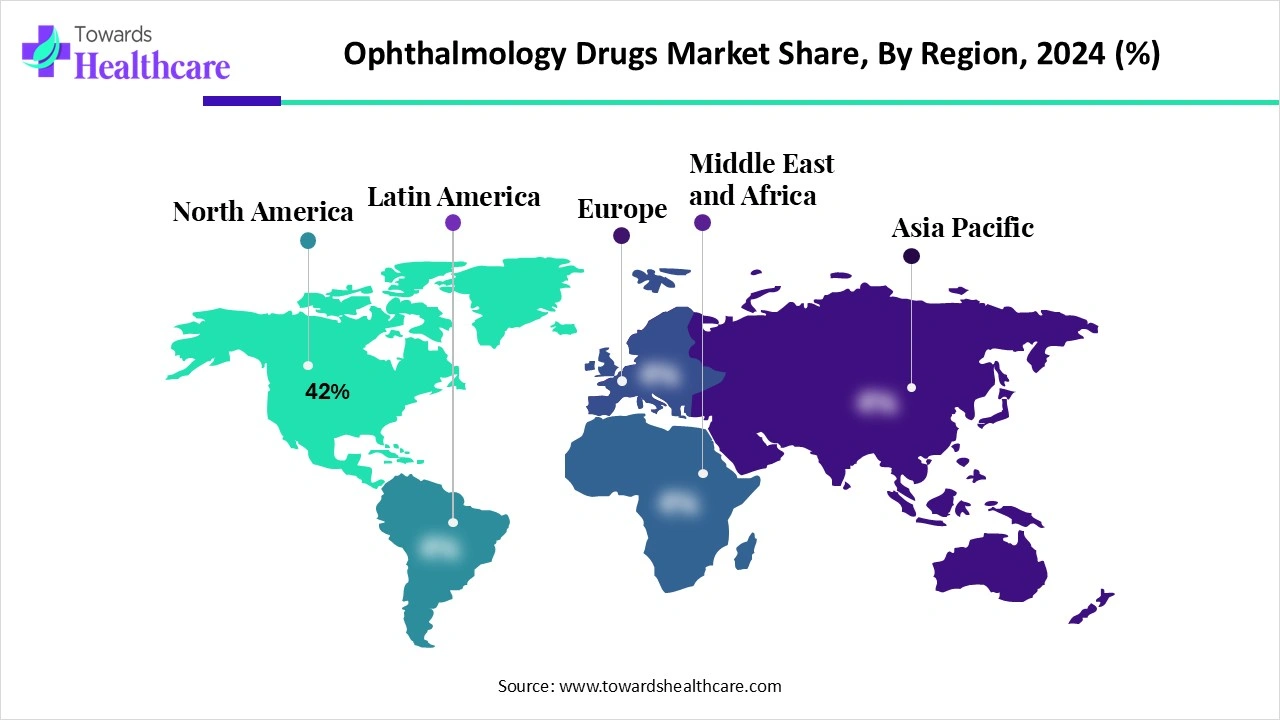
1. North America (42% share in 2024)
High prevalence of eye diseases
◉Age-related macular degeneration (AMD) → Leading cause of blindness in the U.S. (>11M cases, projected to double by 2050).
◉Diabetic macular edema (DME) → Rising with diabetes epidemic; 1 in 3 diabetics experience vision impairment.
◉Glaucoma → >3M Americans, often asymptomatic until late stages.
Strong R&D investment
◉U.S. pharmaceutical leaders like Regeneron, Roche, AbbVie dominate the pipeline.
◉Heavy funding toward gene therapy, biosimilars, and long-acting delivery systems.
◉NIH & private collaborations accelerating trials in retinal & corneal diseases.
U.S. Trends
◉Dry Eye Syndrome (DES): 16M Americans affected → Annual burden $52B in direct + indirect costs.
◉Aging Demographics: >20% prevalence of AMD and cataracts in people aged 80+.
◉Economic Burden of Blindness: Estimated $134.2B annually in medical expenses + productivity loss.
◉AI-driven diagnostics → Widespread adoption of AI imaging for early AMD & diabetic retinopathy detection.
Canada Trends
◉8M Canadians live with glaucoma, cataracts, AMD, diabetic retinopathy.
◉Growing public health push for preventive eye screening & free testing programs.
◉National Strategy for Eye Care Act (2024) → Comprehensive framework for eye health monitoring, research, and equitable access.
◉Government partnerships with pharma companies to fast-track biosimilar adoption and reduce treatment costs.
2. Asia Pacific (Fastest-growing CAGR)
Rising geriatric population
◉Japan → Nearly 30% of population aged 65+, among the highest globally.
◉China & India → Huge patient pools for cataracts, glaucoma, and AMD due to demographic expansion.
Healthcare infrastructure & spending
◉China’s Healthy China 2030 plan is increasing investment in advanced ophthalmic treatments.
◉India’s Ayushman Bharat scheme improving affordability of eye care services.
◉Growth of private hospital chains expanding specialty ophthalmology centers.
Disease prevalence
◉Myopia epidemic: Over 50% prevalence among youth in China, Korea, Singapore.
◉Dry Eye Disease (DED): Screen-time surge driving >25% prevalence in urban populations.
◉Diabetes epidemic: India is world’s “diabetes capital,” fueling diabetic retinopathy growth.
Pharma penetration
◉Entry of global players (Novartis, Roche, AbbVie) into China, India, and Southeast Asia.
◉Rise of local biotech startups in Japan & China focusing on biosimilars, gene therapy, and stem cell research.
◉Growing clinical trial activity due to large patient populations and cost advantages.
3. Europe
Biologics & Biosimilars Adoption
◉Europe among the fastest in approving ophthalmology biosimilars.
◉Wide reimbursement coverage for AMD, glaucoma, and DME treatments.
◉Strong hospital-based ophthalmology networks ensuring distribution.
Key Companies
◉Novartis (Alcon) → Dominant in cataract surgery and glaucoma drugs.
◉Bayer → Partnered with Regeneron on Eylea, huge presence in retinal disorders.
◉Roche → Leader in biologics and long-acting ophthalmic drugs.
◉Screening & Policy
◉EU nations (UK, Germany, France) running nationwide eye screening programs.
◉Reimbursement frameworks in Germany, Scandinavia drive patient access to biologics.
◉UK’s NHS digital initiatives → Integrating AI screening tools into public healthcare.
4. Latin America & Middle East Africa (MEA)
Unmet medical needs
◉Cataracts remain the leading cause of preventable blindness.
◉High glaucoma underdiagnosis due to limited screening infrastructure.
Import-driven market
◉Heavy reliance on drug imports from the U.S. and Europe.
◉Distribution partnerships with multinationals dominate.
Biosimilars & generics
◉Cost sensitivity driving generic anti-VEGF and steroid launches.
◉Brazil and South Africa are leading in local biosimilar manufacturing.
Market evolution
◉Growing presence of NGOs & government-led blindness prevention programs.
◉Middle East investing in premium eye hospitals (UAE, Saudi Arabia).
◉Gradual expansion of AI tele-ophthalmology solutions to reach rural areas.
Market Dynamics
Drivers
◉Rising global burden of eye diseases → 700M vision impairment cases expected by 2050.
◉Myopia epidemic: 4.75B cases projected by 2050, especially severe in Asia.
◉Aging population: Cataracts, AMD, and glaucoma cases rising exponentially.
◉Innovation in drug delivery → Sustained-release implants, nanocarriers, ocular gene therapy.
◉Digital diagnostics adoption → AI-based imaging enabling earlier detection and intervention.
Restraints
◉High cost of biologics (anti-VEGF drugs costing ~$2,000/injection).
◉Affordability barriers in low- and middle-income countries.
◉Limited physician awareness of patient out-of-pocket costs, leading to non-adherence.
◉Lack of advanced infrastructure in emerging nations, delaying treatment delivery.
Opportunities
◉Nanotechnology-based delivery systems → Targeted, long-acting therapies for AMD & glaucoma.
◉Expansion of ophthalmology biosimilars → Cost-effective alternatives, improving accessibility.
◉AI integration → Faster R&D, precision dosing, predictive analytics in clinical trials.
◉Gene therapy & regenerative medicine → Long-term curative potential for retinal disorders.
◉Tele-ophthalmology platforms → Expanding access in underserved regions.
Top Companies (Products, Strengths)
Regeneron Pharmaceuticals
◉Product: Eylea (aflibercept, anti-VEGF)
◉Strength: Market leader in AMD & DME therapies, co-developed with Bayer.
Genentech/Roche
◉Products: Lucentis, Vabysmo
◉Strength: Strong biologics pipeline, pioneering long-acting intravitreal therapies.
Novartis/Alcon
◉Products: Beovu, glaucoma drugs, cataract surgery solutions
◉Strength: Dominant global ophthalmology presence, innovation in biologics.
Bayer
◉Product: Eylea (co-commercialized with Regeneron)
◉Strength: Strong distribution footprint across Europe and Asia.
AbbVie/Allergan
◉Products: Restasis (dry eye), Botox (ophthalmic uses)
◉Strength: Diversified ophthalmology portfolio, strong dry eye market position.
Bausch + Lomb
◉Products: Glaucoma drops, cataract solutions
◉Strength: Wide OTC + prescription network, strong brand equity.
Santen Pharmaceutical
◉Focus: Asia-based ophthalmology specialty company.
◉Strength: Leading innovator in dry eye disease & corneal disorders.

Get a Sample of this Report
Ophthalmology Drugs Market
