

Perfusion Systems Market Insights, Forecast and Overview 2025

Market Size
2023 Market Base Value US$ 1.15 Billion
◉The baseline market value reflects the essential role of perfusion technologies in both clinical (organ transplantation, cardiopulmonary bypass) and research (cell culture, drug testing) settings.
◉Growth in 2023 was supported by the rising number of heart and lung transplants globally, particularly in the U.S. and Europe, as well as adoption in biopharma labs for continuous cell culture.
2034 Projected Value US$ 1.94 Billion
◉The market is projected to grow steadily, almost doubling over 11 years, reaching nearly US$ 2 billion by 2034.
◉This expansion highlights how perfusion systems are moving from a niche, high-cost specialty toward wider adoption in emerging economies and biopharma industries.
CAGR 4.85% (2024–2034)
◉A CAGR below 5% suggests sustained but moderate growth, typical of advanced medical device markets where adoption is limited by high cost but maintained by critical necessity.
◉Unlike rapidly expanding biotech fields (double-digit growth), perfusion’s growth reflects its specialized application mainly in transplant medicine and cell culture.
Revenue Expansion of US$ 0.79 Billion Over 11 Years
◉While this incremental growth seems modest, it is significant for a high-value, low-volume market.
◉Each system costs hundreds of thousands of dollars, meaning even limited adoption among hospitals and pharma firms creates large revenue gains.
Market Trends
Rising Organ Transplant Numbers
◉In 2023, 10,121 heart transplants were performed worldwide (13% increase vs 2022), and 7,811 lung transplants were carried out.
◉In the U.S., more than 46,000 transplants were performed in 2023, reinforcing its leadership in the market.
◉As organ donation rises, perfusion becomes indispensable for preserving and transporting organs with minimal tissue damage.
Living Donors as a Growth Driver
◉In 2024, 7,030 individuals became living donors in the U.S. alone.
◉The growth in living donors requires safe perfusion and preservation techniques to maximize graft viability and reduce risks to both donor and recipient.
Biopharmaceutical R&D Investments
◉The NIH invests: US$ 48 billion annually into research, while the top 20 pharma firms spent US$ 145 billion in 2022–23.
◉Perfusion technologies are used in cell-based drug production, vaccine development, and monoclonal antibody manufacturing.
◉This trend ensures demand from both academic labs and industrial biomanufacturing facilities.
Technology Moving Beyond Static Storage
◉Traditional organ storage relied on static cold storage, which often caused ischemic damage.
◉Now, machine perfusion systems (hypothermic/normothermic) are allowing real-time assessment of organs, extended storage times, and even reconditioning of marginal organs.
Shift Toward Disposable Perfusion Kits
◉Inspira’s single-use disposable oxygenation kit (2024) demonstrates a shift toward cost-effective, portable perfusion technologies.
◉Disposable systems reduce contamination risk, lower maintenance costs, and allow smaller hospitals to adopt perfusion solutions.
Role of AI in Perfusion Systems
Predicting Organ Suitability for Transplantation
◉AI models analyze donor data (age, health, blood chemistry, ischemia time) to decide whether an organ should be preserved using perfusion.
◉This reduces the number of discarded organs and increases the donor pool, addressing the supply-demand gap.
Predicting Patient and Organ Compatibility
◉Machine learning can forecast which organ-recipient pairs have the highest survival likelihood.
◉This ensures that organs preserved using perfusion are utilized for the best-matched recipients, reducing rejection rates.
Automation in Biomanufacturing Perfusion
◉In bioreactors, AI can automatically control nutrient feed rates, oxygen supply, and waste removal.
◉This ensures consistent high-density cell cultures, reducing batch variability in biologic drug manufacturing.
Real-Time Interpretation of Organ Health Data
◉Ex-vivo perfusion systems produce complex datasets (blood gas levels, metabolic function).
◉AI tools can analyze these metrics instantly, alert surgeons about organ viability, and predict post-transplant survival outcomes.
Predictive Maintenance of Perfusion Equipment
◉Perfusion systems are expensive and complex, prone to downtime if not maintained.
◉AI-enabled predictive maintenance reduces repair costs, optimizes system uptime, and makes perfusion systems more feasible for emerging countries.
Regional Insights
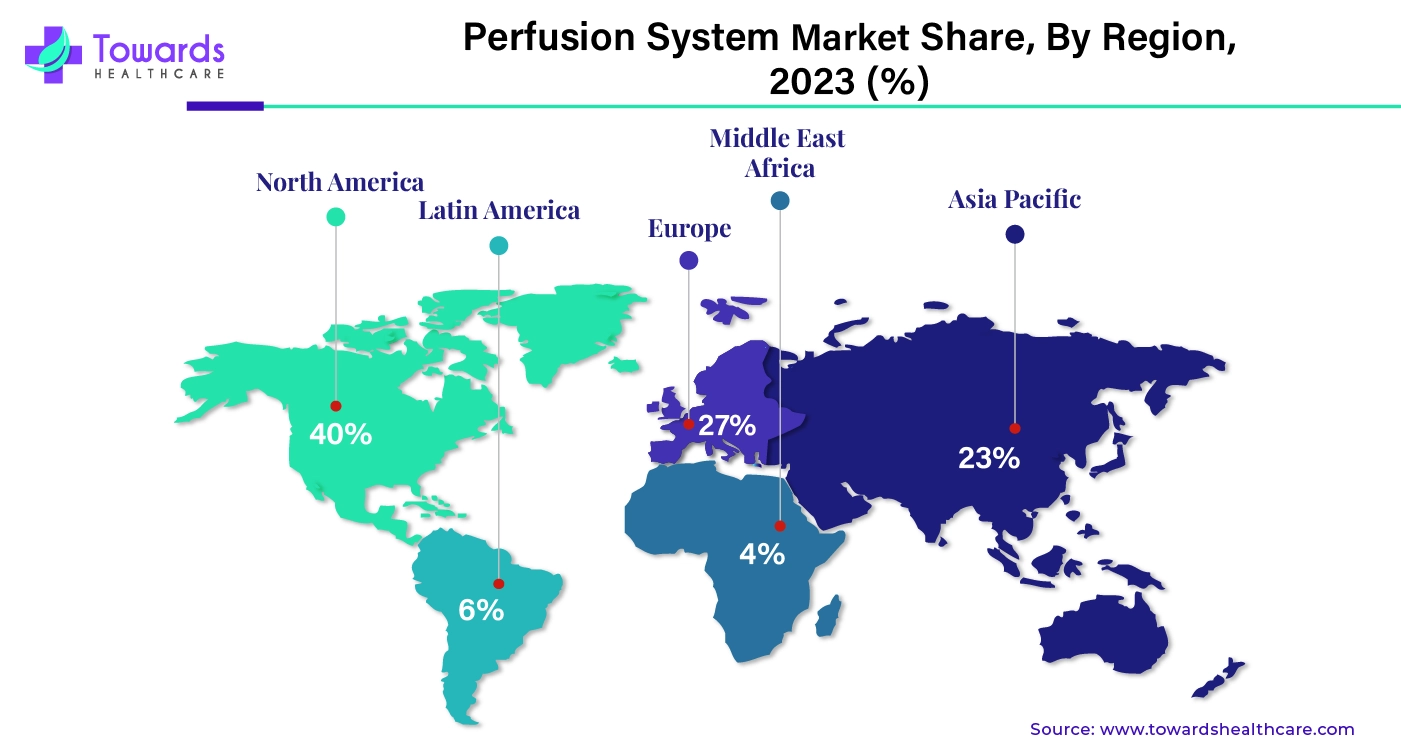
1. North America (40% share in 2023)
◉Accounts for the largest share due to advanced transplant infrastructure, high organ donation rates, and government support.
◉US (46,000+ transplants in 2023) leads globally; Canada also performed 3,212 transplants in 2024.
◉Presence of major players like TransMedics, Medtronic, LivaNova boosts technology adoption.
2. Asia-Pacific (Fastest Growing Region)
◉India performed 16,041 transplants in 2022, while China ranks 2nd globally in transplant volume.
◉Japan is an innovation hub in organ-on-chip and microfluidic perfusion, with 636 transplants in 2024.
◉The rising geriatric population increases demand as older populations face chronic organ failures.
3. Europe (High Donation Activity)
◉Spain is the global leader with 48.9 donors per million population and 122.1 transplants per million in 2023.
◉Germany, UK, France, Italy invest heavily in R&D and are strong markets for advanced perfusion systems.
◉LivaNova launched its Essenz Perfusion System (2023) in Europe, strengthening the market.
4. Latin America
◉Brazil, Mexico, and Argentina are growing markets but limited by cost barriers.
◉Increasing government focus on organ donation programs offers potential for long-term expansion.
5. Middle East & Africa
◉Countries like UAE and Saudi Arabia are investing in transplantation programs and advanced healthcare.
◉South Africa is the key market in Africa, but adoption remains restricted by affordability.
Market Dynamics
Driver – Growing Burden of Chronic Illnesses
◉Cardiovascular and respiratory disorders lead to millions of open-heart and lung surgeries annually.
◉Perfusion systems extend organ survival time outside the body, enabling more successful transplant outcomes.
Driver – Rising R&D in Biopharma
◉Continuous perfusion in bioreactors allows production of biologics at scale (vaccines, cell therapies).
◉With US$ 145 billion spent by pharma giants, demand is projected to expand in research applications.
Restraint – High Cost of Perfusion Systems
◉A single system can cost ~US$ 456,455 in the U.S..
◉In India, systems range between ₹11,000–18,00,000, restricting accessibility in low-income hospitals.
Restraint – Skilled Workforce Shortage
◉Operation of complex perfusion machines requires trained perfusionists and biomedical experts.
◉A lack of such professionals in many countries limits widespread adoption.
Opportunity – Advancements in Perfusion Technologies
◉Innovations such as hypothermic/normothermic machine perfusion, disposable systems, and AI integration create huge opportunities.
◉They make perfusion more scalable, reliable, and applicable across wider healthcare markets.
Top Companies
LivaNova PLC (UK/Italy-US)
Products: Essenz Perfusion System, Inspire Oxygenator, custom tubing systems.
Strengths: Integration of heart-lung support with monitoring tech.
Performance: 2024 revenue $1.25B (+8.7%).
TransMedics Group, Inc. (US)
Products: Organ Care System (OCS) for multiple organ types.
Strengths: Industry leader in portable organ preservation systems.
Performance: 2024 revenue $441.5M (+83% vs 2023).
Thermo Fisher Scientific (US)
Products: DynaDrive bioreactor (single-use, scalable).
Strengths: Global biopharma manufacturing leader with large R&D capacity.
Paragonix Technologies (US)
Products: KidneyVault, FDA-cleared portable kidney preservation system.
Strengths: Combines digital monitoring with portable perfusion technology.
Sartorius (Germany) + Repligen (US)
Joint Offering: Integrated bioreactor with XCell ATF technology for cell retention.
Strengths: Efficiency in upstream perfusion, reducing cost and complexity for biomanufacturers.

Get a Sample of this Report
Perfusion Systems Market