

Physical Therapy Market Trends, Growth, Top Companies and Latest Updates 2025

Market size
Base & forecast figures
●2024 market size: USD 28.06B (base year provided).
●2025 market size: USD 29.18B.
●2034 projected market size: USD 41.54B.
●Absolute growth (2025 → 2034): USD 12.36B.
●Average nominal increase ≈ USD 1.37B per year across 2025–2034.
●CAGR (2025–2034): 4.00% (consistent with your stated 4%).
Regional weight (2024 snapshot)
●North America (39.5%) — implies USD 11.08B of the 2024 market is in North America (28.06 × 0.395 ≈ 11.08B).
●Remaining 60.5% (USD 16.98B) is split across Asia-Pacific, Europe, Latin America, MEA — with APAC singled out as the fastest growing region.
●Segment shares (2024, non-application) — market-dollar equivalents
●Orthopedic physical therapy (therapy type): 31.5% → ≈ USD 8.84B (28.06 × 0.315).
●Adult (18–64 years) age group: 58.2% → ≈ USD 16.33B.
●Geriatric (65+): fastest growing age cohort (high long-term upside).
●In-person delivery mode: 73.4% → ≈ USD 20.60B (large incumbent base).
●Outpatient clinics (end-use): 41% → ≈ USD 11.50B (2024).
●Therapeutic exercise equipment (equipment type): 34.7% → ≈ USD 9.74B.
High-growth pockets
●Tele-physical therapy / telehealth platforms: fastest CAGR among delivery modes — from a small base and driven by digital adoption and remote monitoring trends.
●Wearable sensors & robotic assist devices: highest equipment CAGR expectation — implies hardware/software device market expansion within the overall market.
Concentration & structure
●Mix of large service MSOs (multi-site operators) and device manufacturers; top players span both services and equipment.
●Market structure favors outpatient & clinic networks for volume, with technology vendors driving higher value per patient via devices, wearables and software.
Market Trends
Aging population & chronic disease prevalence
●Geriatric cohort (65+) is the fastest-growing age segment — increases demand for long-term rehab, fall prevention and geriatrics specialization.
Rising number of surgeries & post-operative rehab
●Surgical volumes (orthopedic and other procedures) drive post-op PT demand, a major market growth engine; orthopedic therapy was 31.5% of therapy-type share in 2024.
Musculoskeletal disease burden sustaining baseline demand
●Musculoskeletal disorders held 36% of the market in 2024 — a steady, volume-rich category that underpins equipment and service sales.
Shift to outpatient & home settings
●Outpatient clinics held 41% of market revenue (2024); acquisitions (e.g., outpatient/home care deals) show strategy to capture convenience and cost advantages.
Digitalization & telehealth expansion
●Tele-physical therapy is the fastest-growing delivery mode; platforms reduce travel friction and expand geographic reach.
Device innovation — wearables, robotics & therapeutic equipment
●Therapeutic exercise equipment dominated (34.7% share), while wearables & robotic assist devices are the projected fastest-growing equipment class.
AI/ML & big-data integration
●Companies are investing in AI (VALD, Raintree, others), using datasets and AI to improve assessment, documentation and outcome prediction.
M&A and roll-up strategies among service providers
●Large MSOs and therapy networks expand via acquisitions to increase geographic footprint and create standardized care pathways.
Emergence of virtual/VR therapy and gamified rehab
●Product launches (e.g., robotic gait trainers with VR) point to immersive rehab modalities — higher engagement and adherence.
Regional acceleration in APAC and medical tourism
●APAC expected fastest growth due to population scale, infrastructure investments and medical/rehab tourism (e.g., Kerala).
Workforce constraints & skill shortages
●Lack of skilled professionals (e.g., India ≈ 0.59 physiotherapists/10,000 people) is a key restraint — drives telehealth and task-augmentation technologies.
Reimbursement & policy tailwinds (varies by country)
●Favorable reimbursement in many developed markets supports outpatient clinic expansion and access to advanced devices.
AI roles / impacts Computer vision for objective movement & gait analysis
●What: AI models analyze camera (2D/3D) or sensor data to quantify joint angles, symmetry, range-of-motion, compensations.
●Why it matters: Transforms subjective clinician observations into repeatable metrics for diagnosis, progress tracking and remote assessments.
●Outcome metrics: measurement reliability, reduction in assessment time, improved personalization of exercise dosing.
Predictive risk-stratification & injury prevention
●What: ML models trained on MSK datasets (e.g., VALD’s large MSK dataset) predict individuals’ risk for re-injury or poor rehab outcomes.
●Why it matters: Enables targeted prevention programs, prehab before surgery, and prioritized resource allocation to high-risk patients.
●Clinical KPI: reduction in re-injury rates, lower post-op readmissions.
Personalized exercise prescription & adaptive programs
●What: AI recommends exercise parameters (load, reps, progression cadence) based on patient history, objective sensors, and response curves.
●Why it matters: Accelerates recovery through tailored dosing and reduces clinician bandwidth for routine adjustments.
●Implementation: integrates with therapeutic exercise equipment and tele-platforms.
Remote monitoring via wearables + anomaly detection
●What: Continuous wearable data streamed to ML models to detect deviations (e.g., activity drop, gait deterioration).
●Why it matters: Early intervention triggers prevent setbacks and reduce clinic visits; fits the tele-physical therapy growth thesis.
●Business impact: increases patient retention and improves outcomes-per-dollar.
Robotic control & intelligent assistance
●What: AI controls robotic assist devices (exoskeletons, gait trainers) to adapt assistance/resistance in real time to patient capability.
●Why it matters: Enables scalable high-dose, task-specific practice with safety, crucial for neuro and pediatric populations (e.g., Genrobotics pediatric gait trainer).
●Clinical benefit: increased repetitions, improved motor learning, shorter time to milestones.
Clinical documentation automation & EMR scribing
●What: AI scribes (Raintree’s ScribeIQ example) transcribe therapy sessions, interpret therapy-specific terminology, and populate EMR fields.
●Why it matters: Cuts clinician admin burden, improves coding accuracy, speeds billing cycles, and frees time for patient-facing care.
●Operational metric: clinician time saved per visit; faster documentation turnaround.
Outcome prediction & ROI modelling for payers/providers
●What: Models predict long-term functional outcomes and cost-effectiveness of therapy pathways.
●Why it matters: Supports bundled payments, value-based care contracting, and justifies investment in higher-cost devices for specific cohorts.
●Adoption lever: payers demand evidence — AI helps produce stratified evidence.
Virtual reality (VR) and gamification driven by AI adaptation
●What: AI adjusts game difficulty and therapeutic targets in real time to maintain the “zone of proximal challenge.”
●Why it matters: Improves adherence and motivation, especially in pediatrics and neurorehabilitation.
AI-enabled triage & routing for telehealth platforms
●What: Intake AI routes patients to the right provider type (in-person/tele/hybrid), flags urgent red flags for escalation.
●Why it matters: Optimizes clinic throughput, reduces inappropriate visits and improves access.
Device R&D acceleration through model-driven simulation
●What: ML models simulate patient-device interactions across cohorts, accelerating prototyping of wearables/robotic devices.
Why it matters: Lowers time-to-market and improves design personalization — aligned with VALD’s and other firms’ AI/data strategies.
Implementation challenges & mitigation
●Data privacy (HIPAA/GDPR), model bias, clinical validation (RCTs), clinician acceptance — mitigation via robust privacy design, transparent models, and prospective trials.
Regional insights
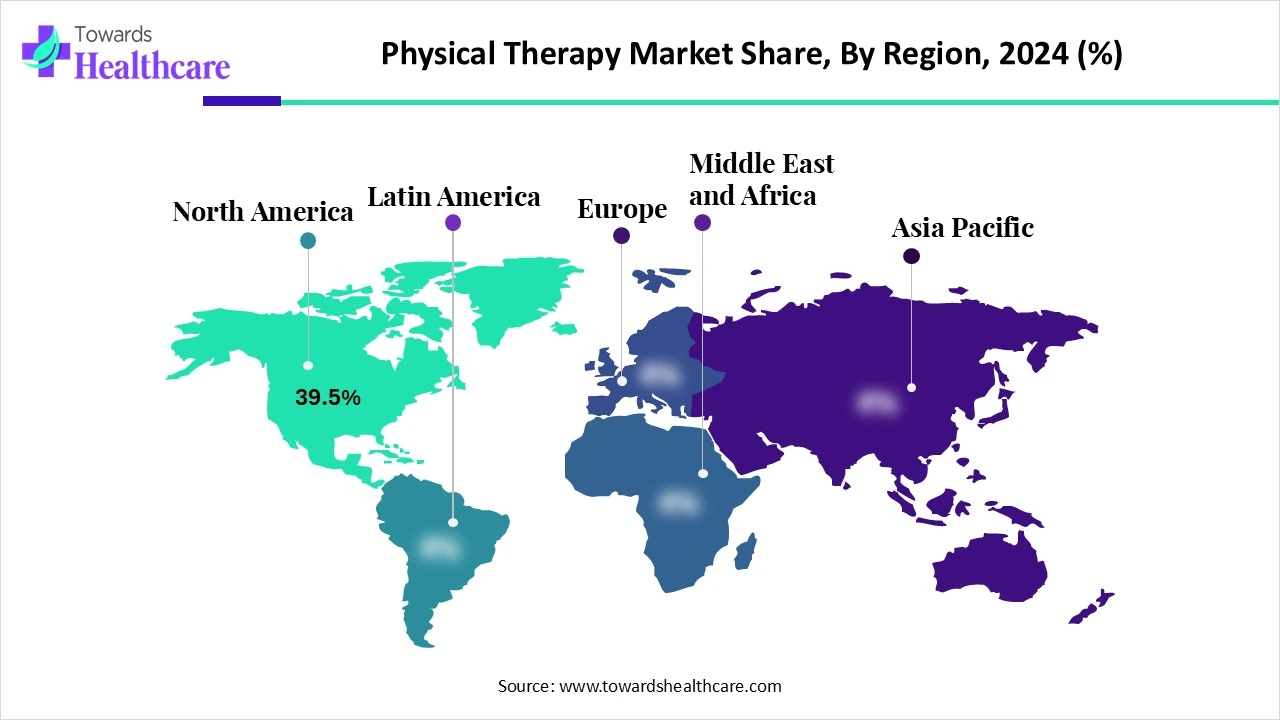
North America (dominant — 39.5% share in 2024)
Market size & structure
●USD 11.08B in 2024 (39.5% of global).
●Large presence of MSOs, outpatient chains and sophisticated reimbursement frameworks.
Drivers
●High surgical volumes, established insurance reimbursement, and investments in rehab infrastructure.
●Strong adoption of telehealth and digital tools.
Workforce & labor market
●Robust demand 50M Americans receive PT annually (your provided stat), and ~13,600 job openings per year forecast — implies workforce tightness and wage pressure.
Strategic implications
●Scale players focus on M&A, vertically integrate home care and telehealth (e.g., acquisitions).
●Tech vendors partner with large PT chains for distribution and evidence generation.
Asia-Pacific (fastest growth)
Demand drivers
●Large population base, rising MSK burden and surgery volumes, increasing middle-class healthcare spending.
●Medical & rehabilitation tourism (low-cost care hubs like Kerala noted).
Structural features
●Lower per-capita PT density in many countries → supply gap.
●Rapid adoption of low-cost wearables and telehealth to address workforce constraints.
Opportunity
●High upside for device vendors, tele-platforms, and franchised outpatient clinics; potential for large-scale data collection (e.g., China rehab need estimates).
China (noted rehabilitation need)
Scale
●2020 estimate: 460M people needed rehab; projection to 2034: 636M — signals massive latent demand for PT and rehab services.
Implication
●Demand will pressure expansion of training, facilities and imported device adoption; strong opportunities for local players and international vendors seeking scale.
India
Burden & supply gap
●35–40 crore (350–400M) Indians with chronic musculoskeletal pain (your provided stat).
●Physiotherapist density: ~0.59 per 10,000 people (major access constraint).
Regional hubs & opportunities
●Kerala as a rehab tourism destination with ~3,000 healthcare institutions — gateway for medical tourism and tech pilots.
Europe (steady growth; pockets of high capacity)
Germany
●One physiotherapist per 430 people; 1,079 rehabilitation facilities (2023) with 161,430 beds — advanced rehab infrastructure.
●Large healthcare expenditure (~€494.65B in 2023) supports high per-patient spend.
UK
●One physiotherapist per 1,136 people; NHS shortage ~12,000 physiotherapists needed — access constraint creates opportunities for private providers and telehealth.
Implication
●Western Europe: mature market for high-value devices and evidence-driven service models; Eastern Europe: expansion opportunities.
Latin America, MEA
Features
●Mixed levels of infrastructure; growth driven by urbanization, rising surgery rates, and private sector expansion.
Strategy
●Low-cost devices, telehealth and capacity building (training programs) will be priority.
Market dynamics
Drivers
●Increasing surgeries & post-op rehab demand — directly increases utilization of PT services.
●Rising prevalence of musculoskeletal and neurological disorders — large, persistent patient pools.
●Awareness of non-pharmacological care — patient preference for conservative management boosts PT uptake.
●Favorable reimbursement & funding — supports access to advanced therapies and devices.
●Technology adoption — wearables, robotics, telehealth and AI expand addressable market.
Restraints
●Skilled workforce shortage — e.g., India 0.59 physiotherapists/10k; UK & some markets report significant gaps.
●Fragmentation of care & variable reimbursement — payer differences slow standardized rollout of advanced tech.
●Capital intensity for advanced devices — high upfront cost can limit adoption in smaller clinics.
Opportunities
●Tele-physical therapy & hybrid care — expand reach and reduce per-patient cost.
●Wearables & robotics — higher-margin device sales and recurring software revenue.
●AI & data monetization — predictive tools, outcome measurement and value-based contracting.
●Medical/rehab tourism (APAC & India) — attract international patients seeking quality at lower cost.
●Training & education models — franchising and certification programs to close skill gaps.
Threats / Risks
●Regulatory / reimbursement shifts — cost containment could squeeze margins.
●Data privacy & cybersecurity — particularly for AI/telehealth vendors.
●Clinical validation gap — devices and AI models need high-quality evidence to secure payer support.
Top 10 companies
Select Medical Corporation
●Overview: Large provider/MSO focusing on rehabilitation hospitals and outpatient therapy networks.
●Product / Service: Multi-site inpatient/outpatient rehab services and integrated care pathways.
●Strengths: Scale in inpatient rehab, strong referral relationships with hospitals, ability to standardize care and capture post-acute volumes.
ATI Physical Therapy
●Overview: National outpatient clinic network specializing in orthopedic & sports rehab.
●Product / Service: Clinic-based PT, performance optimization programs, employer partnerships.
●Strengths: Franchise/chain model for scalable outpatient growth, brand recognition in sports/ortho rehab.
Upstream Rehabilitation
●Overview: Provider of physical therapy services often partnering with health systems.
●Product / Service: Outpatient and home-based therapy models, clinically integrated pathways.
●Strengths: System integration focus (embedding into hospitals/health systems), flexible care modalities.
Kindred Healthcare
●Overview: Provider across continuum (post-acute, home health, rehab).
●Product / Service: Inpatient rehab, home health therapy services.
●Strengths: Cross-site care coordination, ability to manage complex post-acute cases.
Athletico Physical Therapy
●Overview: Large outpatient network with a sports-medicine and work-injury focus.
●Product / Service: Orthopedic PT, sports rehab, employer/workers’ comp contracts.
●Strengths: Strong ties to sports medicine, operational excellence in high-volume clinics.
U.S. Physical Therapy, Inc.
●Overview: Nationwide operator of outpatient PT clinics (noting an acquisition of outpatient home care practice in April 2025).
●Product / Service: Clinic and home-based therapy services; increasingly hybrid care models.
●Strengths: Strategic acquisitions broaden care continuum (in-clinic → home), scale & integration.
Concentra Inc.
●Overview: Occupational health and workforce rehabilitation services (network/clinics).
●Product / Service: Work-related injury management, onsite therapy, employer contracts.
●Strengths: Large employer relationships, specialized occupational expertise.
CORA Health Services
●Overview: Regional provider of rehab and outpatient services.
●Product / Service: Orthopedic and post-op rehab services, outpatient-focused.
●Strengths: Regional penetration, partnerships with local systems.
BTL Industries
●Overview: Device manufacturer (therapeutic equipment / electrotherapy / advanced devices).
●Product / Service: Therapeutic devices, expect focus on electrotherapy, laser therapy, and related equipment (device category implied in your equipment list).
●Strengths: Product portfolio breadth, sell-through to clinics and hospitals, potential for bundling hardware+software.
Enovis (DJO Global) / Zimmer MedizinSysteme / Dynatronics Corporation
●Overview: Device & equipment manufacturers supplying therapy, orthopedics, and electrotherapy products.
●Product / Service: Treatment tables, electrotherapy units (TENS/EMS), ultrasound, mobility aids, rehab devices.
●Strengths: Established R&D, distribution channels into hospitals/outpatient clinics, recognized brand names in equipment.

Get a Sample of this Report
Physical Therapy Market
