

Quantum Computing in Healthcare Market Shares, Dynamics and Latest Updates 2025

Market size
Baseline & near term (reported)
• 2024 actual: USD 121.6M (reported).
• 2025 actual/projection in report: USD 167.71M.
Forecast horizon (2025 → 2034)
• 2034 projected market size: USD 3,037.83M.
• Implied CAGR 2025–2034 = 37.86% (this reflects extremely rapid scaling driven by combined growth of hardware, cloud access, algorithm development, and life-science adoption).
Compound growth interpretation
• The projection implies roughly a 18× increase in total market value over nine years (167.71 → 3,037.83).
• Such growth assumes accelerating commercial utility (hybrid systems, quantum-inspired HPC, cloud access) and growing enterprise spend from pharma/biotech, tech vendors, and government R&D.
Revenue concentration & runway
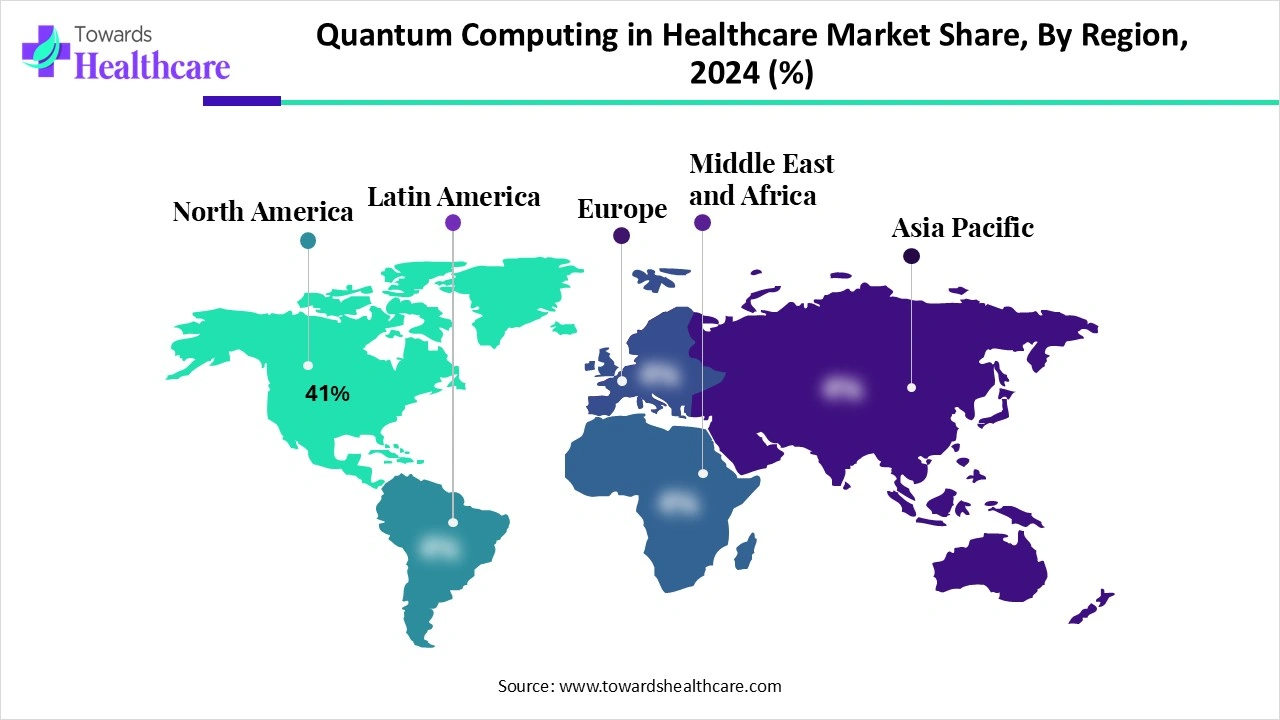
• 2024 indicated regional leader: North America 41% of market revenue — implying concentration of spend, customers, and early use-cases there.
• The balance of market value is split across early adopters (pharma/biotech, academic consortia) and technology vendors (hardware + software + services).
Segment-level monetization (service vs. hardware)
• Quantum software & algorithms comprised a dominant share in 2024 (reported 45% of service-type revenue), indicating early monetization is skewed toward algorithm development, cloud access/subscriptions, and specialized R&D services rather than mass hardware sales.
Market trends of Quantum Computing in Healthcare Market
Drug discovery & molecular modeling leads early adoption
• Reported dominant application (2024): Drug discovery & molecular modeling 35% — pharma invests first where quantum-advantaged simulation/hybrid methods can shorten lead discovery cycles.
Shift toward hybrid/quantum-inspired systems
• While quantum annealing dominated by technology type in 2024 (40%), quantum-inspired/HPC hybrid systems are the fastest growing segment — reflecting practical near-term gains from running quantum-inspired algorithms on classical HPC and cloud GPUs.
Service orientation: algorithms & custom R&D
• Quantum software & algorithms dominated 2024 (45% by service type).
• Custom quantum R&D services are forecasted to grow fastest — customers want tailored workflows (molecular simulation, optimization) rather than one-size-fits-all tools.
End-user evolution: pharma & biotech first, vendors next
• Pharmaceutical & biotech: dominant 2024 segment (36%) given direct ROI potential in drug development.
• Technology vendors / startups: expected fastest growth — cloud offerings, algorithm marketplaces, and SaaS for quantum workflows expand procurement options.
Regional investment & policy stimulus accelerate commercialization
• North America leads (41% share 2024) — heavy R&D ecosystems and government funding.
• Asia-Pacific fastest projected CAGR: large public programs, national quantum missions, and regional investments (India, China, Singapore) expand capacity.
Emergence of quantum-safe and data-security initiatives
• Post-quantum encryption and quantum-safe campaigns (noted by national labs / standards bodies) elevate demand for secure data handling in healthcare applications.
Converging AI + Quantum narrative
• Investments in generative AI and quantum simulation are merging — AI guides molecule proposals, quantum/hybrid systems evaluate candidate physics-accurately faster.
AI’s impact and role in the Quantum Computing in Healthcare Market
AI as a design-generation engine + quantum as a simulation/verification engine
• Generative models (GANs, diffusion, transformer drug design variants) propose candidate molecules; quantum algorithms/hybrid simulators validate binding modes, energy surfaces, and reaction paths with higher fidelity than many classical force-fields.
Accelerating lead optimization loops
• AI ranks and optimizes candidate chemical space; quantum/hybrid computations rapidly refine energy landscapes — shortening design → in-silico test → selection cycles and reducing experimental iterations.
Enhanced feature extraction for quantum-assisted imaging
• AI methods amplify signal processing in imaging (MRI, CT). Quantum algorithms (quantum signal processing, variational circuits) can operate on compressed representations or accelerate reconstruction tasks when integrated with AI pre/post-processing.
Hybrid AI-quantum pipelines for genomics
• Large language model-style architectures for genomes propose variant interpretations; quantum-enhanced algorithms tackle combinatorial problems (haplotype phasing, large-scale matrix factorizations) within hybrid workflows.
Optimization problems: clinical trials & logistics
• AI predicts enrollment patterns and risk; quantum annealing and quantum-inspired solvers solve combinatorial scheduling and supply chain QUBO formulations faster or with better quality for certain problem shapes.
Data privacy, federated learning & quantum-safe needs
• AI models trained across institutions require privacy-preserving techniques; quantum computing raises both opportunities (quantum encryption primitives, secure multi-party computation) and threats (need for post-quantum cryptography).
AI reduces quantum programmer burden
• AI tools (auto-differentiation, code generation, automated ansatz selection) will shorten the expertise gap for quantum algorithm deployment, enabling domain scientists (chemists/biologists) to use quantum-backed services more directly.
Modeling complexity beyond classical limits
• For strongly correlated systems (some bio-relevant molecules), AI-guided variational quantum eigensolvers or quantum-machine-learning approaches may offer qualitatively better models than classical approximations.
Commercialization driver
• AI value propositions (faster hypothesis generation, pattern recognition) combine with quantum’s potential to deliver verifiable physics — this pairing drives buyers (pharma/biotech) to allocate budgets earlier to pilot projects and R&D contracts.
Regional insights
North America (lead — 41% share in 2024)
Ecosystem & customers: Concentration of Big Pharma, cloud providers, national labs and venture capital creates an environment where pilots rapidly scale into multi-year R&D commitments.
Infrastructure: Major cloud quantum access and multiple corporate quantum labs (IBM, Rigetti, Google, Quantinuum presence) allow pharma to test use-cases without acquiring hardware. (See IBM, Rigetti, D-Wave, Quantinuum pages for corporate capabilities).
Policy & standards: U.S. policy initiatives (National Quantum Initiative, NIST guidance on post-quantum standards) provide both funding and a push toward quantum-safe healthcare systems.
Asia-Pacific (fastest projected CAGR)
National missions and funding: Several APAC countries are launching national quantum missions and centers (e.g., India National Quantum Mission, Singapore R&D funding), increasing local capacity and partnerships with global players.
Market drivers: Large population, expanding biotech sectors, and cloud adoption create a high ceiling for clinical and genomics applications.
Localization: Local data sovereignty needs encourage regional cloud/quantum centers (e.g., Quantinuum/IBM partnerships in the region).
Europe
Research-to-commercial pathways: EU funding calls for quantum chip tech and pan-European collaborations drive hardware and algorithm innovations that biotech companies can commercialize.
Regulation & ethics: Strong privacy regulations (GDPR) and clinical data governance shape deployment models (favors federated and secure hybrid workflows).
Canada & Latin America
Niche competencies: Canada’s quantum algorithms institutes and university clusters produce talent and spinouts; Latin America exhibits pockets of academic R&D that can be incubators for trials and algorithm development.
Middle East & Africa
Emerging adoption: Investments in smart health systems and partnerships with international tech vendors will likely produce pilot projects (telehealth + quantum-secure data pipelines) before large commercial uptake.
Market dynamics
Drivers
Urgent pharma need to shorten drug timelines — Quantum-assisted molecular simulation promises to reduce time/cost per candidate.
Cloud quantum access — low barrier to entry for healthcare organizations via cloud APIs and SaaS.
AI + quantum synergy — practical hybrid methods deliver incremental advantages that justify early spending.
Government & institutional funding — national quantum missions and grants reduce adoption risk for vendors and users.
Restraints
Maturity gap in hardware — noisy qubits, error rates, and limited qubit counts restrict full-scale simulation across many pharma-relevant molecules.
Skill shortage — shortage of cross-disciplinary talent (quantum physicists + computational chemists + ML engineers) slows adoption.
Regulatory & clinical validation hurdles — health regulators require high evidentiary standards for computational claims impacting clinical decisions.
High initial cost for custom solutions — bespoke quantum R&D services remain expensive, restraining mid-market adoption.
Opportunities
Hybrid quantum-classical offerings — quantum-inspired HPC and cloud simulators enable near-term ROI and faster adoption curves.
Customized R&D services — consultancies and startups can deliver tailored pipelines for lead discovery, trial design optimization, and imaging enhancement.
Post-quantum security products — growing need for quantum-safe medical data solutions yields additional revenue streams.
Cross-industry partnerships — alliances between cloud vendors, pharma, and national labs speed commercialization and lower risk.
Threats
Overhype / investor fatigue — unmet expectations could lead to funding contractions.
Competing classical methods — advances in classical simulation, AI, and HPC may sustain parity for many use-cases longer than expected.
Standards fragmentation — lack of interoperable software and data standards slows ecosystem effects.
Top companies
IBM Quantum — Products / Overview
• Offers cloud-accessible superconducting quantum processors and enterprise platforms (IBM Quantum Platform, System One/Two).
• Strengths: Extensive cloud footprint, large device fleet, strong developer ecosystem, tie-ups to enterprise services (IBM Research + Red Hat).
Google Quantum AI — Products / Overview
• Developer of superconducting architectures and algorithms; focuses on quantum supremacy/advantage demonstrations and software tools.
• Strengths: Deep research pedigree, high-visibility benchmark achievements, integrated AI/ML expertise for quantum workflows. (Wikipedia: Quantum computing activities; Google pages referenced in general quantum listings.)
D-Wave Systems — Products / Overview
• Focused on quantum annealing processors and hybrid solvers for optimization; offers cloud access to annealers.
• Strengths: Early commercial deployments for combinatorial optimization; strong product-market fit for logistics and certain drug-optimization subproblems.
Rigetti Computing — Products / Overview
• Builds superconducting quantum processors and provides cloud platform (Forest / Quil historically); pursues multi-chip architectures.
• Strengths: Tight hardware-software integration, focus on practical cloud access and multi-chip scaling; partnerships and investments to scale fabrication.
Quantinuum (Cambridge Quantum + Honeywell) — Products / Overview
• Trapped-ion and software platforms focused on high-fidelity devices and quantum software stack.
• Strengths: High quantum volume devices, strong software IP (from Cambridge Quantum), emphasis on enterprise use-cases and reproducible benchmarks.
Microsoft (Azure Quantum) — Products / Overview
• Provides access to multiple quantum vendor backends (incubating topologies), quantum-inspired solvers, and integration with Azure cloud/AI services.
• Strengths: Cloud scale, enterprise customers, hybrid solutions and partnerships that connect quantum R&D directly into existing enterprise workflows.
Others (Zapata, QC Ware, IonQ, Pasqal, Classiq, 1QBit, etc.)
• Zapata / QC Ware: algorithm/software and enterprise services focus — strength in algorithmic IP and industry partnerships.
• IonQ / Pasqal: hardware leaders in ion-trap and neutral-atom approaches respectively — strengths in connectivity and coherence for certain workloads.

Get a Sample of this Report
Quantum Computing in Healthcare Market
