

Recombinant Proteins Market Overview, Top Key Players and Insights 2025

Market Size Insights
Global Growth (2025–2034)
◉2025: USD 3.36 billion
◉2034: USD 8.08 billion
◉CAGR: 10.24%
Regional Breakdown (2024 market share)
◉North America: 42% (largest share, led by U.S.)
◉Asia-Pacific: fastest growth, driven by R&D, government support, and biotech infrastructure.
◉Europe: growing due to personalized medicines and rising geriatric population.
Key Product Segments
◉Cytokines & Growth Factors: largest share in 2024, widely used in oncology, immunology, neurology.
◉Antibodies: projected to grow significantly due to demand in diagnostics and therapeutics.
Host Cell Systems
◉Mammalian Cells: dominant in 2024 due to high similarity to human proteins.
◉Bacterial Cells (E. coli): fastest growth due to easy handling and cost-efficiency.
Market Trends
Rising clinical & chronic disease burden → demand pull
◉Increasing cancer, diabetes, and autoimmune disorder prevalence creates sustained demand for recombinant therapeutics (e.g., immunostimulants, vaccines, antibodies, fusion proteins).
◉Implication: long-term, predictable demand that supports large CAPEX projects and multi-year supply contracts.
Patent expirations → biosimilars & biologic competition
◉Biologics patent cliffs open opportunities for biosimilars and lower-cost recombinant alternatives — driving competition, price pressure, but also larger addressable markets.
◉Implication: firms must balance price competition with differentiation (manufacturing quality, reliability).
Novel expression & production innovations
◉Non-traditional bioreactors and host systems (example: Loopworm’s work with silkworm bioreactors; $3.4M funding in 2024) show innovation toward alternative, potentially lower-cost production routes.
◉Implication: new host systems could reduce some costs or open niche applications (e.g., insect-derived post-translational modifications).
Large M&A and PE activity
◉ProGen acquisition (KKR & Bain, USD 950M) signals consolidation and strategic platform buys.
◉Implication: expect more rollups of specialized recombinant protein firms into platform companies; supplier rationalization and scaling advantages follow.
Corporate R&D scale-up
◉Example: Merck & Co. R&D spend jumped to ~USD 30B in 2023 (vs. USD 13.5B in 2022).
◉Implication: greater internal demand for research reagents and CMC (chemistry, manufacturing, controls) upstream work; faster pipeline development and more late-stage biologics candidate throughput.
Scale & capacity expansion by sample suppliers
◉Proteintech’s 2024 new UK facility (3× prior size) indicates capacity expansion to meet logistics, manufacturing and R&D demand.
◉Implication: improvements in lead-time and scale for reagents and custom protein projects.
Regulatory environment & approvals
◉With approx 100 recombinant therapeutic proteins approved by FDA (per supplied data), the regulatory precedent is mature but still complex — creating barriers to entry for therapeutic-grade production but enabling more standardized pathways.
Ongoing cost pressure & payer scrutiny
◉High production costs translate to high therapeutic pricing; this will trigger payer negotiation and possibly stricter cost-effectiveness scrutiny in some geographies.
Academic–industry collaborations
◉Partnerships like Pfizer CTI show a trend of industry leveraging academia for early innovation and then absorbing scale via industry channels.
◉Implication: a two-tier innovation model — academic discovery feeding industry scaling.
AI: Role & Impact on the Recombinant Proteins Market
In-silico protein design & structure optimization
◉Mechanism: ML models evaluate sequence→structure→function relationships to propose sequence variants with improved stability, binding or expression.
◉Business impact: shortens lead optimization, reduces failed constructs, increases probability of successful therapeutic candidates → lowers discovery costs and compresses timelines.
Expression system & host optimization
◉Mechanism: AI models correlate sequence, vector, host, and culture parameters to predict expression yield and solubility.
◉Business impact: faster selection of the optimal host (mammalian vs bacterial vs insect), fewer wet-lab iterations, higher yields at scale.
Bioreactor process control & predictive maintenance
◉Mechanism: real-time sensor data (pH, DO, temperature, optical density) fed into ML control loops to dynamically adjust feed rates, oxygenation, or temperature. Predictive maintenance flags equipment before failure.
◉Business impact: higher uptime, consistent yields, lower batch loss and downstream variability — improves cost per gram.
Downstream purification optimization
◉Mechanism: ML optimizes chromatographic steps and buffer conditions to maximize purity recovery and throughput.
◉Business impact: reduces number of purification cycles, improves overall process yield, lowers COGS for therapeutic grade proteins.
Analytics & quality control (QC)
◉Mechanism: ML/vision systems analyze mass spec, HPLC, electrophoresis and imaging data to detect subtle impurities or misfolding.
◉Business impact: more sensitive QC → fewer lot rejections and improved regulatory compliance; faster release cycles.
Predictive formulation & stability
◉Mechanism: algorithms predict excipient combinations and formulation conditions that maximize shelf life and thermal stability.
◉Business impact: reduced cold-chain dependence where possible, longer shelf life → lower distribution costs, broader geographic reach.
Candidate prioritization & in silico screening
◉Mechanism: AI triages millions of virtual variants for in vitro testing priority.
◉Business impact: better R&D resource allocation; smaller, higher-value wet-lab screening cohorts.
Patient stratification & personalized biologics
◉Mechanism: AI analyzes patient molecular data to identify those who will respond to a specific recombinant therapeutic.
◉Business impact: precision therapies with higher efficacy, enabling premium pricing and better clinical outcomes; supports personalized medicine business models.
Supply chain forecasting & demand planning
◉Mechanism: ML forecasts reagent and finished product demand using lead indicators (clinical readouts, regulatory milestones, sales trends).
◉Business impact: optimized inventories, just-in-time production, reduced stockouts and obsolescence.
Regulatory analytics & dossier automation (emerging)
◉Mechanism: NLP and structured data extraction streamline compilation of regulatory submissions and batch records.
◉Business impact: faster regulatory filing, lower submission cost, fewer errors in documentation.
◉Overall AI effect: compress R&D timelines, de-risk scale-up, increase yields/quality, and reduce operational cost drivers — collectively expanding addressable markets and enabling new product economics.
Regional insights
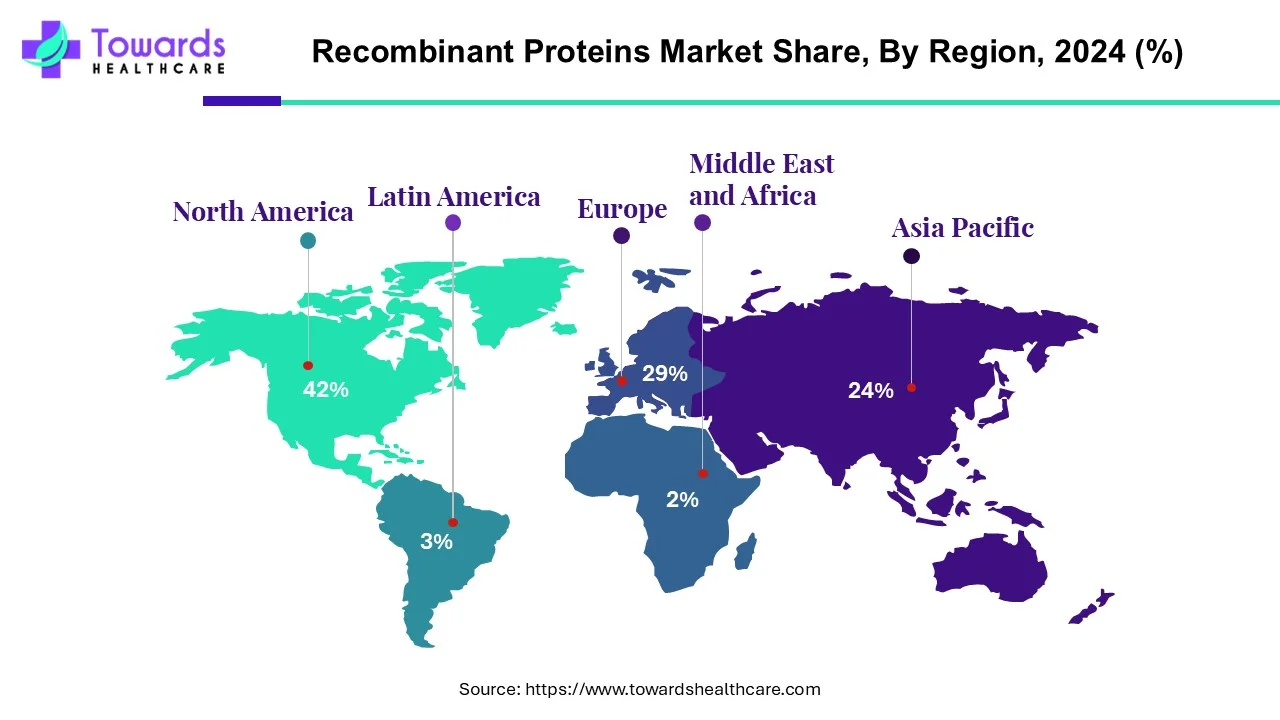
A. North America — (42% market share in 2024)
Demand & epidemiology
◉High cancer incidence (U.S. projected ~1.9M new cancer cases in 2024) drives oncology biologics demand.
Capital & R&D ecosystem
◉Concentrated biotech hubs (academic + VC + CMC suppliers) support rapid translation from discovery → scale.
Manufacturing & CMOs
◉Large existing biomanufacturing capacity and experienced contract manufacturers favor large-scale therapeutic production.
Regulatory clarity
◉Mature FDA pathways for recombinant biologics (≈100 approved) reduce regulatory uncertainty for new entrants.
◉Implication: North America is the primary commercial and clinical launch pad for high-value recombinant therapeutics and a target for early partnership/outsourcing.
B. Asia-Pacific — (highest projected CAGR)
Funding & government incentives
◉Growing public/private financing and favorable policies (cited generically) accelerate local R&D and manufacturing investments.
Scaling & cost arbitrage
◉Lower manufacturing costs and an expanding biotech workforce support scale manufacturing and exports.
Local innovation
◉Emerging alternative platforms (e.g., insect bioreactors) and localized production for regional needs.
◉Implication: APAC will be a growth and manufacturing hub — attractive for cost-sensitive large-volume products and biosimilars.
C. Europe — (significant growth)
Aging population & personalized medicine
◉Higher demand for personalized recombinant therapies and diagnostics; healthcare systems focus on outcomes.
Strong academic–industry collaboration
◉Dense research networks produce discovery pipelines that industry can commercialize.
M&A & strategic consolidation
◉Examples like Danaher’s acquisition of Abcam indicate consolidation to build end-to-end capabilities.
Implication: Europe will remain a strong innovation center and commercialization market for differentiated, high-value recombinant products.
D. Latin America & Middle East & Africa (emerging)
Growth potential but infrastructure gap
◉Countries like Brazil and South Africa show rising investment but overall manufacturing and cold-chain limitations constrain scale.
Government healthcare reforms
◉Improving healthcare budgets and procurement programs create windows for targeted market entry.
◉Implication: Opportunities for reagent supply, diagnostics and partnerships, but therapeutic launches require local manufacturing/partnership strategies.
Market dynamics (drivers, restraints, opportunities, threats, value chain)
Primary drivers
◉Disease incidence (cancer, diabetes, autoimmune) creating sustained therapeutic demand.
◉Patent expiries enabling biosimilars and new market entrants.
◉Large corporates and PE investment fueling capacity and platform purchases.
Key restraints
◉High production cost: production of clinical-grade recombinant proteins is capital- and resource-intensive — often described as “billions of dollars per kilogram” for therapeutic-grade material in your source, which restricts affordability and access.
◉Complex manufacturing & regulatory requirements: GMP facilities, validated processes, and rigorous QC are costly and time-consuming.
Opportunities
◉Biosimilars and cost-effective production routes (new host systems, process intensification).
◉AI-enabled design & manufacturing that reduces time-to-clinic and per-unit cost.
◉Outsourcing and CMO partnerships (e.g., Axio BioPharma opening up for manufacturing projects) expand capacity and shorten customer lead times.
Threats / challenges
◉Pricing/payer pressures that compress margins for expensive therapies.
◉Supply chain fragility for raw materials (media, resins, single-use disposables).
◉Technical risk: expression failures, low yields, or impurity profiles that can stall projects.
Value chain hotspots & levers
◉Upstream R&D — gene design, cell line engineering: high differentiation potential.
◉Upstream production — bioreactor strategy (batch/fed-batch/perfusion): primary cost driver for yield.
◉Downstream processing — chromatography and filtration: major cost and technical complexity.
◉Formulation & fill-finish — secure cold-chain and regulatory release: critical for final product viability.
◉Commercialization — pricing, reimbursement, and distribution channels determine market uptake.
Global healthcare production insights
◉Manufacturing stages — detailed
◉Gene & vector design: codon optimization and strong promoters influence expression.
◉Cell-line development: stable vs transient expression decisions affect timelines and per-batch economics.
◉Upstream cultivation: small-scale screening → scale-up in single-use or stainless steel bioreactors.
◉Downstream purification: capture (affinity), intermediate polishing (ion exchange, hydrophobic interactions), filtration, viral removal — these steps greatly affect cost and purity.
◉Formulation & fill-finish: sterile filling, lyophilization or liquid formulation; robust excipient selection for stability.
◉QC & release: structural analytics, potency assays, impurity profiling and sterility tests required for regulatory release.
Scale-up challenges & mitigation
◉Scalability of yields: a construct that expresses well at small scale may behave differently at 1,000–10,000 L. Mitigation: predictive modeling, process intensification, and pilot scale bridging.
◉Batch variability: process analytics and PAT (process analytical technology) help maintain consistency.
◉Downstream bottlenecks: chromatography resin capacity and throughput can constrain total output. Solution: continuous downstream processes, resin optimization.
CMO & outsourcing dynamics
◉Outsourcing to CMOs accelerates time-to-market and reduces up-front CAPEX; companies like Axio BioPharma positioning as partners signals greater market acceptance of outsourced recombinant manufacturing.
Quality & regulatory compliance
◉Therapeutic recombinant proteins require GMP facilities, validated processes, and extensive stability/safety data; this raises entry bar but protects incumbents who have validated platforms.
Logistics & distribution
◉Cold-chain dependency for many proteins increases distribution cost and complicates access in emerging geographies; formulation advances that reduce cold-chain reliance will expand reach.

Get a Sample of this Report
Recombinant Proteins Market
