

Regulatory Consulting Outsourcing Services Market: Why Life Sciences Companies Are Handing Compliance to Global Experts

What You'll Learn in This Article
- How the regulatory consulting outsourcing services market is approaching USD 22.87 billion by 2035
- Why pharmaceutical and biotech companies are outsourcing regulatory work faster than ever
- Consumer and healthcare industry behavior that is reshaping regulatory consulting
- Regional market shares and fastest-growing countries
- Key service segments driving industry revenue
- Latest regulatory trends transforming healthcare compliance
- Market outlook through 2035
Regulatory Compliance Has Become Too Complex to Handle Alone
Developing a medicine today involves much more than scientific research. Companies must satisfy hundreds of regulatory requirements before a product reaches patients, and those rules continue to evolve every year.
That is why the global regulatory consulting outsourcing services market is expanding rapidly. The market is valued at USD 9.82 billion in 2026 and is projected to reach USD 22.87 billion by 2035, growing at a 9.85% CAGR. Increasing global drug development, stricter regulatory expectations, AI-powered compliance platforms, and expanding post-market surveillance continue to fuel demand.
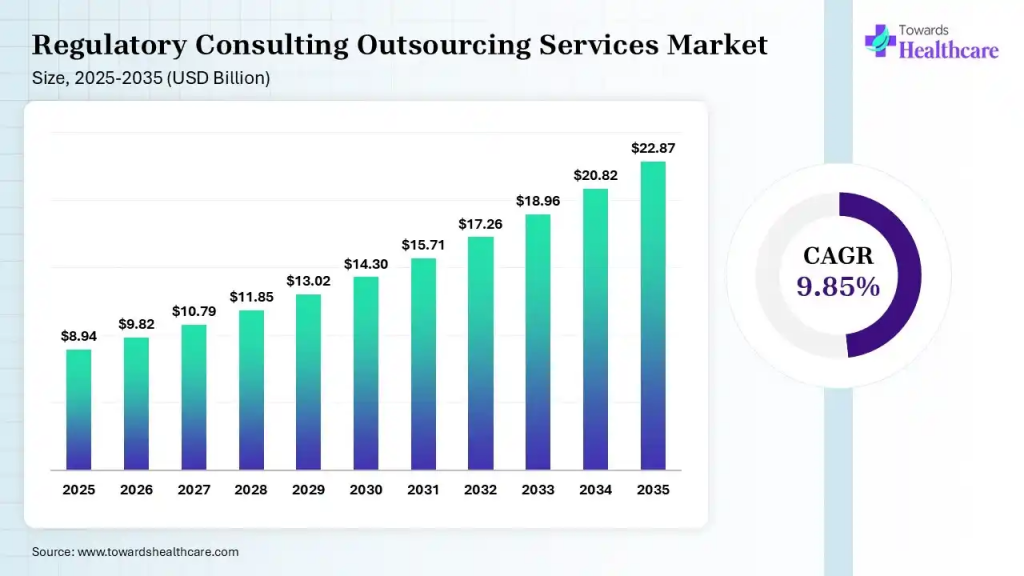
Healthcare companies are realizing that regulatory expertise is no longer an optional support function, it has become a strategic business necessity.
Patients Today Expect Faster Access Without Compromising Safety
Consumer expectations have changed dramatically over the past decade.
Patients increasingly expect new medicines, vaccines, biologics, rare disease therapies, and medical devices to reach hospitals quickly while maintaining the highest safety standards. This has increased pressure on pharmaceutical manufacturers to submit applications faster and maintain compliance across multiple countries simultaneously.
According to the World Health Organization (WHO), regulatory strengthening remains one of the highest priorities for improving global access to safe medicines. Meanwhile, regulators continue expanding post-market surveillance, pharmacovigilance, cybersecurity, and digital health requirements.
Healthcare providers also expect faster regulatory approvals for innovative treatments, creating additional demand for specialized consulting firms.
AI and Digital Platforms Are Changing Regulatory Operations
The biggest transformation is happening inside regulatory departments.
Cloud-based Regulatory Information Management (RIM) platforms, AI-powered document automation, electronic Common Technical Document (eCTD) publishing, regulatory intelligence software, and automated compliance monitoring are significantly reducing submission timelines while improving documentation accuracy.
Large pharmaceutical companies increasingly outsource these digital regulatory operations instead of maintaining large in-house teams, allowing them to focus on research and commercialization.
Small biotechnology companies are adopting the same strategy because building internal regulatory expertise remains expensive.
Regulatory Consulting Outsourcing Services Market Snapshot
| Market Indicator | 2026 Value |
|---|---|
| Market Size | USD 9.82 Billion |
| Expected Market Size (2035) | USD 22.87 Billion |
| Forecast CAGR (2026-2035) | 9.85% |
| North America Share (2025) | 39% |
| Europe Share | 29% |
| Asia Pacific Share | 23% |
| Fastest Growing Region | Asia Pacific (11.80% CAGR) |
Regional Market Performance
| Region | Market Share |
| North America | 39% |
| Europe | 29% |
| Asia Pacific | 23% |
| Latin America | 5% |
| Middle East & Africa | 4% |
North America remains the industry leader because of its mature pharmaceutical ecosystem, stringent FDA regulations, and continuous drug innovation.
Asia Pacific is becoming the fastest-growing market as China and India expand pharmaceutical manufacturing, clinical research, biologics production, and regulatory capabilities.
India is expected to record one of the strongest regional growth rates at 12.6% CAGR, supported by expanding CROs, CDMOs, vaccine manufacturing, and increasing global regulatory submissions.

Get a Sample of this Report
Regulatory Consulting Outsourcing Services Market
