

Can Single Cell Science Transform Healthcare? Market to Reach USD 29.15 Billion by 2034

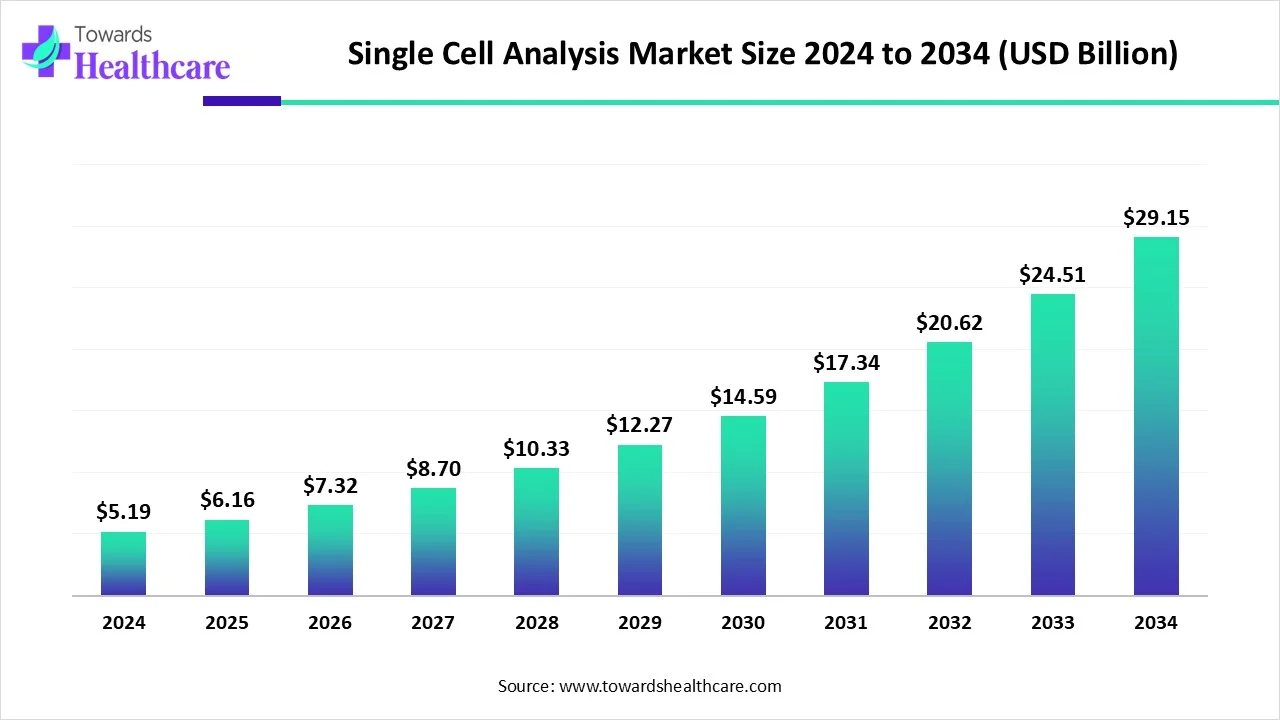
Download the free sample and get the complete insights and forecasts report on this market @ https://www.towardshealthcare.com/download-sample/5682
Why Studying One Cell Matters More Than Ever
Human tissues contain millions of cells, yet not all behave the same way. Even inside a tumor, some cells may grow aggressively while others remain dormant.
Single-cell analysis helps researchers detect these hidden variations. By examining each cell individually, scientists can understand how diseases begin, evolve, and resist treatments.
This approach is particularly powerful in areas like cancer biology, immunology, and regenerative medicine. Instead of guessing how a disease spreads, researchers can track the behavior of specific cells.
That level of insight is transforming the way medical science approaches complex health problems.
Key Forces Powering the Market’s Rapid Growth
Several global trends are pushing the adoption of single-cell analysis technologies.
The increasing burden of chronic diseases has created a strong need for precise diagnostics. Researchers and pharmaceutical companies want deeper biological insights to design targeted treatments.
At the same time, technological breakthroughs in sequencing, microfluidics, and bioinformatics have made these tools more powerful and accessible.
The following factors play a major role in accelerating the market:
-
Rising global cases of cancer and autoimmune diseases
-
Rapid progress in genomics and next-generation sequencing technologies
-
Increasing investment in personalized medicine research
-
Expanding focus on stem cell and regenerative medicine studies
These drivers continue to reshape research laboratories and clinical environments worldwide.
North America Leads While Asia Pacific Accelerates
Regional trends reveal interesting shifts in scientific investment and healthcare innovation.
North America currently dominates the global market, accounting for about 41% of the total share in 2024. Strong research infrastructure, advanced healthcare systems, and large biotechnology investments support this leadership.
The region also hosts many major life-science companies and research institutions that actively develop single-cell technologies.
Meanwhile, Asia Pacific is emerging as the fastest-growing region. Countries across the region are expanding biomedical research funding and strengthening their biotechnology ecosystems.
Growing academic collaborations, improved laboratory infrastructure, and increasing pharmaceutical research activities continue to push regional growth forward.
Products Driving the Technology Revolution
Single-cell analysis relies on multiple tools, technologies, and workflows. Each component plays a critical role in generating accurate cellular insights.
Among product categories, consumables dominated the market in 2024. These include reagents, assay kits, and laboratory materials that researchers use during experiments.
Because scientists frequently use these consumables during testing and analysis, demand remains consistently high.
However, instruments are expected to grow at a strong pace in the coming years. New platforms such as automated sequencing systems and microfluidic devices are making single-cell studies faster and more precise.
As research expands, laboratories continue investing in advanced analytical equipment.
Cancer Research Stands at the Center of Innovation
Cancer remains one of the biggest global health challenges. Understanding how tumors develop requires detailed knowledge of cellular behavior.
Single-cell analysis allows scientists to examine individual tumor cells. This helps researchers identify mutations, track disease progression, and predict treatment responses.
The cancer application segment dominated the market in 2024 due to its importance in oncology research.
However, immunology is expected to grow rapidly in the coming years. Studying immune cells individually helps scientists understand immune responses, infections, and vaccine effectiveness.
This knowledge plays a vital role in developing modern immunotherapies and precision treatments.

Get a Sample of this Report
Can Single Cell Science Transform Healthcare? Market
