

Skincare Market Forecast, Growth, Top Key Players and Latest Insights 2025

Market Size
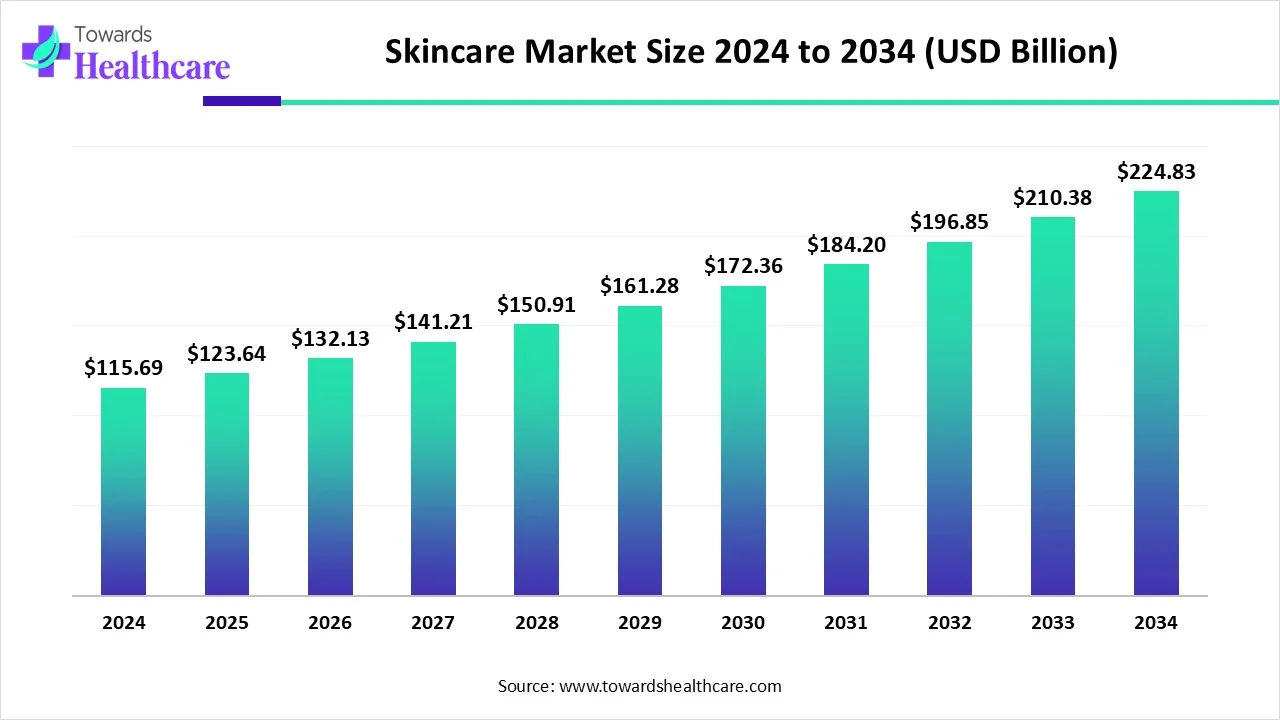
Overall Market Size (2024–2034):
◉2024: USD 115.69 billion
◉2025: USD 123.64 billion
◉2034: USD 224.83 billion
◉CAGR: 6.87% (2025–2034)
Regional Contributions:
◉Asia Pacific: Largest market in 2024 due to large population, increasing urbanization, and rising per capita expenditure on personal care.
◉North America: High growth potential due to high disposable income, awareness of clean-label skincare, and luxury product demand.
Gender Segmentation:
◉Women: Largest market share in 2024 due to economic empowerment, increasing employment, and anti-aging product demand.
◉Men: Rapidly growing segment (2025–2034) as social perceptions evolve, and male consumers embrace self-care routines.
Product Segmentation (2024 Data):
◉Creams: Dominant due to versatility, easy application, and pharmaceutical-grade formulations.
◉Powders: Significant growth potential due to eco-friendliness, lightweight, portability, and preservative-free formulations.
Packaging Segmentation:
◉Tubes: Leading segment in 2024 for cost-efficiency, environmental safety, and precise dispensing.
◉Bottles (Glass): Expected high growth due to stability, barrier properties, and premium appeal, especially for anti-aging, whitening, and antioxidant products.
Distribution Channels:
◉Cosmetic Stores: Largest share in 2024 due to expert guidance and premium in-store experience.
◉Online Channels: Fastest-growing due to ease of access, wide variety, price comparison, and convenience.
Market Trends
Investment & Funding Trends:
◉KorinMi (May 2025): Pre-seed ₹3 crore for Korean skincare tailored to Indian customers. Focus: technology-driven, science-backed formulations.
◉Caldera + Lab (Oct 2024): $6M Series A for men’s sustainable, clean, and high-performance products.
◉Technological Trends:
◉AI & Machine Learning: Personalized skincare recommendations and predictive analytics.
◉Sustainability: Eco-friendly and organic ingredients rising in popularity.
Product Trends:
◉Creams remain dominant due to adaptability, semi-solid application, and multigenerational use.
◉Powders growing due to environmentally friendly composition, lightweight nature, and storage convenience.
Packaging Trends:
◉Tubes dominate due to cost-effectiveness, protection of active ingredients, and precise dispensing.
◉Bottles (glass) are rising due to premium branding, chemical stability, and anti-light properties.
Consumer Demographics & Behavior Trends:
◉Women’s skincare driven by higher discretionary income and anti-aging product demand.
◉Men’s skincare growth due to shift in self-care perception, social media influence, and male-targeted product lines.
◉Online channels rising as consumers prefer 24/7 access, convenience, and wider product choices.
Regional Market Trends:
◉Asia Pacific: Driven by affordability and increasing availability of skincare products.
◉North America: Rising e-commerce adoption, luxury product demand, and awareness of clean-label skincare.
◉Europe: High demand for cruelty-free, organic, and biotech-based skincare.
◉Latin America: Growth due to rising awareness, urbanization, and government support.
AI Impact in the Skincare Market
Personalized Product Formulation:
◉AI processes skin type, environmental conditions, and consumer habits to create customized creams, serums, and powders.
Predictive Customer Insights:
◉Predicts trends, seasonal skincare needs, and demographic-specific solutions.
Enhanced R&D:
◉Reduces time and costs in product development using simulations and formulation optimization.
Virtual Skin Analysis & Chatbots:
◉AI tools provide real-time skincare advice, driving online engagement and sales.
Supply Chain Optimization:
◉Predicts demand spikes for products (e.g., creams vs powders) and optimizes inventory management.
Trend Spotting:
◉Analyzes social media, online reviews, and consumer forums to forecast ingredient and packaging trends.
Regulatory Compliance Support:
◉AI can screen formulations against region-specific restrictions, such as California’s Toxic-Free Cosmetics Act.
Marketing & Personalization:
◉AI enables targeted campaigns, recommending products based on purchase history and skin type, boosting conversion rates.
Regional Insights
Asia Pacific
Market Drivers:
◉Fast urbanization, growing middle-class income, and increased skincare awareness.
Country Insights:
◉China: Second largest cosmetics market, increasing demand for professional and clinically-backed formulations.
◉South Korea: Leader in innovation, natural ingredients, and attractive packaging; strong online shopping penetration.
North America
Market Drivers:
◉High disposable income, luxury skincare adoption, e-commerce growth.
Country Insights:
◉USA: Demand for premium, clean-label skincare; social media drives purchasing decisions.
◉Canada: Strong preference for organic and ethical products; leading provinces are Ontario and Quebec.
Europe
Market Drivers:
◉Strong focus on sustainability, cruelty-free products, and biotech-based formulas (e.g., probiotics, plant-based retinol).
Country Insights:
◉France: Emphasis on professional advice and self-care; pharmacy plays a key role in consumer trust.
◉UK: Leader in clean beauty, microbiome-focused skincare; over 1,800 beauty companies driving innovation.
Latin America
Market Drivers:
◉Urbanization, rising incomes, government awareness campaigns, and social media influence.
Country Insights:
◉Mexico: Hub for cosmetic treatments; over 90 regulated cosmetic products.
◉Brazil: Second-highest cosmetic surgeries globally; ANVISA regulates cosmetics, hygiene, and perfumes.
Market Dynamics
Drivers
◉Rising interest in natural and organic products due to consumer awareness of chemical side effects.
◉Growing demand for eco-friendly and clean-label products.
Restraints
◉Regulatory restrictions: Stringent requirements in regions like California; banning harmful chemicals under acts like Toxic-Free Cosmetics Act.
Opportunities
Personalized skincare solutions: AI and tech-driven tailored solutions creating differentiation and brand loyalty.
◉Growing male skincare segment.
◉Online retail expansion and digital marketing innovations.
Top Skincare Companies
1. L’Oréal Professional (France)
Overview:
◉Global leader in skincare and cosmetics innovation.
◉Focuses on professional-grade formulations and luxury consumer products.
◉Operates in more than 150 countries with strong R&D and marketing presence.
Key Products:
◉Anti-aging creams and serums
◉Moisturizers and lotions
◉Specialty facial treatments
◉Hair and scalp skincare products
Strengths:
◉Strong R&D capabilities, continuously innovating in skincare science.
◉Well-established global distribution network for retail and professional channels.
◉Brand reputation for quality and luxury, trusted by consumers worldwide.
◉Ability to quickly adapt to emerging trends such as clean-label and sustainable products.
2. Unilever (UK)
Overview:
◉Multinational consumer goods company with a diverse personal care portfolio.
◉Skincare is part of a larger personal care and hygiene segment.
◉Strong emphasis on sustainability and natural ingredients.
Key Products:
◉Lotions and creams for daily use
◉Men’s skincare lines
◉Powders and specialty topical treatments
◉Eco-friendly and clean-label products
Strengths:
◉Extensive global supply chain, ensuring availability across multiple markets.
◉Focus on sustainable production and eco-friendly packaging.
◉Strong marketing and branding, leveraging heritage brands to expand consumer trust.
◉Ability to cater to both mass-market and premium consumers.
3. Procter & Gamble (P&G) (USA)
Overview:
◉Leading multinational consumer goods corporation.
◉Offers skincare as part of a broader personal care and grooming portfolio.
◉Operates in both mass-market and premium segments.
Key Products:
◉Creams and moisturizers
◉Facial treatments and serums
◉Anti-aging products
◉Lotions and powders
Strengths:
◉Global brand recognition with strong marketing campaigns.
◉Deep R&D capabilities, particularly in dermatology-backed skincare.
◉Ability to leverage multiple consumer channels, including online, retail, and supermarkets.
◉Strong product portfolio for diverse consumer demographics.
4. Estée Lauder Inc. (USA)
Overview:
◉Premium skincare and cosmetics company.
◉Focuses on high-performance, luxury skincare products with scientific backing.
◉Global footprint in department stores, specialty retailers, and online.
Key Products:
◉Serums and anti-aging creams
◉Facial moisturizers and powders
◉Eye creams and masks
◉Specialty treatments like whitening and antioxidant formulations
Strengths:
◉Strong luxury brand positioning, attracting high-income consumers.
◉Heavy investment in R&D for innovation in anti-aging and targeted skincare.
◉Extensive global distribution through exclusive counters and online platforms.
◉Ability to create premium consumer experiences in stores.
5. Beiersdorf AG (Germany)
Overview:
◉Pioneer in dermatologically-tested skincare.
◉Known globally for Nivea and other trusted brands.
◉Focus on dermatology-based formulations and consumer trust.
Key Products:
◉Creams and lotions (Nivea line)
◉Anti-aging and sun care products
◉Specialty creams for sensitive skin
◉Topical treatments for everyday skincare
Strengths:
◉Strong scientific credibility with dermatologist-tested formulations.
◉Extensive European market presence and growing global reach.
◉Trusted brand legacy, particularly in mass-market skincare.
◉Expertise in formulation innovation, particularly in creams and anti-aging products.
6. Shiseido Co., Ltd. (Japan)
Overview:
◉Major Asian skincare innovator with a global footprint.
◉Known for advanced technology-driven products and premium positioning.
◉Focus on blending science and traditional Japanese skincare concepts.
Key Products:
◉Anti-aging creams and serums
◉Moisturizers and lotions
◉Specialty skincare with natural ingredients
◉Powder-based skincare products
Strengths:
◉Advanced R&D capabilities, particularly in biotech and natural extracts.
◉Strong presence in Asia-Pacific luxury skincare markets.
◉Ability to blend cultural heritage with modern technology.
◉Focus on premium consumer experience and innovative packaging.
7. Coty Inc. (USA)
Overview:
◉Global beauty company with a strong focus on skincare, cosmetics, and fragrances.
◉Known for brand diversification and multiple market segments.
Key Products:
◉Lotions, creams, and serums
◉Skincare kits and sets
◉Specialty products for different age groups
◉Fragrance-infused skincare
Strengths:
◉Wide brand portfolio, appealing to multiple demographics.
◉Strong marketing and distribution capabilities.
◉Ability to target both mass-market and premium segments.
◉Strategic partnerships with retailers globally.
8. Natura & Co (Brazil)
Overview:
◉Focus on eco-friendly, natural, and organic skincare.
◉Known for sustainability and ethical sourcing.
◉Strong presence in Latin America and growing globally.
Key Products:
◉Creams and lotions
◉Organic skincare products
◉Specialty natural ingredient-based formulations
◉Eco-friendly packaging products
Strengths:
◉Commitment to sustainability and ethical production.
◉Strong brand trust in eco-conscious consumer segment.
◉Growing presence in international markets.
◉Ability to innovate in natural ingredient-based formulations.
9. Kao Corporation (Japan)
Overview:
◉Leading Asian personal care and skincare manufacturer.
◉Strong in daily-use skincare products and serums.
◉Focus on Asian consumer needs and innovation.
Key Products:
◉Creams, lotions, and serums
◉Anti-aging formulations
◉Facial treatments for sensitive and general skin types
Strengths:
◉Deep understanding of Asian skin types and climate-specific formulations.
◉Strong R&D and innovation focus.
◉High-quality mass-market and premium products.
◉Ability to integrate natural ingredients and scientific formulations.
10. Johnson & Johnson Services, Inc. (USA)
Overview:
◉Healthcare giant offering trusted skincare brands.
◉Focus on medical-grade and baby skincare.
◉Global distribution across retail, hospitals, and pharmacies.
Key Products:
◉Baby lotions and creams
◉Medical-grade topical treatments
◉Creams and powders for sensitive skin
Strengths:
◉Medical credibility; trusted by consumers and healthcare professionals.
◉Extensive global distribution network.
◉Strong brand trust and product efficacy.
◉Ability to target niche and mass-market segments.
11. Avon Products Inc. (UK)
Overview:
◉Direct-to-consumer beauty and skincare company.
◉Focuses on women’s skincare and cosmetic products.
◉Operates through direct sales representatives and online channels.
Key Products:
◉Lotions, creams, and serums
◉Anti-aging and moisturizing products
◉Specialty skincare sets
Strengths:
◉Extensive direct-sales network, building strong customer relationships.
◉Ability to reach consumers in remote areas through direct selling.
◉Strong brand loyalty and recognition among women.
◉Flexibility in customizing product offerings for local markets.

Get a Sample of this Report
Skincare Market
