

Smart Clinic Market (2025–2034), From US$2.97 Bn to US$10.88 Bn, Rapid AI-First Growth

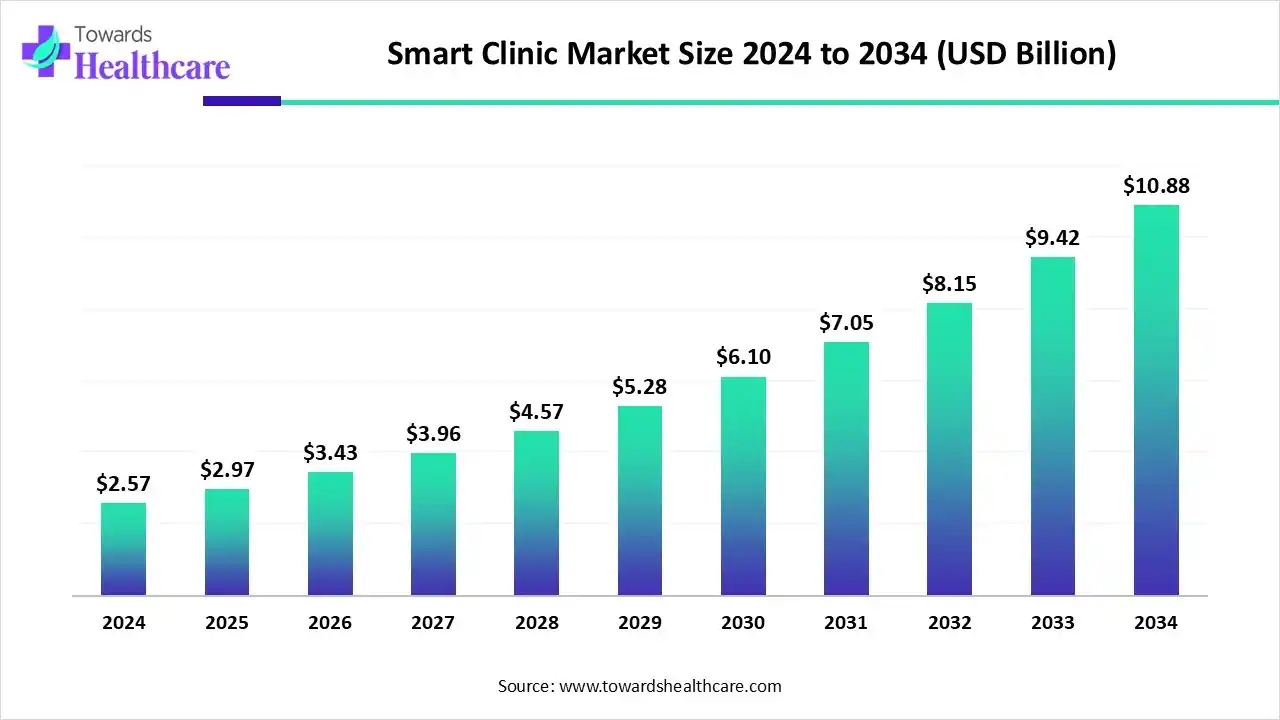
Market Size
●2024 baseline: US$2.57B, commercial traction established across virtual care, EHR, RPM, and cloud workflows.
●2025 checkpoint: US$2.97B, reflecting early AI augmentation of diagnostics and scaled teleconsultation usage.
●2034 outlook: >US$10.88B, >3.6× expansion from 2025 on platformization and hybrid-cloud rollouts.
●Growth velocity: Headline CAGR 15.47% (to 2034); operations/revenue models indicate 15.74% for 2025–2034.
●Revenue mix momentum (2024): Software 49.2% (leader), services fastest (15.5% CAGR), hardware follows via sensor/device refresh.
●Channel gravity: Cloud deployments 63.2% (2024); hybrid models showing the fastest CAGR 27.5% as data governance tightens.
●Solution skew (2024): Telemedicine & teleconsultation 38.6% of revenue; AI/ML solutions are the fastest riser (24.7% CAGR).
●Provider footprint: Hospitals & multi-specialty clinics 35.0% (2024); home healthcare shows the fastest scale-out (21% CAGR).
●Care setting penetration: Primary & outpatient capture 35.1% (2024); specialty lines are the high-growth wedge (19.8% CAGR).
●Regional profile (2024): North America 38.5% lead; APAC outpaces on growth via digital-health scale and policy push.
Market Trends
●Virtual-first front doors: Telemedicine/teleconsultation at 38.6% share (2024); audio/video + asynchronous consults normalize access.
●AI acceleration: AI/ML fastest growth (24.7% CAGR), improving triage, imaging reads, risk scoring, and workflow automation.
●Cloud predominance: 63.2% cloud share; zero-trust, API-first, and multi-tenant analytics unlock cross-site scale.
●Hybrid governance: 27.5% CAGR in hybrid deployments as providers balance PHI locality with cloud elasticity.
●Software center-of-gravity: 49.2% share; interoperability layers unify EHR, RPM, diagnostics, billing, and analytics.
●Service wrap expansion: 15.5% CAGR in consulting, integration, managed AI ops, training, and lifecycle support.
●Outpatient primacy: 35.1% share as clinics shift routine care to digital pathways, reducing wait-times and leakage.
●Home-based care surge: 21% CAGR in home providers, powered by RPM, wearables, and virtual case management.
●Policy tailwinds: U.S. telehealth waiver extensions through Sep 30, 2025; HRSA tech upgrades; Canada & EU grant programs.
●Global rollouts: Dubai’s airport Fakeeh Smart Clinic (Jul 2025); Colombia mobile smart clinic (Sep 2024); Guyana system-wide upgrade (Mar 2025).
10 Deep AI Roles & Impacts
●Autonomous triage & routing: AI symptom checkers prioritize acuity, route to right clinician, cut ED spillover.
●Imaging & diagnostics assist: AI boosts sensitivity/specificity in X-ray/ultrasound; faster reads, lower repeat scans.
●Predictive risk stratification: Early detection of decompensation; targeted outreach reduces readmissions.
●Personalized care plans: ML recommends care pathways, meds titration, and behavioral nudges based on longitudinal EHR + RPM.
●Virtual scribing & coding: Ambient AI reduces documentation time, improves coding accuracy, speeds claim cycles.
●Capacity & scheduling optimization: Forecast no-shows, load-balance provider rosters, minimize idle MRI/CT slots.
●Revenue cycle analytics: Fraud/anomaly detection and denial prediction improve net collections and DSO.
●Quality & safety surveillance: NLP flags gaps in care, drug–drug interactions, and guideline deviations in real time.
●Population health & equity lenses: Geospatial + SDOH models identify underserved cohorts for telehealth outreach.
●Device intelligence: Edge AI on wearables/IoT enables on-device event detection (AFib, hypoxia), lowering alert fatigue.
Regional Insights
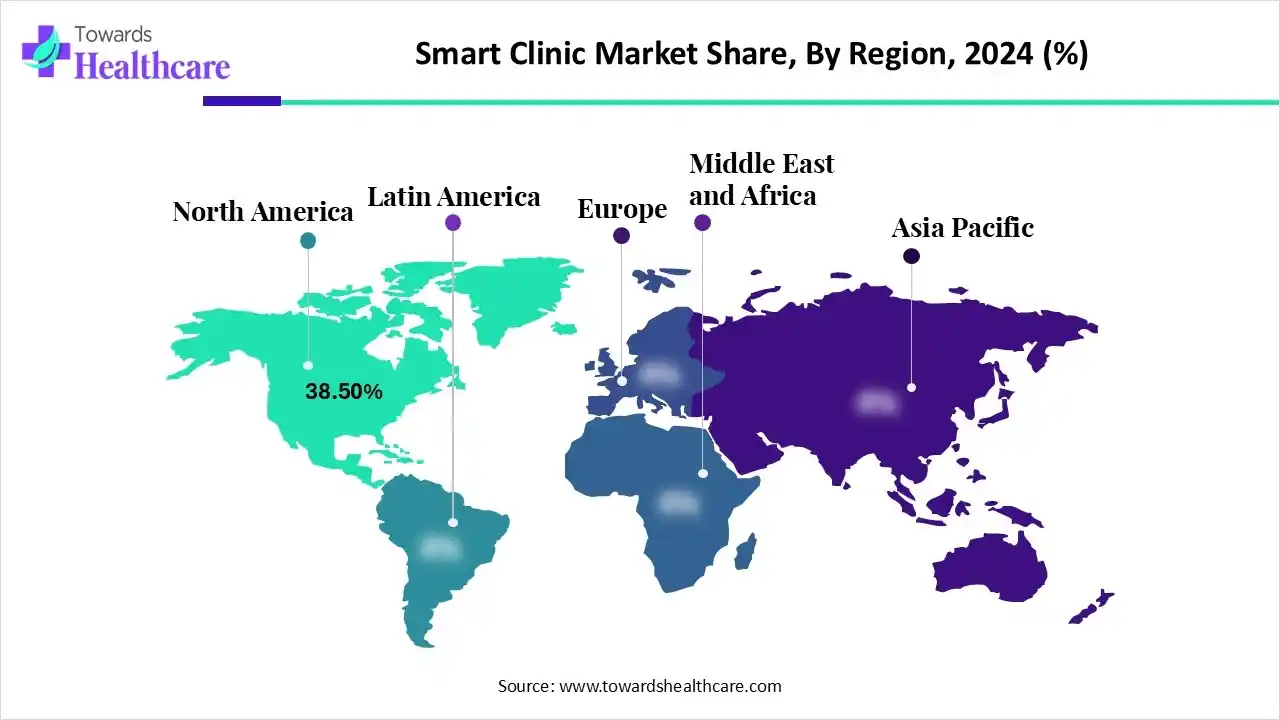
North America (leader: 38.5% in 2024)
●Infrastructure maturity: Dense EHR footprint, interoperable APIs, payer acceptance accelerate smart clinic ROI.
●Policy tailwinds: Telehealth flexibilities through Sep 30, 2025; HRSA US$56M (2024) tech upgrades; CMS Rural Health funding (US$50B, 2025) supports access.
●Enterprise consolidation: Health systems scale cloud + hybrid stacks; strong cybersecurity and data-sharing frameworks.
Europe
●Funding scaffolding: EU RRF ~US$16.2B for digital health; EU4Health ~US$939M; Apply AI (~US$1.3B) catalyzes clinical AI.
●National enablers: DVG (Germany), NHS digital programs (U.K.) back EHR, RPM, and AI deployments.
●Focus: Interop, cybersecurity, and cross-border data services for pan-EU care coordination.
Asia Pacific (fastest growth)
●Scale drivers: Large underserved cohorts, mobile penetration, and cost-effective cloud lift adoption.
●Policy thrusts: India’s ABDM (national digital health IDs, telemedicine), startup funding momentum; China’s Internet-plus-Healthcare and EMR unification.
●Use-cases: Virtual primary care, specialist tele-consults, and community RPM hubs.
Latin America
●Access innovation: Colombia (Sep 2024) mobile smart clinic improves reach to rural communities.
●Digital focus: Telemedicine, e-pharmacy links, and AI triage to mitigate clinician shortages.
Middle East & Africa
●Hub projects: Fakeeh Smart Clinic (Dubai, Jul 2025) shows airport/free-zone on-prem + cloud orchestration.
●System transformation: Guyana (Mar 2025) multi-year upgrade bringing world-class access, with tech integration at scale.
Market Dynamics
Drivers:
●Telemedicine ubiquity (38.6% 2024 share), consumer demand for convenience.
●AI/ML momentum (24.7% CAGR), improving outcomes and throughput.
●Cloud dominance (63.2% 2024), enabling real-time multi-site data access.
●Policy & funding (U.S., Canada, EU; India ABDM) accelerating deployment.
Restraints:
●Data privacy/regulatory variance; need for hybrid architectures (fastest CAGR 27.5%) to localize sensitive data.
●Interoperability friction across legacy EHRs, devices, payers.
●Workforce readiness & change management (AI trust, training, scope of practice).
Opportunities:
●Home health expansion (21% CAGR segment) with RPM + virtual nursing.
●Services monetization (15.5% CAGR) via managed AI ops, integration, and analytics.
●Specialty smart lines (cardio/onc/ortho) with high acuity and ROI (19.8% CAGR).

Get a Sample of this Report
Smart Clinic Market
