

South America Life Science Analytical Instruments Market to Hit $2.67 Billion by 2033; Who’s Really Leading the Growth?

Why This Market Is Expanding Now
The region is shifting from basic healthcare systems to more research-driven ecosystems.
Countries are investing in labs, diagnostics, and drug development capabilities.
Key demand drivers include:
- Growing pharmaceutical manufacturing in Brazil and Argentina
- Increasing clinical testing and diagnostics demand
- Expansion of biotechnology and agricultural research
- Rising regulatory focus on product quality and safety
Analytical instruments alone contribute over 66% of total market revenue, proving how essential these tools are.
Global Market Growth
The global life science & analytical instruments market size is calculated at US$ 56.56 billion in 2024, grew to US$ 59.98 billion in 2025, and is projected to reach around US$ 101.31 billion by 2034. The market is expanding at a CAGR of 6.04% between 2025 and 2034.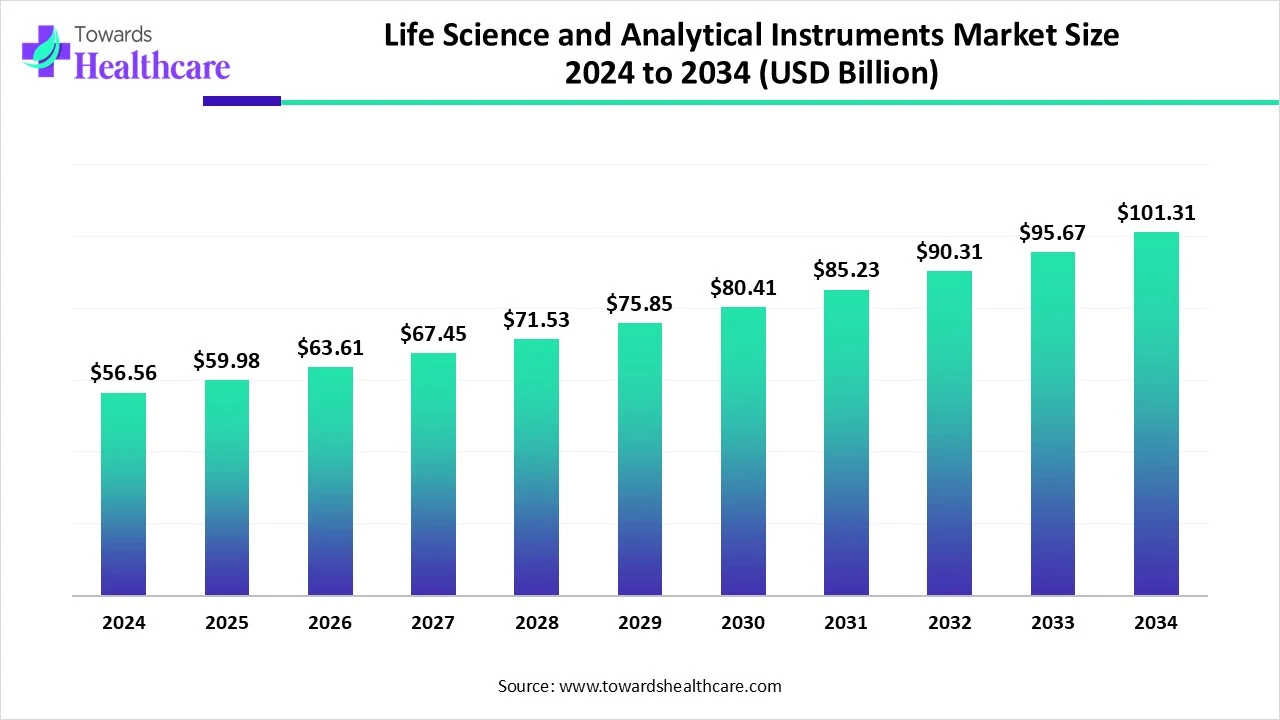
Brazil Dominates the Market Landscape
Brazil clearly leads the South American market.
It holds the highest demand due to strong healthcare infrastructure and rising R&D investments.
This dominance is supported by:
- Government-backed research programs
- A large pharmaceutical manufacturing base
- Expansion of biotech hubs like São Paulo
Brazil continues to account for the largest share and is expected to remain the growth engine of the region.
Real Companies Powering the Market
The market runs on a mix of global technology providers and regional pharmaceutical players.
While global firms dominate advanced instruments, local companies drive demand and adoption.
Global Leaders with Strong Presence
- Thermo Fisher Scientific – Revenue: $42.8+ billion (2024)
- Danaher Corporation – Strong in diagnostics and life science tools
- Agilent Technologies – Leader in chromatography and spectroscopy
- Bio-Rad Laboratories – Major player in clinical diagnostics
- Merck KGaA – Expanding life science distribution in the region
These companies dominate high-end instruments and large-scale contracts.
Key South American Companies & Revenue
Regional companies are not large instrument manufacturers, but they are key drivers of demand.
- Eurofarma (Brazil)
- Revenue: ~$1.1 billion
- Presence across Latin America and global markets
- Grupo EMS (Brazil)
- Estimated revenue: $1 billion+
- One of the largest pharmaceutical companies in Brazil
- Biomm (Brazil)
- Focused on biotechnology and insulin production
- Growing rapidly due to biologics demand
- Laboratorio Bagó (Argentina)
- Estimated revenue: $700–900 million
- Strong in pharmaceuticals and research collaborations
These companies increase demand for analytical instruments through manufacturing, testing, and R&D activities.
Market Structure: A Balanced Competitive Landscape
The market is moderately consolidated.
- Top global companies control around 45–50% of total revenue
- Regional players dominate distribution and service networks
- High-end instruments are mostly imported
This creates a dual ecosystem where global innovation meets local demand.
Where Is the Revenue Coming From?
Different applications contribute differently to the market.
Major revenue contributors:
- Clinical diagnostics – Largest share
- Pharmaceutical manufacturing – High-value segment
- Research and academia – Fastest-growing segment
Fast-growing segments:
- Bioprocess analyzers
- $133 million (2024) → $232 million (2033)
- CAGR: 6.4%
- Bioanalytical testing services
- $188 million (2024) → $398 million (2033)
- CAGR: 8.7%
This shows a strong shift toward advanced testing and precision medicine.

Get a Sample of this Report
South America Life Science Analytical Instruments Market
