

Specialty Medical Chairs Market Growth, Forecast, Trends and Latest Insights 2025

Market-size
Historical / baseline numbers (anchor points)
◉2024 market size (reported): USD 4.77 billion.
◉2025 market size (reported): USD 5.12 billion.
Forecast headline
◉2034 projected market size: USD 9.77 billion; CAGR 2025–2034 = 7.43%.
Yearly totals reconstructed from product breakdown (consistency check)
◉Calculated totals from the provided product-series (Examination + Rehabilitation + Treatment chairs) produce:
2024 4.77B, 2025 5.12B, 2026 5.50B, 2027 5.91B, 2028 6.36B, 2029 6.83B, 2030 7.34B, 2031 7.88B, 2032 8.47B, 2033 9.09B, 2034 9.76B.
◉Note: the derived 2034 total (9.76B) differs by 0.01B from the stated 9.77B — this is attributable to rounding in sub-segment figures; both numbers are consistent within rounding precision.
Growth pattern interpretation
◉The market exhibits a steady, mid-single-digit to low-double-digit expansion year-on-year. Growth accelerates in absolute dollars after 2029 (the total increases by larger absolute amounts as the base grows).
◉The rehabilitation chairs subseries is the largest contributor to total value and thus the main engine of absolute market expansion.
Value drivers behind the monetary growth
◉Demographic expansion (global ageing), higher prevalence of chronic disease, increased outpatient and rehabilitation care, faster uptake of premium/automated chairs and hospital capital spending (explicitly cited increases in government health capital spending).
Market trends
Demographic and clinical demand trends
◉Ageing population: WHO/statistics cited—60+ population rising sharply (from 900M in 2015 to ~2B by 2050) — increases demand for geriatric and long-term care seating.
◉Chronic disease prevalence: More patients with diabetes, cardiovascular disease, cancer and musculoskeletal disorders require recurrent procedures and rehabilitative seating.
Product evolution and technology adoption
◉Advanced/automated chairs: Increasing introduction of motorized adjustment, pressure-relief designs and digitally integrated delivery systems (example: A-dec 500 Pro / 300 Pro).
◉Digitally integrated dental & surgical chairs: suppliers adding digital workflows and integrated delivery units — trend toward software + chair bundles.
Service-setting shifts
◉Hospitals remain largest end-use (2024) due to acute care, surgeries and post-surgical rehabilitation needs.
◉Clinics/outpatient growth: Faster % growth forecast for clinics driven by outpatient surgery growth, specialized clinics (dental, ophthalmic, physiotherapy) and cost-efficient care models.
◉Regional investment & policy trends
◉Increased government capital spending (examples: India Union Budget 2025–26; UK health capital increase; Newfoundland & Labrador investments) — supports procurement of advanced chairs.
◉International aid/aid logistics example: RNZAF delivering specialized chairs to Samoa (shows philanthropic/aid channel demand).
M&A, distribution and investment activity
◉Strategic acquisitions and investments (Nakanishi → DCI; Foresight → DP Medical Systems; Infinium Medical + Lemi MD distribution) reflect consolidation and distribution expansion to capture regional demand.
Price / affordability pressure
◉High cost of premium chairs (cited EUR 4,000–8,000 for some intensive-care chairs) restrains adoption in price-sensitive markets and pushes demand for lower-cost alternatives or refurbished units.
Adjacency and substitution
◉Competition from stretchers, standard exam chairs and electric wheelchairs — rising acceptance of electric mobility devices is both an opportunity and a substitute threat depending on application.
Role & impact of AI / ML
Patient-centric real-time positioning
◉AI-driven controllers can ingest sensor streams (pressure maps, patient posture, vitals) to automatically adjust chair angle, back/leg support and headrests to prevent pressure ulcers, optimize surgical access angles, and maximize comfort without manual intervention.
Personalization & patient profiling
◉ML models trained on patient anthropometrics, clinical condition, and prior preference histories can create personalized seat-profiles (auto recall for recurring patients) — improving throughput and reducing setup time.
Predictive maintenance & uptime optimization
◉Telemetry + ML anomaly detection predicts motor, actuator, or electronics failures before breakdown; schedules preventive maintenance, reducing downtime for high-utilization hospital chairs and lowering total cost of ownership.
Surgery-grade precision positioning
◉For chairs/tables used in procedures (ophthalmic, dental, ambulatory surgery), AI can provide micro-adjustments aligned to surgical robot movements or imaging guidance — enhancing ergonomic access and reducing procedure time.
Manufacturing & supply-chain improvements
◉AI optimizes production scheduling, demand forecasting, and parts sourcing (reducing lead times); generative design can suggest lighter/stronger structural components for chairs at lower material cost.
Clinical decision support integration
◉Chairs that communicate with EHRs/monitoring systems can adjust based on patient vitals (for example: raise head at signs of respiratory distress), and report usage metrics back to clinical teams.
Adaptive user interfaces & accessibility
◉Voice-enabled, ML-driven UIs and simplified control flows help staff (and patients with disabilities) operate complex chairs safely with minimal training.
Regulatory and safety validation
◉AI systems will require clinical validation; explainable ML and traceable logs will be needed to satisfy procurement and regulatory scrutiny — a short-term barrier but long-term differentiator for compliant vendors.
Market implications
◉Premiumization: AI features command price premiums, shifting average selling prices upward (supports higher market value).
◉New revenue streams: Predictive maintenance subscriptions, software licenses, and analytics-as-a-service create recurring revenue beyond hardware sales.
Regional insights
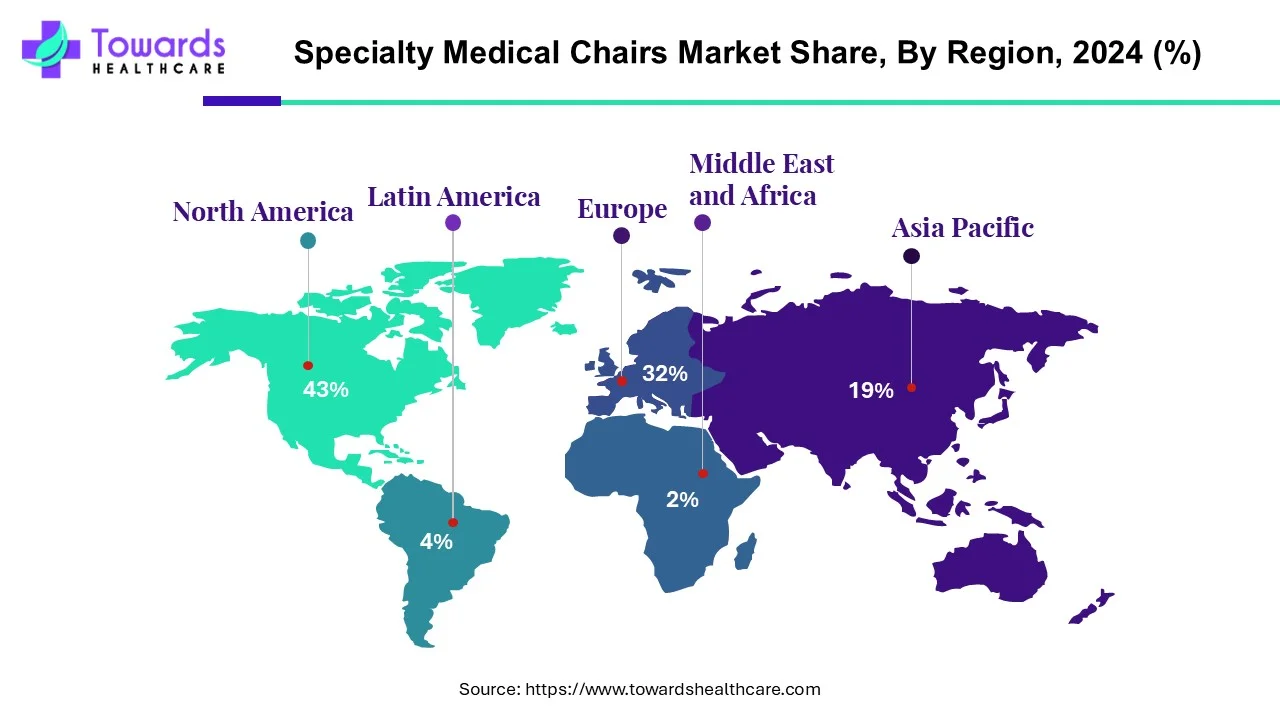
North America (dominant: 43% share in 2024)
Drivers
◉Large elderly population increase (U.S. 65+ projected +47% by 2050 from PRB data), robust reimbursement frameworks, high hospital budgets.
Capabilities
◉Strong presence of major OEMs, dense installed base of high-end chairs, rapid uptake of AI/automation features.
Challenges
◉High labor and purchase costs; procurement focus on ROI and regulatory compliance.
Implication
◉Market leader by value; largest share of premium/advanced chairs and software services.
Europe
Drivers
◉Mature healthcare systems, strong outpatient procedural volumes, emphasis on patient safety and comfort.
Capabilities
◉High adoption of advanced technologies; public procurement programs fund modernization.
Variation
◉Northern/Western Europe faster to adopt premium models; some Eastern markets more price sensitive.
Implication
◉Stable high-value market with regulatory scrutiny and strong demand for durable, certified equipment.
Asia-Pacific (fastest growth predicted)
Drivers
◉Rapid population growth, rising healthcare expenditure, growing middle class, increasing surgical volumes and road-traffic injuries.
Capabilities
◉Rapid hospital expansion and home-care services; mixed maturity — China and India are key growth engines.
Challenges
◉Price sensitivity in many markets forces OEMs to offer tiered products or localization strategies.
Implication
◉High absolute volume growth opportunity; demand for mid-to-high tier chairs and localized manufacturing/distribution.
Latin America
Drivers
◉Growing geriatric cohort, increasing medical tourism, rising healthcare spend in large markets (Brazil, Mexico).
Constraints
◉Budget constraints and uneven distribution of advanced care; reliance on multinational suppliers for premium units.
Implication
◉Growing replacement and new-installation market; potential for used/refurbished equipment trade.
Middle East & Africa
Drivers
◉Selective government investment in large hospital projects; Gulf states as premium buyers.
Constraints
◉Many countries are price sensitive with fragmented procurement; logistics and maintenance networks can be weak.
Implication
◉Patchwork market—niche premium demand (GCC) and slower growth elsewhere.
Market dynamics
Drivers (detailed)
◉Ageing population: Larger 60+ and 80+ cohorts increase long-term care and procedural volumes; WHO projections cited (60+ doubling toward ~2.1B by 2050).
◉Rising chronic disease burden: More dialysis, oncology, cardiology, and rehabilitation cases → higher seat/therapy chair demand. (U.S. example: ~129M people with at least one chronic condition.)
◉Technology premiumization: Adoption of automated/digital chairs with AI/ML, pressure-management and integrated delivery systems increases both unit value and replacement cycles.
◉Government capital spending: Documented increases in public capital (India budget, UK New Hospital Programme, regional investments) fuel procurement.
Restraints (detailed)
◉High unit cost of premium chairs: High-end models (EUR 4k–8k) limit adoption in low-income settings.
◉Maintenance & total cost of ownership: Ongoing service contracts and part replacement costs deter some buyers.
◉Awareness & training: Clinical staff unfamiliarity with advanced features reduces utilization and perceived value.
Opportunities (detailed)
◉Electric mobility convergence: Growing acceptance of electric wheelchairs and IoT sensors creates cross-sell and platform opportunities (Invacare example).
◉Home healthcare expansion: Demand for comfortable, safe chairs for home infusion, dialysis, and long-term care.
◉Software & service revenue: Predictive maintenance, remote monitoring, and analytics subscriptions as recurring revenue.
◉Emerging-market penetration: Tiered products and localized manufacturing to capture APAC and LATAM growth.
Top companies
A-dec, Inc.
◉Product focus: Dental chairs and digitally integrated delivery systems (A-dec 500 Pro / 300 Pro).
◉Overview: Established dental equipment OEM with product lines integrating ergonomic chairs and delivery units.
◉Strengths: Strong dental market brand, integrated digital workflows, North American distribution and service footprint.
ActiveAid, Inc.
◉Product focus: Specialized seating and pressure-relief chairs (rehab focus).
◉Overview: Rehab seating specialist targeting geriatrics and bariatric segments.
◉Strengths: Niche rehab expertise and product customization.
DentalEZ, Inc.
◉Product focus: Dental chairs and dental delivery systems.
◉Overview: Longstanding dental equipment vendor.
◉Strengths: Product reliability for dental clinics; broad clinic channel penetration.
Fresenius Medical Care AG & Co. KGaA
◉Product focus: Dialysis chairs and systems.
◉Overview: Global leader in dialysis solutions; chairs form part of integrated offering for dialysis centers.
◉Strengths: Deep clinical domain knowledge in dialysis, global service network, strong purchasing relationships with dialysis centers.
Topcon Corp.
◉Product focus: Ophthalmic chairs and ophthalmic equipment integration.
◉Overview: Optical/ophthalmic systems vendor offering chairs as part of wider ophthalmic suites.
◉Strengths: Clinic workflow integration, ophthalmology domain expertise.
Midmark Corp.
◉Product focus: Examination chairs, surgical chairs, treatment seating and medical-furniture solutions.
◉Overview: Broad clinical furniture and equipment OEM with manufacturing and educational outreach (e.g., WCOMP partnership).
◉Strengths: Strong OEM reputation, cross-product bundles for clinics/hospitals, emphasis on local partnerships.
Danaher (KaVo Dental GmbH)
◉Product focus: Dental chairs and instruments (KaVo brand).
◉Overview: Large diversified medical technology conglomerate; KaVo an established dental brand within Danaher.
◉Strengths: R&D resources, distribution scale, strong dental brand equity.
Dentsply Sirona
◉Product focus: Dental chairs and integrated dental solutions.
◉Overview: Global dental OEM with comprehensive product portfolio.
◉Strengths: Market reach in dental clinics, innovation in dental equipment.
Planmeca Oy
◉Product focus: Dental and imaging integrated chairs.
◉Overview: Finland-based dental equipment innovator with imaging and chair combos.
◉Strengths: Integrated imaging + chair solutions, strong European presence.
Hill Laboratories Company (and similar regional players)
◉Product focus: Hospital beds and specialty seating (varies by company).
◉Overview: Industrial / medical furniture manufacturers serving hospitals.
◉Strengths: Hospital procurement relationships, capability to supply large projects.
Rahab Seating Systems Inc.
◉Product focus: Rehabilitation and specialty seating for bariatric/pediatric/geriatric users.
◉Overview: Specialty seating OEM for rehab markets.
◉Strengths: Niche product engineering and customization.

Get a Sample of this Report
Specialty Medical Chairs Market
