

Spine Biologics Market Shares, Size, Growth and Industry Reports 2034

Market Size
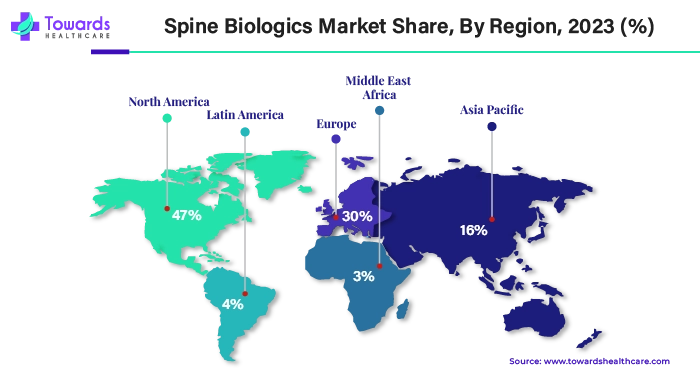
2023 Market Share by Region:
North America: 47% of the market share.
Asia Pacific: Expected to grow at the fastest rate during the forecast period.
Europe, Latin America, and MEA: Show steady growth, particularly in the UK, Germany, and India.
Product Breakdown (2023):
Spinal Allografts: Dominated the market in 2023.
Bone Grafts & Substitutes, BMP, and Synthetic Bone Grafts: Holding significant shares, with strong growth expected in the coming years.
End-Use Breakdown (2023):
Hospitals: Dominated the market as the primary care setting.
Outpatient Facilities: Expected to grow rapidly from 2024-2033 due to cost-effectiveness and efficient care options.
Projected Market Growth (2025-2034):
From USD 4.65 billion in 2025 to USD 7.34 billion by 2034.
Market Trends
Rising Incidence of Spine Disorders:
The increasing prevalence of spinal disorders such as degenerative disc disease and spinal fractures is driving the demand for biologics.
Aging populations, sedentary lifestyles, and job-related risks contribute to higher incidences of spinal conditions.
Technological Advancements:
3D printing and nanotechnology are improving bone regeneration methods.
The development of bioactive materials and stem cell therapies for spine repair is transforming orthopedic surgery.
Shift Towards Minimally Invasive Surgeries (MIS):
MIS techniques are gaining traction for treating spinal disorders due to faster recovery times and reduced patient complications.
Regenerative Treatments:
There is increasing demand for spinal biologics such as stem cell therapies and growth factor treatments to support tissue regeneration.
Focus on Biologics Over Traditional Bone Grafts:
Spinal biologics offer significant advantages over traditional methods (autografts and allografts) due to better safety profiles and enhanced healing properties.
Favorable Healthcare Policies:
Government support in regions like North America and Europe, including reimbursement policies for biologic treatments, is encouraging market growth.
AI Impact or Role in Spine Biologics Market
Advanced Diagnostics:
AI-driven diagnostic tools can help in early detection of spinal conditions, leading to better-targeted biologic treatments.
Predictive Analytics for Treatment Outcomes:
AI can analyze patient data to predict the effectiveness of specific biologic treatments, leading to personalized care.
Robotic-Assisted Surgeries:
AI-powered robotic systems can assist in spinal surgeries, enhancing precision in biologic implants, especially in minimally invasive procedures.
AI in Biomaterial Development:
AI can accelerate the design of new biomaterials for spine regeneration by simulating and testing the effectiveness of different materials.
AI in Drug Discovery:
AI is playing a role in discovering and optimizing new biologic drugs, including growth factors, that target spinal repair.
Smart Implants and Devices:
AI-enabled implants that monitor healing and adjust biologic drug delivery to enhance recovery are emerging in the market.
AI in Rehabilitation:
AI-based rehabilitation tools can assess patient recovery and recommend adjustments to biologic treatment plans based on real-time data.
Supply Chain Optimization:
AI helps in forecasting demand, improving production logistics, and ensuring the timely delivery of biologic implants and materials.
AI in Research & Development:
AI algorithms analyze vast amounts of data from clinical trials and scientific literature, accelerating the R&D process for new biologic therapies.
AI-Powered Patient Monitoring:
Wearable AI devices can monitor patients’ recovery post-surgery and track biologic treatment progress, offering real-time updates to healthcare providers.
Regional Insights
 North America:
Market Share: 47% (2023).
Key Drivers: High patient base, advanced healthcare infrastructure, rapid adoption of new technologies.
Growing Prevalence: Increasing incidence of spinal cord injuries (SCI) and degenerative spine conditions.
Example: The U.S. has about 335 million people and sees approximately 18,000 new traumatic spinal cord injury cases annually.
Asia Pacific:
Fastest Growing Region: Driven by a large patient population and improving healthcare systems.
Key Growth Factors: Rising spinal injuries from accidents, increasing awareness of biologics, growing healthcare infrastructure, and rising obesity rates due to sedentary lifestyles.
Key Countries: India shows the highest growth, with more than 200,000 spinal injury cases annually.
Europe:
Market Growth: Germany and the UK are leading due to rising demand for biologic treatments and strong healthcare R&D investments.
Key Trend: Germany’s aging population and high spinal injury rates are pushing the demand for spine biologics.
Market Dynamics
Drivers:
Increasing spinal diseases and degenerative conditions.
Advancements in regenerative medicine (e.g., stem cells, 3D printing).
Growth in the adoption of minimally invasive surgical procedures.
Restraints:
Allograft Limitations: Risk of infection (HBV, HCV) and loss of osteogenic potential due to sterilization.
Opportunities:
3D Printing & Nanotechnology: Opportunities to create more effective and safer biologics.
Rising Demand in Emerging Markets: Rapidly developing healthcare sectors in regions like APAC are creating new growth opportunities.
Threats:
Regulatory challenges and complexities in biologic approval.
High cost and complex production of biologics compared to traditional treatments.
Top 10 Companies in Spine Biologics Market
Kuros Biosciences:
Product: Biologics for bone healing.
Strength: Innovative biomaterial products for regenerative medicine.
NuVasive, Inc.:
Product: Spine biologics and surgical products.
Strength: Advanced technology in spine surgeries.
Zimmer Biomet:
Product: Spine fusion devices and biologics.
Strength: Strong product portfolio and R&D.
Orthofix:
Product: Bone grafting solutions and biologics.
Strength: Strong focus on regenerative medicine.
DePuy Synthes (Johnson & Johnson):
Product: Bone grafting substitutes, biologics.
Strength: Market leader with extensive global reach.
Medtronic:
Product: Spine biologics and fusion technologies.
Strength: Extensive R&D, including acquisitions like Nanovis.
Arthrex, Inc.:
Product: Spine biologics and minimally invasive surgical instruments.
Strength: Innovative orthobiologic products.
Exactech, Inc.:
Product: Bone biologics for spine treatments.
Strength: Advanced technology in orthopedic devices.
Biocomposites:
Product: Bone regeneration products.
Strength: Focus on cutting-edge biologics.
Organogenesis Inc.:
Product: Regenerative biologic solutions for spine and other orthopedic treatments.
Strength: Focus on tissue regeneration.

Get a Sample of this Report
Spine Biologics Market
