

Sports Medicine Market Shares, Size and Industry Reports 2034

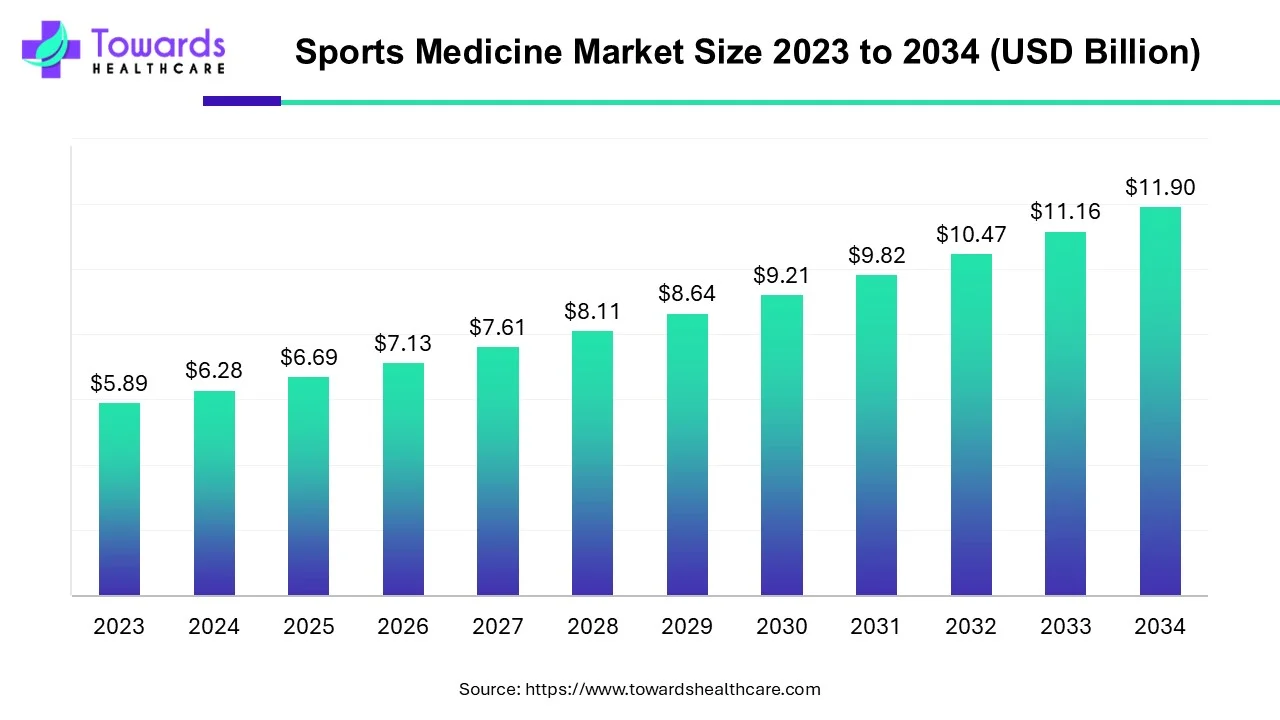
Market size (deep, point-wise)
Baseline & horizon
➣2025: USD 6.69 B (model base year provided).
➣2034: USD 11.90 B at 6.6% CAGR.
Year-by-year trajectory (CAGR 6.6%)
➣2025: 6.69 B
➣2026: 7.13 B
➣2027: 7.60 B
➣2028: 8.10 B
➣2029: 8.64 B
➣2030: 9.21 B
➣2031: 9.82 B
➣2032: 10.46 B
➣2033: 11.16 B
➣2034: 11.90 B
Incremental value creation
➣Absolute addition 2025→2034: USD 5.21 B.
➣Mid-horizon (2029–2031) adds USD 1.18 B as installed robotics, orthobiologics, and rehab tech scaling kicks in.
Volume drivers mapped to value
➣Injury burden: U.S. 3.5 M injuries/year; Johns Hopkins notes >3.5 M injuries in under-14s with 775k ER visits—sustains high utilization of braces, arthroscopy, and ligament repair.
➣Elite events & surveillance data: Beijing 2022 reported 2.4% injuries and 3.1% illnesses among participants—evidence base pushing prevention & rapid-return protocols.
➣Participation tailwinds: U.S. 242 M people (80% aged ≥6) engaged in sport/fitness in 2023; EU sports employment 1.55 M (0.76% of total) supports service capacity growth.
Market trends
Shift to reconstruction & minimally invasive
➣Body reconstruction products led with 41% share (2023); continued mix-shift to arthroscopy, soft-tissue repair (e.g., ACL repair kits) and patient-specific implants.
Knee remains the epicenter
➣32% of market tied to knee injuries (2023); adoption of robotic-assisted TKA (e.g., Mako), advanced ACL repair systems, and AI-guided rehab pathways.
Robotics & navigation scaling
➣>1,000 Mako robots deployed by 2021 enabling >500k procedures; 2023 launch of Mako Total Knee 2.0 adds analytics + haptics; accelerates premium procedure mix.
Wearables & continuous monitoring mainstream
➣WHOOP Strap 4.0 (2023) and smart textiles inform load management, return-to-play decisions, and payer-acceptable outcomes tracking.
Orthobiologics & regenerative medicine
➣Rising use of PRP and stem-cell-based protocols to complement surgical repair, shortening recovery windows for tendons/ligaments.
Tele-sports-medicine & hybrid rehab
➣Remote consults, app-based PT, and AI triage widen access—critical for youth and community athletics with high injury incidence.
Pediatric & adolescent focus
➣FDA-cleared pediatric solutions (e.g., Arthrex TightRope for kid ACLs) mirror high injury rates in <14 cohort; tailored protocols growing.
Institutional expansion
➣New centers (e.g., Ochsner Andrews Institute 2024; Delhi Sports Injury Center 2024) expand multidisciplinary capacity.
Policy & programs fueling activity
➣U.S. President’s Council on Sports, Fitness & Nutrition renewed through Sept-2025; Canada’s Sport Canada investments; China’s Healthy China 2030 ISM strategy; India athlete welfare funds—all stoke participation and care demand.
Cost pressure & affordability innovation
➣With doctor visits USD 100–200, imaging USD 500–2,000, surgeries USD 5k–50k+, providers push value-based bundles, outpatient ASC shift, and digital-first rehab to contain OOP spend.
AI’s role & impact
➣Injury risk prediction: Models blend workload (GPS, wearables), biomechanics, sleep, and prior injuries to calculate individual risk; flags overtraining before tissue failure.
➣Imaging triage & precision diagnosis: AI on MRI/CT/US detects meniscal tears, rotator-cuff pathology, stress fractures; reduces reading times and variability; speeds surgical planning.
➣Robotics optimization: Intra-op AI refines implant alignment and soft-tissue balance (e.g., haptic envelopes + analytics in robotic TKA) → better function, fewer revisions.
➣Personalized rehab: Computer-vision verifies home-exercise form; adaptive protocols adjust intensity; digital twins simulate healing trajectories.
➣Return-to-play decision support: Multivariate thresholds (strength symmetry, hop tests, proprioception, GPS metrics) algorithmically scored to reduce re-injury risk.
➣Tele-PT automation: Chat- and voice-based “PT copilots” deliver cues, adherence nudges, pain-flare routing; lowers therapist load and expands access.
➣Surgical workflow analytics: OR video + instrument telemetry mined to benchmark steps, reduce operative time, and standardize training.
➣Orthobiologics response modeling: Predicts which patients benefit from PRP vs. grafts; optimizes injection timing and dosing windows.
➣Population health & prevention: School and club data lakes surface hot spots (e.g., turf injuries); guide rule changes, gear mandates, and targeted prehab.
➣Revenue cycle & value proof: Auto-extracted outcomes (PROMs, activity data) support payer authorization and bundled-payment justification; reduces denials.
Regional insights
North America (42% share in 2023)
Subpoints
➣Infrastructure density: High concentration of sports medicine institutes, ASCs, and team-affiliated clinics enables rapid referral and advanced care (robotics, arthroscopy).
➣Procedure premiumization: Strong uptake of robotic TKA/THA, advanced ACL repairs, and orthobiologics increases ASPs and case complexity.
➣Participation base: 242 M active participants (2023) sustain steady injury-driven demand; youth sports a major funnel.
➣Implication: Largest revenue pool; payers drive outcomes-based models and remote rehab to manage costs.
Europe
Subpoints
➣Workforce scale: 1.55 M employed in sports sector (2023) underpins multidisciplinary services.
➣Elite club integration: Pro leagues embed on-site imaging/rehab, pushing fast-track protocols into community care.
➣Access parity focus: Public systems emphasize prevention and post-op rehab adherence to reduce re-injury rates.
➣Implication: Stable demand with strong prevention budgets and structured rehab pathways.
Asia Pacific
Subpoints
➣Participation surge: Urbanization + mega-events expand amateur sport; culturally diverse needs (cricket, martial arts) diversify injury patterns.
➣Policy catalysts: China’s ISM / Healthy China 2030 integrates sport & medicine; India’s welfare funds provide pensions and medical support for sportspersons.
➣Capacity build-out: New centers and tele-rehab platforms scale access across metros and tier-2 cities.
➣Implication: Fastest relative growth; significant upside in wearables, tele-PT, and cost-effective implants.
Latin America
Subpoints
➣Grassroots growth: Football-led participation with rising private clinic chains.
➣Cost sensitivity: Strong demand for durable, lower-cost braces/supports and outpatient arthroscopy.
➣Implication: Value-tier products and remote coaching models win.
Middle East & Africa
Subpoints
➣Event-driven investment: Sports cities and elite academies spur top-end facilities.
➣Workforce training gap: Partnerships with global brands to upskill PT and ATC staff.
➣Implication: Early-stage but premium niches (elite rehab tourism) emerging.
Market dynamics
Drivers
➣High and rising injury incidence: U.S. 3.5 M/yr injuries; >3.5 M injuries in under-14s (775k ER visits) sustain procedure + rehab volumes.
➣Technology adoption: Robotics (Mako), AI imaging, and wearables enhance outcomes and throughput.
➣Participation boom: U.S. 242 M active; EU sports employment base; APAC policy pushes.
Restraints
➣Cost barriers: Visits USD 100–200, imaging USD 500–2,000, surgeries USD 5k–50k+; delays care (Commonwealth Fund noted 41% adults deferred care over cost).
➣Stigma & delayed presentation: Athletes fearing bench time postpone treatment, complicating cases.
➣Workforce variability: Shortages of pediatric sports specialists in many regions.
Opportunities
➣ASC shift & same-day surgery: Lowers cost, increases capacity.
➣Tele-sports-medicine: Extends specialist reach; payer-friendly remote rehab.
➣Regenerative protocols & pediatric solutions: Address large unmet need cohorts (youth ACL, tendinopathy).
Contextual evidence
➣Beijing 2022 surveillance and WHOOP/robotics adoption illustrate tech-enabled prevention and faster recovery.
➣Institutional expansions in 2024 (U.S., India) increase addressable capacity.

Get a Sample of this Report
Sports Medicine Market
