

Telerehabilitation Systems Market Trends, Growth, Overview and Latest Updates 2025

Market size
Absolute values & trajectory
◉2024: USD 611.53 million (actual).
◉2025: USD 694 million (reported growth year-over-year).
◉2034 projection: USD 2,165.5 million.
◉Forecast window used for CAGR: 2025–2034 (projected 13.64% CAGR).
Growth shape and implications
◉Projected 3.1× increase from 2025 to 2034 (694 → 2,165.5), implying sustained market expansion and multiple waves of technology adoption (hardware → software → platform & AI services).
◉Rapid CAGR (13.64%) suggests both strong demand and significant white-space for new entrants (software, analytics, VR experiences, home-care integration).
Revenue concentration & component skew
◉Hardware dominated in 2024 with 45% revenue share — reflects capital intensity of sensors, VR kits and robotic rehab.
◉Cloud platforms led by technology share (38%) in 2024 — indicates large portion of value now captured by platform/connectivity services even as hardware leads in revenue.
Segment-level growth signals (size vs growth)
◉Hardware: large base (dominant revenue share) but expected slower CAGR than software.
◉Software: smaller base in 2024 but forecast to be the fastest-growing component over 2025–2034 (driven by subscriptions, analytics, remote monitoring, SaaS).
◉Therapy types: physical therapy largest in revenue (40% share 2024) while cognitive rehab shows the fastest projected growth (higher long-term CAGR).
End-use concentration
◉Rehabilitation centers captured biggest share in 2024 (42%) — they remain primary purchasers of integrated telerehab systems.
◉Homecare settings flagged as fastest-growing end use — consistent with trend of moving care out of clinics.
Regional weighting
◉North America accounted for 40% of market revenue in 2024 (largest single regional share).
Market trends
Shift from hardware dominance to software/platform monetization
◉2024: hardware 45% revenue share (large upfront purchases).
◉Trend: software & cloud to capture more share (recurring revenues, analytics, AI modules).
Virtual/AR & immersive therapies accelerating
◉VR/AR led tech adoption in 2024 in value terms (cloud platforms dominant, but VR/AR noted as fastest growth).
◉Use cases: gamified PT, cognitive rehabilitation, exposure-based pain management.
Homecare & decentralization of rehab
◉Rehab centers still dominant (42%), but homecare is fastest-growing due to lower cost, better adherence, and family involvement.
AI & analytics integration
◉AI is being embedded to personalize therapy, predict outcomes, and automate clinician workflows (see dedicated AI section below).
Wearables & IoMT convergence
◉Wearable motion sensors and connected devices are key hardware drivers, enabling real-time feedback and remote monitoring.
Regulatory & standards activity
◉WHO/ITU improvements to OpenTeleRehab and policy updates (e.g., Medicare telehealth extensions) lower barriers and standardize approaches.
Regional investment & pilot programs
◉North America: mature adoption and reimbursement experiments.
◉Asia-Pacific: fastest projected growth spurred by digital health initiatives, government programs (e.g., India Tele MANAS) and event-driven acceleration.
Funding & startup activity
◉Seed and growth funding examples: XCLR8 Technologies, Strolll, Rebee Health — indicating investor interest in wearables, AR, and digital physiotherapy.
Reimbursement & infrastructure remain gating factors
◉While adoption is strong, inconsistent reimbursement and connectivity issues restrain uniform deployment.
AI’s impact/role in the telerehabilitation market
Personalized therapy plans
◉AI models ingest sensor data (motion, biometrics), historical progress and clinical inputs to generate tailored exercise programs, adjust difficulty, and recommend session frequency.
◉Outcome: better adherence and faster recovery trajectories through dynamic adaptation.
Automated assessment & objective scoring
◉Computer vision + motion analytics provide objective range-of-motion and gait scores, reducing subjective clinician variability.
◉AI can flag deterioration or plateauing automatically for clinician review.
Predictive analytics for outcomes & risk
◉Predictive models estimate readmission risk, fall risk, or likelihood of adhering to treatment — enabling targeted interventions (e.g., extra remote check-ins).
Remote monitoring & anomaly detection
◉Continuous streaming from wearables allows anomaly detection (movement irregularities, arrhythmia signals when integrated with vitals), prompt alerts to clinicians/caregivers.
Natural language & conversational agents
◉AI-driven chatbots or voice assistants provide coaching, explain exercises, collect PROs (patient-reported outcomes), and triage issues — improving scale and 24/7 availability.
Clinical decision support & workflow automation
◉AI suggests progression criteria, generates progress notes and can populate EHR fields — saves clinician time and standardizes documentation for reimbursement.
Enhanced VR/AR experiences
◉AI adapts virtual scenarios in real time (difficulty, sensory cues) based on patient performance and cognitive state, making therapy both effective and engaging.
Data fusion & multimodal models
◉Combining video, sensor, historical clinical data and patient-reported measures gives robust patient models for personalization and longitudinal tracking.
Regulatory & safety validation
◉AI will necessitate explainability, validation datasets and clinical trials to satisfy regulators — creating a new layer of R&D and differentiation.
Business model transformation
◉AI enables value-based contracting (outcome-linked payments), predictive billing, and tiered subscription pricing (basic monitoring vs. AI-augmented care coordination).
Equity & accessibility considerations
◉AI models must be trained on diverse populations; otherwise bias could reduce efficacy in underrepresented groups — a key operational and regulatory risk.
Barrier reduction & scaling expertise
◉By automating routine assessment tasks, smaller clinics and homecare providers can deliver specialist-level rehab guided by AI, expanding access to underserved areas.
Regional insights
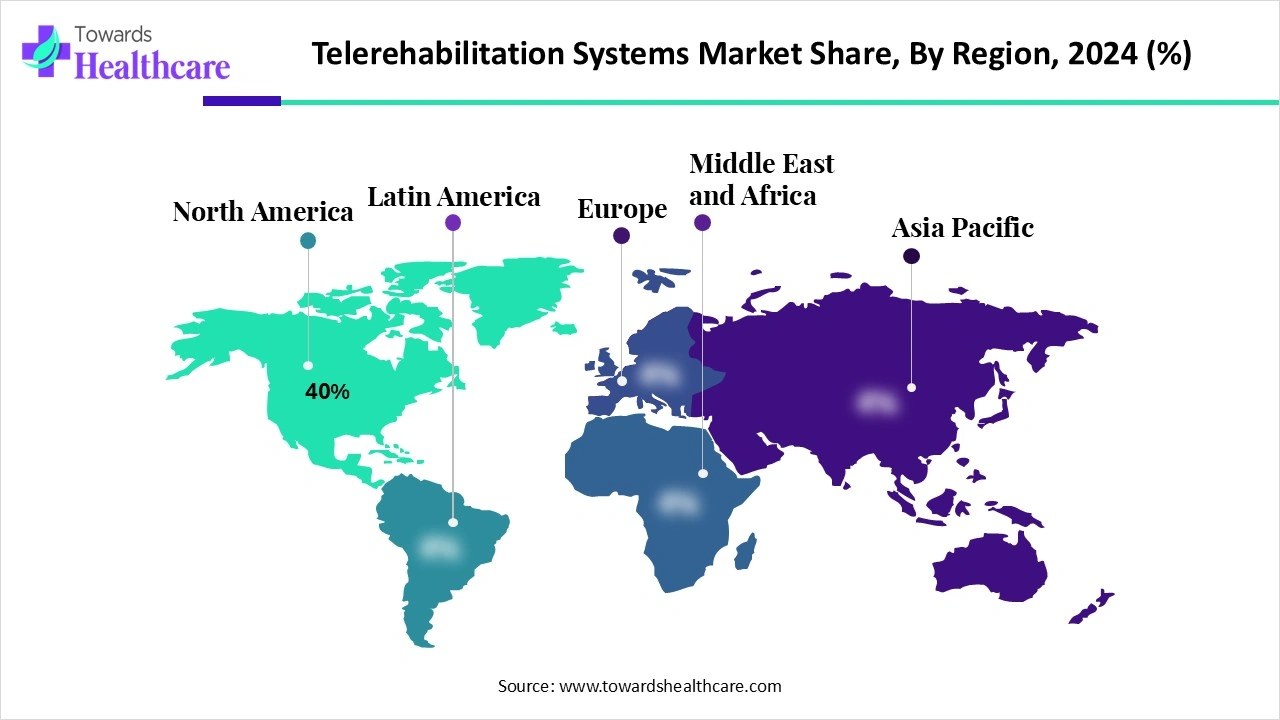
North America (dominant: 40% share in 2024)
Mature payer ecosystems & pilot reimbursement
◉Medicare policy extensions (e.g., telehealth for mental/non-behavioral care to Sept 2025) reduce reimbursement uncertainty — encourages provider adoption.
Technology & infrastructure readiness
◉High broadband penetration and sophisticated clinical IT enable integrated platforms and remote monitoring scale.
Commercialization & enterprise adoption
◉Large rehabilitation centers and hospitals are primary purchasers; enterprise deals (hardware + platform + service bundles) dominate revenues.
Innovation & capital flows
◉Homegrown startups + established med-tech firms compete, with strong VC and corporate investment fueling R&D (AI, VR).
Asia-Pacific (fastest growth projected)
High upside due to under-penetration
◉Lower baseline adoption today → faster percentage growth as infrastructure and programs roll out.
Government programs & inclusion agendas
◉Examples: India’s Tele MANAS & first telerehab center (Sola Civil Hospital) show policy push to broaden access.
Cost sensitivity & homecare orientation
◉Affordability and family caregiving culture favor home-based telerehab and lower-cost sensor systems.
Localization & language challenges
◉Platforms must be localized (languages, cultural therapy preferences) — opportunity for local players.
Europe
Regulatory focus on standards & interoperability
◉EU eHealth initiatives and pilot programs (Germany, Sweden) encourage cross-border learning but create compliance overhead.
Aging population drives demand
◉Higher chronic disease load and long-term care needs sustain demand for remote rehab models and homecare integration.
Mixed payer models
◉Country-by-country reimbursement variability creates fragmented commercialization paths.
Latin America
Infrastructure gaps & concentrated urban uptake
◉Urban hospital systems can adopt telerehab, but rural regions limited by connectivity.
Growing private sector role
◉Private clinics and insurers will lead early adoption; public systems follow with pilots.
Middle East & Africa (MEA)
Selective centers of excellence
◉Adoption in urban tertiary centers; slower broad adoption due to broadband and reimbursement constraints.
Leapfrog potential
◉Mobile-first telehealth models can leapfrog traditional infrastructure if policy and investment align.
Market dynamics
Drivers
Rising remote care demand & aging populations
◉Aging demographics and chronic disease prevalence increase rehab needs; telerehab extends reach and continuity.
Technology convergence (wearables + cloud + AI + VR)
◉Combined systems allow objective monitoring, gamified therapy, and scalable clinician oversight.
Cost containment & hospital off-loading
◉Reduced readmissions and lower long-term care costs position telerehab as value-oriented solution.
Policy & standardization efforts
◉WHO/ITU improvements to OpenTeleRehab and national telehealth programs reduce regulatory friction and raise trust.
Restraints
Connectivity & infrastructure limitations
◉Poor internet in some regions undermines real-time monitoring and video fidelity.
Reimbursement uncertainty
◉Variable or temporary telehealth reimbursement (e.g., Medicare time-limited flexibilities) creates revenue risk for vendors.
Clinical acceptance & training
◉Clinicians need validated workflows and training to effectively interpret remote data and integrate telerehab.
Data privacy & security
◉Health data across cloud and devices increases compliance and cybersecurity costs.
Opportunities
Software & AI monetization
◉Shift from capital sales to SaaS/AI-as-a-service and outcomes-based pricing.
Homecare market expansion
◉Rapid growth in homecare settings as families and payers prefer decentralized care.
Cross-vertical partnerships
◉Alliances with insurers, EHR vendors, and device makers to embed telerehab in care pathways.
Emerging markets
◉Asia-Pacific’s rapid uptake and government initiatives (e.g., Tele MANAS in India) present scale opportunities.
Top companies
Reflexion Health
◉Product: Digital exercise/virtual rehab platforms (clinical content + remote monitoring).
◉Overview: Early mover in virtual physical therapy and clinician dashboards.
◉Strengths: Integrated clinician workflows, enterprise adoption, strong commercialization focus.
CoRehab srl
◉Product: Rehab software/hardware integration (motion capture + analytics).
◉Overview: Specialist in clinical motion analysis solutions.
◉Strengths: Clinical validation focus, strong hardware-software pairing.
Doctor Kinetic
◉Product: Remote physiotherapy platforms and patient engagement apps.
◉Overview: Focus on scalable clinician-to-patient teletherapy.
◉Strengths: Clinician usability and patient adherence tools.
Evolv Rehabilitation Technologies
◉Product: Robotics & sensor systems for rehab.
◉Overview: Hardware centric, targeted at specialized rehab centers.
◉Strengths: High-precision hardware and clinical workflows.
Jintronix Inc.
◉Product: Motion-tracking software and gamified rehab apps.
◉Overview: Consumer and clinical solutions for physical and neuro rehab.
◉Strengths: Gamification, strong software UX, and motion analytics.
Bridgeway Senior Healthcare
◉Product: Elder care and home-based telehealth integration.
◉Overview: Focus on senior care populations and continuity of care.
◉Strengths: Deep experience with geriatric workflows and homecare.
Hinge Health Inc.
◉Product: Digital musculoskeletal therapy programs (apps + coaching).
◉Overview: Employer/insurer focused digital therapy suite.
◉Strengths: Outcome-driven programs and payer partnerships.
GestureTek Health
◉Product: Gesture-based interactive therapy systems.
◉Overview: Motion interaction for engagement and therapy automation.
◉Strengths: Unique interaction modalities (gesture) for patient engagement.
Neuro Rehab VR
◉Product: VR applications for neurorehabilitation.
◉Overview: Immersive rehab for stroke, TBI and other neuro conditions.
◉Strengths: Immersive therapy, targeted cognitive and motor rehab programs.
MIRA Rehab Limited
◉Product: Gamified rehab platform using sensors and games.
◉Overview: Clinician-led remote therapy with progress metrics.
◉Strengths: Strong clinician tools and patient engagement.
Yaro Systems Ltd.
◉Product: Rehabilitation robotics / sensor suites.
◉Overview: Hardware plus software integrations for clinics.
◉Strengths: Robust device engineering and clinical focus.
SWORD Health
◉Product: Digital physical therapy with human-in-the-loop clinicians.
◉Overview: Combines sensors, clinician review and software programs.
◉Strengths: Strong payer and enterprise adoption strategy.
MindMaze SA
◉Product: Neurotechnology and immersive rehab platforms.
◉Overview: Advanced VR/brain-computer interface approaches.
◉Strengths: High-tech R&D and neurorehab specialization.
Kaia Health
◉Product: Digital therapeutic apps for musculoskeletal and COPD/mental health.
◉Overview: Evidence-based digital therapy programs.
◉Strengths: Clinical evidence orientation and direct-to-consumer channels.
Rehametrics
◉Product: Neuro & musculoskeletal rehab software.
◉Overview: Clinical tools for rehab centers and home use.
◉Strengths: Comprehensive therapy libraries and reporting.
Motek Medical
◉Product: Gait labs, motion platforms and robotic hardware.
◉Overview: High-end clinical hardware for specialized centers.
◉Strengths: Engineering excellence and institutionally focused solutions.
Hocoma AG
◉Product: Robotic gait trainers and rehab devices.
◉Overview: Established robotics player in rehab hardware.
◉Strengths: Strong clinical credibility, global distribution.
Virtualware Group
◉Product: VR development and enterprise VR solutions.
◉Overview: VR content and platform delivery for healthcare.
◉Strengths: Content production and customizable virtual scenarios.
Tyromotion GmbH
◉Product: Robotic and sensor-based neurorehabilitation hardware.
◉Overview: Clinic-grade robotic systems.
◉Strengths: Hardware reliability and clinical adoption.
XRHealth
◉Product: VR telehealth platform for clinics and patients.
◉Overview: Platform combining VR therapy and remote clinician oversight.
◉Strengths: Platform approach and VR therapeutic content.

Get a Sample of this Report
Telerehabilitation Systems Market