

U.S. Cell Therapy Market Redefines Healthcare, Crossing $9.77 Billion in 2026

Market size
U.S. market — yearwise (billions USD)
●2024: 6.62 (given)
●2025: 8.04 (given)
●2026: 9.77 (projected, CAGR applied)
●2027: 11.86
●2028: 14.41
●2029: 17.50
●2030: 21.25
●2031: 25.81
●2032: 31.35
●2033: 38.08
●2034: 46.26 (report target)
Global market — yearwise (billions USD)
●2025: 7.21 (given)
●2026: 8.82
●2027: 10.80
●2028: 13.21
●2029: 16.17
●2030: 19.79
●2031: 24.22
●2032: 29.64
●2033: 36.27
●2034: 44.39 (report target)
Market trends
●Autologous dominance (2023): autologous therapies dominated in 2023 because personalized, patient-sourced products (e.g., autologous CAR-T, autologous skin grafting, platelet-rich plasma) reduce immune-rejection risk and fit well into existing clinical workflows — this contributed to earlier revenue concentration in autologous products.
●Allogeneic fastest growth (forecast): allogeneic approaches (off-the-shelf cells from donors/iPSC sources) are forecast to grow fastest due to easier scaling, standardization, and the promise of lower per-patient cost once manufacturing is industrialized.
●Oncology remains the primary therapeutic anchor: oncology led in 2023 and is expected to remain dominant due to approved CAR-T products and a deep pipeline of hematologic and solid-tumor cell therapies.
●Clinical evidence accelerating (Apr 2025 signals): multiple April 2025 reports (Parkinson’s stem-cell trials in Nature; MD Anderson AIC100 safety/efficacy signals; new CAR-T CD30 therapy HSP-CAR30 showing durable responses; USC EchoBack CAR T activation technology) signal rising clinical validation which catalyzes investment and adoption.
●Manufacturing and platform innovation (example — Cytiva Sefia): platform solutions like Cytiva’s Sefia (with Kite/Gilead collaboration) are intended to reduce time and cost to make CAR-T and cell products — platformization is a major trend enabling scale.
●“Activation-on-demand” & local activation tech: technologies such as the EchoBack CAR T (ultrasound-activated) emphasize spatially-restricted activation to reduce off-tumor toxicity and improve safety profiles — this trend improves tolerability and broadens indications.
●Off-the-shelf product push: vendors and academic groups (e.g., trials of allogeneic T products and off-the-shelf PRP for veterinary use) indicate market appetite for standardized, inventory-based products.
●Expanded indications beyond oncology: neurological (Parkinson’s), regenerative and autoimmune indications are moving into trials — broadening TAM (total addressable market).
●Commercial & distribution expansion: specialty pharmacy and distribution moves (Walgreens Specialty Pharmacy) show commercialization/administration models evolving to support cell therapy logistics and payer engagement.
●Cost pressure & payer scrutiny: cell therapies remain expensive (>US$400k to >US$1M per patient), constraining access and pushing industry to pursue manufacturing cost reductions and novel reimbursement models.
AI will impact / play a role in the U.S. cell-therapy market
Automated process optimization (manufacturing yield & cost reduction)
●AI (ML models + real-time process analytics) tunes culture conditions, feed schedules and bioreactor parameters to maximize cell expansion/yield, shorten run times and reduce consumable use.
●Impact: lowers per-dose cost and addresses the “high cost of cell therapy” restraint you noted.
Predictive quality control & early failure detection
●Multimodal models (spectroscopy, imaging, process sensors) predict batch failures early, enabling early intervention or stop decisions, improving overall success rates and saving expensive downstream steps.
●Impact: reduces wasted runs and regulatory complications from out-of-spec lots.
Digital twins for scale-up and facility design
●Create virtual replicas of manufacturing runs to test scale/hardware changes in silico before committing to expensive GMP runs.
●Impact: accelerates platform adoption (e.g., Cytiva Sefia) and reduces capital risk.
Image-based cell phenotyping & potency assays
●Deep learning on microscopy/flow cytometry images automates phenotype classification, potency scoring, and detection of unwanted subpopulations (e.g., exhausted T cells).
●Impact: objective, faster release assays and improved batch consistency.
Optimizing CAR/TCR design and off-target prediction
●Generative models and in-silico screening propose optimized CAR constructs with predicted binding, signaling strength and minimized cross-reactivity.
●Impact: speeds preclinical design and reduces clinical failure risk.
Patient-matching & responder prediction
●Clinical ML models combining genomic, tumor, and immunophenotype data predict which patients are likely to respond or experience toxicity, enabling better trial stratification and payer negotiation.
●Impact: improves trial success rates and value proposition for payers.
Automated regulatory documentation & submission support
●NLP systems compile batch records, generate traceability reports, and prepopulate regulatory templates to accelerate IND/BLAs and QA audits.
●Impact: reduces administrative time and inspection risk.
Supply-chain forecasting and cold-chain optimization
●Predictive analytics optimize scheduling for apheresis, manufacturing slots, and cryo-logistics to minimize hold times and product loss.
●Impact: increases throughput and reduces logistics costs for autologous flows.
Clinical trial design & synthetic control arms
●AI helps find historical patients for synthetic controls, optimizes adaptive trial designs, and simulates population responses to improve trial efficiency.
●Impact: faster trials and lower development cost.
Real-world evidence (RWE) generation & post-market safety surveillance
●ML ingests EHRs, claims and registries to detect rare adverse events, durability signals, and long-term effectiveness—critical for payers and label expansions.
●Impact: supports reimbursement and label broadening, addressing long-term value concerns.
Regional insights (U.S.)
West Coast (California, Pacific Northwest)
●Research & clinical trial density: presence of UC San Diego (Alpha Stem Cell Clinic), numerous academic centers leads to early clinical trial activity and translational pipelines.
●Manufacturing & talent: strong cell-therapy process development talent; proximity to instrumentation and biotech vendors.
●Regulatory & commercialization support: biotech-friendly investor community and access to contract development/manufacturing (CDMO) partners.
Northeast (Boston / New England - implied)
●Dense VC & pharma partnerships: large concentration of biotech capital and strategic pharma partners accelerates early-stage companies and licensing deals.
●Clinical networks: prominent academic hospitals provide trial sites and translational research.
South (Atlanta, Texas, Southeastern hubs)
●Increasing clinical & transplant capacity: City of Hope Atlanta launch shows satellization of transplant/cell therapy programs into new regions, increasing procedural capacity for autologous transplants and CAR-T administration.
●Cost and access implications: expanding regional centers reduce patient travel burdens and broaden access to specialty care.
Midwest
●Manufacturing & logistics advantages: lower real estate/labor costs make the Midwest attractive for large-scale GMP facilities and distribution centers (cold chain).
●Workforce pipelines: technical workforce from regional universities supports manufacturing staffing.
Commercial logistics & specialty pharmacy coverage (nationwide)
●Specialty pharmacy expansion (Walgreens): national pharmacy chains building specialty capabilities facilitate reimbursement navigation, infusion/administration coordination, and patient support programs.
●Payer fragmentation across states: regional differences in Medicaid programs and private plans mean market uptake can be uneven — companies must build state-level market access strategies.
Market dynamics
Primary drivers
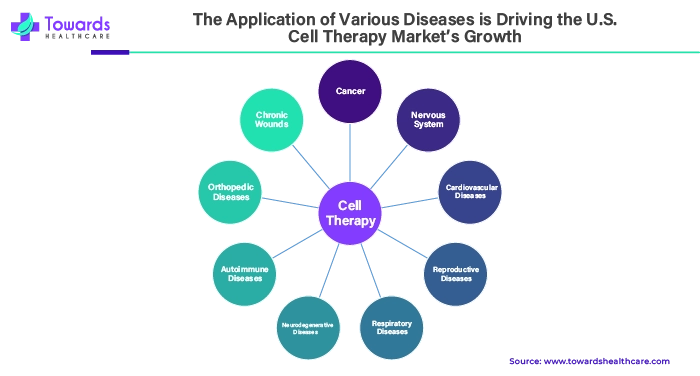
●High disease burden & unmet needs: cardiovascular disease, neurodegenerative diseases, autoimmune disorders and cancer present large patient pools (e.g., Alzheimer’s estimate 6.2M; Parkinson’s ~1M; autoimmune disorders up to 50M in US).
●Clinical validation in multiple indications: successful CAR-T approvals and the April 2025 trial signals in Parkinson’s and thyroid cancer expand clinical confidence.
●Platform & manufacturing innovations: systems like Cytiva’s Sefia and G-Rex manufacturing grants (Sidra Medicine) lower time-to-manufacture and open capacity.
Major restraints
●High per-patient cost and reimbursement pressure: typical prices >US$400k and sometimes >US$1M create payer resistance and access bottlenecks.
●Complex multi-step manufacturing (leukapheresis → genetic engineering → expansion → QC): cost, time and skilled labor requirements increase failure points and limit throughput.
Opportunities
●Allogeneic/off-the-shelf commercialization: scalable inventory models that reduce turnaround time and cost per dose.
●Expanded non-oncology indications (neuro, cardiac, autoimmune): large TAM if durable efficacy is shown.
●Partnerships between CDMOs, pharma and tech firms: accelerate adoption of standardized manufacturing platforms.
Threats & challenges
●Supply chain & raw material constraints: viral vectors, culture media and specialized disposables can constrain capacity and raise costs.
●Regulatory & manufacturing harmonization lag: inconsistent standards across facilities increase QA burden.
●Competition & pricing pressure: as off-the-shelf options emerge, price competition could compress margins.
Quantitative context
●U.S. market growth: from USD 6.62B (2024) to USD 46.26B (2034) at CAGR 21.46% (2025–2034) — indicates a large absolute expansion and investment opportunity despite current cost restraints.
●Oncology dominance: oncology already dominated 2023 and remains central to near-term commercial returns (CAR-T therapies and follow-ons).
Top 10 companies 
Aurion Biotech
●Overview: cell-therapy biotech (listed by you among top players).
●Products/pipeline: (not detailed in supplied content).
●Strength: early-stage innovation focus; likely nimble R&D capabilities.
Vertex Pharmaceuticals Incorporated
●Overview: large biopharma with strong 2024/2025 financial performance (you reported revenue growth).
●Products/pipeline: Vertex reported revenue growth and targets in 2025; active in cell/gene partnerships.
●Strength: strong corporate resources, proven commercialization experience and cash runway to support cell-therapy investments.
Cellular Biomedicine Group, Inc.
●Overview: cell therapy company (on your list).
●Products/pipeline: (not specified in content).
●Strength: cell therapy R&D focus and likely manufacturing experience in specific niches.
Nkarta, Inc.
●Overview: NK-cell engineering company (clinical-stage).
●Products/pipeline: financials reported (marketable securities $380.5M as of 31 Dec 2024); R&D/G&A expense figures provided.
●Strength: engineered NK platform, solid cash runway to progress clinical programs.
Atara Biotherapeutics, Inc.
●Overview: allogeneic T-cell / EBV T-cell platform specialist (detailed pipeline supplied).
●Products/pipeline: Tab-cel® (EBV+ PTLD); ATA3219 (allogeneic anti-CD19 CAR-T memory phenotype); ATA3431 off-the-shelf CD19/CD20 program (IND target H2 2025); ATA188 for EBV-infected B cells (MS focus).
●Strength: deep allogeneic T-cell platform, multiple programs across oncology & autoimmune — clear R&D pipeline and regulatory path planning.
Johnson & Johnson
●Overview: global pharmaceutical/device conglomerate with cell therapy investments.
●Products/pipeline: broad innovative medicines portfolio; Q2 2025 adjusted EPS and revenue data reported (sales $23.74B).
●Strength: enormous commercialization capability, global infrastructure, payer relationships and capital to scale therapies.
CARGO Therapeutics, Inc.
●Overview: (listed) presumed cell therapy biotech.
●Products/pipeline: (not specified in provided content).
●Strength: niche R&D capabilities; potential platform or cell engineering technology.
Bristol-Myers Squibb Company
●Overview: major oncology player with cell/gene investments and marketed cancer drugs.
●Products/pipeline: (not detailed here).
●Strength: extensive oncology development & commercialization expertise; ability to integrate cell therapies into combination regimens.
Selecta Bioscience
●Overview: specialty biotech focusing on immune-modulation/delivery (not fully described in the supplied text).
●Products/pipeline: (not detailed).
●Strength: platform technologies for immune tolerance / delivery that can be complementary to cell therapies.
Gilead Sciences, Inc.
●Overview: large biopharma with Kite (CAR-T) heritage and multiple CAR programs listed (KITE-197, KITE-753, KITE-363, iMMagine-1, ZUMA programs).
●Products/pipeline: detailed list in your content: multiple CD19, CD19/CD20, BCMA, and ZUMA series programs spanning Ph1–Ph3.
●Strength: established CAR-T commercialization (Yescarta, Tecartus lineage via Kite), product portfolio scale, manufacturing partnerships (e.g., collaborations mentioned with Cytiva/Kite).

Get a Sample of this Report
U.S. Cell Therapy Market
