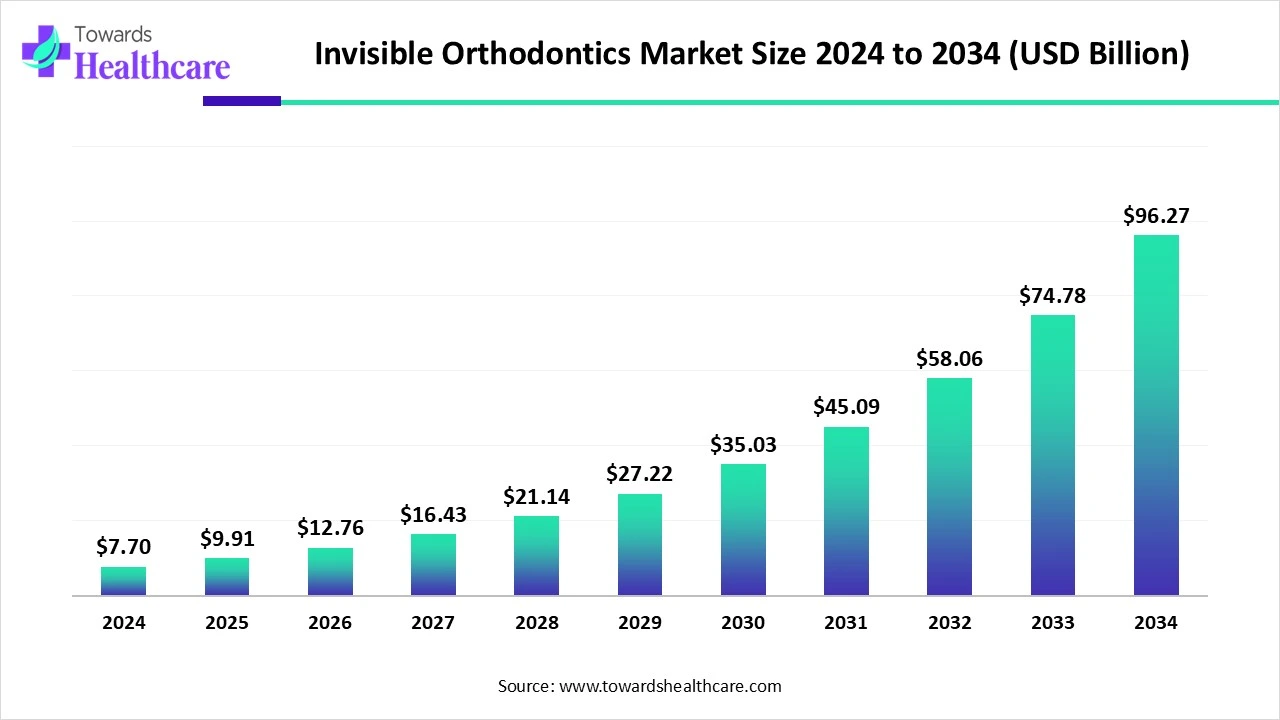
The global invisible orthodontics market reflects this transformation. The industry reached USD 9.9 billion in 2025, climbed to USD 12.72 billion in 2026, and analysts expect it to approach USD 121.87 billion by 2035. With a 28.54% compound annual growth rate, the sector is one of the fastest-growing segments in dental healthcare.
Download Free Sample: https://www.towardshealthcare.com/download-sample/5620
This surge signals a deeper shift in how people view dental care—no longer as a purely medical procedure but also as part of personal image and confidence.
Why People Are Turning Away from Traditional Braces
A growing number of patients want orthodontic treatment without the visible metal. Adults especially prefer subtle solutions that allow them to maintain their professional and social image.
Invisible orthodontics offers exactly that. Clear aligners fit comfortably over the teeth and remain almost unnoticeable during everyday activities.
Several factors are pushing patients toward these modern solutions:
-
Aesthetic appeal: Clear aligners remain nearly invisible, which appeals to adults and young professionals.
-
Comfort and convenience: Aligners do not involve metal wires that can irritate the mouth.
-
Removability: Patients can remove aligners while eating or brushing their teeth.
-
Predictable treatment planning: Digital technology allows dentists to map tooth movement in advance.
Because of these benefits, more individuals now view orthodontic treatment as accessible and lifestyle-friendly rather than inconvenient.
Technology Is Redefining Orthodontic Care
Technology sits at the heart of the invisible orthodontics boom. Modern dental clinics now rely on advanced tools that dramatically improve treatment precision.
Digital intraoral scanners capture highly detailed images of the patient’s teeth. Specialized software then converts these scans into a 3D model that orthodontists use to design custom aligners.
3D printing further accelerates the process. Manufacturers can produce precise aligner sets tailored to each patient’s treatment plan.
These innovations deliver several advantages:
-
Faster treatment planning
-
More accurate tooth movement predictions
-
Improved comfort for patients
-
Reduced need for manual adjustments
As digital dentistry continues to evolve, invisible orthodontics will likely become even more efficient and widely adopted.
Artificial Intelligence Enters the Dental Chair
Artificial intelligence is beginning to reshape orthodontic treatment planning. AI-driven software can analyze dental scans, X-rays, and patient data to recommend highly personalized treatment plans.
This technology helps orthodontists simulate tooth movements and forecast results before treatment even begins.
AI also helps reduce trial and error during the treatment process. By predicting the best aligner designs and treatment timelines, dentists can deliver more precise outcomes.
For patients, this means fewer clinic visits, shorter treatment durations, and greater confidence in the final results.
As AI continues to integrate with digital dentistry, orthodontic care may soon become faster, more predictable, and more accessible.
Adults Are Driving the Market Boom
Orthodontic treatments were once associated primarily with teenagers. Today, adults represent a major share of the invisible orthodontics market.
Many professionals who avoided braces earlier in life are now choosing discreet solutions to improve their smiles.
In fact, adults accounted for over half of the market share in 2025, highlighting how strongly this demographic influences industry growth.
Several social factors are behind this shift. Modern workplaces emphasize personal presentation, and social media culture has made smiles more visible than ever.
As a result, adults increasingly view orthodontic treatment as an investment in both health and self-confidence.
Clear Aligners Lead the Product Segment
Among various invisible orthodontic solutions, clear aligners dominate the market. These transparent trays gradually shift teeth into alignment through a series of customized stages.
The segment captured around 50% of the market share in 2025, making it the most widely adopted product category.
Ceramic braces, another discreet option, are also gaining attention. Unlike traditional metal braces, ceramic versions blend more naturally with the teeth.
While aligners currently lead the industry, both solutions contribute to expanding treatment choices for patients who prefer subtle orthodontic options.
Access our exclusive, data-rich dashboard dedicated to the healthcare market – built specifically for decision-makers, strategists, and industry leaders. The dashboard features comprehensive statistical data, segment-wise market breakdowns, regional performance shares, detailed company profiles, annual updates, and much more. From market sizing to competitive intelligence, this powerful tool is one-stop solution to your gateway.
Access the Dashboard: https://www.towardshealthcare.com/access-dashboard
Checkout the Market Report Now at: https://www.towardshealthcare.com/checkout/5620
You can place an order or ask any questions, please feel free to contact us at sales@towardshealthcare.com
Europe Region – +44 778 256 0738
North America Region – +1 8044 4193 44
APAC Region: +91 9356 9282 04
Visit Our Website: https://www.towardshealthcare.com
Find us on social platforms: LinkedIn | Twitter | Instagram | Medium
About the Author