Medical billing translates medical services into standardized billing claims that insurers can understand and process. It involves coding diagnoses, verifying patient information, submitting claims, and tracking reimbursements.
As healthcare systems grow more complex, this process has evolved from manual paperwork into a technology-driven ecosystem.
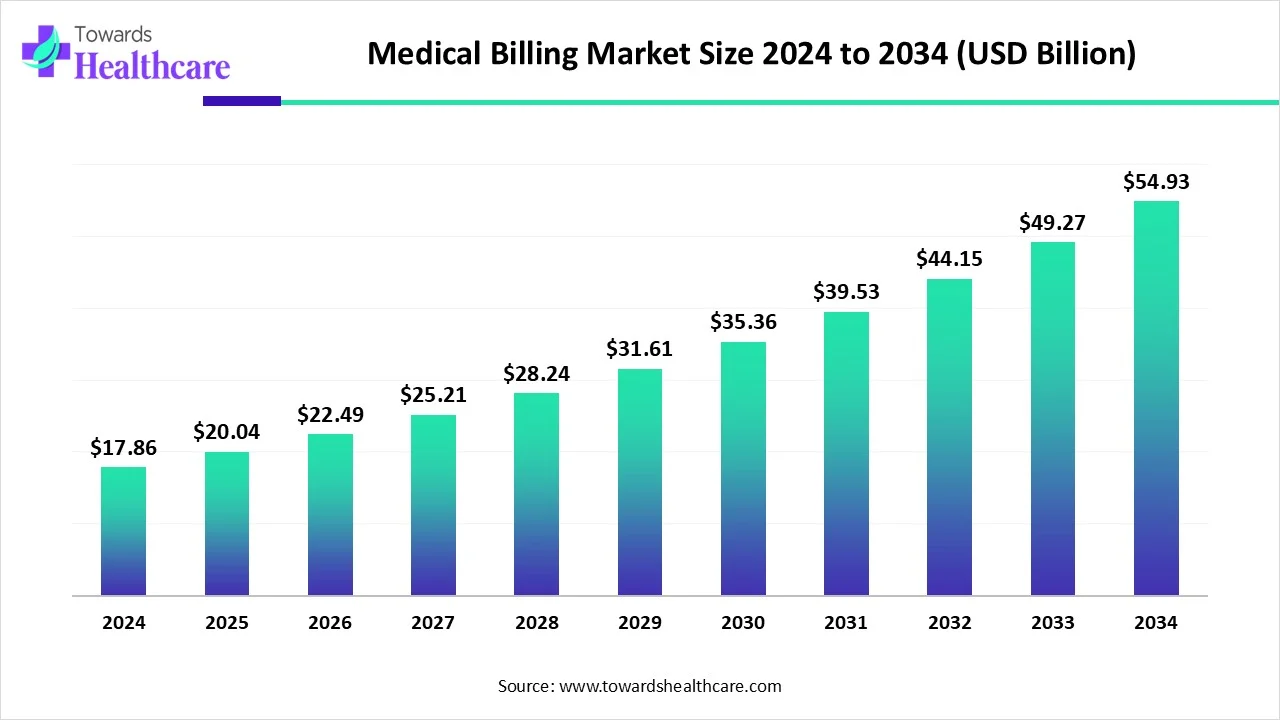
Today, the global medical billing market reflects that transformation. The industry is valued at USD 20.04 billion in 2025 and is projected to reach USD 63.19 billion by 2035, expanding at a steady CAGR of 12.17%.
Download the free sample and get the complete insights and forecasts report on this market @ https://www.towardshealthcare.com/download-sample/5684
This growth highlights one reality: efficient billing systems are no longer optional—they are essential to healthcare sustainability.
Healthcare Complexity Is Redefining Billing Systems
Healthcare providers are managing more patients, treatments, and insurance claims than ever before. Population growth, aging demographics, and rising chronic diseases are driving a surge in healthcare utilization across the world.
Every additional patient visit generates documentation, coding requirements, and insurance claims. Managing these processes manually creates delays and increases the risk of errors.
Hospitals and clinics now rely on advanced billing systems to handle:
-
Large volumes of insurance claims
-
Complex coding standards
-
Compliance with healthcare regulations
-
Payment tracking and denial management
Without efficient billing workflows, providers face delayed reimbursements and financial losses. As a result, healthcare organizations increasingly treat billing as a strategic operational function rather than just an administrative task.
Technology Is Reshaping the Billing Landscape
One of the most powerful forces reshaping the medical billing market is technological innovation. Digital tools have replaced many manual processes, allowing billing teams to work faster and more accurately.
Automation software now handles repetitive tasks such as claim submissions and payment verification. Cloud-based platforms allow healthcare providers to access billing information in real time, regardless of location.
Electronic Health Records (EHRs) also play a major role in this transformation. When patient data connects directly with billing systems, providers can automatically generate accurate claims based on treatment details.
This integration reduces errors, accelerates reimbursement cycles, and improves the overall financial performance of healthcare institutions.
Artificial Intelligence Is Changing the Game
Artificial intelligence has emerged as one of the most disruptive technologies in medical billing. By analyzing massive volumes of healthcare data, AI systems can detect patterns, predict billing errors, and automate complex workflows.
AI-driven coding tools can identify appropriate billing codes based on patient diagnoses and procedures. This dramatically reduces the risk of human error in claim submissions.
Another major advantage lies in predictive analytics. AI can analyze historical claims data to identify trends that may lead to claim denials or payment delays.
Healthcare providers now use AI to:
-
Predict and prevent claim denials before submission
-
Detect billing irregularities and potential fraud
-
Improve revenue forecasting and financial planning
These capabilities not only reduce administrative workload but also strengthen financial stability across healthcare systems.
Institutional Billing Leads the Market
Within the medical billing ecosystem, institutional billing currently dominates the market. Large healthcare facilities such as hospitals and nursing homes handle complex services that require detailed billing processes.
These institutions process thousands of claims daily, covering services such as inpatient care, surgeries, diagnostic procedures, and specialized treatments.
Because of this complexity, hospitals depend heavily on advanced billing systems capable of handling large-scale claim processing. Institutional billing platforms allow providers to manage multiple services under a unified financial framework.
At the same time, professional billing is expected to grow rapidly in the coming years. Individual physicians, outpatient clinics, and specialized healthcare providers are expanding their use of digital billing tools.
The shift toward outpatient care and specialized treatment services is accelerating demand for efficient billing solutions in smaller healthcare settings.
Financial Applications Drive Operational Efficiency
Medical billing platforms perform several functions, but financial management remains the most dominant application. Healthcare providers rely on billing systems to manage revenue cycle operations—from claim creation to payment collection.
Revenue cycle management ensures that healthcare organizations maintain consistent cash flow while minimizing billing errors.
Financial billing applications support essential activities such as:
-
Insurance claim processing
-
Payment collection and reconciliation
-
Financial reporting and analytics
-
Denial management and reimbursement tracking
As healthcare costs continue to rise globally, providers are prioritizing financial efficiency. This trend is driving the adoption of sophisticated billing platforms capable of managing large financial workflows.
Electronic Billing Is the Future
Another important shift in the industry is the growing adoption of electronic billing systems. These platforms replace paper-based billing methods with digital claim processing and automated payment tracking.
Electronic billing offers several advantages over traditional systems. It significantly reduces administrative workload while accelerating claim processing.
Healthcare organizations are increasingly adopting electronic billing because it allows them to:
-
Process claims faster and reduce paperwork
-
Integrate billing with electronic health records
-
Improve billing accuracy and compliance
-
Scale operations as patient volumes grow
As digital infrastructure continues to expand across healthcare systems, electronic billing is expected to become the standard for medical financial operations.
North America Leads, Asia-Pacific Accelerates
Regionally, North America currently dominates the global medical billing market. The region benefits from a highly developed healthcare infrastructure and widespread adoption of digital healthcare technologies.
Healthcare providers in the United States and Canada invest heavily in automation, AI, and revenue cycle management systems. The complexity of insurance frameworks also increases demand for specialized billing services.
However, the Asia-Pacific region is emerging as the fastest-growing market. Rapid urbanization, expanding healthcare infrastructure, and growing insurance coverage are driving the adoption of modern billing systems.
Countries such as China and India are investing heavily in healthcare digitization. Hospitals and clinics across the region are transitioning from manual billing processes to cloud-based platforms.
Additionally, the region has become a global hub for medical billing outsourcing. Skilled professionals, lower operational costs, and advanced technology capabilities make Asia-Pacific an attractive destination for healthcare administrative services.
Regulatory Complexity Remains a Major Challenge
Despite rapid technological progress, the medical billing industry faces significant regulatory challenges. Healthcare laws, insurance policies, and coding standards frequently change, requiring constant updates to billing systems.
Failure to comply with regulatory guidelines can lead to claim denials, financial penalties, or legal complications.
Smaller healthcare providers often struggle to keep pace with these changes due to limited resources. As a result, many organizations choose to outsource billing operations to specialized service providers that can manage regulatory compliance more efficiently.
Access our exclusive, data-rich dashboard dedicated to the healthcare services market – built specifically for decision-makers, strategists, and industry leaders. The dashboard features comprehensive statistical data, segment-wise market breakdowns, regional performance shares, detailed company profiles, annual updates, and much more. From market sizing to competitive intelligence, this powerful tool is one-stop solution to your gateway.
Access the Dashboard: https://www.towardshealthcare.com/access-dashboard
Checkout the Market Report Now at: https://www.towardshealthcare.com/checkout/5684
You can place an order or ask any questions, please feel free to contact us at sales@towardshealthcare.com
Europe Region – +44 778 256 0738
North America Region – +1 8044 4193 44
APAC Region: +91 9356 9282 04
Visit Our Website: https://www.towardshealthcare.com
Find us on social platforms: LinkedIn | Twitter | Instagram | Medium
About the Author