
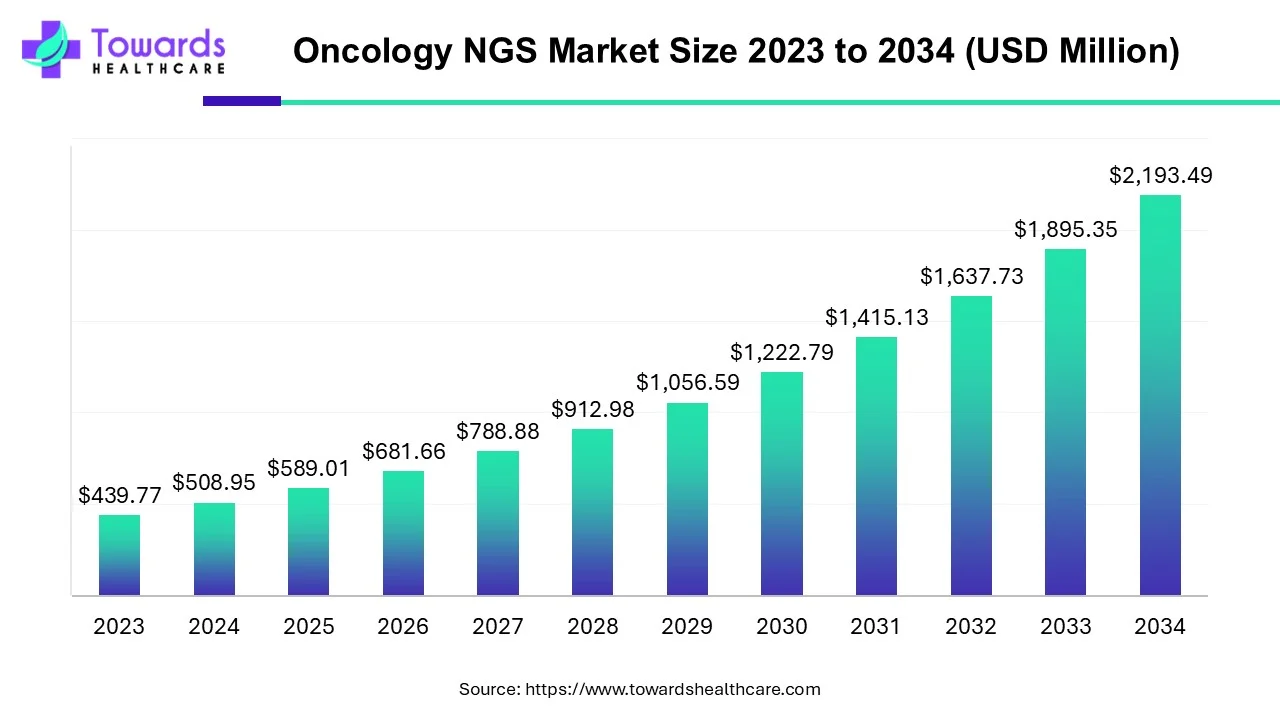
The oncology next-generation sequencing market did not emerge overnight, nor did it grow on promises alone. It evolved alongside the slow but steady realization that cancer is not a single disease but a complex collection of molecular abnormalities that differ from patient to patient. By 2024, the global oncology NGS market stood at approximately USD 508.95 million. In 2025, it crossed USD 589 million, and by 2034 it is projected to approach USD 2.2 billion. These numbers matter, but what matters more is what they represent: a structural shift in how cancer is understood, diagnosed, and treated.
Download Free Sample Now and Get the Complete Report Easily at: https://www.towardshealthcare.com/download-sample/5369
Over the last decade, oncology has moved from organ-based classification to molecular-driven decision-making. Clinicians no longer ask only where the tumor originated. They ask what genetic alterations are driving it. NGS has become the tool that allows those questions to be answered with precision, speed, and scale. Unlike conventional diagnostic methods that test one gene at a time, NGS examines hundreds or even thousands of genes in a single run. This shift has reshaped workflows, clinical thinking, and long-term treatment strategies.
Why NGS Became Indispensable in Oncology
The true value of NGS lies in its ability to see what was previously invisible. Cancer cells often carry multiple genetic mutations, some of which drive disease progression while others influence drug response or resistance. Traditional testing approaches struggle to capture this complexity. NGS, by contrast, provides a comprehensive molecular snapshot of a tumor.
This capability has changed how oncologists approach therapy selection. Targeted therapies and immunotherapies depend heavily on identifying actionable mutations. Without reliable genomic profiling, these therapies lose much of their effectiveness. NGS ensures that treatment decisions are grounded in molecular evidence rather than probability alone.
Another critical advantage is efficiency. Instead of ordering sequential tests that consume time, tissue samples, and financial resources, NGS consolidates testing into a single assay. This is especially important in oncology, where tissue samples are often limited and treatment delays can affect outcomes. The sensitivity of NGS further strengthens its clinical relevance, as it can detect mutations present in very low proportions within a tumor sample.
The Market Grew Because Cancer Did
The growth of the oncology NGS market mirrors the global cancer burden. Cancer incidence continues to rise due to population aging, lifestyle factors, and environmental exposures. Global cancer cases are expected to increase significantly over the coming decades, creating sustained demand for advanced diagnostic solutions.
As cancer becomes more prevalent, healthcare systems face pressure to improve early detection, refine diagnosis, and optimize treatment outcomes. NGS addresses all three challenges. It supports early screening, helps differentiate between inherited and sporadic cancers, and guides therapy decisions throughout the disease lifecycle.
The increasing adoption of NGS is not limited to advanced economies. Emerging markets are also investing in genomic infrastructure, driven by falling sequencing costs, improved access to technology, and growing awareness among clinicians.
Targeted Sequencing Led the Way, But the Story Is Expanding
Targeted sequencing and resequencing dominated the oncology NGS market in recent years for practical reasons. This approach focuses on predefined gene panels that are known to be clinically relevant. It offers a balance between cost, turnaround time, and actionable insight, making it suitable for routine clinical use and large-scale trials.
However, the narrative is evolving. Whole genome sequencing is gaining momentum as costs decline and analytical capabilities improve. WGS offers an unbiased view of the tumor genome, capturing structural variants, copy number changes, and non-coding regions that targeted panels may miss. For researchers and advanced clinical centers, this level of detail opens new pathways for discovery and personalized treatment design.
Whole exome sequencing continues to occupy an important middle ground, offering broader coverage than targeted panels while remaining more economical than whole genome approaches. Together, these technologies form a layered ecosystem rather than a competitive hierarchy.
Workflow Innovation Reshaped Clinical Adoption
The oncology NGS workflow has matured significantly over the past decade. Early adoption was limited by complex sample preparation, long sequencing times, and heavy computational demands. Today, improvements across pre-sequencing, sequencing, and data analysis have streamlined the entire process.
Sequencing itself remains the dominant and fastest-growing workflow segment. Advances in platform throughput, accuracy, and automation have made NGS more accessible to clinical laboratories. Data analysis, once a major bottleneck, is increasingly supported by optimized bioinformatics pipelines and cloud-based solutions.
Despite these improvements, challenges remain. The shortage of skilled bioinformaticians and molecular pathologists continues to limit adoption in some regions. However, the integration of artificial intelligence and machine learning is beginning to address this gap by automating variant interpretation and clinical reporting.
Screening Anchored the Market, Precision Medicine Accelerated It
Screening applications held the largest share of the oncology NGS market in recent years. NGS-based screening enables the identification of genetic alterations linked to cancer risk, disease progression, and treatment response. It has become a cornerstone of research and early diagnostic efforts.
At the same time, companion diagnostics emerged as the fastest-growing application segment. As targeted therapies proliferate, the need for reliable biomarkers has intensified. NGS offers a comprehensive solution by identifying multiple biomarkers simultaneously, aligning seamlessly with the principles of precision medicine.
This shift reflects a broader transformation in oncology. Treatment decisions increasingly rely on molecular eligibility rather than histological classification alone. NGS acts as the bridge between genomic science and clinical action.
Laboratories Built the Foundation, Clinics Are Scaling the Impact
Laboratories dominated the oncology NGS market by end use, driven by their role in test development, validation, and research. These facilities possess the technical expertise and infrastructure required to manage complex genomic workflows.
However, clinics are rapidly expanding their role. Specialized oncology clinics are integrating NGS into routine care, supported by trained personnel and advanced equipment. This transition brings genomic testing closer to the point of care, reducing turnaround times and improving patient experience.
Hospitals continue to play a critical role, particularly in large cancer centers where multidisciplinary teams rely on genomic insights for treatment planning and clinical trial enrollment.
North America Set the Pace, Asia Pacific Is Redefining Scale
North America led the oncology NGS market in 2023, supported by strong research funding, regulatory support, and a high concentration of industry leaders. The region’s focus on precision medicine accelerated the clinical adoption of NGS-based diagnostics.
The United States, in particular, benefited from a robust ecosystem of biotechnology companies, academic institutions, and regulatory frameworks that support innovation. FDA approvals for NGS-based companion diagnostics reinforced confidence among clinicians and payers alike.
Canada followed a similar trajectory, emphasizing accuracy, cost reduction, and clinical integration. The adoption of NGS in clinical trials further strengthened the country’s position in the market.
Asia Pacific, however, is shaping the next phase of growth. Rapid investments in healthcare infrastructure, government-backed precision medicine initiatives, and declining sequencing costs are driving adoption across the region. China’s large-scale genomics programs and domestic technology development have significantly expanded access to NGS. India’s growing focus on personalized medicine, supported by collaborations between hospitals, academic institutions, and biotech firms, is steadily increasing market penetration.
Artificial Intelligence Is Quietly Transforming NGS
The integration of artificial intelligence into oncology NGS represents one of the most important yet understated developments in the market. AI enhances data interpretation by identifying clinically relevant patterns within vast genomic datasets. It reduces analysis time, improves accuracy, and supports decision-making in environments with limited expert availability.
Machine learning models are increasingly used to predict treatment response, identify novel biomarkers, and streamline variant classification. While AI does not replace human expertise, it augments it in meaningful ways, enabling NGS to scale beyond specialized centers.
As AI tools mature, they are expected to further lower barriers to adoption and improve consistency across laboratories and clinics.
Cost and Talent Remain the Market’s Biggest Tests
Despite its progress, the oncology NGS market faces persistent challenges. High upfront costs for sequencing platforms, data storage, and computational infrastructure remain significant barriers, particularly for smaller institutions. Although sequencing costs have declined, the total cost of ownership remains substantial.
Equally important is the shortage of trained professionals capable of interpreting genomic data in a clinical context. Without adequate expertise, the value of NGS cannot be fully realized. Addressing this gap will require sustained investment in education, training, and user-friendly analytical tools.
Personalized Medicine Is No Longer a Vision
The opportunity for oncology NGS lies in its central role in personalized medicine. NGS enables clinicians to tailor treatments based on a patient’s unique molecular profile, improving outcomes while reducing unnecessary toxicity. This approach aligns with the broader shift toward value-based care, where effectiveness and efficiency matter as much as innovation.
As evidence continues to accumulate, NGS is moving from optional to essential in oncology practice. Its role extends beyond diagnosis to monitoring disease progression, detecting resistance mechanisms, and guiding long-term care strategies.
Competition Fueled Innovation, Not Saturation
The competitive landscape of the oncology NGS market includes established sequencing technology providers, diagnostic companies, and bioinformatics specialists. Competition has driven rapid innovation, leading to improved platforms, expanded test menus, and integrated solutions.
Recent product launches and regulatory approvals highlight the industry’s focus on clinical relevance and quality. Rather than saturating the market, competition has expanded its scope by addressing unmet clinical needs and improving accessibility.
Access our exclusive, data-rich dashboard dedicated to the diagnostics market – built specifically for decision-makers, strategists, and industry leaders. The dashboard features comprehensive statistical data, segment-wise market breakdowns, regional performance shares, detailed company profiles, annual updates, and much more. From market sizing to competitive intelligence, this powerful tool is one-stop solution to your gateway.
Access the Dashboard: https://www.towardshealthcare.com/access-dashboard
Checkout or Order Oncology NGS Market Report Now at: https://www.towardshealthcare.com/checkout/5369
Become a valued research partner with us - https://www.towardshealthcare.com/schedule-meeting
You can place an order or ask any questions, please feel free to contact us at sales@towardshealthcare.com
Powering Healthcare Leaders with Real-Time Insights: https://www.towardshealthcare.com/healthcare-intelligence-platform
Europe Region – +44 778 256 0738
North America Region – +1 8044 4193 44
APAC Region: +91 9356 9282 04
Visit Our Website: https://www.towardshealthcare.com
Find us on social platforms: LinkedIn | Twitter | Instagram | Medium | Pinterest