From One-Size-Fits-All to One-in-a-Billion Care
Healthcare is undergoing a quiet but profound transformation. For decades, medicine relied on standardized treatment protocols designed for the “average” patient. Today, that model is steadily giving way to precision medicine, an approach that recognizes each patient as biologically unique. At the center of this transformation sits precision medicine software, the digital backbone that converts vast amounts of genomic, clinical, and real-world data into actionable medical insight.
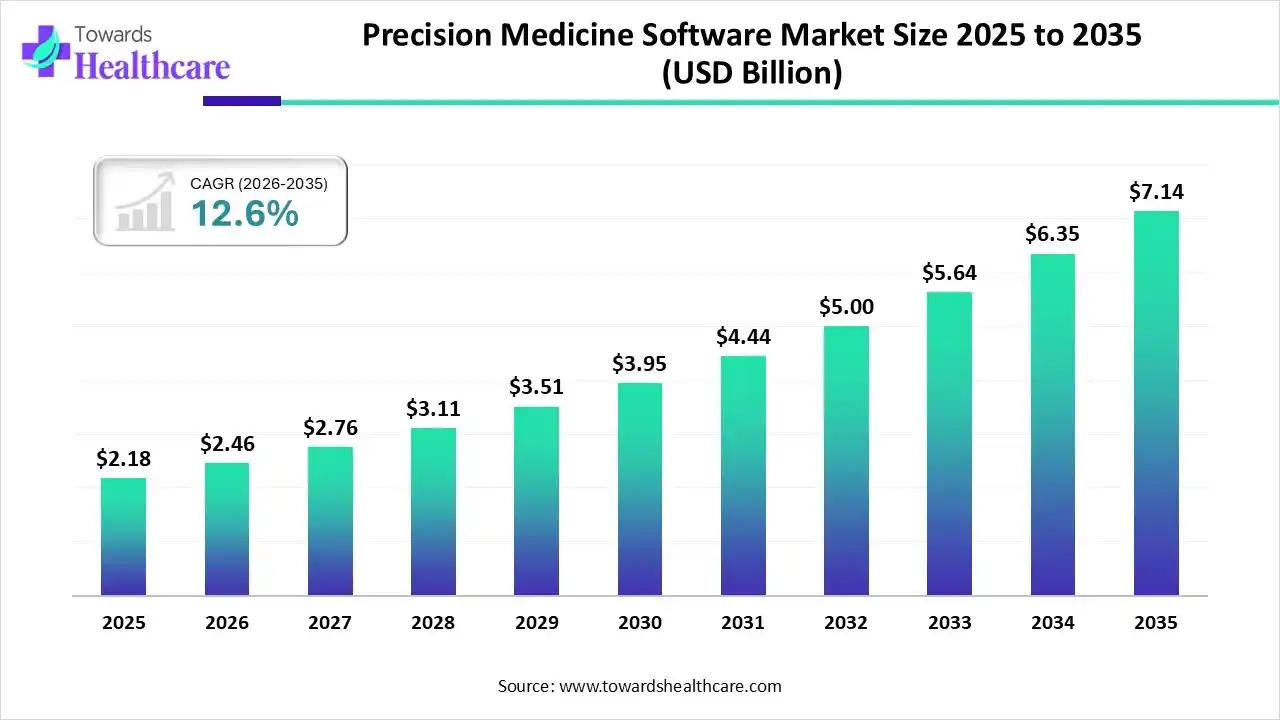
In 2025, the global precision medicine software market stands at a valuation of US$ 2.18 billion. By 2026, it grows to US$ 2.46 billion, and by 2035, projections indicate a market size of approximately US$ 7.14 billion, expanding at a steady CAGR of 12.6 percent. These numbers are not just indicators of market momentum; they reflect a fundamental shift in how diseases are understood, diagnosed, and treated across the globe.
Download Sample: https://www.towardshealthcare.com/download-sample/6471
Why Software Has Become the Brain of Precision Medicine
Precision medicine is data-driven by nature. It depends on the integration of genomics, proteomics, clinical records, imaging, lifestyle data, and increasingly, real-world evidence. Without sophisticated software platforms, this complexity would be unmanageable. Precision medicine software acts as the analytical engine that connects these diverse data streams and transforms them into clinical decisions.
What distinguishes modern precision medicine software is not merely storage or visualization, but intelligence. Advanced platforms now leverage artificial intelligence, machine learning, and generative AI to identify patterns that human analysis would miss. These tools help clinicians predict disease progression, select optimal therapies, and reduce adverse drug reactions. In oncology and rare genetic disorders especially, software has become indispensable for treatment planning and outcome optimization.
Market Growth Driven by Genomics, AI, and Clinical Urgency
The growth trajectory of the precision medicine software market reflects three powerful forces working in parallel. First is the exponential expansion of genomic sequencing. The cost of sequencing has dropped dramatically, enabling hospitals and diagnostic labs to adopt next-generation sequencing at scale. Second is the rise of AI-driven analytics capable of interpreting this genomic data in clinically meaningful ways. Third is the urgent clinical need for better outcomes in complex diseases such as cancer, rare disorders, and autoimmune conditions.
Precision medicine software no longer supports only research environments. It increasingly plays a central role in everyday clinical workflows. From genomic data management and clinical decision support to companion diagnostics and clinical trial matching, software platforms now influence the entire continuum of care.
Software Takes the Lead While Services Gain Momentum
Within the market, software remains the dominant component, a position it held firmly in 2024. Software platforms enable healthcare systems to operationalize precision medicine by embedding analytics directly into clinical processes. As interoperability standards improve and cloud infrastructure matures, these platforms are becoming more scalable, secure, and adaptable across healthcare settings.
At the same time, services associated with precision medicine software are gaining traction at the fastest growth rate. Implementation, integration, validation, clinical interpretation, and regulatory support services are increasingly critical as healthcare organizations struggle to manage complex data ecosystems. Precision medicine is not a plug-and-play solution. It requires deep expertise to ensure data quality, regulatory compliance, and clinical relevance, which explains the accelerating demand for specialized services.
Cloud Platforms Shape the New Deployment Landscape
Deployment preferences reveal another important shift. Cloud-based precision medicine software dominated the market in 2024, driven by the need for scalability, collaborative research, and cost efficiency. Cloud platforms enable multi-institutional data sharing, rapid algorithm updates, and real-time analytics across geographies. These advantages are particularly important for genomic research, population-scale studies, and pharmaceutical collaborations.
Despite the dominance of cloud solutions, on-premise deployment continues to grow at a significant pace. Many hospitals, research institutions, and government labs still prefer on-premise systems due to data sovereignty, privacy regulations, and legacy infrastructure. As security technologies advance, hybrid models are also emerging, allowing organizations to balance flexibility with control.
Applications Expand Beyond Genomics into Real-World Care
Genomic data management and analysis remains the largest application area within precision medicine software. However, the market is rapidly diversifying. Multi-omics analytics now integrates genomic, transcriptomic, proteomic, and metabolomic data to deliver a more holistic understanding of disease biology. Clinical decision support systems are evolving from rule-based alerts to AI-driven treatment recommendations.
One of the fastest-growing application areas is companion diagnostics and biomarker discovery. Software platforms now help identify which patients are most likely to respond to specific therapies, improving clinical trial efficiency and accelerating drug approvals. Clinical trial matching tools also play a critical role by aligning patient profiles with suitable trials, reducing recruitment timelines and enhancing diversity in research.
Technology Evolves from Algorithms to Ecosystems
From a technology perspective, AI and machine learning models dominated the precision medicine software market in 2024. These technologies enable predictive analytics, risk stratification, and outcome forecasting across disease areas. Generative AI further enhances capabilities by automating data interpretation and summarizing complex genomic insights for clinicians.
Interoperability technologies, including FHIR and HL7 integration, represent the fastest-growing technological segment. As healthcare systems generate data from countless sources, seamless data exchange becomes essential. Precision medicine software increasingly functions as part of a larger digital health ecosystem, connecting electronic health records, laboratory systems, imaging platforms, and research databases into a unified framework.
Oncology Leads Today While Rare Diseases Shape Tomorrow
Oncology continues to dominate the therapeutic landscape for precision medicine software. Cancer care relies heavily on genomic profiling, molecular diagnostics, and targeted therapies, all of which depend on advanced software platforms. Precision oncology software supports tumor profiling, therapy selection, and longitudinal outcome tracking, making it indispensable in modern cancer centers.
Rare and genetic disorders, however, represent the fastest-growing therapeutic area. With more than 7,000 rare diseases affecting millions globally, software-driven genomic interpretation is often the only path to diagnosis and treatment. In many cases, precision medicine software shortens diagnostic odysseys from years to weeks, fundamentally altering patient outcomes.
Hospitals Anchor Adoption While Labs Accelerate Growth
Hospitals remained the largest end users of precision medicine software in 2024, reflecting the integration of these platforms into clinical workflows. Hospitals increasingly use precision medicine tools for oncology boards, pharmacogenomics, and personalized treatment planning.
Diagnostic laboratories and genomic service providers are emerging as the fastest-growing end-use segment. As testing volumes rise and data complexity increases, labs rely on software platforms to ensure accuracy, speed, and regulatory compliance. Pharmaceutical and biotechnology companies also play a crucial role, using precision medicine software to support drug discovery, biomarker validation, and real-world evidence generation.
Regional Dynamics Reveal Uneven but Accelerating Adoption
North America dominated the precision medicine software market in 2025, driven by strong healthcare IT adoption, advanced research infrastructure, and significant investment in genomics and AI. The United States, in particular, benefits from early adoption of precision oncology and pharmacogenomics, supported by academic institutions, technology firms, and government initiatives.
Asia Pacific is expected to grow at the fastest CAGR during the forecast period. Countries such as China, India, Japan, South Korea, and Taiwan are investing heavily in digital health, genomic research, and population-scale precision medicine programs. The region’s large patient base and increasing focus on personalized care position it as a major growth engine.
Europe continues to show steady growth, supported by strong regulatory frameworks and cross-border research collaborations. South America and the Middle East and Africa represent emerging markets where digital health infrastructure and policy reforms are gradually enabling precision medicine adoption.
Competitive Landscape Reflects Convergence of Tech and Healthcare
The precision medicine software market features a diverse mix of specialized software firms, healthcare technology giants, and genomics leaders. Companies such as SOPHiA GENETICS, Genomind, IQVIA, Genedata AG, Tempus AI, Owkin, Syapse, and others provide platforms that span data analytics, clinical decision support, and research enablement.
Illumina stands out as a foundational player, not only through its sequencing hardware but also through its software platforms that manage and interpret genomic data at scale. Its integrated approach underscores a broader industry trend toward end-to-end ecosystems rather than isolated tools.
Oracle, through its healthcare technology offerings, highlights another trend: the entry of enterprise software providers into precision medicine. As data volumes grow, the need for robust infrastructure, security, and interoperability draws established technology companies deeper into healthcare.
Innovation Fueled by Investment and Collaboration
Recent years have seen sustained investment in precision medicine software startups, reflecting confidence in long-term growth. Venture capital, corporate venture arms, and strategic partnerships continue to fuel innovation, particularly in AI-powered diagnostics and predictive modeling.
Collaborations between software developers, pharmaceutical companies, research institutions, and healthcare providers are becoming more common. These partnerships aim to accelerate drug discovery, improve clinical trial efficiency, and translate research insights into clinical practice more quickly.
Challenges That Will Define the Next Phase
Despite strong momentum, the market faces challenges that will shape its future. Data privacy, regulatory compliance, and interoperability remain persistent concerns. Integrating software into clinical workflows without increasing physician burden is another critical hurdle. Moreover, the shortage of skilled professionals capable of interpreting complex genomic and AI-driven insights could limit adoption in some regions.
Yet these challenges also represent opportunities for innovation. Companies that simplify usability, enhance transparency, and build trust through robust governance frameworks will define the next generation of precision medicine software.
A Market Still Writing Its Story
Precision medicine software is no longer an emerging concept; it is becoming a foundational element of modern healthcare. Its growth reflects a broader recognition that better data leads to better decisions, and better decisions lead to better patient outcomes.
As the market moves toward a projected valuation of US$ 7.14 billion by 2035, its impact will extend far beyond financial metrics. Precision medicine software will increasingly determine how diseases are diagnosed, how therapies are developed, and how patients experience care.
The future of healthcare will not be defined by a single breakthrough drug or device, but by intelligent systems that understand human biology in all its complexity. Precision medicine software is steadily becoming that system, reshaping medicine one dataset, one patient, and one decision at a time.