The regenerative medicine market is no longer a niche scientific space. It is evolving into a high-impact healthcare segment with strong financial momentum.
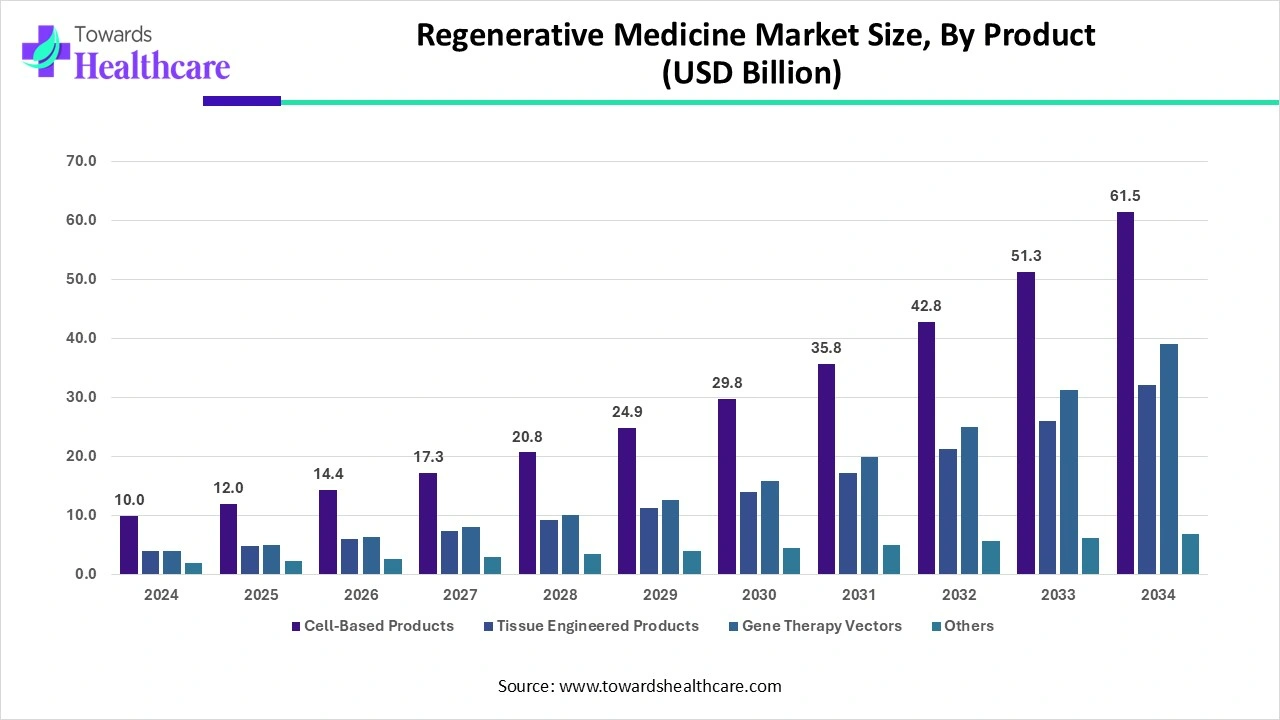
From around $10 billion in 2024, the market is projected to cross $61 billion by 2034 for cell-based products alone. This sharp rise reflects both clinical demand and technological maturity.
Download the free sample and get the complete insights, shares and stats with forecasts report on this market @ https://www.towardshealthcare.com/download-sample/5092
What stands out is not just growth, but the speed at which innovation is turning into real-world treatments.
Cell-Based Products Take the Lead
Cell-based products clearly dominate the regenerative medicine landscape. Their market value is expected to grow from $12 billion in 2025 to $61.5 billion by 2034.
This dominance comes from their ability to directly repair, replace, or regenerate damaged tissues. Unlike traditional drugs, they address the root cause rather than just symptoms.
The segment continues to expand as new therapies move from clinical trials to commercialization.
Why This Segment Is Winning
Cell-based therapies are gaining traction because they offer solutions where conventional medicine struggles.
They are widely used in treating chronic diseases, cancers, and degenerative disorders. Their adaptability across multiple therapeutic areas gives them a clear advantage.
Key drivers behind their dominance include:
- Rising demand for personalized and precision medicine
- Increasing approvals of advanced cell therapies
- Strong pipeline of stem cell and immunotherapy innovations
These factors are not temporary trends—they are reshaping treatment protocols globally.
Science Behind the Surge
At the core of this growth is the biological power of cells. These therapies can differentiate into specialized cells, making them ideal for repairing tissues.
This capability allows doctors to treat conditions like spinal injuries, cardiac damage, and neurological disorders more effectively.
The science is complex, but the outcome is simple—better recovery and improved quality of life for patients.
Other Segments Are Growing, But Slower
While cell-based products dominate, other segments also contribute to the market.
Tissue-engineered products and gene therapy vectors are expanding steadily. By 2034, tissue-engineered products are expected to reach over $30 billion, while gene therapy vectors may approach $39 billion.
However, their growth trajectory still trails behind cell-based solutions due to higher complexity and longer approval timelines.
Schedule a session with our experts and get every detail you need to truly understand your market: Schedule a Meeting
Innovation Is Driving Real Change
The regenerative medicine space is no longer limited to research labs. It is actively transforming clinical practices.
Companies are investing heavily in R&D, leading to breakthroughs in areas like CAR-T therapies and stem cell treatments.
This wave of innovation is pushing boundaries in:
- Cancer treatment through cellular immunotherapies
- Regenerative solutions for organ damage
- Advanced therapies for rare and genetic diseases
Each advancement brings the industry closer to personalized healthcare.
Clinical Applications Are Expanding Rapidly
Cell-based therapies are no longer restricted to a few conditions. Their applications are expanding across multiple disease areas.
From oncology to orthopedics, these therapies are proving effective in diverse medical fields.
This wide applicability ensures sustained demand, making the segment resilient even during market fluctuations.
Challenges Still Exist
Despite strong growth, the segment faces real-world challenges.
High treatment costs, regulatory complexities, and scalability issues continue to slow adoption in some regions.
Manufacturing these therapies requires precision and strict quality control, which increases operational costs.
Still, ongoing advancements in bioprocessing and automation are expected to gradually reduce these barriers.
About the Author