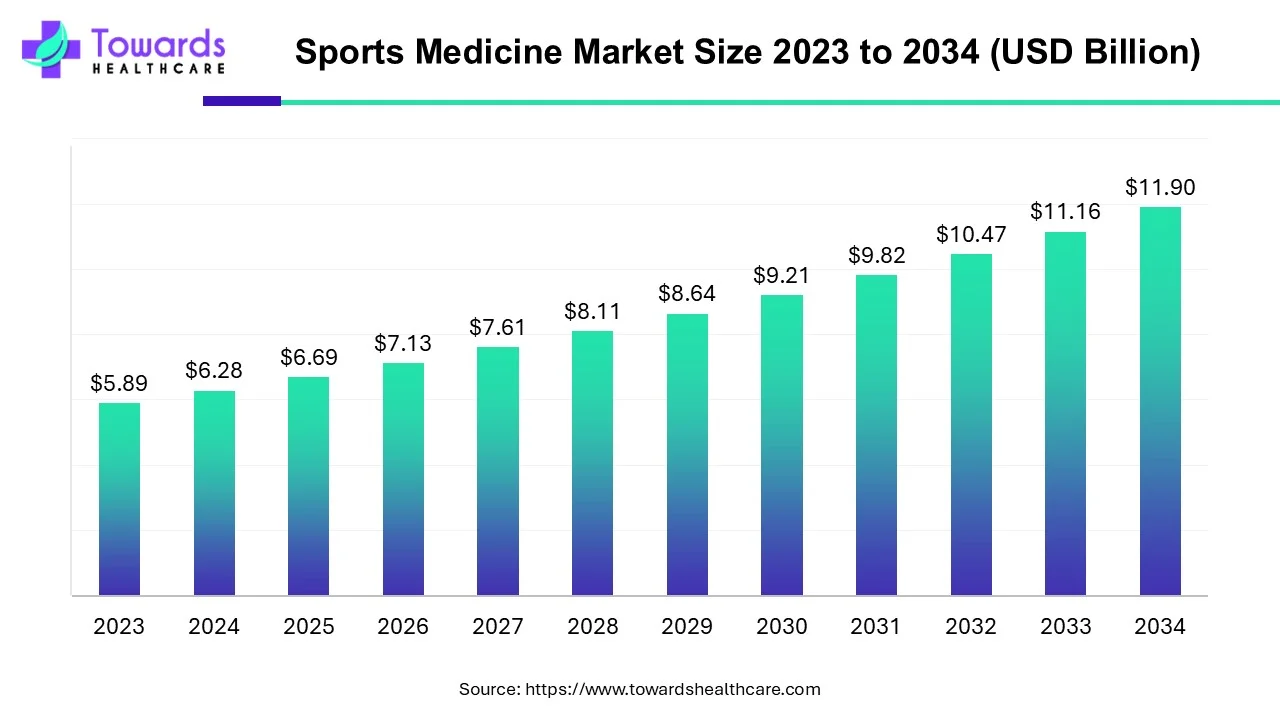
The global sports medicine market is set to expand from USD 6.69 billion in 2025 to USD 11.90 billion by 2034 (CAGR 6.6%), propelled by high injury incidence (e.g., 3.5 million U.S. injuries/year; 725 injuries and 1,119 illnesses at Beijing 2022) and strong demand for body reconstruction solutions (41% share in 2023) and knee-injury care (32% share in 2023), with North America at 42% share (2023).
Download the free sample and get the complete insights and forecasts report on this market @ https://www.towardshealthcare.com/download-sample/5107
Market size (deep, point-wise)
Baseline & horizon
➣2025: USD 6.69 B (model base year provided).
➣2034: USD 11.90 B at 6.6% CAGR.
Year-by-year trajectory (CAGR 6.6%)
➣2025: 6.69 B
➣2026: 7.13 B
➣2027: 7.60 B
➣2028: 8.10 B
➣2029: 8.64 B
➣2030: 9.21 B
➣2031: 9.82 B
➣2032: 10.46 B
➣2033: 11.16 B
➣2034: 11.90 B
Incremental value creation
➣Absolute addition 2025→2034: USD 5.21 B.
➣Mid-horizon (2029–2031) adds USD 1.18 B as installed robotics, orthobiologics, and rehab tech scaling kicks in.
Volume drivers mapped to value
➣Injury burden: U.S. 3.5 M injuries/year; Johns Hopkins notes >3.5 M injuries in under-14s with 775k ER visits—sustains high utilization of braces, arthroscopy, and ligament repair.
➣Elite events & surveillance data: Beijing 2022 reported 2.4% injuries and 3.1% illnesses among participants—evidence base pushing prevention & rapid-return protocols.
➣Participation tailwinds: U.S. 242 M people (80% aged ≥6) engaged in sport/fitness in 2023; EU sports employment 1.55 M (0.76% of total) supports service capacity growth.
Market trends
Shift to reconstruction & minimally invasive
➣Body reconstruction products led with 41% share (2023); continued mix-shift to arthroscopy, soft-tissue repair (e.g., ACL repair kits) and patient-specific implants.
Knee remains the epicenter
➣32% of market tied to knee injuries (2023); adoption of robotic-assisted TKA (e.g., Mako), advanced ACL repair systems, and AI-guided rehab pathways.
Robotics & navigation scaling
➣>1,000 Mako robots deployed by 2021 enabling >500k procedures; 2023 launch of Mako Total Knee 2.0 adds analytics + haptics; accelerates premium procedure mix.
Wearables & continuous monitoring mainstream
➣WHOOP Strap 4.0 (2023) and smart textiles inform load management, return-to-play decisions, and payer-acceptable outcomes tracking.
Orthobiologics & regenerative medicine
➣Rising use of PRP and stem-cell-based protocols to complement surgical repair, shortening recovery windows for tendons/ligaments.
Tele-sports-medicine & hybrid rehab
➣Remote consults, app-based PT, and AI triage widen access—critical for youth and community athletics with high injury incidence.
Pediatric & adolescent focus
➣FDA-cleared pediatric solutions (e.g., Arthrex TightRope for kid ACLs) mirror high injury rates in <14 cohort; tailored protocols growing.
Institutional expansion
➣New centers (e.g., Ochsner Andrews Institute 2024; Delhi Sports Injury Center 2024) expand multidisciplinary capacity.
Policy & programs fueling activity
➣U.S. President’s Council on Sports, Fitness & Nutrition renewed through Sept-2025; Canada’s Sport Canada investments; China’s Healthy China 2030 ISM strategy; India athlete welfare funds—all stoke participation and care demand.
Cost pressure & affordability innovation
➣With doctor visits USD 100–200, imaging USD 500–2,000, surgeries USD 5k–50k+, providers push value-based bundles, outpatient ASC shift, and digital-first rehab to contain OOP spend.
AI’s role & impact
➣Injury risk prediction: Models blend workload (GPS, wearables), biomechanics, sleep, and prior injuries to calculate individual risk; flags overtraining before tissue failure.
➣Imaging triage & precision diagnosis: AI on MRI/CT/US detects meniscal tears, rotator-cuff pathology, stress fractures; reduces reading times and variability; speeds surgical planning.
➣Robotics optimization: Intra-op AI refines implant alignment and soft-tissue balance (e.g., haptic envelopes + analytics in robotic TKA) → better function, fewer revisions.
➣Personalized rehab: Computer-vision verifies home-exercise form; adaptive protocols adjust intensity; digital twins simulate healing trajectories.
➣Return-to-play decision support: Multivariate thresholds (strength symmetry, hop tests, proprioception, GPS metrics) algorithmically scored to reduce re-injury risk.
➣Tele-PT automation: Chat- and voice-based “PT copilots” deliver cues, adherence nudges, pain-flare routing; lowers therapist load and expands access.
➣Surgical workflow analytics: OR video + instrument telemetry mined to benchmark steps, reduce operative time, and standardize training.
➣Orthobiologics response modeling: Predicts which patients benefit from PRP vs. grafts; optimizes injection timing and dosing windows.
➣Population health & prevention: School and club data lakes surface hot spots (e.g., turf injuries); guide rule changes, gear mandates, and targeted prehab.
➣Revenue cycle & value proof: Auto-extracted outcomes (PROMs, activity data) support payer authorization and bundled-payment justification; reduces denials.
Regional insights
North America (42% share in 2023)
Subpoints
➣Infrastructure density: High concentration of sports medicine institutes, ASCs, and team-affiliated clinics enables rapid referral and advanced care (robotics, arthroscopy).
➣Procedure premiumization: Strong uptake of robotic TKA/THA, advanced ACL repairs, and orthobiologics increases ASPs and case complexity.
➣Participation base: 242 M active participants (2023) sustain steady injury-driven demand; youth sports a major funnel.
➣Implication: Largest revenue pool; payers drive outcomes-based models and remote rehab to manage costs.
Europe
Subpoints
➣Workforce scale: 1.55 M employed in sports sector (2023) underpins multidisciplinary services.
➣Elite club integration: Pro leagues embed on-site imaging/rehab, pushing fast-track protocols into community care.
➣Access parity focus: Public systems emphasize prevention and post-op rehab adherence to reduce re-injury rates.
➣Implication: Stable demand with strong prevention budgets and structured rehab pathways.
Asia Pacific
Subpoints
➣Participation surge: Urbanization + mega-events expand amateur sport; culturally diverse needs (cricket, martial arts) diversify injury patterns.
➣Policy catalysts: China’s ISM / Healthy China 2030 integrates sport & medicine; India’s welfare funds provide pensions and medical support for sportspersons.
➣Capacity build-out: New centers and tele-rehab platforms scale access across metros and tier-2 cities.
➣Implication: Fastest relative growth; significant upside in wearables, tele-PT, and cost-effective implants.
Latin America
Subpoints
➣Grassroots growth: Football-led participation with rising private clinic chains.
➣Cost sensitivity: Strong demand for durable, lower-cost braces/supports and outpatient arthroscopy.
➣Implication: Value-tier products and remote coaching models win.
Middle East & Africa
Subpoints
➣Event-driven investment: Sports cities and elite academies spur top-end facilities.
➣Workforce training gap: Partnerships with global brands to upskill PT and ATC staff.
➣Implication: Early-stage but premium niches (elite rehab tourism) emerging.
Market dynamics
Drivers
➣High and rising injury incidence: U.S. 3.5 M/yr injuries; >3.5 M injuries in under-14s (775k ER visits) sustain procedure + rehab volumes.
➣Technology adoption: Robotics (Mako), AI imaging, and wearables enhance outcomes and throughput.
➣Participation boom: U.S. 242 M active; EU sports employment base; APAC policy pushes.
Restraints
➣Cost barriers: Visits USD 100–200, imaging USD 500–2,000, surgeries USD 5k–50k+; delays care (Commonwealth Fund noted 41% adults deferred care over cost).
➣Stigma & delayed presentation: Athletes fearing bench time postpone treatment, complicating cases.
➣Workforce variability: Shortages of pediatric sports specialists in many regions.
Opportunities
➣ASC shift & same-day surgery: Lowers cost, increases capacity.
➣Tele-sports-medicine: Extends specialist reach; payer-friendly remote rehab.
➣Regenerative protocols & pediatric solutions: Address large unmet need cohorts (youth ACL, tendinopathy).
Contextual evidence
➣Beijing 2022 surveillance and WHOOP/robotics adoption illustrate tech-enabled prevention and faster recovery.
➣Institutional expansions in 2024 (U.S., India) increase addressable capacity.
Top 10 Key Players and Company Profile
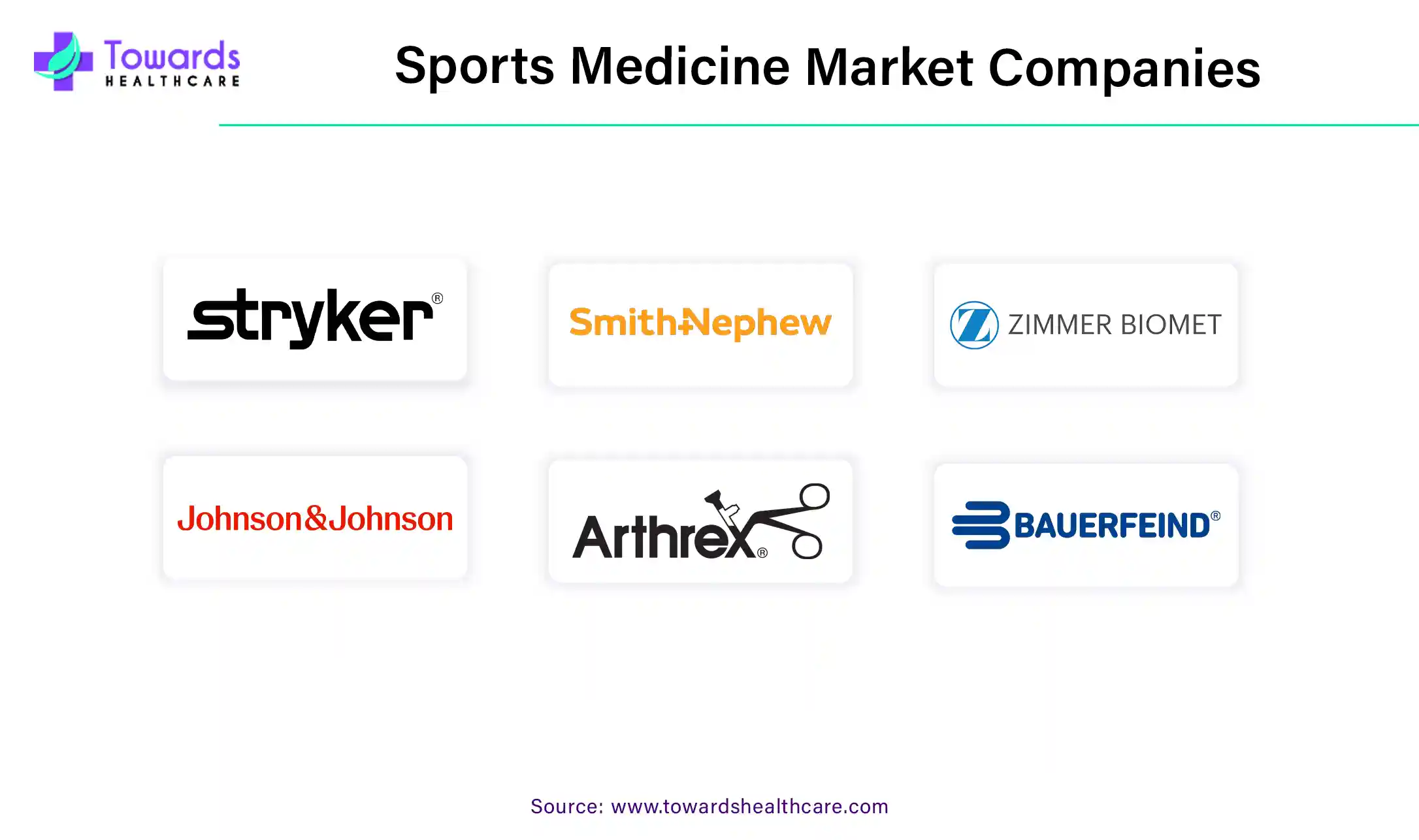
Stryker Corporation
Products: Mako SmartRobotics (incl. Total Knee 2.0), arthroscopy tools, soft-tissue and ligament repair, trauma systems.
Overview: Ortho and med-tech leader with installed robotic base >1,000 by 2021; expanding analytics-driven joint workflows.
Strengths: Robotics leadership, haptic guidance, data analytics ecosystem, ASC penetration.
Smith & Nephew
Products: Arthroscopy (shoulder/knee), ligament repair implants, sports biologics, negative pressure wound therapy.
Overview: Strong sports medicine franchise across soft-tissue and arthroscopy with education platforms.
Strengths: Surgeon training depth, broad soft-tissue portfolio, global reach.
Zimmer Biomet
Products: Identity Shoulder System (FDA-cleared 2022), knee/hip systems, sports medicine accessories.
Overview: Recon powerhouse diversifying into shoulder and sports indications.
Strengths: Recon brand trust, shoulder platform innovation, distribution.
Johnson & Johnson MedTech (DePuy Synthes)
Products: Extremities, fixation, soft-tissue repair; expanded via CrossRoads Extremity Systems acquisition (2022).
Overview: Full-line ortho with growing foot/ankle presence.
Strengths: Scale, M&A integration, comprehensive hospital relationships.
Arthrex
Products: ACL Repair TightRope & SwiveLock ACL Repair Kit (FDA 2023), extensive arthroscopy and sports implants.
Overview: Sports medicine pure-play renowned for rapid innovation and surgeon education.
Strengths: First-to-market pediatric ACL approvals, broad procedure sets, KOL engagement.
Enovis (DJO Global)
Products: Bracing/supports, PT equipment; DynaClip bone staples (2023) for foot & ankle.
Overview: Bracing to surgical solutions with strong rehab footprint.
Strengths: End-to-end continuum (support → surgery → rehab), ASC-friendly economics.
Performance Health Holding Inc.
Products: Rehabilitation equipment, therapeutic modalities, tape, and clinical supplies.
Overview: Core supplier to PT/ATC settings across collegiate and community sports.
Strengths: Wide catalog, recurring consumables, training-room penetration.
Bauerfeind AG
Products: High-end braces, compression, orthoses for knee/ankle/back.
Overview: Premium support & recovery brand used by elite athletes.
Strengths: Product quality, athlete endorsements, clinical efficacy credentials.
Mueller Sports Medicine
Products: Braces, tapes, supports, and accessories.
Overview: Value-to-mid market focus with broad retail visibility.
Strengths: Affordability, breadth, grassroots reach.
Ochsner Andrews Orthopedics & Sports Medicine (provider)
Products/Services: Multidisciplinary surgical, PT, and performance services; new Acadiana facility (2024).
Overview: Integrated care model linking elite protocols to community access.
Strengths: Clinical brand equity, comprehensive continuum, regional expansion model.
Latest announcements
2025 | Modern Sports Medicine & Wellness (MSMW) × NeuralCure AI
➣What: Strategic partnership to embed AI (predictive analytics, diagnostics enhancement, treatment simulations).
➣Why it matters: Operationalizes AI across triage→plan→rehab, improving throughput and personalization, especially for non-surgical orthobiologics and telehealth.
2024 | Ochsner Andrews Institute – Acadiana
➣What: 14,000-sq-ft dedicated physical therapy & sports medicine facility.
➣Impact: Adds capacity for multidisciplinary rehab; supports ASC-linked care pathways.
2024 | India Center for Sports Injury (South Delhi)
➣What: 20-bed tertiary center with advanced ortho & rehab tech.
➣Impact: Strengthens APAC access; platform for youth-injury protocols.
Recent developments
Arthrex (2023): FDA clearance for TightRope implant; first pediatric ACL repair tools approved—expands addressable pediatric segment.
Stryker (2023): Mako Total Knee 2.0 with 3D CT planning, haptics, analytics—elevates outcomes vs. manual surgery.
Enovis/DJO (2023): DynaClip Quattro/Delta bone staples—efficiency in foot/ankle fixation.
Zimmer Biomet (2022): Identity Shoulder System—modularity across shoulder arthroplasty indications.
DePuy Synthes (2022): Acquired CrossRoads Extremity Systems—strengthens foot/ankle solutions.
Stryker (2021): >1,000 Mako robots in hospitals; >500k procedures—proof of robotic scale.
WHOOP (2023): Strap 4.0—personalized training insights for prevention/return-to-play.
WOA × FIMS (2021): Joint projects for Olympian long-term health; global health study infrastructure.
Segments Covered
By Product
1. Body Reconstruction
➣Scope: Orthopedic implants, fracture/ligament repair products, arthroscopy devices, soft-tissue repair systems, prosthetics, and orthobiologics.
In-depth analysis:
Market dominance:
➣Accounted for 41% of the total market in 2023, making it the largest product category.
➣Growth driven by rising incidence of ACL/MCL tears, rotator cuff injuries, and shoulder dislocations among both professional and amateur athletes.
Technological advancements:
➣Adoption of robotic-assisted surgical systems such as Stryker’s Mako SmartRobotics and AI-based preoperative planning enhances surgical precision.
➣Arthrex’s TightRope ACL Repair Kit and SwiveLock system offer minimally invasive repair options, reducing rehabilitation time.
➣Increasing use of biologics (PRP, stem cells) to improve healing and tissue regeneration post-surgery.
Growth drivers:
➣Growing participation in sports (242 million U.S. participants aged 6+ in 2023).
➣Expanding orthopedic surgery centers and ambulatory surgical facilities.
➣Rising acceptance of prosthetics and custom-fit implants using 3D printing and bioresorbable materials.
Outlook (2025–2034):
➣Expected to maintain its lead with high-single-digit growth, supported by continuous innovation, shorter hospital stays, and value-based surgical care models.
2. Body Support & Recovery
➣Scope: Braces, supports, compression wear, physiotherapy (PT) equipment, thermal therapy systems, electrostimulation, and other recovery aids.
In-depth analysis:
Market share:
➣Second-largest segment, projected for steady mid-single-digit CAGR through 2034.
➣Driven by increased focus on injury prevention and rehabilitation-based therapies post-surgery.
Technological progress:
➣Smart braces with embedded sensors monitor patient mobility, load, and progress.
➣Electrostimulation and cryotherapy devices used for faster recovery post-surgery or muscle fatigue.
➣Compression wear increasingly used by professional athletes for circulation enhancement and fatigue reduction.
Market dynamics:
➣Rising number of physiotherapy centers and home-based rehab solutions.
➣Growing demand among non-professional and fitness enthusiasts, not just elite athletes.
Digital physiotherapy tools integrating AI and telehealth for remote guidance and recovery tracking.
Outlook:
➣Key growth area due to affordability, accessibility, and expansion of preventive sports medicine programs in schools, universities, and community fitness centers.
3. Accessories & Other Products
➣Scope: Bandages, tapes, disinfectants, wraps, and other sports accessories.
In-depth analysis:
Role in market:
➣Essential low-cost consumables ensuring continuity of care in training rooms, physiotherapy centers, and field-side medical setups.
➣High-volume, recurring demand due to daily use and disposable nature.
Innovation trends:
➣Development of eco-friendly and hypoallergenic tapes, biodegradable wraps, and anti-microbial disinfectant sprays.
➣Digital inventory management systems used by sports clubs to maintain continuous stock.
Market characteristics:
➣Low-margin, high-volume business model.
➣Dominated by Mueller Sports Medicine, Performance Health, and Bauerfeind.
➣Increasing penetration through online retail and subscription-based supply chains.
Outlook:
➣Stable market growth; sustainability and hygiene-based innovations will strengthen this segment’s position.
By Injury Type
1. Knee Injuries (32% in 2023)
In-depth analysis:
Dominant category representing one-third of global revenue.
➣Rising prevalence of ACL/MCL tears and meniscal damage due to intense physical activities and professional sports.
Technological landscape:
Robot-assisted total knee arthroplasty (TKA) systems like Mako 2.0 enable precision and faster recovery.
➣Pediatric ACL repair tools (Arthrex TightRope) now FDA-approved, expanding patient demographics.
➣Use of orthobiologics such as PRP for cartilage repair and joint preservation.
Market implication:
➣Knee reconstruction continues to dominate due to its frequency, clinical complexity, and need for post-surgical rehabilitation programs.
2. Shoulder Injuries
In-depth analysis:
➣Growing category led by sports like baseball, swimming, and weightlifting.
➣Common injuries include rotator cuff tears, labral injuries, and dislocations.
Technological enhancements:
➣Arthroscopic procedures replacing open surgeries, ensuring faster return-to-play.
➣Development of modular shoulder implants (e.g., Zimmer Biomet’s Identity Shoulder System).
➣Regenerative solutions—tissue patches, biologic scaffolds—speed tendon healing.
Outlook:
➣Expected to grow steadily, supported by increased awareness among aging athletes and postural correction programs.
3. Foot & Ankle, Back & Spine, Hip & Groin, and Others
In-depth analysis:
Foot & Ankle:
➣Rising due to overuse injuries and sprains; DJO/Enovis’ DynaClip bone staples simplify fixation and recovery.
➣Growing podiatric clinics and outpatient care models in developed countries.
Back & Spine:
➣Sports-related lower back pain and disc injuries drive demand for non-invasive therapies, electrostimulation, and physiotherapy.
➣PT-based conservative management dominates.
Hip & Groin:
➣Increasing arthroscopy for femoroacetabular impingement (FAI) and labral tears.
➣Rehabilitation tools and targeted training to restore mobility.
Other injuries:
➣Include elbow (tennis elbow), wrist (carpal strains), and head trauma management (protective gear).
By End User
1. Hospitals
In-depth analysis:
Role:
➣Handle complex reconstruction surgeries and multi-injury trauma cases.
➣Equipped with integrated imaging, surgical robotics, and intensive post-surgery rehabilitation departments.
Trends:
➣Partnerships with sports clubs and federations for exclusive athlete care.
➣Shift towards value-based care and bundled payment models.
➣Hospitals integrating AI diagnostics and tele-rehabilitation platforms.
Outlook:
➣Stable but premium segment; focus on multi-specialty collaboration and advanced surgical systems.
2. Ambulatory Surgical Centers (ASCs)
In-depth analysis:
Role:
➣Ideal for same-day arthroscopy, ligament repair, and minimally invasive surgeries.
➣Offer cost-efficient operations with shorter recovery periods.
Market influence:
➣Preferred by insurers for lower overhead costs compared to hospitals.
➣Adoption of modular surgical trays and compact robotics systems for efficiency.
➣Surge in private equity investments in ASC networks.
Outlook:
➣Fastest-growing end-user segment due to the global push for outpatient and same-day surgery models.
3. Physiotherapy Centers & Others
In-depth analysis:
Role:
➣Core of post-injury rehabilitation and long-term conditioning.
➣Integration of digital PT apps, motion-tracking systems, and AI-guided exercise regimens.
Trends:
➣Expansion of tele-physiotherapy and home-based recovery services post-COVID.
➣Wearable tech (WHOOP, smart garments) used for continuous performance monitoring.
➣Increasing collaboration between physiotherapists, orthopedic surgeons, and sports trainers for holistic care.
Outlook:
➣Expected to witness high growth with expansion of preventive healthcare programs and remote rehabilitation technology.
By Geography
1. North America (42% share in 2023)
In-depth analysis:
Market leader with advanced healthcare infrastructure, high sports participation, and widespread insurance coverage.
Key drivers:
➣242 million people actively involved in sports/fitness.
➣High rate of sports injuries (~3.5 million/year).
➣Presence of top players like Stryker, Zimmer Biomet, Arthrex, and DJO Global.
Outlook:
➣Maintains dominance due to strong R&D investments and adoption of robotics and telemedicine.
2. Europe
In-depth analysis:
➣Strong sports culture and public healthcare integration.
➣1.55 million people employed in the sports sector (0.76% of total EU employment).
➣Collaboration with sports federations enhances preventive programs.
➣Increasing use of rehabilitation technologies and orthopedic implants supported by public insurance systems.
Outlook:
➣Moderate but steady growth, driven by rising investments in athletic injury prevention and recovery programs.
3. Asia Pacific
In-depth analysis:
➣Fastest-growing region, supported by urbanization, government sports initiatives, and growing middle-class interest in fitness.
Country specifics:
➣China: “Healthy China 2030” integrates medicine and sports (ISM program).
➣India: National funds provide pensions and medical support for sportspersons; new centers like the 2024 Sports Injury Center in Delhi.
Trends:
➣Surge in local manufacturing of braces and PT equipment.
➣Telemedicine and wearable diagnostics adoption to bridge rural-urban gaps.
Outlook:
➣Double-digit CAGR potential; strong opportunities in affordable rehabilitation and orthobiologics.
4. Latin America
In-depth analysis:
➣Emerging market with growing sports participation and rising sports medicine awareness.
➣Demand driven by football-related injuries and a rise in fitness clubs.
➣Focus on low-cost braces, bandages, and outpatient physiotherapy setups.
Outlook:
➣Value-based growth driven by affordability and regional manufacturing partnerships.
5. Middle East & Africa
In-depth analysis:
➣Early-stage but promising due to sports tourism, high-profile events, and government funding for elite athlete care.
➣Gulf countries investing in sports cities and orthopedic centers.
➣Partnerships with U.S. and European healthcare providers for skill transfer and training.
Outlook:
➣High growth potential in premium rehabilitation services and specialized orthopedic care.
Top 5 FAQs
-
What is the market size and growth?
USD 6.69 B (2025) → USD 11.90 B (2034), 6.6% CAGR; cumulative addition ~USD 5.21 B. -
Which products lead the market?
Body reconstruction products led with 41% share (2023); arthroscopy and soft-tissue repair are key. -
What injury type dominates demand?
Knee injuries at 32% (2023); ACL/meniscus care and robotic-assisted knee procedures are major growth drivers. -
Which region is largest today?
North America with 42% (2023), supported by high participation (242 M active) and advanced facilities. -
What forces are accelerating demand?
High injury incidence (e.g., U.S. ~3.5 M/yr; children >3.5 M injuries with 775k ER visits), technology adoption (robotics, wearables, AI), and expanding specialized centers; tempered by cost barriers (visits USD 100–200, imaging USD 500–2,000, surgeries USD 5k–50k+).
Access our exclusive, data-rich dashboard dedicated to the therapeutic area sector – built specifically for decision-makers, strategists, and industry leaders. The dashboard features comprehensive statistical data, segment-wise market breakdowns, regional performance shares, detailed company profiles, annual updates, and much more. From market sizing to competitive intelligence, this powerful tool is one-stop solution to your gateway.
Access the Dashboard: https://www.towardshealthcare.com/access-dashboard
Immediate Delivery Available | Checkout this Premium Research Report @ https://www.towardshealthcare.com/checkout/5107
Become a valued research partner with us – https://www.towardshealthcare.com/schedule-meeting
You can place an order or ask any questions, please feel free to contact us at sales@towardshealthcare.com
Powering Healthcare Leaders with Real-Time Insights: https://www.towardshealthcare.com/healthcare-intelligence-platform
Europe Region – +44 778 256 0738
North America Region – +1 8044 4193 44
APAC Region: +91 9356 9282 04
Web: https://www.towardshealthcare.com
Find us on social platforms: LinkedIn | Twitter | Instagram | Medium | Pinterest
About the Author