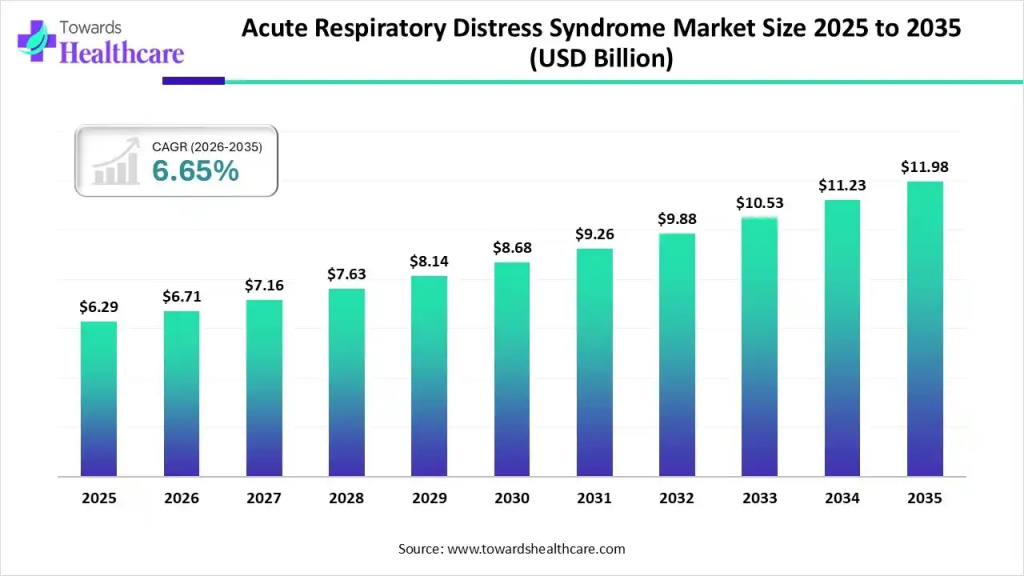
The global acute respiratory distress syndrome (ARDS) industry is entering a period of steady transformation as healthcare systems focus on faster diagnosis, advanced respiratory support, and more personalized treatment approaches. Valued at USD 6.29 billion in 2025, the industry is expected to reach approximately USD 11.98 billion by 2035, expanding at a 6.65% CAGR from 2026 to 2035.
The rising burden of severe respiratory infections, pneumonia, sepsis, trauma, and other critical illnesses is increasing the need for effective ARDS management. At the same time, advancements in mechanical ventilation, extracorporeal membrane oxygenation (ECMO), AI-enabled monitoring, and emerging therapies are creating new opportunities for improving patient outcomes.
Key Highlights
- The global ARDS industry is projected to reach USD 11.98 billion by 2035.
- Growth is expected at a 6.65% CAGR between 2026 and 2035.
- North America accounted for approximately 37% of the global share in 2025.
- Asia Pacific is expected to record the fastest growth through 2035.
- Bronchodilators represented the leading drug-class segment in 2025.
- Steroids and antibiotics are expected to witness strong growth.
- Oral administration accounted for the largest share in 2025.
- Inhalation-based treatment is gaining momentum because it delivers medication directly to the lungs.
- Hospital pharmacies remained the leading distribution channel.
- Online pharmacies are expected to expand rapidly as digital healthcare adoption increases.
Understanding Acute Respiratory Distress Syndrome
Acute respiratory distress syndrome is a serious and potentially life-threatening condition in which inflammation and fluid accumulation damage the lungs and interfere with oxygen exchange. Patients may develop ARDS following pneumonia, sepsis, trauma, aspiration, or severe viral and bacterial infections.
Treatment primarily focuses on maintaining adequate oxygen levels and supporting breathing while addressing the underlying cause. Mechanical ventilation, oxygen therapy, medications, fluid management, and ECMO may be used depending on disease severity.
ARDS continues to represent a major challenge in intensive care. The growing number of critically ill and aging patients is increasing demand for advanced respiratory support, better monitoring systems, and more effective therapeutic approaches.
Innovation Is Reshaping ARDS Treatment
The treatment landscape is gradually moving beyond conventional respiratory support toward more targeted and personalized approaches.
Researchers are investigating therapies that can control inflammation, reduce lung injury, and support tissue recovery. Cellular therapies, novel anti-inflammatory medicines, biomarkers, and precision treatment strategies are among the areas receiving increasing attention.
Technology is also becoming an important part of critical care. Advanced ventilators can provide more precise respiratory support, while ECMO can temporarily take over critical oxygenation and carbon dioxide removal in patients with severe respiratory failure.
Wearable respiratory monitoring devices and connected ICU systems may further improve continuous patient observation and help clinicians respond to deterioration more quickly.
How AI Is Transforming ARDS Care
Artificial intelligence is emerging as an important tool for improving the diagnosis and management of ARDS.
AI systems can analyze large volumes of clinical information, including respiratory patterns, lung mechanics, blood gas measurements, imaging data, and patient histories. These capabilities can help clinicians identify high-risk patients, predict disease progression, estimate mortality risk, and support treatment decisions.
AI-enabled monitoring may also help optimize ventilation parameters in real time. By combining continuous patient data with predictive analytics, healthcare teams can potentially identify changes earlier and deliver more personalized respiratory support.
Key Trends Shaping the Future
Personalized Treatment
ARDS does not affect every patient in the same way. Differences in disease severity, underlying conditions, inflammatory responses, and causes of lung injury are encouraging researchers to explore more personalized treatment strategies.
Novel Drug Therapies
Corticosteroids, neuromuscular blockers, inhaled pulmonary vasodilators, and other pharmacological approaches continue to attract research interest. New therapies are being evaluated for their potential to reduce inflammation, improve oxygenation, and support recovery.
Growing Role of ECMO
Extracorporeal membrane oxygenation has become an important option for selected patients with severe respiratory failure. ECMO can provide oxygenation and remove carbon dioxide while allowing the lungs to rest.
Continued improvements in ECMO equipment, patient selection, and clinical protocols could expand its role in critical care.
Drug-Class Insights
Bronchodilators accounted for approximately 24% of the global share in 2025, making them the leading category. These medicines help relax airway muscles and improve airflow in patients experiencing respiratory difficulties.
The steroids and antibiotics category is expected to experience strong growth. Corticosteroids can help control inflammation, while antibiotics play an important role when bacterial infections contribute to respiratory complications.
Other important treatment categories include vasoconstrictors, nitric oxide, sedatives and paralytics, surfactants, and supportive therapies.
Route of Administration
The oral route represented approximately 40% of the share in 2025. Its convenience, affordability, and widespread availability contribute to its continued use.
However, inhalation-based delivery is gaining momentum. Delivering medication directly to the lungs can provide targeted exposure while potentially reducing the systemic effects associated with some oral medications.
Distribution Channel Insights
Hospital pharmacies accounted for approximately 58% of the share in 2025. ARDS patients generally require intensive medical supervision, making hospitals a central point for medication management and respiratory treatment.
Meanwhile, online pharmacies are expanding rapidly as digital healthcare adoption increases. Improved home delivery, digital prescriptions, online consultations, and easier access to medicines are supporting this shift.
North America Leads the Global Landscape
North America represented approximately 37% of the global share in 2025. Advanced healthcare infrastructure, high critical-care spending, strong clinical research capabilities, and the presence of leading pharmaceutical and biotechnology companies are supporting regional growth.
The United States remains a major center for ARDS research and clinical development. Increasing investment in pharmaceutical and biotechnology research is encouraging the development of targeted therapies and advanced critical-care technologies.
Canada Strengthens Critical-Care Capabilities
Canada is witnessing growing demand for advanced respiratory care due to an aging population and increasing cases of severe respiratory infections and critical illness.
Investments in healthcare infrastructure, ECMO availability, mechanical ventilation systems, and clinical research are helping hospitals strengthen their ability to manage severe respiratory conditions.
Asia Pacific Shows Strong Growth Potential
Asia Pacific is expected to record the fastest growth through 2035. A large and aging population, increasing respiratory disease burden, healthcare infrastructure development, and rising investments in biotechnology are contributing to this expansion.
Growing air pollution, tobacco exposure, infectious diseases, and unequal access to advanced healthcare services continue to create significant respiratory health challenges across several countries.
India
India is experiencing increasing demand for advanced respiratory care. Air pollution, infectious respiratory diseases, limited access to specialized critical-care facilities in some areas, and a growing healthcare infrastructure are influencing demand.
Investment in hospitals, diagnostic services, biotechnology research, and critical-care technologies is expected to support further development.
China
China is strengthening its respiratory healthcare capabilities through greater investment in critical-care infrastructure, domestic biotechnology research, and advanced medical technologies.
The country’s expanding clinical research ecosystem and increasing adoption of AI-assisted monitoring are creating opportunities for new treatment approaches and improved intensive-care management.
Europe Advances Through Healthcare Innovation
Europe is witnessing steady development supported by strong healthcare systems, increasing chronic disease burdens, and investments in medical research.
The region is also focusing on digital healthcare, advanced critical-care infrastructure, and improved access to specialized treatment. Research organizations and pharmaceutical companies continue to investigate new approaches for managing severe respiratory conditions.
Germany
Germany benefits from advanced hospitals, strong biomedical research capabilities, and widespread access to intensive-care technologies. ECMO, advanced ventilation systems, and clinical research programs are supporting the country’s role in respiratory care innovation.
United Kingdom
The UK continues to strengthen its healthcare and life sciences ecosystem through research partnerships, digital technologies, and investments in advanced medical infrastructure.
Universities, hospitals, and biotechnology companies are actively involved in developing improved approaches for critical-care management.
Competitive Landscape
The global ARDS treatment ecosystem includes pharmaceutical companies, biotechnology firms, research organizations, and technology providers working on therapies, respiratory support systems, and diagnostic technologies.
Key companies include:
- Athersys Inc.
- mondoBIOTECH AG
- HEALIOS K.K.
- GSK plc.
- Pfizer Inc.
- Teva Pharmaceuticals USA Inc.
- Altor BioScience
- Faron Pharmaceuticals Ltd.
These companies are exploring areas such as cellular therapies, anti-inflammatory treatments, respiratory medicines, biomarkers, and advanced critical-care solutions.
Recent Industry Developments
In October 2025, Edesa Biotech reported positive Phase 3 research results for paridiprubart (EB05), an investigational therapy being studied for acute respiratory distress syndrome.
In December 2025, HEALIOS K.K. announced its development strategy for HLCM051, prioritizing its potential use in ARDS treatment.
Athersys has also been evaluating MultiStem cell therapy in clinical research involving ARDS associated with COVID-19 and other pathogens.
These developments highlight the growing focus on regenerative medicine, cellular therapies, and targeted treatments for severe respiratory conditions.
Opportunities Ahead
Several areas could shape the next phase of ARDS treatment and healthcare innovation:
- AI-assisted diagnosis and patient monitoring
- Precision respiratory care
- Advanced mechanical ventilation
- ECMO technology
- Cellular and stem cell therapies
- Novel anti-inflammatory medicines
- Biomarker-based diagnosis
- Remote respiratory monitoring
- Personalized treatment protocols
- Digital ICU technologies
Together, these developments could help healthcare providers detect deterioration earlier, optimize treatment decisions, and improve outcomes for critically ill patients.
Challenges
Despite technological progress, ARDS remains difficult to treat because of its complex and heterogeneous nature.
High treatment costs, limited access to advanced ICU technologies, the need for highly trained healthcare professionals, and the absence of a universally effective disease-modifying therapy continue to present challenges.
The complexity of ARDS biology also makes drug development particularly difficult. Differences in disease causes and patient responses require carefully designed clinical research and more precise patient selection.
Future Outlook
The future of ARDS care is expected to be shaped by a combination of advanced respiratory support, precision medicine, artificial intelligence, cellular therapies, and improved clinical research.
As healthcare providers increasingly adopt connected monitoring systems and data-driven decision-making, the ability to identify high-risk patients and personalize treatment may improve.
At the same time, expanding healthcare infrastructure in emerging economies and increasing investment in critical-care technologies are expected to create new opportunities.
Overall, the global ARDS industry is projected to grow from USD 6.29 billion in 2025 to approximately USD 11.98 billion by 2035, reflecting a broader shift toward smarter, faster, and more personalized respiratory care.
Download Customized Sample: https://www.towardshealthcare.com/download-sample/6603
About Us
Healthcare WebWire is a part of Towards Healthcare Research & Consulting is a global healthcare market research and consulting firm dedicated to helping businesses make informed decisions through reliable market intelligence and strategic insights. We serve pharmaceutical, biotechnology, medical device, AI in healthcare, cell and gene therapy, digital health, and life sciences organizations with in-depth market research, custom consulting, competitive analysis, and growth forecasts. Our team combines industry expertise with rigorous research to deliver clear, actionable insights that support market expansion, product strategy, investment decisions, and long-term business growth. From emerging innovations to established healthcare markets, we help organizations understand where the industry is today and where it’s headed tomorrow.
You can place an order or ask any questions, please feel free to contact us at [email protected]
Europe Region – +44 778 256 0738
North America Region – +1 8044 4193 44
APAC Region: +91 9356 9282 04
Visit Our Website: Towards Healthcare Research & Consulting – Expert Consulting Solutions & Research Reports
Find us on social platforms: LinkedIn | Twitter | Instagram | Medium