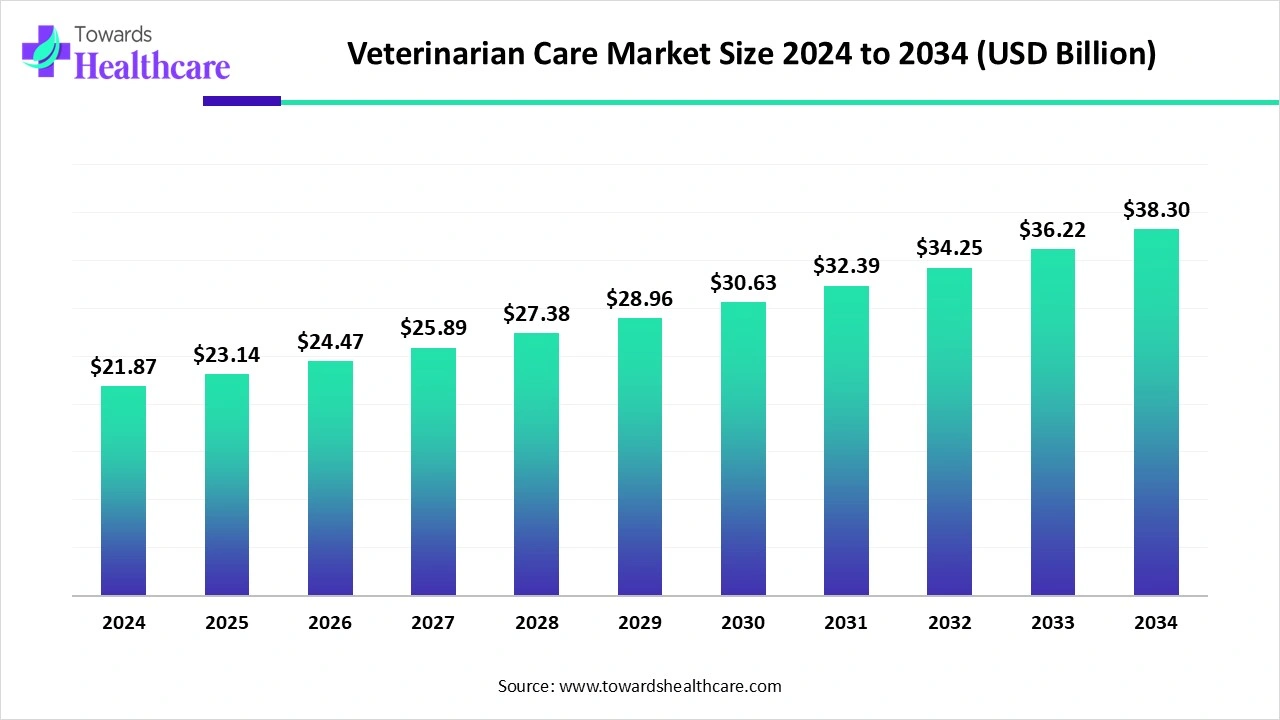
The global veterinarian care market was US$21.87 billion in 2024, is set to reach US$23.14 billion in 2025, and is forecast to hit US$38.3 billion by 2034 at a 5.75% CAGR (2025–2034), led by North America (42% share, 2024), with APAC growing fastest; preventive & wellness (36% share), companion animals (61% share), private clinics (48% share) and in-clinic care are today’s revenue anchors, while specialty services, equine, mobile and home/on-site care scale quickest.
Download the free sample and get the complete insights and forecasts report on this market @ https://www.towardshealthcare.com/download-sample/6158
Market size
Baseline & horizon
●2024: US$21.87Bn
●2025: US$23.14Bn
●2034: US$38.3Bn
●Absolute value creation (2024→2034): US$16.4Bn
●Annual trajectory (from 2025 base @ 5.75% CAGR)
●2026: US$24.47Bn
●2027: US$25.88Bn
●2028: US$27.37Bn
●2029: US$28.94Bn
●2030: US$30.60Bn
●2031: US$32.36Bn
●2032: US$34.22Bn
●2033: US$36.19Bn
●2034: US$38.30Bn
Current revenue anchors (2024 mix indicators)
●Preventive & wellness: 36%
●Companion animals: 61%
●Private veterinary clinics: 48%
●Mode: In-clinic care largest
Market trends
Telemedicine normalization
●24/7 virtual access and remote triage expanding reach and lowering stress.
●Evidence: Greencross (Sep 2025) deployed Heidi Health (AI documentation); Vetster (Oct 2024) partnered with Mella to deliver 24/7 care via app across the U.K., Canada, U.S.
AI-assisted clinical productivity
●Ambient scribing, decision support, scheduling optimization embedded into clinic workflows (e.g., Heidi Health use case above).
Regenerative & advanced therapies
●Wider adoption of PRP / stem-cell for ortho and soft-tissue cases.
●Evidence: Endurance Technologies (Aug 2025) launched Endoret PRGF PRP system for clinics, specialty centers, rehab.
Network expansion & consolidation
●New multi-specialty hospitals and urgent care nodes increase availability and case acuity handling.
●Evidence: Chewy Vet Care opened in Austin (Mar 2025); OSU announced US$250M 255k-sq-ft vet teaching hospital (May 2025); Mumbai 100-bed municipal hospital plan (Aug 2025); North Carolina US$2.5M community clinic (2025).
Humanization of pets drives premiumization
●Preventive plans, wellness subscriptions, nutrition counseling, diagnostics bundles.
Insurance uptake
●Higher coverage → greater acceptance of diagnostics/specialty procedures; supports revenue stability in North America.
Mobile & home/on-site care surge
●Doorstep vaccinations, monitoring, minor procedures; fastest growth on convenience and low-stress handling.
Specialty services outpacing general practice
●Oncology, cardiology, orthopedics, critical care rising with improved imaging and surgical capabilities.
Operational resilience focus
●Practices adopt inventory analytics, staffing tools, and standardized SOPs to mitigate regulatory/economic pressures.
Ecosystem partnerships
●Platforms and GPOs enabling independents with tech, training, pricing power (e.g., VerticalVet–Zomedica, Aug 2025).
10 ways AI impacts this market
Diagnostic decision support
●Pattern recognition on imaging/labs + longitudinal EMR context to flag early disease; reduces misdiagnosis and repeat visits.
Triage & load balancing
●AI chat/voice agents route cases to tele-consult, urgent, or specialty; cuts wait times and improves case mix.
Ambient clinical documentation
●Real-time scribe auto-generates SOAP notes, codes, discharge summaries; frees 15–30% clinician time for care.
Predictive care plans
●Risk scores from breed/age/lab history → proactive screenings, vaccine schedules, diet plans; boosts wellness plan adherence.
Imaging automation
●Auto-measurements (e.g., cardiac indices), lesion detection on radiographs/ultrasound; standardizes quality across sites.
Inventory & procurement optimization
●Demand forecasting for meds/consumables reduces stockouts, shrink, and working capital.
Revenue cycle intelligence
●Eligibility checks, code suggestions, denial prediction; higher clean-claim rates and faster cash conversion.
Staffing & rota optimization
●Schedule models align surgeon/ER availability with forecasted case loads; lowers overtime and burnout.
Client engagement & retention
●Personalized reminders, AI chat follow-ups, adherence nudges; lifts revisit rates and preventive compliance.
Quality & outcomes benchmarking
●Cross-clinic analytics (complication rates, LOS, readmits) surface best practices; feeds continuous improvement.
Regional insights
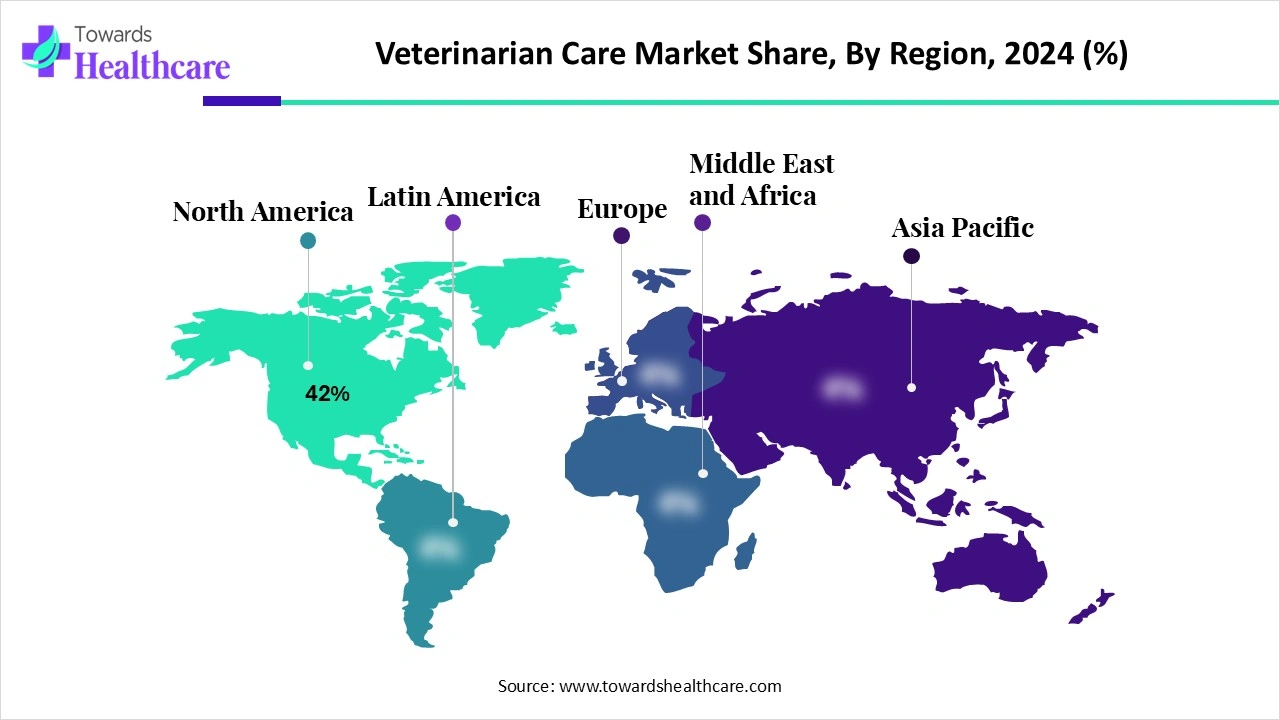
North America (2024 share 42%)
Demand drivers: High companion animal ownership, strong pet insurance penetration, willingness to pay for premium care.
Infrastructure: Dense networks of clinics/hospitals and specialty ERs; integrated diagnostics and tele-vet platforms.
Ecosystem moves: New nodes like Chewy Vet Care (Mar 2025); academic expansion (OSU US$250M hospital).
Outlook: Mature but still expanding via specialty, urgent care, and AI-enabled efficiency.
Asia Pacific (fastest growth)
Macro: Rising disposable income, urban pet adoption, growing welfare awareness.
Access expansion: New hospitals in metros (e.g., Mumbai 100-bed plan), mobile/tele-vet to penetrate peri-urban/rural.
Capability lift: Investment in vet education, gradual insurance introduction; strong runway in diagnostics and specialty.
Europe
Market shape: Consolidated chains alongside strong independent clinics; high standards of welfare and regulation.
Focus: Specialty referrals, preventive programs, and cross-border diagnostic platforms; AniCura and others scale ER/specialty.
Latin America
Trajectory: Growing companion animal spend; opportunity in wellness plans, vaccinations, and diagnostics access.
Middle East & Africa
Build-out: Emerging specialty and referral facilities in GCC; mobile/tele-vet to extend reach; import-heavy diagnostics.
Market Dynamics
DRIVERS
1) Pet ownership & humanization → durable preventive revenue
Commercial effect: With preventive & wellness at 36% of 2024 revenue, clinics lock in predictable, high-margin, subscription-like flows (vaccines, parasite control, checkups).
Unit economics: Preventive plans lower cost per visit (standardized protocols) and lift lifetime value via earlier diagnostics referrals (lab + imaging uplift).
Pricing power: Humanization supports premium offerings (nutrition consults, dental, dermatology), improving mix even when visit volumes plateau.
Execution plays:
●Bundle wellness + diagnostics (annual CBC/Chem/UA + dental screening).
●Loyalty & reminders to lift adherence (vaccination windows, parasite seasonality).
●Breed/age risk stratification to personalize plans.
2) Capacity build-out & network effects (OSU US$250M, NC US$2.5M, Mumbai 100-bed, Chewy Vet Care Austin)
Supply expansion: New nodes add clinical throughput and case acuity capacity (ER, surgery, specialty) → higher average revenue per case (ARPC).
Referral flywheel: Teaching/research hospitals (OSU) and large municipal/retail-linked sites (Mumbai, Chewy) become regional gravity wells, increasing downstream imaging, surgery, and rehab volumes.
Talent magnet: Flagship facilities attract specialists (oncology, cardio, ortho), enabling service-line growth (your data: specialty services fastest-growing).
Execution plays:
Design spoke-to-hub pathways (GP → ER/Specialty) with shared EMR and SOPs.
Co-locate diagnostics to compress “order-to-result” times and lift conversion.
3) Technology adoption at the point of care (tele-vet, AI documentation at Greencross)
Throughput & access: Tele-triage + virtual follow-ups decongest clinics, preserve in-clinic slots for procedures (your data: in-clinic is largest mode).
Admin relief: AI scribing (e.g., Heidi Health) shrinks documentation time, enabling more consults per clinician/day without eroding quality.
Care continuity: Tele-vet + remote monitoring (e.g., app-based vitals) reduce lapses between visits, reinforcing preventive plan adherence.
Execution plays:
Route routine follow-ups/behavior/nutrition to tele-tracks.
Standardize AI-assisted SOAP templates; audit for compliance and coding accuracy.
RESTRAINTS
1) Regulatory complexity & welfare compliance → higher non-clinical load
Cost centers: Licensing, facility standards, controlled drug handling, data privacy, and welfare audits increase overhead per site.
Operational drag: Variability across jurisdictions complicates multi-region SOPs; slows rollouts of mobile/home services (fastest-growing mode).
Mitigations:
Central compliance PMO; unified policy library and training cadence.
Pre-deployment checklists for mobile/home units (cold-chain, biohazard, consent).
EMR audit trails + AI prompts to enforce documentation completeness.
2) Economic cyclicality → deferral of discretionary procedures
Demand sensitivity: Elective and non-urgent specialty work (dentals, ortho fixes, oncology workups) is timing-sensitive; consumers may delay in downturns.
Cash flow: Slower approvals on larger estimates without insurance; pressure on AR and cancellations.
Mitigations:
Tiered care plans (good/better/best) + transparent estimates.
Financing/BNPL options and insurance education at point-of-care.
Protect the core: emphasize preventive (36%) to stabilize utilization.
OPPORTUNITIES
1) Untapped markets via mobile and tele-vet (fastest-growing end-user & mode)
White space unlock: Rural/peri-urban areas and dense urban micro-neighborhoods lack convenient access; mobile clinics bridge last-mile logistics.
Cost advantage: Lower fixed costs per additional catchment vs. full brick-and-mortar; route-optimized schedules maximize clinician utilization.
Execution plays:
Hub-and-route design: mobile for vaccines/parasite control + sample collection; complex cases funneled to hubs.
Bundle home/on-site wellness with tele-follow-ups to maintain continuity and upsell diagnostics.
2) Mix upgrade via specialty services (fastest-growing service) & equine (fastest animal growth)
Revenue density: Advanced procedures (oncology, cardio, ortho, dentistry, rehab) drive higher ARPC and stickier referral relationships.
Equine tailwind: Rising investment in breeding/racing/recreation boosts imaging, surgery, and rehab adoption; portability of PRP/stem-cell protocols supports field care.
Execution plays:
Build referral compacts with GP clinics; guaranteed turnaround and consult notes within 24–48h.
Equip equine field teams with portable imaging and regenerative kits (PRP) to capture high-value cases.
3) Platform & partnership leverage (e.g., VerticalVet–Zomedica)
Scale benefits for independents: Access to diagnostics platforms, training, negotiated pricing, and shared analytics raises clinical and financial performance.
Standardization: Shared SOPs and tech stacks enable network-level quality dashboards (outcomes, recheck rates, complications).
Execution plays:
Join/forge alliances for pricing power on consumables/diagnostics.
Benchmark KPIs across peers to drive continuous improvement.
WHAT THIS MEANS FOR OPERATORS
Protect the core 36%: Expand wellness-plan tiers; include annual labs + dental screening to push earlier detection and specialty referrals.
Exploit modality arbitrage: Shift routine consults to tele-vet/home to free in-clinic capacity for higher-margin procedures.
Invest where growth is fastest: Stand up specialty lines and equine field capabilities; align marketing with referral partners.
Standardize with AI: Roll out ambient scribing + coding prompts; measure note time, claim acceptance, and recheck compliance.
De-risk compliance: Centralize regulatory tracking; use EMR hard stops for consent, controlled-substance logs, and welfare checks.
KPIs & LEADING INDICATORS
Growth drivers
Wellness plan penetration (% of active clients; target steady YoY lift).
Tele-to-in-clinic conversion (triage accuracy → procedure bookings).
Specialty case mix (% of total revenue; rising share confirms mix upgrade).
Restraints control
Admin minutes per consult (post-AI target: sustained reduction).
Compliance audit pass rate (first-time pass %) and incident rate.
Cancellation/deferral rate on estimates > set thresholds during soft demand.
Opportunity capture
Mobile route yield (revenue/route/day; revisit rates).
Equine ARPC and field procedure uptake (PRP, imaging, rehab).
Referral turnaround (time to consult, report quality scores).
RISK SCENARIOS & RESPONSES
Downturn shock: Spike in deferrals → activate “value tier” care bundles, financing offers, and focus marketing on preventive ROI.
Regulatory tightening: New welfare or mobile-care rules → preempt with policy blueprints and modular compliance kits for vans/home visits.
Talent scarcity in specialty: Competes up wages → grow internal fellowships, tele-specialist overlays, and case-review programs to scale expertise.
Top 10 companies
Banfield Pet Hospital (Mars, Inc.)
Product/Focus: Preventive plans, primary care at scale across hundreds of clinics.
Overview: Largest companion-animal GP network.
Strengths: National footprint, standardized protocols, data scale.
VCA Animal Hospitals (Mars, Inc.)
Product/Focus: GP + specialty + emergency, reference labs access.
Overview: Broad U.S./Canada presence.
Strengths: Referral pathways, integrated diagnostics, training.
BluePearl Specialty & Emergency (Mars, Inc.)
Product/Focus: 24/7 ER, oncology, cardiology, surgery.
Overview: Specialty/ER leader.
Strengths: Complex case management, advanced imaging.
National Veterinary Associates (NVA)
Product/Focus: Community of independent-style hospitals.
Overview: Large multi-brand operator.
Strengths: Local practice autonomy with central ops support.
Greencross Vets
Product/Focus: Clinics across Australia; wellness and integrated retail.
Overview: Leading APAC network.
Strengths: Tech adoption (e.g., Heidi Health), preventive programs.
IDEXX Laboratories (diagnostics-focused)
Product/Focus: In-clinic analyzers, reference labs, imaging software.
Overview: Diagnostics backbone for clinics.
Strengths: Installed base, innovation cadence, data services.
CVS Group plc
Product/Focus: U.K./EU practices, referrals, labs.
Overview: Consolidated European operator.
Strengths: Integrated services, specialist centers.
MedVet Associates
Product/Focus: Specialty and ER hospitals.
Overview: U.S. referral network.
Strengths: High-acuity care, clinician depth.
Thrive Pet Healthcare (Pathway Vet Alliance)
Product/Focus: GP + specialty, membership wellness, urgent care.
Overview: U.S. multi-format provider.
Strengths: Value access models, unified CRM/EMR.
AniCura (Mars, Inc., Europe)
Product/Focus: Specialty, referral, and advanced diagnostics.
Overview: Pan-European network.
Strengths: Consistent quality standards, ER/specialty scale.
Latest announcements
VerticalVet × Zomedica (Aug 2025): Partnership to equip independent practices with advanced platforms to improve clinical outcomes and operational efficiency.
FoW Partners / Elevated Veterinary Solutions (Sep 2025): Workforce-centric, tech-powered clinic growth platform to expand access to care.
Recent developments
Elanco (Feb 2025): Launched Pet Protect—vet-designed supplements for dogs and cats to tap fast-growing pet nutraceuticals.
Greencross (Sep 2025): Expanded Heidi Health AI documentation across its network to speed consults and reduce admin.
Vetster × Mella (Oct 2024): 24/7 tele-vet via Mella app in U.K., Canada, U.S.
Endurance Technologies (Aug 2025): Endoret PRGF—advanced PRP system for clinics, specialty centers, rehab.
Chewy Vet Care (Mar 2025): New Austin clinic combining wellness, urgent care, and surgery.
Capacity build-outs (2025): OSU US$250M new vet hospital; North Carolina US$2.5M community clinic; Mumbai 100-bed municipal hospital plan.
Segments covered
By Service Type
Preventive & Wellness (36% share, 2024): Vaccinations, checkups, parasite control; recurring revenue foundation.
Diagnostics & Imaging: Lab testing; X-ray, ultrasound, MRI/CT; enables early detection and specialty referrals.
Surgery & Emergency: Acute/critical interventions; high value per case.
Specialty Services (fastest growth): Orthopedics, oncology, cardiology, dermatology, dentistry, rehab/PT—driven by tech and owner willingness to pay.
By Animal Type
Companion animals (61% share, 2024): Dogs, cats, others; highest visit frequency and spend per pet.
Livestock: Cattle, swine, poultry, small ruminants; herd health and productivity services.
Equine (fastest growth): Sports/recreation care; imaging, surgery, rehab adoption rising.
By End User
Private veterinary clinics (48% share, 2024): Accessible, relationship-centric GP care.
Veterinary hospitals: Multi-specialty and ER capabilities; referral hubs.
Mobile veterinary services (fastest growth): Doorstep convenience; vaccinations, wellness, minor procedures.
Academic & research institutions / Others: Teaching hospitals, shelters, NGOs, military services.
By Mode of Service
In-clinic care (largest): Full equipment, controlled environment for diagnostics/surgeries.
Home/on-site (fastest growth): Convenience, low-stress handling, enabled by portable diagnostics.
Tele-veterinary: Triage, follow-ups, chronic management; 24/7 access.
By Region
North America (42% share, 2024), Europe, Asia Pacific (fastest), Latin America, Middle East & Africa—see regional insights above for growth drivers.
Top 5 FAQs
-
What is the market size now and in the future?
US$21.87Bn (2024) → US$23.14Bn (2025) → US$38.3Bn (2034) at 5.75% CAGR (2025–2034). -
Which region leads today?
North America with 42% share (2024); APAC grows fastest. -
Which segments lead and which grow fastest?
Lead: Preventive & wellness (36%), companion animals (61%), private clinics (48%), in-clinic care.
Fastest: Specialty services, equine, mobile services, home/on-site care. -
What’s driving growth?
Rising pet ownership/humanization, clinic network expansion (OSU US$250M, Chewy Vet Care, Mumbai 100-bed), tele-vet normalization, AI-enabled productivity. -
How is AI changing vet care?
From diagnostic support and ambient scribing to predictive care plans, triage, inventory/RCM, and quality benchmarking—improving access, accuracy, and margins.
Access our exclusive, data-rich dashboard dedicated to the therapeutic area sector – built specifically for decision-makers, strategists, and industry leaders. The dashboard features comprehensive statistical data, segment-wise market breakdowns, regional performance shares, detailed company profiles, annual updates, and much more. From market sizing to competitive intelligence, this powerful tool is one-stop solution to your gateway.
Access the Dashboard: https://www.towardshealthcare.com/access-dashboard
Immediate Delivery Available | Checkout this Premium Research Report @ https://www.towardshealthcare.com/checkout/6158
Become a valued research partner with us – https://www.towardshealthcare.com/schedule-meeting
You can place an order or ask any questions, please feel free to contact us at [email protected]
Powering Healthcare Leaders with Real-Time Insights: https://www.towardshealthcare.com/healthcare-intelligence-platform
Europe Region – +44 778 256 0738
North America Region – +1 8044 4193 44
APAC Region: +91 9356 9282 04
Web: https://www.towardshealthcare.com
Find us on social platforms: LinkedIn | Twitter | Instagram | Medium | Pinterest