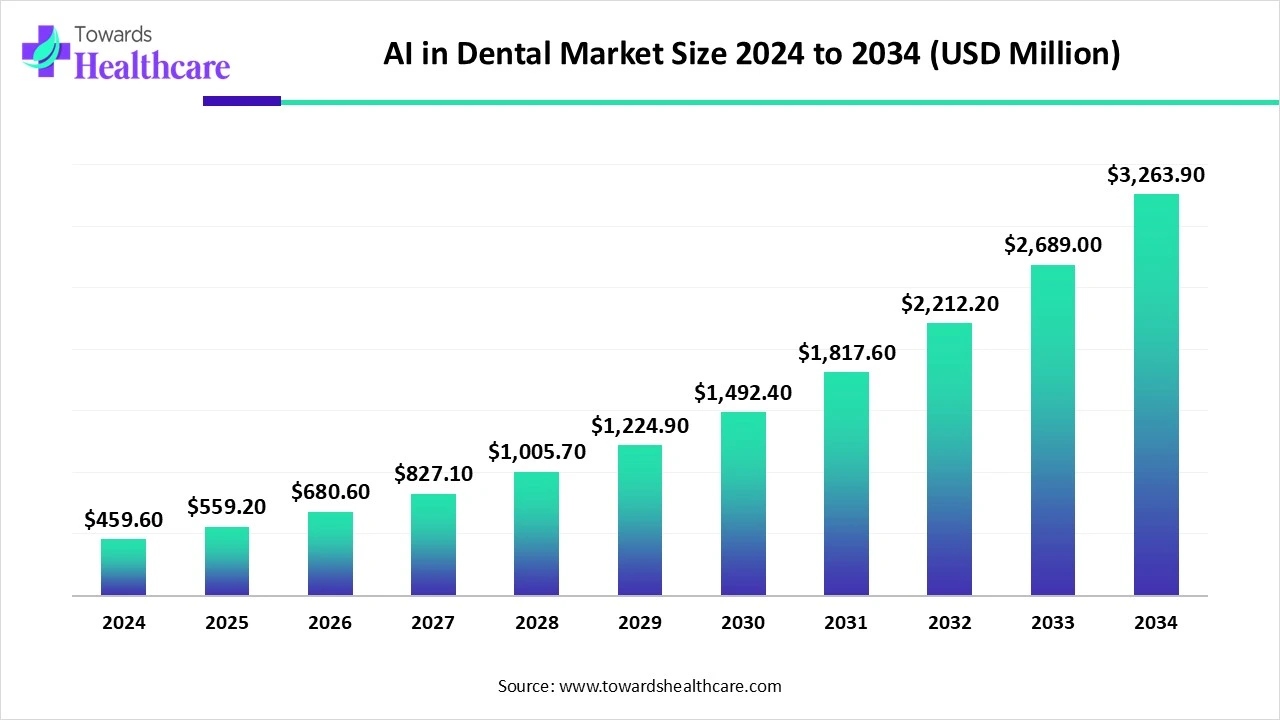
The global AI in dental market is US$ 459.6 Mn (2024), US$ 559.2 Mn (2025), and is set to hit US$ 3,263.9 Mn by 2034—a 7.1× scale-up, compounding at 21.78% (2025–2034).
Download the free sample and get the complete insights and forecasts report on this market @ https://www.towardshealthcare.com/download-sample/6142
Market Size
Current & Near-term Levels
●2024: US$ 459.6 Mn (base year).
●2025: US$ 559.2 Mn; +US$ 99.6 Mn vs. 2024 (21.7% YoY).
Long-term Trajectory
●2034: US$ 3,263.9 Mn; +US$ 2,804.3 Mn absolute increase vs. 2024.
Growth multiple: 7.1× (2034 vs. 2024).
●Incremental opportunity (2025→2034): US$ 2,704.7 Mn.
●Milestones (implied by CAGR 21.78%)
●Crosses US$ 1 Bn: 2028.
●Acceleration drivers: digitization of imaging, cloud deployments, DSO standardization, payer/claims AI.
Price/Value Mix
●Rapid software subscription adoption (cloud) outpacing one-time licenses (on-prem), lifting recurring revenue share.
Customer Mix Trend
●DSOs/Group practices expand faster than solo clinics, concentrating demand for enterprise-grade AI.
Market Trends
●Diagnostic precision mainstreams: AI boosts detection of caries, perio issues, and pathologies from 2D/3D images, improving case acceptance and outcomes.
●Cloud-first orchestration: Cloud dominates deployments in 2024 and remains fastest-growing, enabling real-time analysis, centralized data, and scalable multi-site rollouts.
●Revenue cycle automation: AI enters claims/RCM, cutting denials and documentation gaps (e.g., ClaimsAI launches) and unlocking lost revenue.
●Training & adoption flywheel: Credentialed AI training for dental professionals (e.g., VA series) accelerates responsible adoption.
●Chairside decision support: Real-time CADe on radiographs and integrated treatment insights increase productivity and reduce variability.
●Virtual consults & patient engagement: AI enhances remote triage, case presentation, and follow-ups; boosts conversion and retention.
●Predictive analytics: Risk scoring for caries/perio and recall optimization reduces emergency visits and improves scheduling yield.
●Workflow automation: From documentation to insurance narratives, AI trims admin time, letting clinicians focus on care.
●Interoperability with practice platforms: Smart dental platforms bundle imaging AI + PMS/CRM to unify operations.
●Orthodontics & prosthodontics acceleration: AI-guided simulation/design shortens treatment cycles and improves fit/esthetics—fastest-growing solution cluster through 2034.
10 Deep AI Roles/Impacts in Dental
●Early lesion detection: Finds incipient caries/periodontal changes missed by the naked eye; elevates preventive care.
●Consistency & quality control: Reduces diagnostic variability across providers/locations, aiding DSOs in standardizing care.
●Treatment planning optimization: AI simulates tooth movement/prosthetic fit, minimizing refinements and remakes.
●Chairside time compression: Instant reads on radiographs and auto-charting reduce appointment lengths.
●Case acceptance uplift: Visual AI annotations improve patient understanding, boosting acceptance of recommended care.
●Insurance readiness: Auto-generated narratives and annotated evidence cut denials and resubmissions.
●Throughput & revenue lift: More accurate scheduling, fewer no-shows, and better hygiene recall via predictive analytics.
●Training & upskilling: Structured AI curricula (ADA-accredited examples) help clinicians adopt new workflows safely.
●Data-driven DSOs: Centralized cloud data enables benchmarking across hundreds of operatories; informs procurement and training.
●Tele-dentistry & access: Remote triage + AI review expand access in underserved areas, especially across APAC and rural North America.
Regional Insights
North America (dominant, 2024)
Drivers
●High digital dentistry adoption; chronic tooth decay prevalence in children/adults.
●Mature DSO landscape seeking standardized AI across multi-site networks.
●Robust health IT investment and payer pressures driving RCM AI.
Illustrative move
Guardian Dentistry Partners selecting cloud PMS and Pearl’s AI to modernize 160+ practices.
Asia Pacific (fastest growth, 2025–2034)
Why fastest
●Rising dental caries/periodontal disease, large aging base; expanding healthcare spend.
●Government support for digital health; clinics leapfrog to cloud.
Country notes
●China: Policy push for quality dental care; caries/periodontal disease remain major burdens.
●India: Low awareness/infrastructure gaps create demand for AI triage and efficient care pathways.
Europe (notably growing)
Context
●High tooth loss prevalence; strong insurance/Govt programs improve affordability of AI-enhanced care.
●Country note
●Germany: Strong prevention outcomes in youth; high prosthetic costs make AI-optimized planning attractive.
U.S. & Canada snapshots
●U.S.: Workforce shortages in dental health areas → tele-dentistry + AI scale access; education platforms expand.
●Canada: Rising dental care utilization with higher incomes/education; emphasis on affordable access supports AI adoption.
Latin America & MEA (emerging)
Focus
●Private chains/urban centers pilot AI first; cloud reduces capex barriers; gradual regulatory clarity to follow.
Market Dynamics
Drivers
●Rising prevalence of caries, perio disease, tooth loss, and oral cancers; earlier detection benefits are significant.
●Cloud scalability enables real-time analysis and multi-location standardization; DSOs drive procurement.
●Evidence-based dentistry & patient experience expectations push adoption of CADe and simulation tools.
Restraints
●Upfront costs and budget constraints for small clinics; change management and training needs.
●Data governance and integration complexity with legacy PMS and imaging stacks.
Opportunities
●Robotic/AI-assisted workflows (prep/design/education) show major time gains.
●RCM/claims AI can recapture sizeable lost revenue in U.S. dentistry.
●Education & accreditation programs lower adoption friction, expanding the addressable base.
Top 10 Leading Innovators
Align Technology, Inc.
Products: Invisalign® clear aligners, iTero® scanners, exocad CAD/CAM; Align X-ray Insights (CADe).
Overview: Digital orthodontics leader expanding into restorative decision support.
Strengths: Massive case dataset, robust hardware–software ecosystem, global brand.
Dentsply Sirona Inc.
Products: Imaging (orthopanoramic/CBCT), SureSmile®, CAD/CAM (CEREC), software suites.
Overview: End-to-end digital dentistry portfolio across clinics and labs.
Strengths: Installed base, integrated workflows, training footprint.
Envista Holdings Corporation
Products: DEXIS imaging & software, Nobel Biocare, Ormco orthodontics.
Overview: Multi-brand platform spanning implants, ortho, imaging.
Strengths: Cross-sell breadth, DSO relationships, upgrade path to AI tools.
Carestream Dental LLC
Products: CS Imaging, intraoral/extraoral/CBCT systems; software integrations.
Overview: Imaging specialist modernizing with AI-ready pipelines.
Strengths: Imaging heritage, broad modality coverage, channel reach.
Planmeca Oy
Products: ProMax®/Viso® imaging, Romexis® software platform, chairside units.
Overview: Premium integrated hardware + software vendor.
Strengths: Seamless ecosystem, clinic ergonomics, R&D cadence.
Henry Schein One
Products: Dentrix®, Denticon (cloud PMS), practice analytics, patient comms.
Overview: Practice management leader embedding AI into ops and engagement.
Strengths: Massive PMS footprint, partner marketplace, DSO contracts.
3Shape A/S
Products: TRIOS® intraoral scanners, Dental System™, ortho/prostho design tools.
Overview: Digital impressions & design pioneer integrating AI features.
Strengths: Scan accuracy, software usability, lab–clinic connectivity.
Overjet Inc.
Products: FDA-cleared radiograph AI, practice & DSO analytics, claims support.
Overview: Clinical + business intelligence on top of imaging AI.
Strengths: Regulatory wins, real-time chairside overlays, DSO scaleouts.
Pearl AI
Products: Second Opinion® (radiograph AI), Practice Intelligence.
Overview: Global dental AI provider, strong cloud integrations.
Strengths: Generalizable models, PMS partnerships, international clearances.
VideaHealth
Products: FDA-cleared caries/perio detection; ClaimsAI (RCM).
Overview: Clinical AI expanding into revenue cycle automation.
Strengths: DSO penetration, enterprise analytics, payer/claims ROI.
Latest Announcements
Align Technology (Mar 2025): Launched Align X-ray Insights (AI CADe) across EU/UK to auto-analyze 2D radiographs, extending beyond orthodontics into restorative insights.
VideaHealth (Jul 2025): Unveiled ClaimsAI, targeting ~US$ 15 Bn in annual U.S. dental revenue leakage via AI-driven documentation/denial reduction.
VA + Partners (Jun 2025): Rolled out an ADA-accredited AI training series for dental professionals—on-demand and free, accelerating clinician readiness.
Guardian Dentistry Partners (Mar 2025): Adopted Denticon (cloud PMS) + Pearl AI across 160+ practices to modernize workflows.
Recent Developments
CareStack × Overjet (Mar 2025): Introduced Smart Dental Platform—unifying patient care, operations, and growth with embedded AI.
Archy (Jun 2025): Launched Archy Intelligence—AI agents tackling top practice pain points (scheduling, comms, ops).
RevenueWell × Mila Health (May 2025): Brought human-like AI assistants to automate up to 90% of patient care management tasks.
RipeGlobal (Jul 2025): Entered U.S. market with cloud-based, hands-on education; 10,000+ professionals, spanning 35 countries.
Laxmi Dental (Aug 2025): Investment in IDBG AI Dent Global to advance AI imaging/diagnostics in India.
ANTECH (May 2025): RapidRead Dental AI for veterinary radiographs (10-minute reads; tooth-by-tooth analysis) showcases cross-domain momentum into human workflows.
Segments Covered
By Solution Type
AI-Powered Imaging & Radiology (dominant in 2024)
Core value: Real-time CADe on 2D/3D (bitewings, periapicals, pano, CBCT) to flag caries, perio bone loss, apical lesions, margin defects.
Primary buyers: DSOs, imaging-heavy clinics, academic centers; secondary—solo practices upgrading sensors/CBCT.
Workflow fit: Auto-ingests DICOMs, overlays findings in the viewer, exports annotated images into clinical notes and insurance narratives.
KPI impact: +5–15% case acceptance, −2–5 min per exam, fewer missed pathologies; improved audit/QA.
Integration stack: PACS/VNA, PMS, claims; SSO, role-based access; cloud analytics across locations.
Pricing norms: Per-op or per-site SaaS; volume tiers for DSOs; occasional imaging-bundle discounts.
Adoption frictions: Radiology liability concerns, model generalizability across sensors/CBCT brands, data privacy reviews.
2034 outlook: Stays the largest revenue pool as AI becomes standard on every radiograph; expansion into 3D segmentation and longitudinal change-tracking.
AI Diagnosis & Treatment Planning
Scope: Multi-modal risk scoring, decision support, and evidence-linked recommendations across caries, perio, endo, surgery.
Who buys: Clinicians focused on comprehensive care plans; DSOs seeking standardized protocols.
Workflow: Pulls chart + images, proposes plan options, estimates time/visits, generates consent and financing alternatives.
KPI impact: Fewer treatment revisions, better chair utilization, higher patient acceptance due to visual explanations.
Risks/controls: Guardrails to maintain clinician authority; transparent rationale and editable outputs.
2034 outlook: Deep links to lab and insurance pre-auth; widespread in mid/large practices.
AI Workflow & Practice Management
Scope: Scheduling automation, no-show prediction, clinical note drafting, eligibility checks, claim scrubbing, analytics.
Economic lever: Converts administrative time into clinical chairtime; mitigates revenue leakage.
Typical wins: −10–30% no-shows in at-risk cohorts; faster claim throughput; standardized SOAP notes.
Data needs: PMS + comms + limited imaging context; benefits from cloud to benchmark across sites.
2034 outlook: Bundled within cloud PMS; “autopilot” back office for DSOs and growing groups.
AI for Orthodontics & Prosthodontics Design (fastest-growing)
What it does: Tooth movement simulation, aligner staging, attachment/force optimization; crown/bridge/implant-prosthesis design with margin detection and occlusal tuning.
Clinical payoffs: Fewer refinements/remakes, shorter chairtime, better fit/esthetics; faster lab cycles.
Dependencies: High-quality scans (IOS/CBCT), calibrated photos, lab/print workflows.
Risk guards: Rule-based constraints to avoid biologically unsafe movements or occlusal interferences.
2034 outlook: AI-first design becomes default; human QA remains, but design cycles compress dramatically.
Predictive Analytics & Risk
Focus: Caries/perio risk, recall timing, peri-implantitis watchlists, patient churn risk, demand forecasting by provider/location.
Value: Right-sized hygiene intervals, smarter outreach, and accurate supply/staffing plans.
Data stack: PMS + imaging metadata + comms history; longitudinal models benefit from cloud.
2034 outlook: Moves from dashboarding to closed-loop automation (auto-recall scheduling, inventory triggers).
By Deployment Mode
Cloud-Based Solutions (dominant & fastest)
Why it wins: Elastic scaling for multi-site DSOs, instant model updates, centralized analytics, easier security posture (managed SOC2/ISO).
Ops advantages: Lower IT overhead, rapid rollout to new operatories, safe model versioning, disaster recovery.
Security/compliance: Encrypted at rest/in transit, fine-grained RBAC, detailed audit logs; regional data residency options.
2034 outlook: Default choice for new deployments; near-real-time benchmarking across hundreds of locations becomes standard.
On-Premise Solutions (steady niche growth)
Who prefers: Clinics with strict data-locality rules, patchy internet, or capex budgeting; imaging rooms needing offline continuity.
Strengths: Deterministic performance on local GPUs/CPUs; operation during outages.
Trade-offs: Slower model updates, heavier IT management, less cross-site analytics.
2034 outlook: Remains important for specific compliance/continuity needs, often in hybrid setups.
By Dental Specialty
Orthodontics (dominant, 2024)
Why: Clear aligner planning, tooth-movement prediction, progress assessment, appointment interval optimization.
Gains: Fewer refinements; clearer patient communication via visual simulations; tighter inventory of attachments/auxiliaries.
Prosthodontics (fastest-growing)
AI roles: Margin detection, emergence profile/occlusion optimization, implant-prosthesis design, esthetic harmonization.
Payoff: Lower remake rates, better first-time fit, reduced chairside adjustments.
Endodontics
Use cases: Periapical radiolucency detection, canal morphology hints on CBCT, case triage.
Outcome: Better case selection, more predictable outcomes, fewer undetected lesions.
Periodontics
Use cases: Automated bone-level measurements, longitudinal change tracking, peri-implantitis surveillance.
Outcome: Objective staging over time; targeted maintenance scheduling.
Oral Surgery
Use cases: 3D segmentation for nerve/sinus proximity, implant planning, graft volume estimation.
Outcome: Safer placement, reduced complications, shorter OR time.
General Dentistry
Use cases: Chairside CADe, automated documentation, recall/risk analytics, claims support.
Outcome: Time savings for clinicians; improved acceptance of comprehensive care plans.
By Distribution Channel
Direct Sales (dominant, 2024)
Why clinics choose it: Solution consulting, enterprise contracting, implementation support, bundled training/validation, and SLA-backed uptime.
DSO angle: Standardized contracts across dozens/hundreds of practices; faster security/legal review cycles.
Online Platforms & Digital Marketplaces (fastest ahead)
Why growing: Self-serve trials, transparent pricing, instant provisioning, rich education (demos, reviews, webinars).
Best fit: Tech-forward solo/mini-groups; add-on modules to existing cloud PMS without long sales cycles.
By Region
North America (lead, 2024)
Market shape: High digital adoption, strong DSO presence, heavy imaging volumes, and active push into AI-assisted RCM/claims.
Execution notes: Frequent cloud rollouts, strong emphasis on compliance, training/credentialing programs accelerate uptake.
Revenue profile: Largest absolute spend; early adopters of integrated “smart platform” stacks.
Asia Pacific (fastest growth, 2025–2034)
Drivers: High disease burden, rapid clinic modernization, government digital-health momentum, and cloud leapfrogging.
Country contours:
China: Policy-led quality upgrades; CBCT/IOS penetration rising; AI aids throughput in urban centers.
India: Access gaps and workforce constraints make AI triage/decision support attractive; strong interest in affordable cloud tools.
Japan/Korea: High imaging standards; precision-driven practices receptive to AI QA and design automation.
Go-to-market: Price-sensitive tiers, multilingual UX, low-IT installs; training and clinical validation localized.
Europe (notably growing)
Context: High tooth-loss prevalence and strong insurance/Gov schemes; rigorous data protection requires clear compliance postures.
Adoption: Imaging AI + prostho design popular; emphasis on auditable, explainable outputs and CE-marked pathways.
Latin America
Pattern: Urban private chains lead adoption; cloud reduces capex barriers; growing interest in AI-assisted aligner planning and claims support.
Needs: Spanish/Portuguese workflows, flexible pricing, offline-tolerant features.
Middle East & Africa (MEA)
Hotspots: GCC private groups and teaching hospitals piloting AI imaging/CBCT analytics; Africa early but mobile-first tele-triage shows promise.
Key asks: Vendor training, local partner support, hybrid cloud/on-prem options.
Top 5 FAQs
-
What is the market size and growth outlook?
US$ 459.6 Mn (2024) → US$ 559.2 Mn (2025) → US$ 3,263.9 Mn (2034) at 21.78% CAGR. -
Which region leads and which grows fastest?
North America leads (2024) on digital adoption/DSOs; Asia Pacific grows fastest (2025–2034) on population needs and policy support. -
What solutions dominate today?
AI-powered imaging/diagnostics dominate 2024; AI in orthodontics & prosthodontics grows fastest through 2034. -
Which deployment wins?
Cloud dominates and expands fastest; on-prem remains relevant for offline continuity and one-time licensing models. -
When does the market cross US$ 1 Bn?
Around 2028, consistent with the 21.78% growth path from US$ 559.2 Mn (2025).
Access our exclusive, data-rich dashboard dedicated to the dental market – built specifically for decision-makers, strategists, and industry leaders. The dashboard features comprehensive statistical data, segment-wise market breakdowns, regional performance shares, detailed company profiles, annual updates, and much more. From market sizing to competitive intelligence, this powerful tool is one-stop solution to your gateway.
Access the Dashboard: https://www.towardshealthcare.com/access-dashboard
Immediate Delivery Available | Checkout this Premium Research Report @ https://www.towardshealthcare.com/checkout/6142
Become a valued research partner with us – https://www.towardshealthcare.com/schedule-meeting
You can place an order or ask any questions, please feel free to contact us at [email protected]
Powering Healthcare Leaders with Real-Time Insights: https://www.towardshealthcare.com/healthcare-intelligence-platform
Europe Region – +44 778 256 0738
North America Region – +1 8044 4193 44
APAC Region: +91 9356 9282 04
Web: https://www.towardshealthcare.com
Find us on social platforms: LinkedIn | Twitter | Instagram | Medium | Pinterest