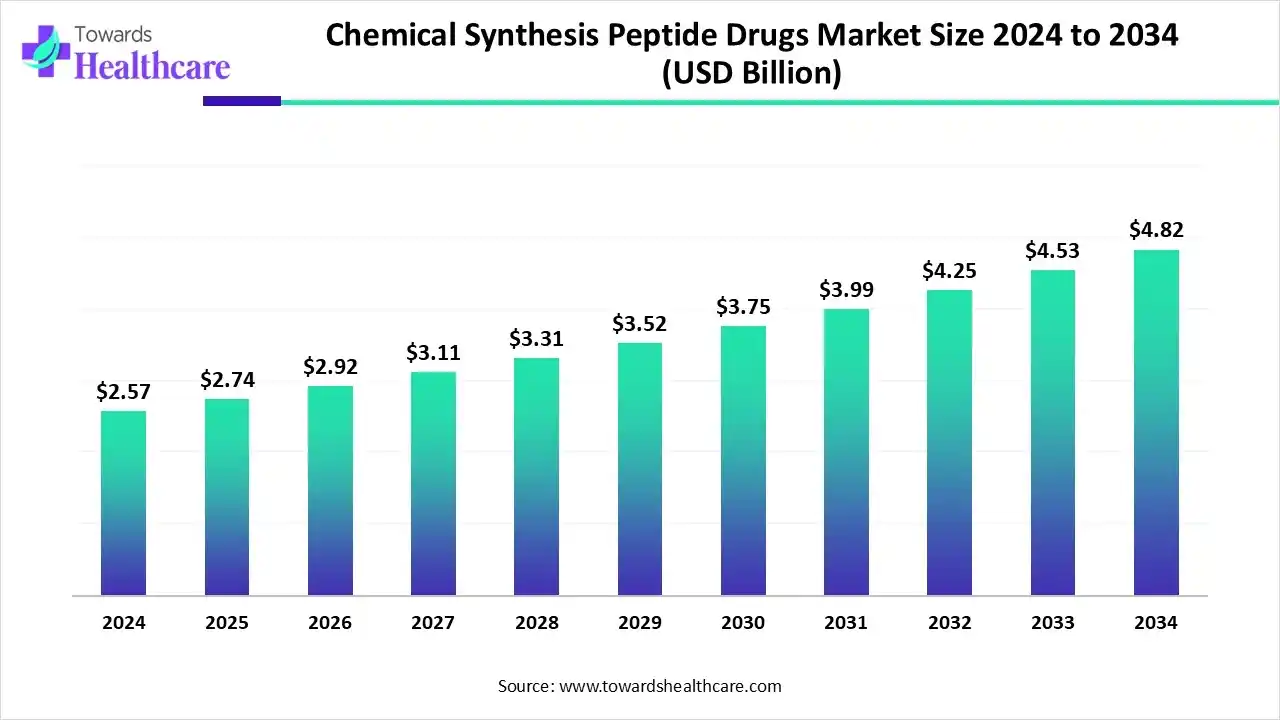
The global Chemical Synthesis Peptide Drugs Market was valued at USD 2.57 billion in 2024, and is expected to grow to USD 2.74 billion in 2025. The market is projected to reach around USD 4.82 billion by 2034, expanding at a CAGR of 6.54% between 2025 and 2034. The key factors driving growth are the increasing prevalence of chronic diseases like cancer and diabetes, technological advancements in peptide synthesis, and the rise in demand for targeted therapies.
Download this Free Sample Now and Get the Complete Report and Insights of this Market Easily @ https://www.towardshealthcare.com/download-sample/6361
Market Size
Market Size in 2024: USD 2.57 Billion
➤The chemical synthesis peptide drugs market was valued at USD 2.57 billion in 2024.
Market Size in 2025: USD 2.74 Billion
➤The market is expected to expand to USD 2.74 billion by 2025.
Projected Market Size in 2034: USD 4.82 Billion
➤By 2034, the market size is projected to reach USD 4.82 billion, growing at a CAGR of 6.54% from 2025 to 2034.
Growth Drivers:
➤Increasing prevalence of chronic diseases.
➤Technological advancements in peptide synthesis and automation.
➤Rise in demand for targeted peptide therapeutics.
Market Trends
Advancements in Synthesis Technologies:
➤Solid-Phase Peptide Synthesis (SPPS) technology dominates the market with approximately 72% market share in 2024, and new developments in sustainable ultrasound-assisted SPPS (SUS-SPPS) are reducing solvent consumption and improving efficiency.
Rise in Automation and AI:
➤Increased automation in peptide synthesis, coupled with AI integration, is improving reproducibility and efficiency. Key players are focusing on leveraging AI platforms for optimized synthesis.
Focus on Green Chemistry:
➤Reduction of solvent use through green chemistry methods is becoming a significant trend in the market. Companies are focusing on using sustainable solvents such as 2-methyltetrahydrofuran and ethyl acetate.
Growth in Custom Peptide Synthesis Services:
➤The demand for custom peptide synthesis services is growing, driven by the need for tailored solutions in pharmaceutical and biotechnology research.
Rise in Demand for Therapeutic Peptides:
➤The therapeutics segment, including peptide-based treatments for cancer, diabetes, and metabolic disorders, dominates with around 70% market share in 2024.
Shift Towards Non-Chemical Synthesis:
➤The non-chemical synthesis segment, particularly recombinant DNA technology, is expected to expand rapidly in the coming years.
Expansion in Emerging Markets:
➤Asia Pacific, especially China and India, is expected to grow at the fastest CAGR due to the high burden of chronic diseases and increased demand for peptide-based therapies.
Technological Innovations:
➤Hybrid-phase peptide synthesis is becoming more popular as it combines the advantages of SPPS and LPPS, offering higher yields and greater effectiveness in complex peptide synthesis.
Focus on Personalized Medicine:
➤Personalized peptide therapies are gaining traction, with India and China emerging as key regions for this development due to their growing research and development facilities.
Investment in Peptide R&D:
➤There is increased investment in peptide R&D, particularly in AI-driven drug discovery, which is expected to lead to the development of novel peptides with improved efficacy and safety profiles.
AI Impact or Role in the Chemical Synthesis Peptide Drugs Market
AI-Driven Drug Discovery:
➤AI technologies are accelerating peptide drug discovery by predicting peptide sequences and optimizing synthesis routes for better efficacy.
Optimization of Peptide Synthesis:
➤AI-driven platforms enhance the optimization of synthesis conditions, improving the quality and yield of peptides during the chemical synthesis process.
Automation of Peptide Manufacturing:
➤AI-enabled automation is revolutionizing large-scale peptide production by reducing human error and speeding up the process.
Enhanced Peptide Libraries Creation:
➤AI assists in creating large peptide libraries for high-throughput screening and identification of therapeutic peptides.
AI for Predictive Analytics:
➤AI models can predict the stability, solubility, and bioavailability of peptides, thus accelerating their development into market-ready therapeutics.
Synthesis Process Monitoring:
➤AI-driven monitoring systems can track the chemical synthesis process in real time, ensuring consistent product quality and reducing waste.
AI in Personalized Peptide Therapy:
➤AI technologies are essential for the development of personalized peptide therapies tailored to individual patient needs, especially in cancer and metabolic diseases.
AI-Optimized Peptide Conjugates:
➤AI is used in the design and optimization of peptide-drug conjugates (PDCs) to enhance drug delivery to specific targets with greater precision.
Accelerating Peptide Characterization:
➤AI tools aid in the rapid characterization and analysis of peptide structures, aiding pharmaceutical companies in advancing peptide-based therapeutics.
Improved Clinical Trial Design:
➤AI tools enhance clinical trial designs for peptide drugs by predicting patient responses and optimizing dosage regimens.
Regional Insights
North America:
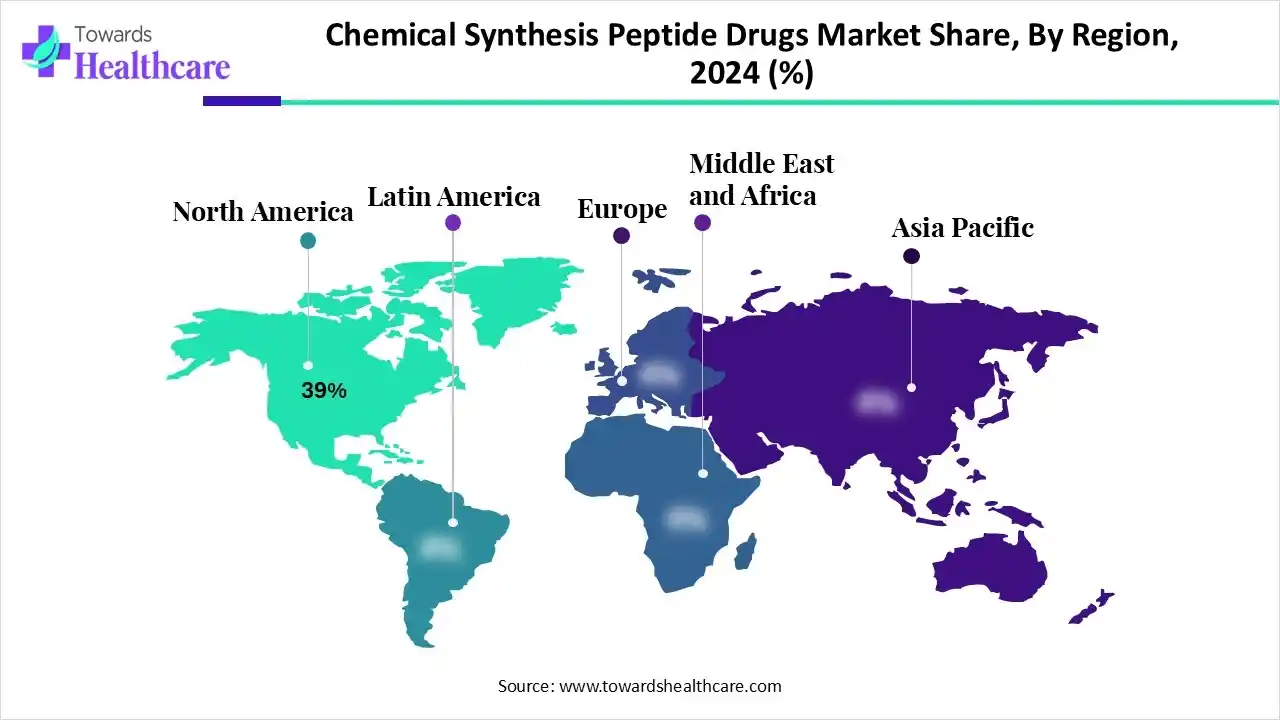
➤Dominated the market in 2024 with a 39% revenue share. The region is driven by rising cases of chronic diseases like cancer and diabetes, along with advancements in peptide therapeutics and the presence of major key players.
➤US Market Trend: The adoption of high-throughput automation for peptide synthesis is expanding rapidly, facilitating faster development and production of peptides.
Asia Pacific:
➤Expected to grow at the fastest CAGR due to a high prevalence of chronic diseases and an increasing demand for peptide-based therapies.
➤China Market Trend: China is focusing heavily on automation to scale up peptide production, especially cyclic peptides and peptide-drug conjugates (PDCs).
➤India Market Trend: India is focusing on personalized medicine and investing heavily in R&D hubs in cities like Bangalore and Hyderabad.
Europe:
➤Europe is seeing significant growth due to innovations in synthetic methods and the use of AI for peptide design. Additionally, the region is increasingly focusing on complex and modified peptides.
➤Germany Market Trend: The German market is emphasizing complex peptides with specialized modifications like PEGylation and lipidation.
Market Dynamics
Driver:
➤Increasing demand for targeted therapies driven by rising incidences of chronic diseases like cancer, diabetes, and metabolic disorders.
Restraint:
➤High production costs associated with chemical synthesis and peptide modification, which limit access to peptide drugs in low-income regions.
Opportunity:
➤Emerging markets, especially in Asia Pacific, present substantial growth opportunities due to rising healthcare expenditure and increasing focus on chronic disease management.
Threat:
➤Competition from biopharmaceutical companies developing alternative biologics like monoclonal antibodies could hinder growth in the peptide drugs market.
Technology Advancements:
➤Innovations like solid-phase peptide synthesis (SPPS) and AI-driven peptide discovery are transforming the manufacturing process, making it more efficient and scalable.
Top 10 Companies in the Chemical Synthesis Peptide Drugs Market
Takeda Pharmaceutical Company Limited
Product: Peptide-based therapeutics.
Overview: Leading global pharmaceutical company.
Strength: Strong presence in oncology and metabolic diseases.
AstraZeneca PLC
Product: Peptide drugs for oncology and diabetes.
Overview: Major player in the oncology and metabolic space.
Strength: Strong pipeline and innovation in peptide drugs.
Bristol-Myers Squibb (BMS)
Product: Peptide-based cancer therapies.
Overview: Focuses on immuno-oncology and peptide therapeutics.
Strength: Strong oncology pipeline.
Merck & Co., Inc. (MSD)
Product: Peptide therapeutics for cancer and metabolic diseases.
Overview: A leader in the healthcare industry with a strong focus on peptide-based therapies.
Strength: Extensive R&D capabilities.
Amgen Inc.
Product: Peptide therapeutics for oncology and cardiovascular diseases.
Overview: Major player in peptide-based drug development.
Strength: Leading in peptide and biologics therapeutics.
PolyPeptide Group
Product: Custom peptide synthesis and therapeutic peptides.
Overview: Specializes in peptide manufacturing and services.
Strength: Expertise in large-scale peptide manufacturing.
Bachem AG
Product: Peptide synthesis services and therapeutics.
Overview: Offers end-to-end peptide manufacturing services.
Strength: Strong focus on quality and sustainability.
Lonza Group Ltd.
Product: Peptide manufacturing and custom peptide synthesis.
Overview: A leading CDMO in the pharmaceutical industry.
Strength: Expertise in complex peptide therapeutics.
CordenPharma
Product: Peptide API manufacturing services.
Overview: Specializes in the development and manufacturing of peptides.
Strength: Strong presence in peptide drug synthesis.
GenScript Biotech Corporation
Product: Custom peptide synthesis services and AI-driven drug discovery platforms.
Overview: Known for advanced peptide synthesis and biotechnology services.
Strength: Integration of AI in drug discovery and peptide synthesis.
Latest Announcements
Bachem:
In February 2025, Bachem started a new large-scale peptide production site in Switzerland.
ProteinQure:
In May 2025, ProteinQure secured an $11 million Series A funding round for advancing its AI-created peptide candidate.
Cytovance Biologics & PolyPeptide:
In January 2025, they announced a partnership to integrate Cytovance’s expertise in microbial and mammalian expression with PolyPeptide’s capabilities in complex peptide manufacturing.
Frequently Asked Questions (FAQs)
What is the size of the Chemical Synthesis Peptide Drugs Market?
The market is valued at USD 2.57 billion in 2024 and is projected to reach USD 4.82 billion by 2034.
What are the major trends in the Chemical Synthesis Peptide Drugs Market?
Major trends include AI-driven drug discovery, green chemistry, automation, and the rise of custom peptide synthesis services.
Which technology is dominating the market?
Solid-Phase Peptide Synthesis (SPPS) dominates the market with a 72% share in 2024.
What regions are driving market growth?
North America, Asia Pacific, and Europe are driving market growth, with Asia Pacific expected to grow at the fastest CAGR.
Who are the key players in the market?
Takeda, AstraZeneca, Merck, Bachem, Lonza are some of the top players in the market.
Segments Covered
1. By Synthesis Method:
Chemical Synthesis
Solid-Phase Peptide Synthesis (SPPS): The most commonly used method, where peptides are synthesized step by step while being anchored to a solid support (resin). This allows for easy purification of the synthesized peptide after each reaction. SPPS dominates the market due to its efficiency and high scalability.
Liquid-Phase Peptide Synthesis (LPPS): Involves the synthesis of peptides in a liquid solution, typically used for small-scale production of peptides. Though less common than SPPS, it is suitable for the synthesis of complex peptides.
Hybrid Phase Synthesis: A combination of SPPS and LPPS, this method aims to combine the benefits of both techniques, offering greater flexibility and higher yield for complex peptide synthesis.
Non-Chemical Synthesis
Recombinant DNA Technology: Involves the use of genetic material to produce peptides in a biological system, such as bacteria or yeast. This method is typically used for the production of large or complex peptides, including biologics.
Group-Assisted Purification Peptide Synthesis (GAP-PS): A newer approach that utilizes group-assisted technology to purify peptides more efficiently, optimizing yield and purity in peptide synthesis, especially for more complex peptide structures.
2. By Synthesis Technology:
Solid-Phase Peptide Synthesis (SPPS)
The dominant technology in peptide synthesis, making up approximately 72% of the market. It allows high efficiency, scalable production, and ease of automation, contributing to its wide use in both research and commercial production. SPPS has the advantage of enabling direct purification of peptides, reducing the complexity of the synthesis process.
Liquid-Phase Peptide Synthesis (LPPS)
LPPS is used primarily for smaller-scale applications and when the peptide is particularly challenging to synthesize. While it offers flexibility in synthesizing certain complex structures, it is not as scalable or cost-efficient as SPPS.
Hybrid Phase Peptide Synthesis
This method integrates the advantages of SPPS and LPPS, providing an optimal solution for complex peptide synthesis. It allows greater efficiency in both small- and large-scale peptide production by balancing the needs for flexibility and scalability.
3. By Product Type:
Reagents & Consumables
Amino Acids: The building blocks of peptides, used in both research and industrial peptide synthesis. Amino acids are essential for the creation of peptide bonds.
Coupling Reagents: These are chemicals that help form peptide bonds between amino acids. Common examples include carbodiimides and other coupling agents used to activate amino acids.
Solvents: Used for dissolving reagents and amino acids, solvents are a critical part of the synthesis process, with green chemistry solutions being increasingly adopted to reduce environmental impact.
Equipment
Peptide Synthesizers: Devices designed to automate the peptide synthesis process. These machines allow for the rapid and efficient production of peptides at various scales, from research-grade to commercial production.
Automated Synthesizers: A specialized type of peptide synthesizer that integrates automation to perform multiple steps simultaneously, increasing throughput and reducing manual labor.
Services
Custom Peptide Synthesis: Custom peptide synthesis services are provided by many companies, allowing researchers and pharmaceutical companies to obtain peptides tailored to specific sequences and applications.
Analytical Services: These services help verify the quality, purity, and structure of synthesized peptides, using techniques like mass spectrometry and HPLC to ensure high standards.
4. By End-User:
Pharmaceutical & Biotechnology Companies
These companies are major consumers of peptide drugs, especially for therapeutic applications such as cancer treatment, diabetes management, and neurological conditions. They rely on peptide synthesis for both R&D and commercialization of peptide-based drugs.
CDMOs/CROs
Contract Development and Manufacturing Organizations (CDMOs) and Contract Research Organizations (CROs) are critical to the peptide synthesis market. They provide outsourced services, including synthesis, purification, and scale-up of peptide production for pharmaceutical and biotech companies.
5. By Application:
Therapeutics
Cancer Therapeutics: Peptide drugs used in cancer treatment often aim to target specific cancer cell types, improving the precision of treatment. These peptides may function as targeted therapies, hormone therapies, or immune modulators.
Diabetes Treatments: Peptide-based drugs are increasingly used in managing diabetes, particularly for the targeted regulation of insulin and glucagon secretion, improving blood sugar control with fewer side effects than traditional treatments.
Diagnostics
Infectious Disease Diagnostics: Peptides are used in diagnostic tests, such as biosensors and immunoassays, to detect biomarkers for infections.
Cancer Biomarker Detection: Peptides play a crucial role in detecting cancer biomarkers, allowing for early diagnosis and targeted therapeutic interventions.
6. By Region:
North America
U.S.: The U.S. dominates the market with significant investments in R&D, a large number of pharmaceutical companies, and high demand for peptide-based drugs in the treatment of chronic diseases.
Canada: Canada is also experiencing growth in the peptide synthesis sector, with strong research and development activities focused on peptide therapeutics for metabolic diseases.
Asia Pacific
China: China is increasing its focus on automating peptide synthesis and expanding its pharmaceutical manufacturing capabilities to meet rising demand for peptides.
India: India is a growing hub for peptide synthesis, supported by a robust pharmaceutical industry and significant investments in peptide therapeutics, particularly for chronic diseases like diabetes.
Japan: Japan is focusing on advanced peptide research and development, including innovations in cyclic peptides and modified peptides for therapeutic use.
Europe
Germany: Germany leads in the development of modified peptides, which are crucial in the treatment of chronic diseases and cancer.
UK, France, and Italy: These countries contribute significantly to the European peptide market, with an emphasis on peptide-based drugs for therapeutic and diagnostic purposes.
Latin America, Middle East & Africa
These regions are expected to see gradual growth in the market, driven by rising healthcare awareness and a growing number of chronic diseases.
Access our exclusive, data-rich dashboard dedicated to the pharmaceuticals industry – built specifically for decision-makers, strategists, and industry leaders. The dashboard features comprehensive statistical data, segment-wise market breakdowns, regional performance shares, detailed company profiles, annual updates, and much more. From market sizing to competitive intelligence, this powerful tool is one-stop solution to your gateway.
Access the Dashboard: https://www.towardshealthcare.com/access-dashboard
Immediate Delivery Available | Checkout this Premium Research Report @ https://www.towardshealthcare.com/checkout/6361
Become a valued research partner with us – https://www.towardshealthcare.com/schedule-meeting
You can place an order or ask any questions, please feel free to contact us at [email protected]
Powering Healthcare Leaders with Real-Time Insights: https://www.towardshealthcare.com/healthcare-intelligence-platform
Europe Region – +44 778 256 0738
North America Region – +1 8044 4193 44
APAC Region: +91 9356 9282 04
Web: https://www.towardshealthcare.com
Find us on social platforms: LinkedIn | Twitter | Instagram | Medium | Pinterest