The human brain protects itself with remarkable precision. At the center of that protection lies the blood-brain barrier (BBB)—a complex biological gatekeeper that filters what enters and exits the brain. For decades, this protective shield has posed one of the biggest challenges in neuroscience and drug development. Today, however, science and technology are beginning to unlock its secrets.
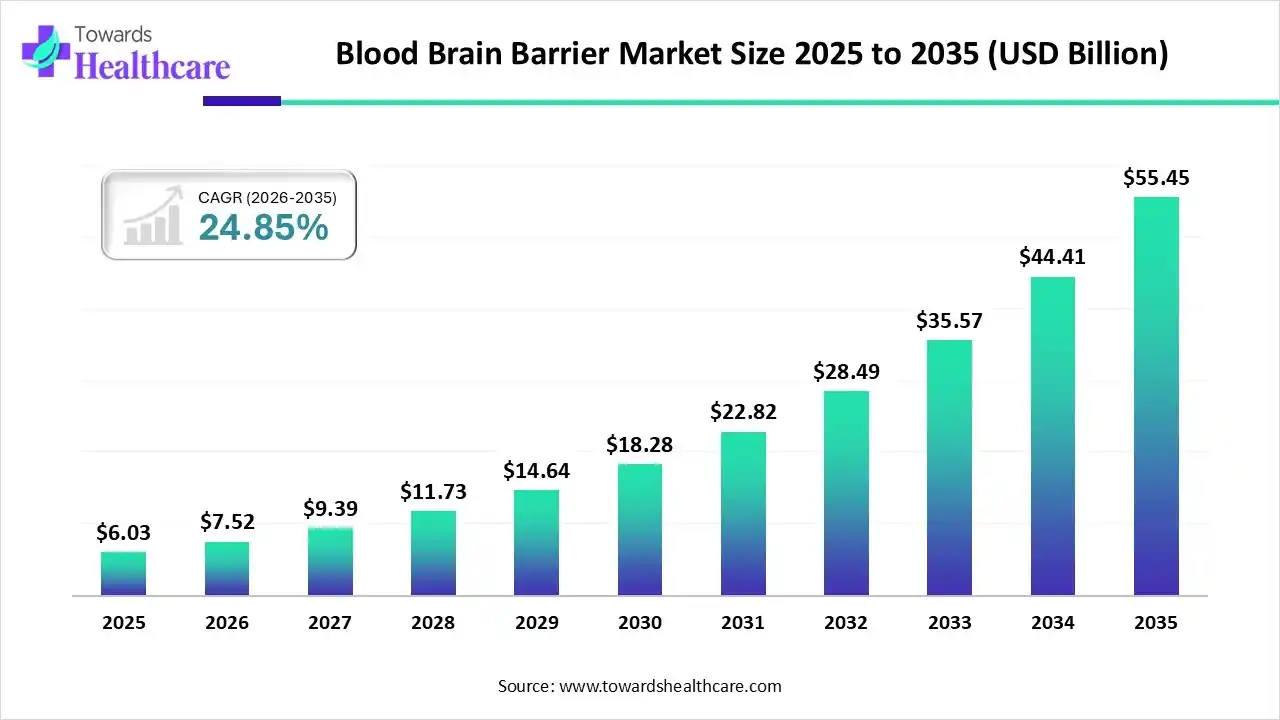
The global blood-brain barrier market is expanding at an unprecedented pace. Valued at USD 6.03 billion in 2025, the market is projected to reach USD 55.45 billion by 2035, growing at a striking compound annual growth rate (CAGR) of nearly 25% during the forecast period. This surge reflects not just financial momentum but also a scientific breakthrough moment in neurology, oncology, and advanced drug delivery.
Download Free Sample: https://www.towardshealthcare.com/download-sample/6549
The world is not merely studying the brain anymore—it is learning how to reach it safely and effectively.
The Brain’s Gatekeeper: Why the BBB Matters More Than Ever
The blood-brain barrier functions as a selective filter. It shields the brain from toxins, pathogens, and harmful chemicals circulating in the bloodstream. While this defense mechanism protects cognitive function, it also blocks nearly 98% of small-molecule drugs and almost all large biologics from entering the brain.
For patients suffering from Alzheimer’s disease, Parkinson’s disease, brain tumors, multiple sclerosis, and other central nervous system (CNS) disorders, this barrier often stands between treatment and therapeutic success.
The blood-brain barrier market includes technologies and services designed to model, study, modulate, or bypass this barrier. These range from in vitro assay systems and organ-on-chip platforms to computational prediction tools and advanced drug delivery systems such as nanocarriers and receptor-mediated transport technologies.
As neurological disorders rise globally, researchers and biotech innovators are racing to transform the BBB from an obstacle into an opportunity.
Neurological Disorders Surge: A Growing Medical Imperative
The global burden of neurological disorders continues to increase dramatically. Dementia prevalence alone rose from 60 million cases in 2020 and is projected to reach 140 million by 2050. Aging populations, particularly in Asia-Pacific and Europe, contribute significantly to this rise.
Alzheimer’s disease and dementia accounted for approximately 30% of the therapeutic focus within the BBB market in 2025. The connection between BBB dysfunction and neurodegeneration has strengthened research efforts, with thousands of clinical trials exploring treatments that can effectively cross or modulate the barrier.
Brain tumors and oncology applications are also expanding rapidly. Researchers anticipate this segment to grow at a CAGR of approximately 21% over the forecast period. Brain cancer remains complex and aggressive, and effective drug delivery across the BBB is critical to improving survival outcomes.
The urgency is clear: better permeability means better treatment possibilities.
AI Enters the Equation: Predicting Permeability Before Failure
Artificial intelligence (AI) and machine learning are reshaping how researchers approach BBB permeability. Instead of relying solely on laboratory testing, scientists now use computational models to predict whether a drug candidate can cross the barrier.
These AI-driven platforms analyze molecular structures, transport mechanisms, and biological data sets to identify permeability patterns early in drug development. By doing so, they reduce failure rates in clinical trials—a persistent challenge in CNS drug development.
Companies like Roche Holding AG and Denali Therapeutics actively integrate computational science and biomarker research into neuroscience R&D. AI not only accelerates screening but also helps researchers simulate drug behavior post-BBB penetration.
In a field where late-stage failure costs billions, predictive modeling has become indispensable.
In Vitro Models Take the Lead: Reducing Animal Testing and Enhancing Precision
Technology innovation remains at the core of market expansion. In vitro BBB models held a dominant 35% share in 2025. These laboratory-based systems replicate BBB conditions, enabling researchers to evaluate drug permeability and toxicity without relying extensively on animal testing.
Regulatory policies increasingly encourage alternatives to animal models, further accelerating the adoption of cell-based transwell systems, 3D organoids, and microfluidic platforms.
The rise of organ-on-chip systems marks a pivotal shift. These microfluidic devices mimic the dynamic environment of the human brain with controlled fluid flow and extracellular matrix conditions. The organ-on-chip BBB systems segment is expected to grow steadily, supported by advancements in microfabrication and biosensor integration.
In November 2025, Emulate, Inc. launched its Brain-Chip R1 platform, enabling researchers to examine drug transport and neuroinflammation with unprecedented precision. Collaborations with FUJIFILM Cellular Dynamics, Inc. further highlight the integration of stem cell technology with microphysiological systems.
The lab bench is evolving into a digital-biological hybrid ecosystem.
Pharma and Biotech Companies Drive the Revenue Engine
Pharmaceutical and biotechnology companies accounted for nearly 40% of the market’s revenue share in 2025. These companies possess the infrastructure, capital, and collaborative networks necessary to develop advanced BBB technologies.
Strategic investments underline their commitment. In 2025:
-
Roche Holding AG invested $55 million in Manifold Bio to develop next-generation brain shuttle platforms.
-
GSK invested £38.5 million in ABL Bio to access its Grabody-B BBB-crossing platform.
-
Alzheimer’s Drug Discovery Foundation funded Modulo Bio’s innovative dementia candidate.
These investments reflect confidence in BBB-targeted therapeutics as a future cornerstone of neuroscience.
Meanwhile, Contract Research Organizations (CROs) are emerging as fast-growing contributors. Many biotech startups lack specialized facilities and outsource neurological research to CROs. This outsourcing model accelerates development timelines and reduces capital burden.
Drug Delivery Reinvented: From Nanoparticles to Focused Ultrasound
Traditional drug molecules struggle to cross the BBB. To overcome this, researchers now design sophisticated delivery systems.
Nanocarriers optimize particle size, surface charge, and targeting ligands to evade immune clearance and penetrate the barrier. Receptor-mediated transport platforms attach therapeutic molecules to peptides that bind naturally occurring transport receptors in the BBB.
Companies such as Ossianix leverage deimmunized VNAR antibodies derived from shark biology to develop BBB-penetrant biologics. Gate2Brain focuses on peptide-based delivery systems that efficiently cross biological barriers.
Focused ultrasound (FUS) offers another breakthrough. By applying controlled ultrasound waves, clinicians can temporarily increase BBB permeability in targeted regions of the brain, allowing localized drug delivery without systemic exposure.
Innovation is no longer incremental—it is transformative.
Regional Powerhouses: North America Leads, Asia-Pacific Accelerates
North America commanded approximately 40% of the global market share in 2025. Advanced research infrastructure, strong funding mechanisms, and regulatory oversight from the U.S. Food and Drug Administration contribute to this leadership.
The U.S. approved 226 pharmaceuticals for 32 novel neurological indications between 2018 and 2023, signaling strong regulatory momentum in CNS innovation.
Institutions like the National Institute of Neurological Disorders and Stroke continue to allocate billions toward neuroscience research. The fiscal year 2025 budget reached $2.83 billion, reinforcing long-term investment.
Asia-Pacific, however, is poised for the fastest growth. Countries such as China, Japan, South Korea, and India are expanding R&D capacity while addressing rising neurological disease prevalence.
China alone reported approximately 13.14 million Alzheimer’s cases and launched a national action plan to combat dementia by 2030. With nearly 297 million citizens aged 60 and above, demographic pressure is catalyzing innovation.
Europe also strengthens its position through collaborative initiatives. The UK’s Neuro Forum and significant investments in brain tumor research highlight policy-driven momentum.
The global race to master the BBB is intensifying.
Brain Tumors: The Next Battlefield
Oncology within the BBB market represents one of the most promising yet challenging frontiers. Brain tumors resist conventional chemotherapy due to restricted permeability and tumor heterogeneity.
Innovative intranasal delivery platforms and implantable medical devices attempt to bypass the barrier altogether. Companies such as NeOnc Technologies Holdings, Inc. explore intranasal systems designed to target cancer cells directly.
Meanwhile, precision devices like NeuroAccess enable localized delivery and biomarker monitoring, redefining therapeutic precision.
The oncology segment’s projected CAGR of 21% underscores the urgency of breakthroughs in this space.
Market Strengths and Structural Challenges
The blood-brain barrier market stands on strong foundations:
-
Rising prevalence of neurological disorders
-
Expanding geriatric populations
-
Strong government and private investments
-
Rapid technological convergence
However, challenges remain.
CNS drug development historically suffers from high failure rates. Translational gaps between preclinical and clinical outcomes persist. Advanced BBB platforms remain expensive, limiting access in low- and middle-income regions.
Moreover, researchers in certain developing markets still lack adequate expertise in BBB biology due to its inherent complexity.
Addressing these structural barriers will determine the sustainability of growth.
The Future Vision: Toward Precision Neuromedicine
The blood-brain barrier market does not simply represent another healthcare vertical. It signifies a shift toward precision neuromedicine.
Emerging microfluidic chips, AI-driven modeling, 3D printing customization, nanotechnology-enabled carriers, and transient BBB disruption techniques collectively redefine how medicine approaches the brain.
As pharmaceutical pipelines expand and digital technologies integrate with biological sciences, the once-impenetrable barrier increasingly appears manageable.
Over the next decade, stakeholders expect:
-
Greater AI integration into early drug screening
-
Personalized BBB permeability profiling
-
Expansion of organ-on-chip commercial platforms
-
Broader global collaboration in neuroscience research
-
Increased regulatory clarity for BBB-focused therapies
The brain’s protective shield once symbolized limitation. Today, it symbolizes possibility.
A Defining Decade for Neuroscience Innovation
The blood-brain barrier market’s projected leap from USD 6.03 billion in 2025 to USD 55.45 billion by 2035 reflects more than economic expansion. It reflects a scientific turning point.
Researchers no longer ask whether they can cross the barrier. They now ask how efficiently, how safely, and how precisely they can do so.
From AI-driven permeability prediction to nanotechnology-based delivery and focused ultrasound modulation, the field stands at the intersection of biology, engineering, and computational science.
The next decade may well redefine the boundaries of neurological treatment. If current momentum continues, the blood-brain barrier will transition from being medicine’s greatest obstacle to becoming its most strategic gateway.
The brain’s gatekeeper is no longer just a barrier—it is becoming a bridge.
Access our exclusive, data-rich dashboard dedicated to the life science industry – built specifically for decision-makers, strategists, and industry leaders. The dashboard features comprehensive statistical data, segment-wise market breakdowns, regional performance shares, detailed company profiles, annual updates, and much more. From market sizing to competitive intelligence, this powerful tool is one-stop solution to your gateway.
Access the Dashboard: https://www.towardshealthcare.com/access-dashboard
Checkout Blood-Brain Barrier Market Report Now at: https://www.towardshealthcare.com/checkout/6549
You can place an order or ask any questions, please feel free to contact us at [email protected]
Europe Region – +44 778 256 0738
North America Region – +1 8044 4193 44
APAC Region: +91 9356 9282 04
Visit Our Website: https://www.towardshealthcare.com
Find us on social platforms: LinkedIn | Twitter | Instagram | Medium | Pinterest