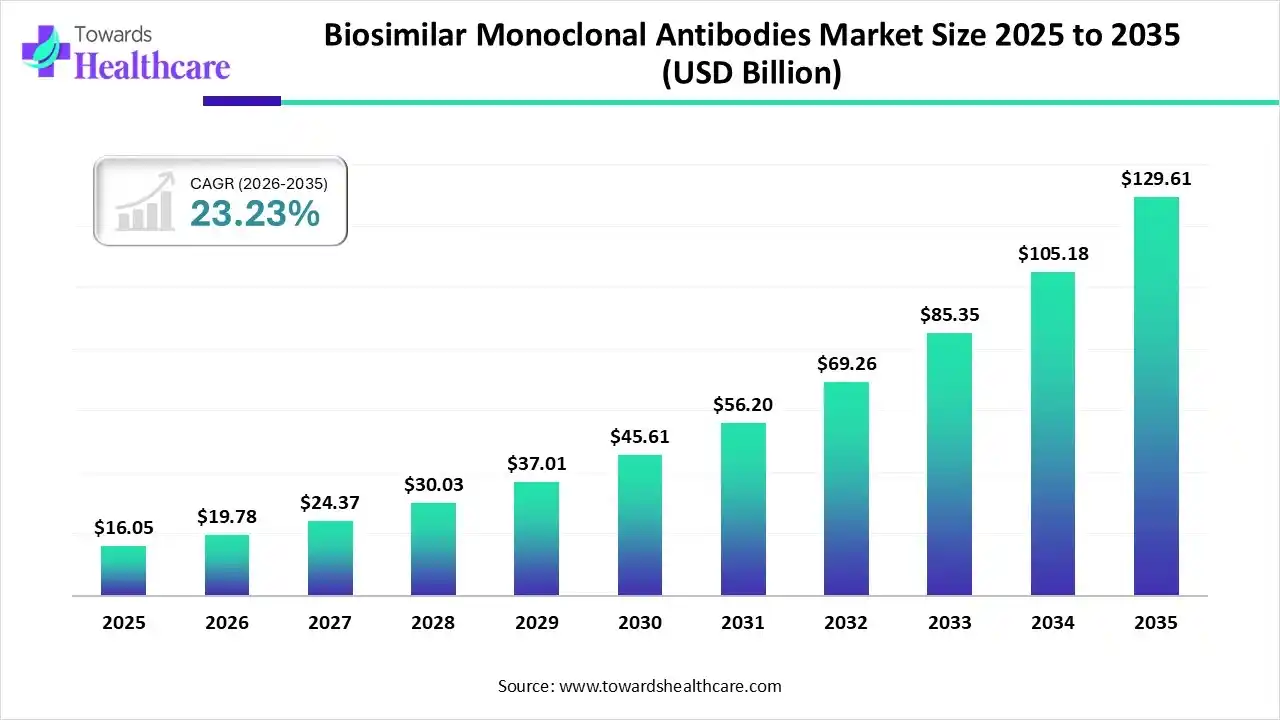
The biosimilar monoclonal antibodies market is expanding at an exceptional pace, supported by rising demand for affordable biologic therapies.
Valued at nearly $16 billion in 2025, the market is expected to reach around $129 billion by 2035, growing at a CAGR of about 23.23%.
This growth is not uniform; each segment holds its share for very specific reasons tied to clinical use, cost, and accessibility.
Download Free Sample: https://www.towardshealthcare.com/download-sample/6639
Why This Market Is Growing So Fast
Biosimilars are reshaping treatment economics.
They deliver similar clinical outcomes as original biologics but at significantly lower costs, which is critical for long-term therapies.
As diseases like cancer and autoimmune disorders increase globally, demand naturally shifts toward cost-effective solutions.
Indication-Based Share: Why Oncology Leads the Market
Oncology Holds 44–50% Share
Oncology holds the largest share of the biosimilar monoclonal antibodies market by 44–50% share.
Cancer treatments rely heavily on monoclonal antibodies such as trastuzumab and bevacizumab, which are used repeatedly over long durations.
Why this segment leads:
- Cancer cases are rising globally, increasing treatment demand
- Therapies are expensive, so biosimilars provide strong cost relief
- Hospitals prefer biosimilars to manage high patient volumes
This combination of high demand and high cost makes oncology the largest revenue contributor.
Autoimmune Diseases Hold 30–35% Share
Autoimmune diseases account for a significant portion of the market by 30–35% share.
Conditions like rheumatoid arthritis and Crohn’s disease require lifelong treatment, increasing reliance on affordable therapies.
Why this segment is growing fast:
- Long-term therapy increases cumulative cost
- Biosimilars reduce financial burden on patients
- Increasing diagnosis rates globally
This segment continues to expand due to sustained treatment demand.
Drug Type Share: Why Certain Molecules Dominate
Infliximab Leads with 32–38% Share
Infliximab dominates the biosimilar monoclonal antibodies market by 32–38% share.
This drug is widely used across multiple autoimmune diseases, making it highly versatile.
Reasons for dominance:
- Established clinical trust and usage
- Wide application across diseases
- Early patent expiry enabled early biosimilar entry
Its early entry into the biosimilar space helped secure a strong market position.
Adalimumab Grows Fast at 24% CAGR
Adalimumab is the fastest-growing segment, expanding at approximately 24% CAGR.
As one of the most widely used biologics globally, its biosimilar versions are gaining rapid traction.
Why it is growing rapidly:
- Large existing patient base
- Strong demand across multiple conditions
- Increased competition lowering prices
This segment is expected to capture a larger share in the coming years.
Other Drugs Hold 25–30% Share
Other monoclonal antibodies collectively contribute around 25–30% share of the market.
These include rituximab, trastuzumab, and bevacizumab, widely used in oncology and immune disorders.
Why they remain important:
- Strong clinical effectiveness
- Continuous use in hospital settings
- Increasing biosimilar approvals
They provide stability and diversification to the market.
End User Share: Why Hospitals Dominate
Hospitals Hold 49% Share
Hospitals account for the largest portion of the market by 49% share.
They are the primary centers for administering complex biologic therapies.
Reasons for hospital dominance:
- Need for controlled environments for infusion therapies
- Availability of trained healthcare professionals
- Higher patient footfall for serious conditions
Most treatments require monitoring, making hospitals essential.
Cancer Centers Hold 25–30% Share
Cancer centers contribute significantly with around 25–30% share.
These specialized facilities focus on oncology treatments and high patient volumes.
Why they are growing:
- Rising cancer-specific infrastructure
- Focused treatment protocols
- Increasing patient trust in specialized care
Their role continues to expand alongside oncology demand.
Regional Share: Understanding Global Market Distribution
North America Leads with 35–41% Share
North America holds the largest portion of the global market by 35–41% share.
This dominance is driven by advanced healthcare systems and high biologics spending.
Why North America dominates:
- Advanced healthcare infrastructure
- High adoption of innovative therapies
- Strong insurance and reimbursement systems
The region remains a key revenue generator globally.
Europe Holds 30–35% Share
Europe captures a substantial part of the market by 30–35% share.
It has been one of the earliest adopters of biosimilars.
Reasons for strong share:
- Favorable regulatory environment
- Government-driven cost-saving policies
- High physician acceptance
This has enabled consistent and widespread adoption.
Asia-Pacific Holds 20–25% Share
Asia-Pacific accounts for a growing share of the market by 20–25% share.
The region is rapidly expanding both in demand and production.
Why this region is growing rapidly:
- Large patient population
- Increasing healthcare investment
- Strong local manufacturing capabilities
It is expected to gain a larger share in the future.
Access our exclusive, data-rich dashboard dedicated to the healthcare market – built specifically for decision-makers, strategists, and industry leaders. The dashboard features comprehensive statistical data, segment-wise market breakdowns, regional performance shares, detailed company profiles, annual updates, and much more. From market sizing to competitive intelligence, this powerful tool is one-stop solution to your gateway.
Access the Dashboard: https://www.towardshealthcare.com/access-dashboard
Checkout the Market Report Now at: https://www.towardshealthcare.com/checkout/6639
You can place an order or ask any questions, please feel free to contact us at [email protected]
Europe Region – +44 778 256 0738
North America Region – +1 8044 4193 44
APAC Region: +91 9356 9282 04
Visit Our Website: https://www.towardshealthcare.com
Find us on social platforms: LinkedIn | Twitter | Instagram | Medium