The global cleanroom technologies industry is entering a period of steady expansion as pharmaceutical, biotechnology, medical device, semiconductor, and electronics manufacturers place greater emphasis on contamination control and product quality.
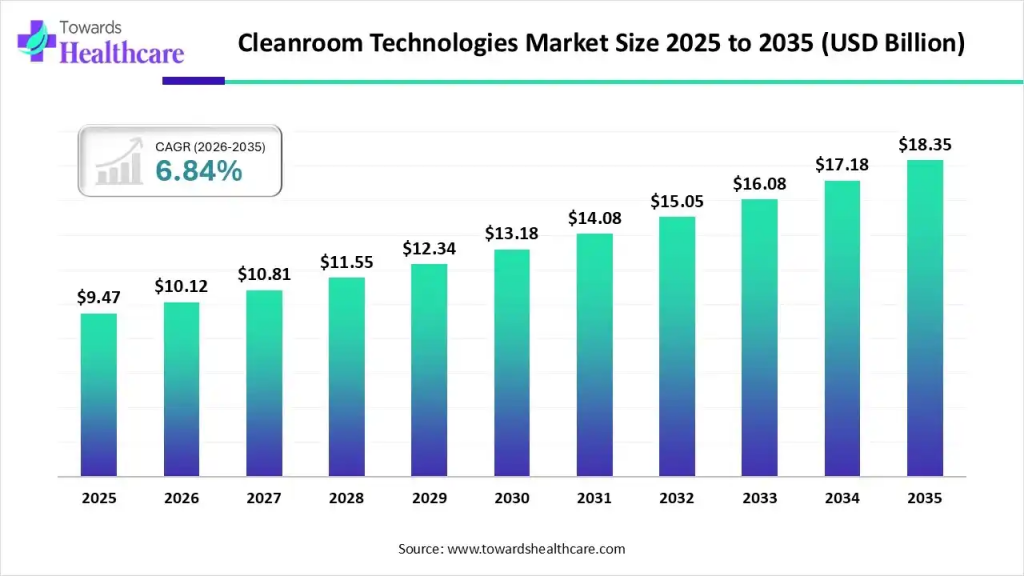
The global cleanroom technologies industry was valued at USD 9.47 billion in 2025 and is projected to reach USD 10.12 billion in 2026. By 2035, it is expected to reach approximately USD 18.35 billion, growing at a CAGR of 6.84% from 2026 to 2035.
The growing production of biologics, vaccines, cell and gene therapies, advanced medical devices, and high-performance electronic components is creating stronger demand for controlled manufacturing environments. At the same time, stricter quality standards are encouraging companies to invest in advanced filtration, environmental monitoring, automation, and validation systems.
Cleanroom Technologies: Supporting High-Precision Manufacturing
Cleanrooms are controlled environments designed to limit airborne particles, microorganisms, temperature variations, humidity, and other contamination risks. They are particularly important in industries where even small contaminants can affect product quality, safety, or manufacturing performance.
Modern cleanroom solutions include:
- HEPA and ULPA filtration systems
- Air handling units and HVAC systems
- Environmental monitoring systems
- Particle counters
- Modular cleanroom structures
- Laminar flow hoods and isolators
- Cleanroom garments and consumables
- Air showers and pass-through systems
- Validation and certification services
- Building management and automation systems
Pharmaceutical and biotechnology companies depend on these technologies for aseptic manufacturing and advanced therapies, while semiconductor manufacturers require highly controlled environments to protect sensitive components during fabrication.
Key Growth Indicators
- 2025 valuation: USD 9.47 billion
- 2026 valuation: USD 10.12 billion
- 2035 projected valuation: USD 18.35 billion
- CAGR: 6.84% from 2026 to 2035
- Leading region in 2025: North America
- Fastest-growing region: Asia Pacific
- Leading product segment: HEPA/ULPA filtration and air handling units
- Leading cleanroom class: ISO 6–8 / Grade C–D
- Leading deployment model: Traditional stick-built cleanrooms
- Leading service: Installation and commissioning
- Leading end-use sector: Pharmaceuticals and biotechnology
Why Is Demand for Cleanroom Technologies Increasing?
Growing Need for Contamination-Free Manufacturing
The pharmaceutical and biotechnology sectors are investing heavily in biologics, vaccines, cell and gene therapies, and personalized medicines. These products often require highly controlled production environments.
The semiconductor and electronics industries are also expanding their use of cleanrooms. As electronic components become smaller and more sophisticated, microscopic particles can create manufacturing defects and reduce production yields.
This is encouraging manufacturers to upgrade filtration, airflow management, environmental monitoring, and contamination-control systems.
Stricter Quality and Regulatory Requirements
Manufacturers are facing increasing pressure to maintain consistent production conditions and demonstrate compliance with international quality standards.
Cleanroom validation, environmental monitoring, particle counting, and certification have therefore become important parts of manufacturing operations, particularly in pharmaceutical, biotechnology, medical device, and semiconductor facilities.
Expansion of Advanced Therapies
The development of cell therapies, gene therapies, biologics, and personalized medicines is creating new requirements for sterile and highly controlled manufacturing spaces.
As production capacity expands, companies are also looking for cleanrooms that can be configured and upgraded more easily.
AI Is Making Cleanrooms Smarter
Artificial intelligence is becoming an important part of modern cleanroom management.
AI-enabled monitoring systems can continuously analyze information from sensors measuring:
- Air quality
- Particle levels
- Temperature
- Humidity
- Pressure differentials
- Microbial contamination
- Equipment performance
Machine learning algorithms can identify unusual patterns and alert operators before conditions become serious contamination risks.
AI can also support predictive maintenance. Instead of waiting for filtration or HVAC equipment to fail, manufacturers can use equipment data to identify potential problems earlier. This can reduce downtime, improve operational efficiency, and support more consistent environmental control.
Automated disinfection and robotics are another emerging area. Robots can perform specific cleaning and material-handling activities while reducing unnecessary human intervention inside controlled environments.
Sustainability Becomes a Major Priority
Cleanrooms traditionally require significant amounts of energy because air must be continuously filtered, circulated, heated, cooled, and controlled.
Manufacturers are therefore exploring more energy-efficient designs.
Variable Air Volume Systems
Variable air volume technology can adjust airflow according to operating conditions, helping facilities avoid unnecessary energy consumption.
Demand-Controlled Ventilation
Sensors can monitor environmental conditions and adjust ventilation based on real-time requirements.
Heat Recovery
Heat recovery systems can capture energy from exhaust air and reuse it to reduce heating and cooling requirements.
Energy-Efficient Lighting
LED lighting, motion sensors, and daylight management can further reduce electricity consumption within cleanroom facilities.
The shift toward sustainable cleanroom infrastructure is likely to become increasingly important as manufacturers balance contamination control with environmental goals.
HEPA and ULPA Filtration Lead Product Adoption
HEPA/ULPA filtration and air handling units represented approximately 30% of the industry in 2025.
These systems form the foundation of cleanroom air purification. HEPA and ULPA filters remove extremely small airborne particles and help facilities maintain the required cleanliness classification.
Their importance is particularly high in pharmaceutical manufacturing, biotechnology laboratories, semiconductor fabrication, and medical device production.
Environmental monitoring and particle-counting systems are expected to record strong growth in the coming years as manufacturers move toward continuous monitoring and digital documentation.
Modular Cleanrooms Gain Momentum
Traditional stick-built cleanrooms accounted for approximately 44% of deployment in 2025.
They remain widely used for permanent manufacturing facilities where companies require large, long-term controlled environments.
However, modular and prefabricated cleanrooms are expected to expand rapidly.
Their major advantages include:
- Faster installation
- Flexible configuration
- Easier expansion
- Reduced construction waste
- Lower disruption during facility upgrades
- Adaptability to changing production requirements
These characteristics make modular cleanrooms particularly attractive to pharmaceutical, biotechnology, medical device, and electronics manufacturers.
Pharmaceuticals and Biotechnology Remain Major Users
The pharmaceutical and biotechnology sector accounted for approximately 34% of cleanroom technology adoption in 2025.
The expansion of biologics, vaccines, injectable medicines, and advanced therapies is increasing the need for controlled manufacturing conditions.
Cleanrooms help manufacturers protect products from contamination while maintaining consistent production conditions.
The semiconductor and electronics sector, meanwhile, is expected to experience rapid growth as demand increases for advanced chips, sensors, integrated circuits, and other high-performance components.
North America Maintains a Strong Position
North America accounted for approximately 36% of global activity in 2025.
The region benefits from a strong pharmaceutical and biotechnology industry, advanced medical device manufacturing, semiconductor investments, and well-established quality standards.
United States
The United States remains an important center for cleanroom technology adoption because of its strong biologics and personalized medicine sectors. Growing semiconductor production and investment in advanced manufacturing facilities are also supporting demand for sophisticated contamination-control systems.
Canada
Canada is seeing increased investment in pharmaceutical and biotechnology manufacturing, medical devices, life sciences research, and advanced healthcare infrastructure.
The expansion of biologics and cell therapy research is encouraging organizations to adopt modern environmental monitoring, energy-efficient HVAC, and automated cleanroom systems.
Asia Pacific Offers Strong Growth Potential
Asia Pacific is expected to record the fastest growth through 2035.
The region is benefiting from expanding pharmaceutical manufacturing, semiconductor fabrication, electronics production, healthcare infrastructure, and biotechnology research.
Countries such as India, China, Japan, and South Korea are increasing investments in advanced manufacturing facilities, creating additional opportunities for cleanroom technology providers.
India
India is strengthening its pharmaceutical, biotechnology, medical device, and electronics manufacturing capabilities.
Government initiatives supporting domestic manufacturing, including Make in India and Production Linked Incentive programs, are encouraging investment in new production facilities.
The expansion of vaccine manufacturing, biologics, semiconductor projects, and healthcare infrastructure is expected to increase adoption of advanced cleanroom systems.
China
China continues to expand its pharmaceutical, biotechnology, semiconductor, and electronics manufacturing capabilities.
Increasing investments in advanced production facilities are creating demand for automated environmental monitoring, energy-efficient filtration, modular cleanrooms, and contamination-control systems.
Europe Focuses on Quality and Energy Efficiency
Europe is expected to experience notable growth as pharmaceutical manufacturing, biotechnology, medical device production, and advanced research activities expand.
European manufacturers are also placing greater emphasis on energy efficiency and environmental performance.
Germany, the UK, France, Italy, and other European countries are investing in modern manufacturing infrastructure that combines strict contamination control with improved energy management.
Key Companies
Major companies operating across the cleanroom technology ecosystem include:
- Camfil
- Filtration Group / AAF
- Donaldson Company, Inc.
- Parker Hannifin
- Honeywell International Inc.
- Johnson Controls
- Carrier Global Corporation
- Daikin Industries, Ltd.
- Trane / Ingersoll Rand
- TSI Incorporated
- Fluke Corporation
- Entegris, Inc.
- Ecolab
- STERIS
- Avantor
- Kimberly-Clark Professional
- DuPont
- G-CON Manufacturing
- Terra Universal
- Azbil Corporation
These companies are focusing on filtration, HVAC, environmental monitoring, modular systems, automation, contamination control, validation, and energy-efficient solutions.
Recent Industry Developments
In July 2025, the Cleanroom Centre partnered with Bio North Texas and established its global headquarters in Dallas, Texas. The partnership is intended to strengthen infrastructure supporting bioscience innovation, manufacturing, and workforce development.
In August 2025, SKAN Group completed the acquisition of a majority stake in Metronik, strengthening its position in isolator systems for aseptic pharmaceutical and biotechnology production.
Future Outlook
The next phase of cleanroom development will focus on combining contamination control, automation, digital monitoring, flexibility, and sustainability.
AI-powered environmental monitoring, IoT-connected sensors, predictive maintenance, modular construction, energy-efficient HVAC systems, and automated documentation are expected to become increasingly common.
At the same time, growing investments in biologics, cell and gene therapies, advanced medical devices, semiconductor fabrication, and precision electronics will continue to create demand for highly controlled production environments.
Overall, cleanroom technologies are evolving from conventional controlled spaces into smart, connected, energy-conscious manufacturing environments that support quality, compliance, productivity, and long-term operational efficiency.
Download Customized Sample: https://www.towardshealthcare.com/download-sample/6055
About Us
Healthcare WebWire is a part of Towards Healthcare Research & Consulting is a global healthcare market research and consulting firm dedicated to helping businesses make informed decisions through reliable market intelligence and strategic insights. We serve pharmaceutical, biotechnology, medical device, AI in healthcare, cell and gene therapy, digital health, and life sciences organizations with in-depth market research, custom consulting, competitive analysis, and growth forecasts. Our team combines industry expertise with rigorous research to deliver clear, actionable insights that support market expansion, product strategy, investment decisions, and long-term business growth. From emerging innovations to established healthcare markets, we help organizations understand where the industry is today and where it’s headed tomorrow.
You can place an order or ask any questions, please feel free to contact us at [email protected]
Europe Region – +44 778 256 0738
North America Region – +1 8044 4193 44
APAC Region: +91 9356 9282 04
Visit Our Website: Towards Healthcare Research & Consulting – Expert Consulting Solutions & Research Reports
Find us on social platforms: LinkedIn | Twitter | Instagram | Medium