The world of molecular diagnostics is evolving faster than ever, and digital PCR (dPCR) is at the center of this transformation. Once considered a niche advancement, it is now emerging as a powerful tool that is reshaping how scientists, clinicians, and researchers detect and measure genetic material.
Unlike traditional PCR techniques, digital PCR brings a new level of precision and reliability. It allows professionals to measure DNA and RNA with unmatched sensitivity, making it highly valuable in areas where accuracy is critical. As healthcare systems demand faster and more dependable results, dPCR is stepping forward as a solution that bridges innovation with real-world impact.
Why Digital PCR Is Gaining Ground So Rapidly
Digital PCR stands out because it solves some of the biggest limitations of conventional methods. It does not rely heavily on standard curves and offers absolute quantification, which simplifies analysis and improves accuracy.
The technology works by partitioning samples into thousands of individual reactions. This approach increases the chances of detecting even the smallest traces of genetic material. As a result, it becomes easier to identify rare mutations, low viral loads, or minimal residual disease.
What makes this even more impactful is its efficiency. By using smaller volumes of samples and reagents, dPCR reduces operational costs without compromising performance. This balance between cost and precision is one of the key reasons behind its growing adoption.
Droplet Digital PCR Takes the Lead
Among the different types of digital PCR, droplet digital PCR (ddPCR) has emerged as the dominant segment, capturing nearly 50% of the market share in 2025. Its ability to divide samples into thousands of droplets allows for highly accurate and sensitive detection.
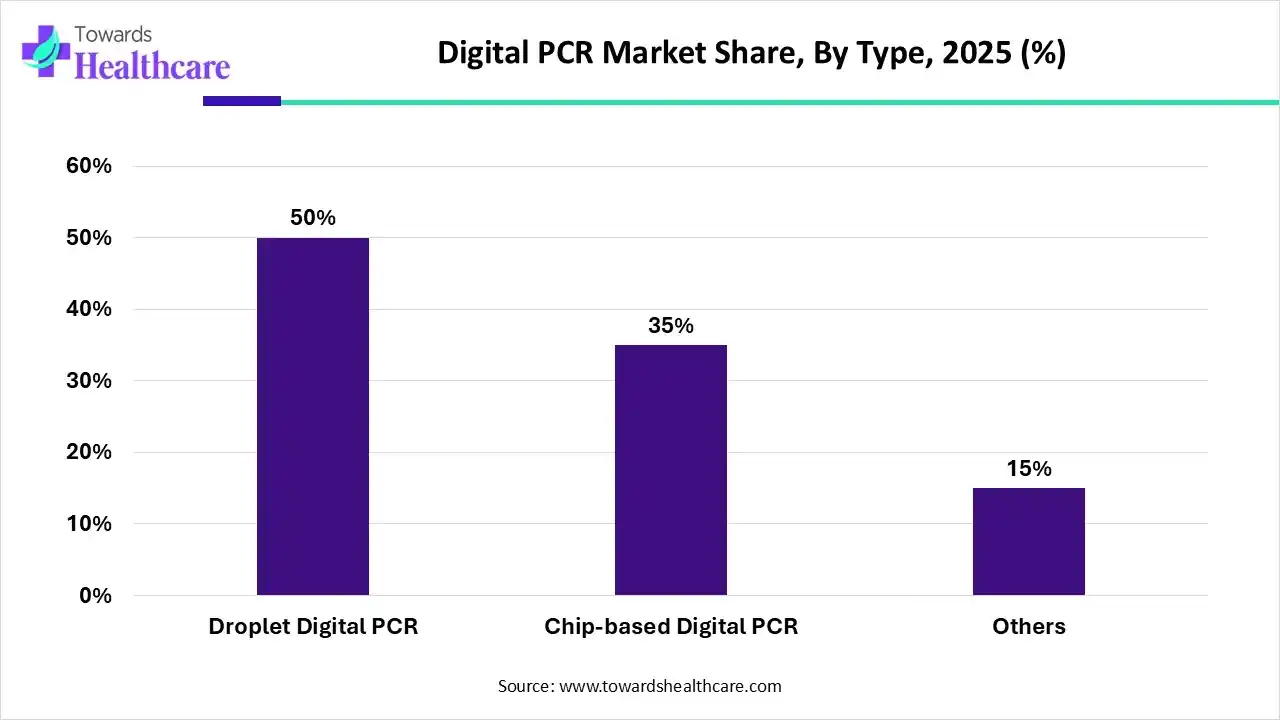
This method has proven particularly useful in applications where precision cannot be compromised. From detecting rare genetic mutations to monitoring disease progression, ddPCR provides consistent and reliable results.
At the same time, chip-based digital PCR is steadily gaining attention. While it currently holds a smaller share, it offers advantages such as faster partitioning and efficient use of samples. Its ability to handle multiple reactions within a single instrument positions it as a promising option for future growth.
Instruments Drive the Backbone of the Market
When looking at the market from a product perspective, instruments dominate with a 45% share. These systems play a crucial role in maintaining the precise thermal conditions required for PCR processes, including denaturation, annealing, and extension.
Without reliable instruments, achieving accurate results would not be possible. This is why laboratories continue to invest in advanced equipment that ensures consistency and reproducibility.
Alongside instruments, reagents and consumables are gaining momentum. As the volume of testing increases, the demand for these components grows rapidly. They are essential for daily operations, making them a key contributor to the market’s future expansion.
The software and services segment, although smaller, is becoming increasingly important. As data complexity rises, laboratories need better tools to analyze and interpret results efficiently.
Genetic Disorders Lead, But Oncology Is Catching Up
Digital PCR has found strong applications in the study of genetic disorders, which currently hold around 40% of the market share. The technology enables precise quantification, making it highly effective for identifying inherited conditions and conducting preclinical studies.
Researchers rely on dPCR to gain deeper insights into genetic variations. Its accuracy helps in detecting even minor changes, which can be critical in understanding disease mechanisms.
However, oncology is quickly emerging as a high-growth segment. The ability of dPCR to detect oncogenic mutations and copy number variations (CNVs) makes it a valuable tool in cancer research and diagnostics.
In cancer care, early detection and monitoring are essential. Digital PCR supports this by providing fast and accurate results, helping clinicians make informed decisions and improve patient outcomes.
Academic Institutions Shape the Present
Academic and research organizations currently dominate the end-user landscape, accounting for about 40% of the market. These institutions play a vital role in advancing scientific knowledge and testing new applications of digital PCR.
They use dPCR in a wide range of activities, including:
-
Experimental design and validation
-
Clinical research studies
-
Educational and training purposes
Their contribution goes beyond usage. They are also responsible for driving innovation, developing new methodologies, and expanding the scope of dPCR applications.
Clinical Laboratories Are Driving the Future
While academic institutions lead today, clinical laboratories are expected to grow at the fastest pace. This shift highlights the transition of digital PCR from research settings to real-world healthcare applications.
Clinical labs are adopting dPCR for its reliability and precision in diagnosing diseases. Its applications are expanding across multiple areas, including oncology, microbiology, epidemiology, and prenatal screening.
This transition marks an important milestone. It shows that digital PCR is no longer limited to experimental use but is becoming an integral part of routine diagnostics.
Clinical Applications Take the Spotlight
The clinical segment leads the application landscape with a 45% market share in 2025. This growth is driven by the increasing demand for accurate and dependable diagnostic tools in healthcare.
Healthcare providers are focusing on improving patient outcomes, and this requires precise testing methods. Digital PCR meets this need by offering high sensitivity and reproducibility.
At the same time, the research segment is expanding rapidly. As scientific exploration continues to grow, researchers are turning to dPCR for its ability to deliver consistent and reliable data.
Key areas where digital PCR is making a difference include:
-
Early disease detection and monitoring
-
Infectious disease analysis
-
Genetic research and biomarker discovery
These applications highlight the versatility of dPCR and its ability to adapt to different scientific and clinical needs.
What Lies Ahead for Digital PCR
The future of digital PCR looks promising as technology continues to evolve and integrate with other advanced systems. Innovations in automation, data analysis, and miniaturization are expected to further enhance its capabilities.
As awareness increases and costs become more manageable, adoption is likely to expand across emerging markets. This will open new opportunities for healthcare systems to improve diagnostic accuracy and efficiency.
Moreover, the growing focus on personalized medicine will further boost the demand for precise diagnostic tools. Digital PCR, with its ability to deliver accurate and actionable insights, is well-positioned to support this shift.
A Silent Revolution in Precision Medicine
Digital PCR may not always make headlines, but its impact is undeniable. It is quietly transforming how we understand and detect diseases, offering a level of precision that was once difficult to achieve.
From research laboratories to clinical settings, its influence continues to grow. As the technology matures, it is set to play an even bigger role in shaping the future of healthcare.
In a world where accuracy can make all the difference, digital PCR is not just an innovation—it is becoming a necessity.
Access our exclusive, data-rich dashboard dedicated to the healthcare services market – built specifically for decision-makers, strategists, and industry leaders. The dashboard features comprehensive statistical data, segment-wise market breakdowns, regional performance shares, detailed company profiles, annual updates, and much more. From market sizing to competitive intelligence, this powerful tool is one-stop solution to your gateway.
Access the Dashboard: https://www.towardshealthcare.com/access-dashboard
Checkout the Market Report Now at: https://www.towardshealthcare.com/checkout/5367
You can place an order or ask any questions, please feel free to contact us at sales@towardshealthcare.com
Europe Region – +44 778 256 0738
North America Region – +1 8044 4193 44
APAC Region: +91 9356 9282 04
Visit Our Website: https://www.towardshealthcare.com
Find us on social platforms: LinkedIn | Twitter | Instagram | Medium
About the Author