Drug delivery devices are no longer secondary tools. They are central to therapeutic success, patient adherence, and healthcare system efficiency. With the global drug delivery devices market valued at USD 463.86 billion in 2025, projected to reach USD 500.23 billion in 2026, and expected to approach USD 986.7 billion by 2035 at a CAGR of 7.84%, the scale of transformation is undeniable.
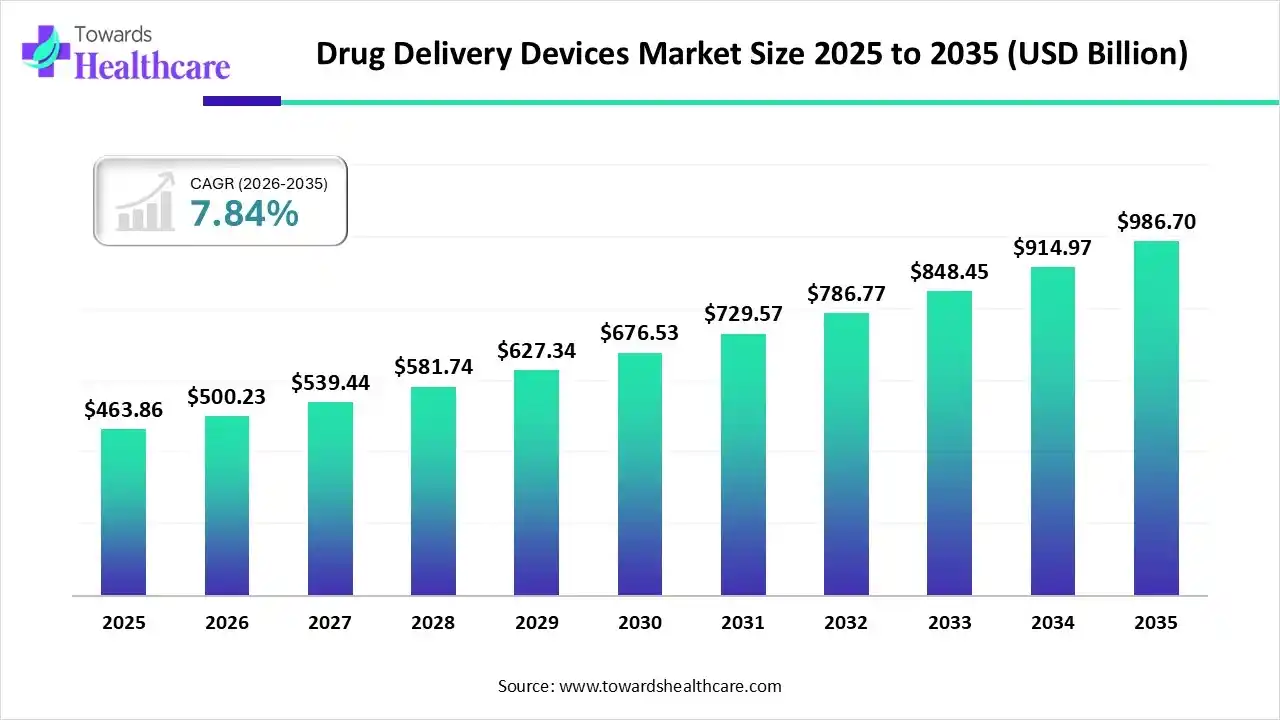
This is not incremental growth. It is systemic evolution.
Download Free Sample: https://www.towardshealthcare.com/download-sample/6609
From Molecule to Mechanism: Why Delivery Now Defines Success
Pharmaceutical science has entered the era of biologics, gene therapies, and highly sensitive formulations. These advanced therapies demand specialized administration systems. Oral tablets cannot deliver monoclonal antibodies. Complex biologics degrade in the gastrointestinal tract. Precision dosing matters more than ever.
Drug delivery devices solve these constraints through:
-
Controlled and sustained release mechanisms
-
Targeted delivery to specific tissues
-
Improved pharmacokinetics
-
Enhanced patient safety
-
Reduced systemic toxicity
The success of therapy now depends as much on engineering as on chemistry.
Macroeconomic Forces Accelerating Market Expansion
1. The Chronic Disease Explosion
Non-communicable diseases dominate global mortality statistics. Diabetes, respiratory diseases, cardiovascular conditions, autoimmune disorders, oncology, and central nervous system disorders require long-term, often lifelong, therapy.
Chronic conditions drive recurring device usage. A diabetic patient may use insulin pens or pumps daily. An asthma patient relies on inhalers repeatedly. This recurring demand creates durable market expansion.
2. Aging Demographics and Home-Based Care
An aging global population increases the prevalence of chronic illness while simultaneously pressuring healthcare systems to reduce hospitalization costs.
Self-administration devices reduce:
-
Hospital visits
-
Clinical staff dependency
-
Emergency admissions
-
Treatment interruptions
Home healthcare is no longer optional; it is economically necessary.
3. Biologics and Biosimilars Pipeline Growth
Biologics represent one of the fastest-growing pharmaceutical segments. These therapies require injectable, implantable, or infusion-based delivery platforms.
Advanced drug delivery systems ensure:
-
Stability of sensitive molecules
-
Precise volume administration
-
Controlled infusion rates
-
Minimized injection pain
The growth of biologics directly correlates with device demand.
AI and Smart Systems: Engineering Intelligence into Care
Artificial intelligence is transforming drug delivery from mechanical administration to intelligent therapy management.
AI integration enables:
-
Predictive analytics to anticipate patient response
-
Real-time dose tracking
-
Remote monitoring
-
Behavioral adherence analysis
-
Data-driven personalization
Smart insulin pumps adjust doses dynamically. Connected inhalers track usage patterns. Wearable injectors transmit performance data to physicians through cloud-based platforms.
The convergence of medtech and digital health creates an ecosystem where treatment becomes interactive rather than passive.
Segment Deep Dive: Product Innovation in Motion
Inhalers: The Established Leader
Inhalers dominated the product segment in 2025, driven by the high prevalence of respiratory disorders.
Key strengths include:
-
Rapid drug onset
-
Localized pulmonary delivery
-
Reduced systemic side effects
-
Portability and convenience
Metered-dose inhalers (MDIs) and dry powder inhalers (DPIs) remain critical for asthma and COPD management. However, innovation continues in breath-actuated systems and smart inhalers.
Injection Devices: The High-Growth Engine
Injection devices are projected to grow at the fastest pace.
Subsegments include:
-
Prefilled syringes
-
Auto-injectors
-
Pen injectors
-
Needle-free injectors
-
Wearable injectors
Drivers include:
-
Rising biologics adoption
-
Demand for self-administration
-
Improved safety mechanisms
-
Reduced dosing errors
Auto-injectors simplify therapy for patients with limited dexterity. Wearable injectors support large-volume biologics that require slow subcutaneous infusion.
Application Landscape: Where Demand Concentrates
Diabetes: The Dominant Application
Diabetes held the leading application share in 2025. Daily insulin administration, growing global incidence, and technological advancements in glucose monitoring systems drive this segment.
Insulin pens, pumps, and patch-based infusion systems continue to evolve with digital connectivity.
Central Nervous System Disorders: Emerging Growth Frontier
CNS disorders are projected to grow fastest due to:
-
Expanding neurotherapeutics pipelines
-
Increased prevalence of neurological conditions
-
Investment in blood-brain barrier targeting technologies
Drug delivery solutions capable of precise central targeting will shape future market expansion.
End-Use Evolution: Decentralizing Healthcare
Hospitals: The Primary Anchor
Hospitals dominated the market in 2025 due to:
-
High patient throughput
-
Availability of advanced infrastructure
-
Emergency care capability
-
Reimbursement frameworks
Diagnostic Centers and Home Care: Accelerating Shift
Diagnostic centers are expanding due to advanced imaging and rapid diagnostics.
Simultaneously, home care settings are growing as patients demand autonomy. Remote monitoring technologies enhance this shift.
The market’s structure is transitioning from institution-centered to patient-centered care models.
Regional Strategy: Growth Patterns Across Geographies
North America: Innovation Leadership
North America led the market due to:
-
Advanced healthcare systems
-
Strong R&D investments
-
High adoption of smart devices
-
Regulatory stability
The U.S. market, in particular, drives innovation through technology integration and venture capital investment.
Asia Pacific: The Fastest Growth Corridor
Asia Pacific is expected to expand at the highest rate between 2026 and 2035.
Growth drivers include:
-
Large and aging populations
-
Rising chronic disease prevalence
-
Expanding healthcare infrastructure
-
Government-backed manufacturing initiatives
Emerging economies in this region increasingly prioritize domestic device production and healthcare accessibility.
Europe: Technology and Homecare Focus
Europe demonstrates strong growth through:
-
Emphasis on biologics
-
Shift toward outpatient care
-
Public-private research collaboration
-
Robust regulatory oversight
Innovation pipelines in Western Europe continue to strengthen regional competitiveness.
Competitive Ecosystem: Global Players Shaping the Industry
Several multinational corporations lead device innovation and market penetration:
-
Medtronic
-
Becton Dickinson (BD)
-
West Pharmaceutical Services
-
Insulet
-
Aptar Pharma
-
Ypsomed
-
Gerresheimer
-
Terumo Corporation
-
SHL Medical
-
Owen Mumford
These companies compete across insulin management systems, autoinjectors, wearable injectors, prefilled syringes, and digital-enabled platforms.
Recent strategic investments, such as the $30 million commitment by Sanofi to expand syringe transfer manufacturing capacity, demonstrate confidence in high-volume and wearable systems.
Value Chain Complexity: Engineering Meets Regulation
Drug delivery device development follows a multi-stage lifecycle:
Research & Development
Focus areas include:
-
Biocompatible materials
-
Nanotechnology
-
Microfluidics
-
Smart sensors
-
Human-factor engineering
Clinical Validation and Regulatory Approval
Devices undergo rigorous evaluation for:
-
Safety
-
Reliability
-
Performance consistency
-
Drug-device compatibility
Regulatory frameworks impose stringent compliance standards, increasing development costs but ensuring patient protection.
Manufacturing and Quality Control
Precision manufacturing is critical. Variability in injection force, dose accuracy, or material stability can compromise therapy.
Post-Market Surveillance and Patient Support
Companies now integrate:
-
Digital training tools
-
Mobile apps
-
Real-time technical support
-
Data analytics platforms
Patient engagement extends beyond product sales.
SWOT Perspective: Strategic Realities
Strengths
-
Precision dosing
-
Targeted drug release
-
Enhanced adherence
-
Compatibility with biologics
Weaknesses
-
High production costs
-
Accessibility challenges in low-income regions
-
Training requirements for complex systems
Opportunities
-
Expansion of biosimilars
-
Telehealth integration
-
AI-enabled personalization
-
Emerging markets growth
Threats
-
Regulatory delays
-
Technological obsolescence
-
Supply chain disruptions
-
Competitive pricing pressures
The Future: Where Will the Market Go Next?
By 2035, drug delivery devices will likely integrate:
-
Fully adaptive AI-based dosing
-
Biodegradable implants
-
Microneedle patches
-
Closed-loop infusion systems
-
Digital twin modeling for patient-specific optimization
Healthcare will increasingly reward outcomes rather than volume. Devices that improve adherence and reduce complications will gain competitive advantage.
The projected valuation of USD 986.7 billion by 2035 reflects structural healthcare evolution rather than short-term expansion.
Conclusion: Devices Are Redefining Therapeutic Success
Drug delivery devices now stand at the intersection of biotechnology, engineering, and digital health.
They:
-
Enable advanced therapies
-
Improve patient autonomy
-
Reduce healthcare costs
-
Enhance treatment precision
-
Support data-driven care
The pharmaceutical industry may develop molecules, but drug delivery devices determine how effectively those molecules change lives.
As healthcare systems decentralize and therapies become more personalized, drug delivery innovation will remain one of the most decisive forces shaping the future of medicine.
The transformation is not approaching. It is already underway.
Access our exclusive, data-rich dashboard dedicated to the medical devices industry – built specifically for decision-makers, strategists, and industry leaders. The dashboard features comprehensive statistical data, segment-wise market breakdowns, regional performance shares, detailed company profiles, annual updates, and much more. From market sizing to competitive intelligence, this powerful tool is one-stop solution to your gateway.
Access the Dashboard: https://www.towardshealthcare.com/access-dashboard
Checkout Drug Delivery Device Market Report Now at: https://www.towardshealthcare.com/checkout/6609
You can place an order or ask any questions, please feel free to contact us at [email protected]
Europe Region – +44 778 256 0738
North America Region – +1 8044 4193 44
APAC Region: +91 9356 9282 04
Visit Our Website: https://www.towardshealthcare.com
Find us on social platforms: LinkedIn | Twitter | Instagram | Medium | Pinterest