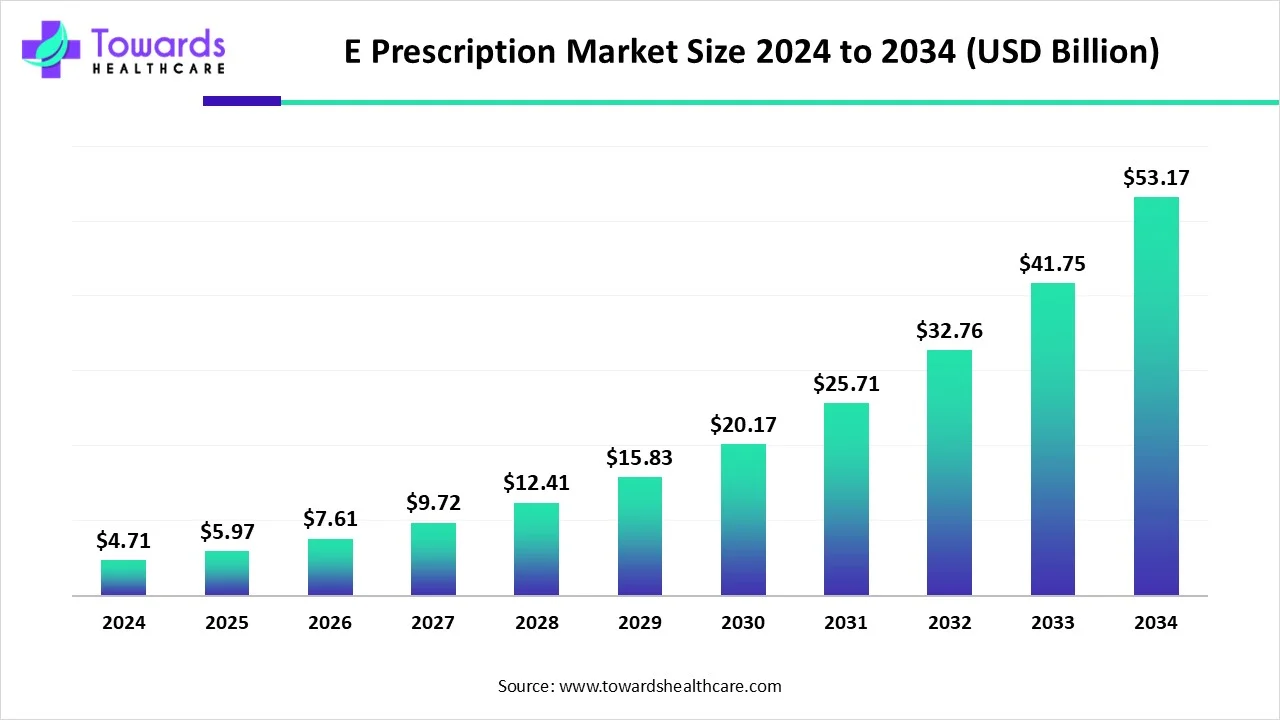
The global e-prescription market is undergoing rapid expansion, growing from USD 4.71 billion in 2024 to USD 53.17 billion by 2034 at a CAGR of 26.84%. The shift is driven by rising patient loads, chronic disease prevalence, and the urgent need to reduce prescription errors through digital systems.
Download the free sample and get the complete insights and forecasts report on this market @ https://www.towardshealthcare.com/download-sample/5582
Governments and healthcare providers worldwide are accelerating the adoption of e-prescriptions, supported by initiatives like India’s eSanjeevani, Australia’s eRx Script Exchange, and hospital trials in RIMS and Kolkata. Post-COVID digital transformation, growing telemedicine use, and cybersecurity investments have further strengthened adoption. With North America leading today and Asia-Pacific emerging as the fastest-growing region, the market is poised for long-term, technology-driven expansion, reshaping global prescription management and patient safety standards.
Market Size & Growth Outlook (2024 – 2034)
◉2024 Market Size: USD 4.71 billion.
◉2025 Market Size: USD 5.97 billion (early expansion stage).
◉2034 Market Size Projection: USD 53.17 billion.
◉CAGR (2025 – 2034): 26.84%, indicating one of the fastest adoption rates among digital healthcare solutions.
Growth Trajectory Insights
◉The market expands 11x between 2024 and 2034, showing accelerated adoption post-2025 due to digital transformation in healthcare systems worldwide.
◉North America leads due to high EHR (Electronic Health Record) adoption, regulatory frameworks, and established IT infrastructure.
◉Asia-Pacific emerges as the fastest-growing hub, fueled by government-backed telemedicine initiatives like India’s eSanjeevani service and rising digital healthcare penetration.
◉Strong hospital adoption contributes to early market dominance, while pharmacies and telemedicine platforms are expected to drive future exponential demand.
◉The market is reinforced by regulatory push, post-pandemic paperless healthcare demand, and chronic disease prevalence, creating a long-term growth cycle.
Market Trends
Government-Backed Digital Health Initiatives
◉Launch of eSanjeevani Telemedicine Service in India shows how national-level programs fuel electronic prescribing adoption, especially in emerging economies.
◉In Kolkata (July 2023), e-prescriptions were implemented in government hospitals, medical colleges, and 175 primary health centers—promoting digital records, generic drug use, and patient data integration.
Institutional & Hospital Trials
◉May 2025: Rajendra Institute of Medical Sciences (RIMS), India, initiated e-prescription trials across five departments (psychiatry, ENT, ophthalmology, nephrology, plastic surgery) to boost accuracy, efficiency, and patient experience.
◉Such pilots indicate a departmental integration approach, likely to expand to full-scale adoption across hospitals.
Cybersecurity & Resilience in Digital Health
◉March 2024: Change Healthcare launched a new Rx ePrescribing service to support pharmacies and physicians after a cyberattack.
◉Highlights cybersecurity resilience as a major trend, ensuring business continuity and trust in e-prescription systems.
International Adoption & National Contracts
◉May 2023: Fred IT secured Australia’s national e-prescription delivery service contract (eRx Script Exchange), ensuring a robust, secure nationwide system.
◉Demonstrates how governments prefer single-vendor, national-scale solutions to ensure interoperability and long-term reliability.
Post-COVID Digital Shift
◉The pandemic accelerated paperless prescriptions to minimize infection spread.
◉Telemedicine integration and precision medicine compatibility further drive usage, particularly in remote and rural healthcare settings.
Focus on Patient Safety & Efficiency
◉E-prescription reduces handwritten errors, drug misuse, and allergic reactions through automated drug-interaction checks.
◉The trend aligns with the global push for patient safety and value-based care models.
Role of AI in the E-Prescription Market
◉AI is reshaping the e-prescription industry by enhancing efficiency, accuracy, and security. Its impact can be broken down as follows:
A. Clinical Decision Support & Personalized Prescribing
◉AI analyzes patients’ medical history, allergies, and previous prescriptions to recommend the safest, most effective medication.
◉It predicts potential adverse drug interactions by comparing medication profiles, reducing life-threatening errors.
◉Personalized prescriptions enhance patient adherence and outcomes.
B. Automation & Workflow Efficiency
◉AI-driven automation reduces repetitive alerts for pharmacists and providers, preventing alert fatigue.
◉Saves pharmacists’ time by automating drug validation, refills, and dosage accuracy checks.
◉Enables physicians to process prescriptions faster, freeing time for patient care.
C. Natural Language Processing (NLP)
◉AI-powered NLP interprets prescriptions in different formats (typed, scanned, or free-text notes).
◉Ensures unified, structured prescription records, even when providers use varied EHR systems.
D. Fraud Prevention & Security with Blockchain-AI Integration
◉AI-assisted blockchain frameworks help create tamper-proof digital prescription records.
◉Prevents forgery, misuse of controlled substances, and prescriber identity theft.
◉Enhances patient trust in digital systems.
E. Predictive Analytics & Proactive Care
◉AI detects early warning signals (missed refills, inconsistent dosage) and alerts providers.
◉Supports chronic disease management by predicting when patients might need refills.
◉Reduces hospital readmissions by ensuring continuous medication adherence.
F. Environmental Contribution
◉AI optimizes digital workflows, reducing reliance on paper-based systems.
◉Encourages eco-friendly healthcare digitization by cutting down prescription slips and physical storage needs.
Regional Insights
North America (Market Leader – 2024)
Drivers: Advanced healthcare IT infrastructure, early adoption of EHR, strong regulatory support (CMS standards, ONC programs).
U.S.:
◉92% of professionals already e-prescribe (per ONC).
◉Government funding programs (HITECH Act, SUPPORT Act, NIST) actively boost adoption.
◉AI integration focuses on error detection & controlled substances monitoring.
Canada:
◉750 million prescriptions annually, creating strong demand for automation.
◉75% of Canadians want electronic renewal requests.
◉Adoption barriers exist in rural areas due to infrastructure, but AI-enabled cloud systems reduce this gap.
Asia-Pacific (Fastest Growing Region)
◉Key Drivers: Rising chronic diseases, government-led digitization, need for accuracy in overloaded healthcare systems.
India:
◉eSanjeevani Telemedicine service provides AI-ready infrastructure for nationwide digital prescribing.
◉RIMS hospital pilot (2025) shows step-by-step departmental rollout (psychiatry, ENT, ophthalmology, nephrology, plastic surgery).
China:
◉AI systems used to prevent insurance fraud worth over 100 million yuan.
◉26 provinces already linked hospitals & pharmacists via e-platforms.
Australia:
◉189 million e-prescriptions (2024) issued by over 80,000 prescribers.
◉AI-backed eRx Script Exchange ensures secure, national coverage.
◉Strong focus on patient data analytics & drug safety frameworks.
Europe (Strong Support & Growing Awareness)
◉Drivers: EU-wide digitization policies, funding for healthcare IT, rising awareness.
England:
◉6 NHS hospital trusts using e-prescriptions since 2023.
◉Repeat prescriptions via e-platforms grew by 45% (3.1 million/month).
◉AI supports drug error reduction & efficiency in outpatient services.
Wales:
◉First e-prescription service launched in 2023 (Rhyl).
◉By 2024, national rollout planned for all hospitals & primary care.
◉Focus on efficiency, safety, and digital medicine records.
Market Dynamics
Driver: Environmental Sustainability
◉Paper accounts for 26% of landfill waste, and healthcare contributes heavily.
◉E-prescriptions reduce 420 million tons of annual paper demand globally.
◉Eliminates transportation-related fossil fuel emissions from prescription slips.
◉Governments worldwide mandate paperless processes to achieve carbon goals.
Restraint: High Cost of Adoption
◉Systems cost $500–$800 annually per prescriber.
◉Maintenance & upgrades add hidden expenses.
◉Particularly challenging for low- and middle-income countries, where funding for digital health is limited.
Opportunity: Adoption of Advanced Technologies
Growth of cloud storage & interoperability frameworks makes scaling easier.
AI & NLP adoption streamlines workflows, reducing errors.
75% of U.S. hospitals already use EHR → natural synergy with e-prescriptions.
Telemedicine integration boosts efficiency, especially in chronic care & remote regions.
Top Companies: Overview, Products & Strengths
1. AdvancedMD
Product: Integrated digital healthcare platform offering EHR, practice management, and telemedicine, including e-prescription functionality.
Overview: Focuses on ambulatory care providers and small-to-mid-sized practices.
Strengths:
Seamless integration across practice workflows (billing, scheduling, e-prescribing).
User-friendly interface, reducing training time for physicians.
Scalable solutions designed for independent practices.
2. DoseSpot
Product: Cloud-based e-prescribing software used by telemedicine companies, hospitals, and digital health startups.
Overview: Specialized in secure prescribing of both controlled and uncontrolled substances.
Strengths:
Insurance integration → real-time price transparency for patients.
Simplifies compliance with DEA and state-level regulations.
Strong footprint in telehealth & digital-first care platforms.
3. DrFirst
Product: TrueRx, advanced e-prescribing and medication management platform.
Overview: U.S.-based company providing medication intelligence solutions to hospitals, pharmacies, and clinicians.
Strengths:
Strong security features for fraud prevention and prescriber identity protection.
AI-driven alerts for unusual prescribing behavior.
Broad adoption across hospital networks.
4. FredIT
Product: eRx Script Exchange (Australia’s national electronic prescribing delivery service).
Overview: Australia’s largest IT services provider for pharmacies.
Strengths:
Monopoly-like position in Australia due to government contracts.
Ensures interoperability between prescribers and pharmacies.
Trusted network with strong cybersecurity compliance.
5. iCoreConnect, Inc.
Product: iCoreRx – cloud-based e-prescription software integrated with practice management systems.
Overview: SaaS healthcare technology company aimed at improving workflow productivity and profitability.
Financials:
2024 revenue: $10.74M (up from $8.15M in 2023).
Gross profit 2024: $8.25M → showing high-margin software business.
Strengths:
Cloud-native platform ensuring high scalability.
Focus on profitability-driven solutions for providers.
Growing adoption among independent practices.
6. MDToolbox
Product: E-prescribing software with a focus on customizable solutions.
Overview: Offers flexibility for small healthcare providers and EMR/EHR vendors.
Strengths:
API integrations for EHR vendors.
Cost-effective, lightweight solution for providers with limited infrastructure.
7. PharmacyX
Product: Electronic Prescription Service (EPS) for pharmacies and hospitals.
Overview: Focused on pharmacy digitalization, connecting prescribers directly to dispensing outlets.
Strengths:
Active role in Wales e-prescription rollout.
Streamlines pharmacy workflow, reduces errors.
Ensures real-time updates for pharmacies receiving prescriptions.
8. PracticeSuite
Product: Cloud-based healthcare platform with eRx functionality integrated into its EHR.
Overview: Serves multi-specialty practices with workflow automation.
Strengths:
Multi-specialty adaptability (oncology, cardiology, orthopedics, etc.).
Combines billing, scheduling, and eRx in one system.
9. Practice Fusion
Product: Cloud-based EHR platform with embedded e-prescribing.
Overview: One of the most widely used cloud EHRs for small practices in the U.S.
Strengths:
Low-cost entry model for small and independent clinics.
Wide adoption → strong network effects.
10. RXNT
Product: eRx software, integrated with RXNT EHR and practice management tools.
Overview: U.S.-based digital health company serving ambulatory practices and hospitals.
Financials:
2024 revenue: $54M (up from $42M in 2023).
Strengths:
Strong year-on-year growth → +28.5% revenue in 2024.
End-to-end digital health tools integration.
Cloud-native architecture ensuring fast scalability.
11. Surescripts
Product: Nationwide e-prescription network in the U.S.
Overview: Dominates the U.S. digital prescription exchange ecosystem.
Strengths:
Unmatched scale and reach across prescribers and pharmacies.
Ensures high compliance with U.S. federal standards.
Trusted backbone for secure, interoperable e-prescribing.
12. Veradigm
Product: EHR and e-prescription solutions (subsidiary of Allscripts).
Overview: Provides analytics-driven digital health solutions.
Strengths:
Strong integration with analytics and patient engagement tools.
Well-established partnerships with payers and providers.
Latest Announcements by Industry Leaders
DoseSpot (CEO Josh Weiner)
◉Emphasized patient empowerment through digital transparency.
◉New features integrate insurance info into the prescribing process → patients can view true drug costs and choose pharmacies.
◉Reinforced compliance with strict DEA standards for controlled/uncontrolled substances.
Recent Developments
1 PharmacyX – Wales EPS Expansion
Timeline:
◉September 2024 → Began assurance process for Electronic Prescription Service.
◉October 2024 → Entered live phases of assurance testing.
◉Early 2025 → Full completion expected.
Impact:
◉First large-scale rollout of EPS in Wales, modernizing national pharmacy workflows.
◉Improves transparency, efficiency, and error reduction.
◉Key step towards fully digital medicines management in the UK.
2 DrFirst – Launch of TrueRx (March 2024)
Feature: AI-powered digital fingerprint analysis.
Objective: Prevent prescriber identity theft & prescription fraud.
How It Works:
◉Analyzes prescribing behavior patterns.
◉Alerts pharmacists about outliers that suggest fraud.
Impact:
◉Major leap in controlled substances monitoring.
◉Enhances trust in digital prescribing by closing gaps in security.
E-Prescription Market Segments
1 By Product
◉ Solutions (Dominant, 2024)
Overview: Software solutions designed to generate, manage, and transmit prescriptions electronically. Includes integrated and standalone systems.
Drivers of Dominance:
Cost-efficiency: Eliminates paperwork, reduces administration overhead.
User adoption: Hospitals and large physician groups prefer integrated EHR + e-prescription systems.
Error reduction: Automatically cross-checks for drug interactions and allergies.
Scalability: Flexible for both small clinics and multi-specialty hospitals.
Hospitals’ Preference: Large hospitals with high patient flow adopt solutions as core systems to streamline workflows.
Security Advantage: Solutions often come with advanced authentication to reduce prescription fraud.
◉ Services (Fastest-Growing)
Overview: Includes implementation, support, training, and ongoing IT maintenance.
Growth Drivers:
Customization: Tailored for different specialties (sports medicine, cardiology, oncology).
No staffing burden: Providers outsource IT management to service providers, cutting costs on in-house staff.
Increasing adoption of SaaS: Cloud-first healthcare systems demand managed services.
Trend: Demand for outsourced training and support for compliance with controlled substances laws is boosting service revenues.
2. By Delivery Mode
◉ Web/Cloud-Based (Dominant, 2024)
Overview: Software hosted on cloud, accessed via internet browsers or mobile apps.
Why Leading:
Remote access: Physicians can prescribe from clinics, hospitals, or telemedicine setups.
Scalability: Ideal for expanding hospital networks or national health systems.
Cost-effective: Subscription models reduce upfront IT investment.
COVID-19 Impact: Telemedicine surge made cloud systems essential.
Security Note: Providers are integrating AI-based monitoring to handle cyberattack risks (e.g., Change Healthcare 2024 case).
◉ On-Premise (Fastest-Growing)
Overview: Systems installed locally within healthcare institutions.
Growth Factors:
Higher security control: Sensitive patient data stored in-house.
Customization: Large hospitals prefer full ownership of infrastructure.
Compliance: Some regions (e.g., EU GDPR, Middle East data laws) favor local data storage.
Trade-off: Higher upfront cost, but increasingly demanded by hospitals handling controlled substances.
3 By End-Use
◉Hospitals (Dominant, 2024)
Drivers of Dominance:
Patient volume: Hospitals generate majority of prescriptions.
IT infrastructure: Hospitals already have EMRs/EHRs, making integration easier.
Regulatory pressure: Government mandates for digital health drive hospital adoption.
Reimbursement support: Digital records simplify insurance claims.
Long-term factor: Hospitals will remain the anchor of digital prescribing adoption due to complexity of care and volume.
◉ Pharmacies (Fastest-Growing)
Overview: Pharmacies adopting EPS (Electronic Prescription Service) to link directly with doctors.
Growth Drivers:
Dispensing accuracy: Reduces manual entry errors and fraud.
Operational efficiency: Digital prescriptions accelerate processing.
Global shift to pharmacy-first care: Retail pharmacies are becoming primary care access points.
Example: PharmacyX (2024, Wales EPS rollout) shows pharmacy segment momentum.
4. By Usage Methods
◉Handheld Devices (Dominant, 2024)
Overview: Smartphones, tablets, portable prescribing devices.
Why Dominant:
Mobile-first world: Doctors prefer prescribing on-the-go.
Emergency use: Useful for refills in ambulances, ER, or bedside.
Telemedicine growth: Direct link from teleconsultation to pharmacy.
Advantage: Handheld prescribing reduces turnaround time drastically, especially in rural outreach programs.
◉ Computer-Based Devices (Fastest-Growing)
Overview: Desktops, laptops with dashboard-driven prescribing software.
Why Fastest-Growing:
Better safety features: Advanced dashboards for cross-checking drug-drug interactions.
Detailed patient history integration: Linked to hospital information systems.
Specialties demand: Complex prescribing in cardiology/oncology needs full-screen interfaces.
Trend: AI-driven dashboards (fraud alerts, allergy prediction) are pushing growth.
5. By Substances
◉ Controlled Substances (Dominant, 2024)
Definition: Prescription drugs regulated by governments (opioids, stimulants, sedatives).
Why Leading:
Regulatory oversight: Governments mandate digital tracking.
Fraud prevention: AI-enabled systems (DrFirst’s TrueRx) prevent misuse & prescriber fraud.
Crisis factor: U.S. opioid epidemic accelerates adoption.
Dominance Reason: Controlled substances require the highest compliance, ensuring rapid digital prescribing adoption.
◉ Non-Controlled Substances (Fastest-Growing)
Definition: Regular prescriptions like antibiotics, antihypertensives, antidiabetics.
Growth Drivers:
Chronic disease prevalence: WHO states ~1 in 3 adults worldwide live with multiple chronic conditions.
Volume: Far more prescriptions are for non-controlled drugs compared to controlled substances.
Digital convenience: Patients prefer refills digitally without hospital visits.
6. By Specialties
◉ Sports Medicine (Dominant, 2024)
Reason for Dominance:
High incidence of injuries: ~3.5M youth sports injuries annually in the U.S. alone.
Frequent prescriptions: Painkillers, anti-inflammatories, muscle relaxants.
Adoption in clinics: Sports medicine clinics digitize first due to volume + mobility needs.
◉ Cardiology (Fastest-Growing)
Drivers of Growth:
High global burden: Cardiovascular diseases cause ~17.9M deaths annually (WHO).
Continuous medication: Long-term prescriptions for hypertension, anticoagulants, statins.
AI-enabled adherence tools: Reminders and monitoring integrated in e-prescription apps.
Growth Reason: Chronic, lifelong care model ensures sustained demand for digital prescribing.
7. By Region
◉North America (Leader, 2024)
Why Leading:
Strongest digital healthcare infrastructure.
Strict opioid prescription regulations.
High adoption of telemedicine post-COVID.
Presence of leading vendors (Surescripts, RXNT, Veradigm).
◉Asia-Pacific (Fastest-Growing)
Why Growing Fastest:
Government-backed programs (e.g., India’s eSanjeevani telemedicine service).
Rising chronic disease prevalence.
Expanding hospital networks and urbanization.
Increasing acceptance of pharmacy-first care models.
◉Europe (Rapid Digitalization)
Why Expanding:
EU-wide mandates on electronic health records.
Countries like UK, Sweden, Germany are rolling out national EPS networks.
Focus on cost-efficiency and generic prescriptions.
Access our exclusive, data-rich dashboard dedicated to the healthcare market – built specifically for decision-makers, strategists, and industry leaders. The dashboard features comprehensive statistical data, segment-wise market breakdowns, regional performance shares, detailed company profiles, annual updates, and much more. From market sizing to competitive intelligence, this powerful tool is one-stop solution to your gateway.
Access the Dashboard: https://www.towardshealthcare.com/access-dashboard
Immediate Delivery Available | Buy This Premium Research @ https://www.towardshealthcare.com/price/5582
Become a valued research partner with us – https://www.towardshealthcare.com/schedule-meeting
You can place an order or ask any questions, please feel free to contact us at [email protected]
Europe Region – +44 778 256 0738
North America Region – +1 8044 4193 44
Web: https://www.towardshealthcare.com
Find us on social platforms: LinkedIn | Twitter | Instagram | Medium | Pinterest