The global filtration in biologics market is projected to grow from USD 4.74 billion in 2024 to USD 8.08 billion by 2034, at a CAGR of 6.11%, driven by increasing demand for monoclonal antibodies, vaccines, cell & gene therapies, and rising adoption of advanced filtration technologies like nanofiber membranes, automation, and AI-enhanced processes.
Download the free sample and get the complete insights and forecasts report on this market @ https://www.towardshealthcare.com/download-sample/5798
Market Size
Global Market Size & Forecast
●2024 Revenue: USD 4.74 billion
●Projected 2034 Revenue: USD 8.08 billion
●CAGR: 6.11%
●Growth driven by biologics manufacturing, adoption of innovative filtration systems, and focus on regulatory compliance and product purity.
Filtration Type Market Size
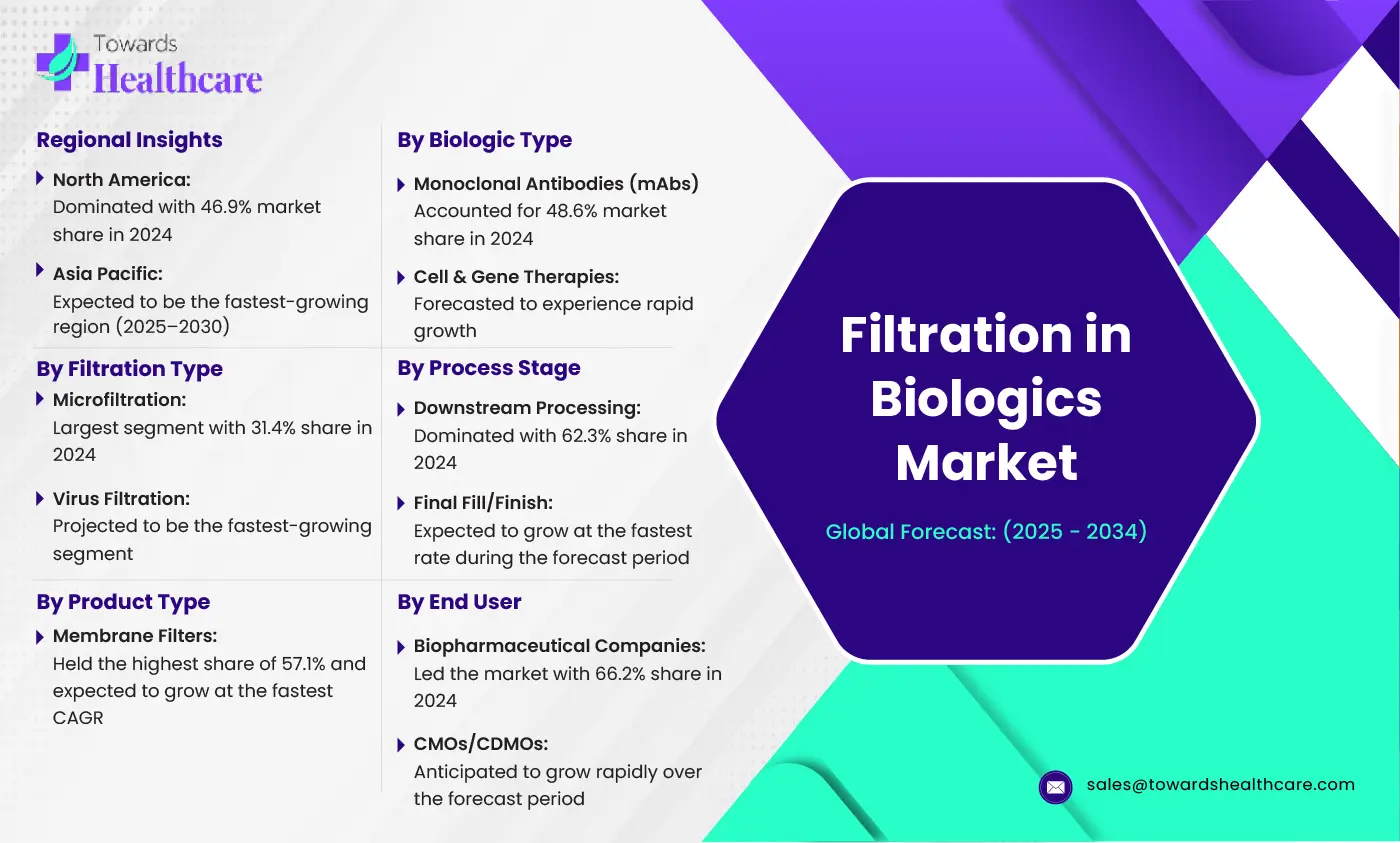
●Microfiltration: 31.4% revenue share in 2024, leading the market.
●Virus Filtration: Expected to be fastest-growing segment during 2025–2034.
●Nanofiltration, Ultrafiltration, Sterile Filtration: Increasing adoption due to advanced bioprocessing needs.
Product Type Market Size
●Membrane Filters: 57.1% revenue share in 2024, leading the segment; versatility in pore sizes enables applications across microfiltration, ultrafiltration, and nanofiltration.
Biologic Type Market Size
●Monoclonal Antibodies (mAbs): 48.6% revenue share in 2024.
●Cell & Gene Therapies: Fastest-growing due to pipeline expansion and increasing regulatory approvals.
Process Stage Market Size
●Downstream Processing: Dominant with 62.3% revenue share in 2024; driven by single-use technologies and risk reduction of cross-contamination.
●Final Fill/Finish: Expected fastest growth due to delicate biologics requiring precise environmental control.
End User Market Size
●Biopharmaceutical Companies: 66.2% revenue share in 2024, driven by rising disease incidence and biologics/biosimilars production.
●CMOs/CDMOs: Expected rapid growth due to outsourced production needs.
Market Trends:
Automation & AI Integration
●AI-powered predictive maintenance, yield optimization, and filtration efficiency improvements.
●Automation reduces human error and contamination risk.
Nanofiber Membrane Technology
●Increasing adoption for higher purity, flux, and virus/bacteria removal.
●Eco-friendly, recyclable membranes are gaining attention.
Single-Use Filtration Systems
●Minimize contamination, reduce turnaround times, and improve scalability.
Expansion of Biologics Manufacturing
●Increase in vaccines, mAbs, and cell & gene therapies globally.
R&D Collaborations
●Example: Shilpa Biologicals & mABTree Biologics (March 2025, immune-oncology asset development).
M&A Activities
●Thermo Fisher’s acquisition of Solventum for $4.1B (Feb 2025) to enhance purification & filtration portfolio.
Virus Filtration Growth
●Adoption of single-use virus filters due to reduced contamination risks and cost-effectiveness.
Focus on Regulatory Compliance
●Stringent regulations require robust sterile filtration and impurity removal.
Emergence of Eco-Friendly Filters
●UK and Europe driving recyclable filter housings and bio-based membranes.
Digitalization of Filtration Systems
●Data-driven QC, process optimization, and real-time monitoring.
AI Impact / Role
Process Optimization
●AI algorithms adjust flow rates, pressure, and membrane usage to improve yield.
Predictive Maintenance
●Sensors and AI predict filter fouling and replacement timing to reduce downtime.
Quality Control Automation
●AI monitors impurities, viral clearance, and contamination risks in real-time.
Waste Reduction
●AI minimizes over-filtration and reduces product loss while maintaining purity.
Process Scalability
●Machine learning models help scale lab processes to industrial production seamlessly.
Enhanced Viral & Microbial Detection
●AI-assisted filtration systems detect microorganisms faster, ensuring product safety.
Supply Chain Optimization
●AI predicts filter demand, optimizing inventory and reducing operational costs.
Energy & Resource Efficiency
●AI optimizes energy and water consumption during filtration operations.
Adaptive Filtration Designs
●AI-driven simulations help design membranes with tailored pore sizes and flow patterns.
Regulatory Compliance Support
●AI ensures consistent adherence to cGMP and FDA standards by automating validation and reporting.
Regional Insights
1. North America
Revenue Share: 46.9% in 2024, making it the market leader.
Key Drivers:
●High Biologics Production: Significant demand for mAbs, vaccines, recombinant proteins, and cell & gene therapies.
●Strict Regulatory Environment: FDA and Health Canada regulations mandate high-purity biologics, sterile processes, and viral clearance, driving adoption of advanced filtration systems.
●Advanced R&D Infrastructure: Availability of research hubs and pharmaceutical centers promoting innovations in filtration technologies.
United States Trends:
●Nanofiber Membranes: Enhancing filtration efficiency, throughput, and reducing contamination risk.
●AI Integration: Optimization of filtration processes, predictive maintenance, and process automation.
●Single-Use Systems: Reducing downtime, cross-contamination, and validation costs.
●Example: Biocon Biologics launched Yesintek Biosimilar for Crohn’s disease, ulcerative colitis, and psoriasis (Feb 2025), requiring robust filtration solutions for production.
Canada Trends:
●Tangential Flow Filtration (TFF): Widely adopted for protein concentration and diafiltration in downstream processes.
●AI-Powered Filtration: Predictive process optimization and reduced operational costs.
●Single-Use Systems: Popular among CDMOs and research institutes to reduce cross-contamination and improve flexibility.
●Explanation: North America’s dominance is due to a combination of high-volume biologics manufacturing, regulatory enforcement, and cutting-edge R&D, which drives the adoption of sophisticated filtration solutions including AI-enabled and single-use systems.
2. Asia Pacific
Fastest-Growing Region: Expected rapid growth between 2025–2030.
Key Drivers:
●Rising prevalence of cancer, diabetes, heart disease, and other chronic illnesses.
●Growing demand for personalized and advanced therapies.
●Government-backed investments in biotech research hubs, particularly in China, India, and Japan.
China:
●Government-led initiatives to develop vaccine and biologics manufacturing hubs.
●Collaboration with African countries, e.g., Kenya-China joint vaccine production initiative (June 2025), increasing global outreach and local manufacturing capabilities.
India:
●Active partnerships with global biotech companies to enhance vaccine production.
●Example: Serum Institute of India & Bavarian Nordic collaboration (Dec 2024) to produce the Mpox vaccine.
●Rising investments in filtration R&D and single-use technologies to support scalable biologics production.
●Explanation: APAC’s rapid growth is driven by healthcare demand, supportive government policies, and expanding biotech infrastructure, making it a hub for emerging biologics production and innovative filtration adoption.
3. Europe
Growth Drivers:
●Increased demand for advanced filtration technologies to meet the needs of regenerative therapies and personalized medicines.
●Strong focus on biologics safety, efficiency, and sustainability.
Germany:
●Innovations in membrane materials (PES, PVDF, Nylon, PTFE) improving filtration efficiency, flux, and sterility.
●Integration of automation in filtration systems for downstream processing, enhancing reproducibility and reducing human error.
United Kingdom:
●Emphasis on eco-friendly filtration technologies, including recyclable filter housings and bio-based membranes.
●Example: Dr. Reddy’s Versavo launch (Mar 2024) required high-purity sterile filtration systems to comply with stringent UK regulations.
●Explanation: Europe’s growth is propelled by technological innovation, regulatory compliance, and eco-conscious manufacturing, driving the adoption of next-gen filtration systems.
4. Middle East & Africa (MEA) and Latin America
Investment Trends:
●Focus on developing local biologics and vaccine production facilities.
●Example: African Development Bank, IFC, and U.S. DFC jointly financed $45M for VaxSen, a Senegal-based vaccine manufacturing subsidiary (Dec 2024).
Emerging Focus Areas:
●Increased production of vaccines, monoclonal antibodies, and biosimilars to improve local healthcare access.
●Adoption of single-use filtration systems and membrane technologies to ensure sterility and high-purity outputs with limited infrastructure.
●Explanation: MEA and Latin America are investment-driven markets, where government funding, international partnerships, and the need for local biologics production are driving gradual yet strategic adoption of filtration technologies.
Market Dynamics
Drivers
●Rising demand for biologics and biosimilars.
●Increased focus on product purity and regulatory compliance.
●Growth of chronic and autoimmune diseases fueling biologics production.
●Investments in biopharma R&D and production infrastructure.
Restraints
●Product loss due to small pore-sized filters.
●High operational and capital costs of filtration systems.
●Maintenance challenges including frequent filter replacement.
Opportunities
●Growing applications of membrane, depth, and tangential flow filtration.
●Adoption of single-use filtration systems for cost-effectiveness and sterility.
●Integration of AI and automation for optimization and scalability.
Latest Announcements
GSK plc (Jan 2025): Collaboration with University of Oxford on cancer prevention vaccines.
African Development Bank / IFC / DFC (Dec 2024): $45M financing to VaxSen for local pharmaceutical manufacturing in Africa.
Biocon Biologics (Feb 2025): Launch of Yesintek Biosimilar in the US.
Dr. Reddy’s Laboratories (Mar 2024): Versavo launch in the UK for cancer treatment.
Recent Developments
Creative Diagnostics (June 2025): Human Hybrid IgM Control Monoclonal Antibodies launched.
Zydus Lifesciences (Feb 2025): Vaccine for new influenza strain introduced.
Asahi Kasei Medical (Oct 2024): Planova™ FG1 next-gen virus removal filter launched.
Segments Covered
1. Filtration Type
Microfiltration
●Used to remove bacteria, particulates, and cell debris.
●Critical for sterile filtration and clarification processes in downstream production.
●Increasing adoption of single-use microfiltration systems reduces contamination risks and downtime.
Virus Filtration
●Specifically designed to remove viruses from biologics, mAbs, and vaccines.
●Rapid growth due to rising investment in single-use virus filtration systems and regulatory requirements for viral clearance.
Nanofiltration
●Removes smaller impurities and viruses while allowing passage of desired proteins.
●Increasingly applied in purification of cell & gene therapies and high-value biologics.
Ultrafiltration
●Concentrates proteins and biologics; used in diafiltration and buffer exchange.
●Enhances yield while reducing processing time and operational costs.
Endotoxin Removal
●Critical in ensuring biologics are free from bacterial endotoxins.
●Often integrated into downstream processing to meet regulatory safety standards.
Sterile Filtration
●Ensures final product sterility before formulation and packaging.
●Vital for vaccines, mAbs, and sensitive recombinant proteins.
Final Fill / Aseptic Processing
●Ensures the biologic is filled under sterile conditions.
●Essential for product integrity, especially for cell & gene therapies sensitive to environmental changes.
Explanation: Filtration type selection depends on particle size, sterility requirement, desired concentration, and purification target, ensuring high-quality, safe biologics production.
2. Product Type
Membrane Filters
●Versatile filters for microfiltration, ultrafiltration, and nanofiltration.
●Adaptable for different pore sizes and bioprocessing requirements.
Microfiltration, Ultrafiltration, Nanofiltration
●Specialized for specific particle size ranges and molecular weight cut-offs.
●Used in purification, concentration, and sterilization.
Reverse Osmosis (RO)
●Primarily used for water purification in upstream and buffer preparation.
●Ensures low particulate and microbial contamination in media preparation.
Pre-filters & Depth Media
●Capture large particles and reduce membrane fouling.
●Enhance filtration efficiency and extend lifespan of main filters.
Single-Use Systems (Cartridges, Capsules)
●Reduce cross-contamination risks, improve scalability, and minimize cleaning/validation requirements.
Filtration Accessories (Housings, Filter Holders)
●Support main filtration systems; ensure proper installation, pressure, and flow rates.
●Explanation: Product type selection depends on process stage, biologic type, production scale, and specific filtration application, optimizing cost-efficiency and product safety.
3. Biologic Type
Monoclonal Antibodies (mAbs)
●Largest market segment (48.6% in 2024).
●Require precise microfiltration and virus filtration to maintain efficacy and regulatory compliance.
Vaccines
●Require sterile filtration and virus removal for safety.
●Single-use systems and tangential flow filtration (TFF) reduce contamination risk.
Recombinant Proteins
●Filtration removes impurities from cell culture and expression systems.
●Ultrafiltration and diafiltration optimize protein concentration.
Cell & Gene Therapies
●Fastest-growing biologic type.
●Filtration ensures cell integrity and purity; nanofiltration and sterile filtration are critical.
Blood-Derived Products
●Require endotoxin and virus removal to prevent transfusion-related infections.
●Membrane and sterile filtration dominate.
●Explanation: Each biologic has unique filtration requirements, driven by molecular size, contamination risk, and sensitivity to environmental conditions, making the choice of filtration technology critical.
4. Process Stage
Upstream Processing
●Media filtration: Removes impurities in culture media before cell growth.
●Cell culture harvesting: Microfiltration and depth filtration capture cells while clarifying media.
Downstream Processing
●Clarification: Removes cell debris and large impurities post-harvest.
●Purification: Ultrafiltration, nanofiltration, virus filtration ensure high purity biologics.
●Concentration & Buffer Exchange: Optimizes biologic concentration and formulation.
●Final Fill/Finish: Sterile filtration and aseptic filling ensure product safety and integrity.
●Explanation: Downstream processing dominates (62.3% revenue share, 2024) due to its critical role in ensuring purity, sterility, and biologic efficacy. Upstream filtration is essential for maintaining cell culture quality but has lower revenue contribution.
5. End Users
Biopharmaceutical Companies
●Lead market share (66.2% in 2024).
●Require large-scale filtration systems for mAbs, vaccines, and recombinant proteins.
CMOs/CDMOs
●Outsourced production partners; growing reliance due to cost-effectiveness and technical expertise.
●Rapid adoption of single-use filtration systems to accelerate client projects.
Academic & Research Institutes
●Use filtration systems in experimental and early-stage biologics research.
●Demand smaller-scale, versatile filtration systems.
Clinical Research Organizations (CROs)
●Filtration required for clinical trial biologics production, ensuring purity and regulatory compliance.
●Explanation: Filtration demand correlates with production scale, outsourcing needs, and R&D intensity, with biopharmaceutical companies dominating due to large biologics pipelines.
6. Region
North America
●Market leader (46.9% revenue share, 2024).
●Advanced R&D, strong biologics production, stringent regulatory standards drive adoption.
Asia Pacific
●Fastest-growing region (2025–2030).
●Drivers: Rising cancer, diabetes, heart disease; government-funded biotech hubs (China, India, Japan); adoption of single-use technologies.
Europe
●Growth driven by regenerative therapies, personalized medicines, and advanced membrane technologies.
●Germany: Innovations in PES, PVDF, Nylon, PTFE membranes, automation integration.
●UK: Focus on eco-friendly and recyclable filtration technologies.
Latin America & MEA
●Growing focus on local biologics and vaccine manufacturing.
●Investments in regional pharmaceutical hubs and funding initiatives (e.g., VaxSen $45M financing for Senegal, 2024).
●Explanation: Regional growth is influenced by biologics production capacity, healthcare infrastructure, disease prevalence, and government-backed R&D initiatives.
Top 5 FAQs
-
What is driving the filtration in biologics market?
-
Rising demand for mAbs, vaccines, cell & gene therapies, and focus on purity and regulatory compliance.
-
-
Which filtration type dominates the market?
-
Microfiltration with 31.4% revenue share in 2024; virus filtration expected fastest growth.
-
-
Which product type is most used?
-
Membrane filters, holding 57.1% share, versatile in microfiltration, ultrafiltration, nanofiltration.
-
-
Which regions are growing fastest?
-
Asia Pacific fastest-growing (2025–2030) due to rising chronic diseases and government-backed biotech hubs.
-
-
How is AI impacting filtration?
-
Optimizes processes, reduces waste, enhances QC, predictive maintenance, and ensures regulatory compliance.
-
Access our exclusive, data-rich dashboard dedicated to the biotechnology sector – built specifically for decision-makers, strategists, and industry leaders. The dashboard features comprehensive statistical data, segment-wise market breakdowns, regional performance shares, detailed company profiles, annual updates, and much more. From market sizing to competitive intelligence, this powerful tool is one-stop solution to your gateway.
Access the Dashboard: https://www.towardshealthcare.com/access-dashboard
Immediate Delivery Available | Buy This Premium Research @ https://www.towardshealthcare.com/price/5798
Become a valued research partner with us – https://www.towardshealthcare.com/schedule-meeting
You can place an order or ask any questions, please feel free to contact us at [email protected]
Powering Healthcare Leaders with Real-Time Insights: https://www.towardshealthcare.com/healthcare-intelligence-platform
Europe Region – +44 778 256 0738
North America Region – +1 8044 4193 44
APAC Region: +91 9356 9282 04
Web: https://www.towardshealthcare.com
Find us on social platforms: LinkedIn | Twitter | Instagram | Medium | Pinterest