Flow cytometry has quietly become one of the most powerful tools in modern science.
It allows researchers to analyze thousands of cells in seconds, almost like scanning data points in real time.
This laser-based technology measures physical and chemical properties of cells.
From identifying cancer cells to mapping immune responses, it transforms invisible biology into measurable insights.
Today, scientists rely on it not just for detection—but for decision-making.
It’s no longer just a lab technique; it’s becoming a foundation for precision medicine.
Market Momentum: From Billions to Breakthroughs
The flow cytometry market is not just growing; it’s evolving with purpose.
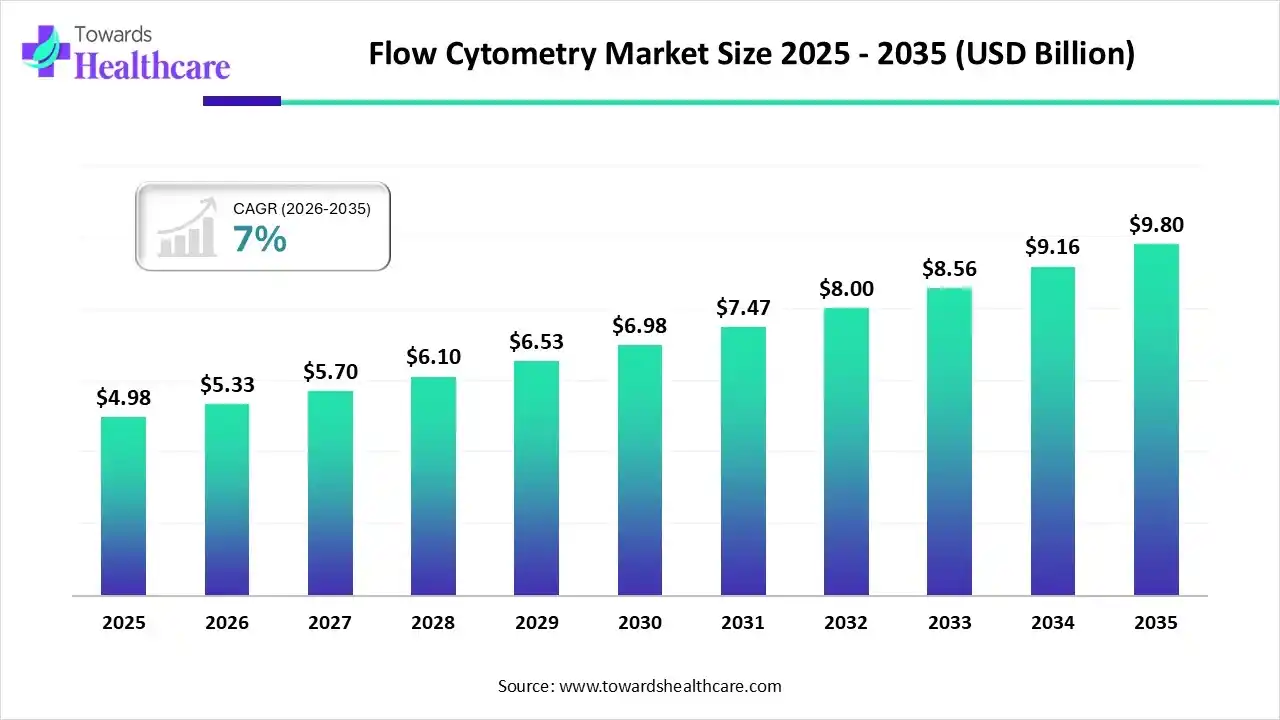
Valued at $4.98 billion in 2025, it is projected to reach $9.80 billion by 2035, expanding at a steady 7% CAGR.
Download Free Sample: https://www.towardshealthcare.com/download-sample/5326
This growth reflects more than demand; it signals dependency.
Healthcare, biotech, and research sectors now treat flow cytometry as a critical infrastructure.
North America currently leads due to advanced healthcare systems.
However, Asia-Pacific is catching up rapidly, driven by rising healthcare investments and research expansion.
What’s Driving This Surge in Demand?
The increasing burden of chronic diseases is pushing innovation forward.
Conditions like cancer, immune disorders, and blood diseases require deeper cellular understanding.
Flow cytometry fits perfectly into this need.
It helps clinicians and researchers break down complex biological systems into actionable insights.
Key demand drivers include:
-
Rising prevalence of hematological and immunological disorders
-
Increased focus on personalized and precision medicine
-
Growth in biotechnology and drug discovery pipelines
-
Expanding use in clinical diagnostics and research labs
These factors are not isolated—they are interconnected.
Together, they create a strong, long-term growth ecosystem.
From Instruments to Intelligence: Technology Is Evolving Fast
Earlier, flow cytometry focused mainly on counting and sorting cells.
Today, it goes far beyond that.
Modern systems integrate software, automation, and advanced detection technologies.
This shift is turning instruments into intelligent analytical platforms.
For example, spectral flow cytometry now allows researchers to analyze multiple markers simultaneously.
This improves accuracy while reducing time and complexity.
Recent developments highlight this transformation:
-
Advanced nuclear stains now enable precise live cell profiling
-
New spectral cytometers support high-dimensional data analysis
-
Improved detector technologies allow larger antibody panels
These innovations are not incremental—they are redefining capabilities.
They are pushing the boundaries of what scientists can observe and measure.
Beyond the Lab: Expanding Real-World Applications
Flow cytometry is no longer limited to research environments.
It is actively shaping clinical and industrial applications.
In healthcare, it plays a crucial role in disease diagnosis and monitoring.
In biotech, it accelerates drug discovery and cell therapy development.
Its applications span across multiple domains:
-
Clinical diagnostics: Identifying cancer cells and immune disorders
-
Drug discovery: Testing cell responses to new compounds
-
Transplantation: Monitoring immune compatibility
-
Industrial use: Quality control in bioprocessing
This versatility makes it one of the most adaptable technologies in life sciences.
Its ability to scale across industries adds to its long-term relevance.
A Shift Toward Precision Medicine
Healthcare is moving away from generalized treatments.
The focus is now on personalized care tailored to individual biology.
Flow cytometry plays a key role in this transition.
It helps identify specific cell populations and biomarkers unique to each patient.
This level of detail enables targeted therapies.
It improves treatment outcomes while reducing unnecessary interventions.
As precision medicine grows, the demand for high-resolution cellular analysis will rise.
Flow cytometry stands at the center of this shift.
Innovation Meets Collaboration: Industry Is Moving Together
The market is not growing in isolation—collaboration is driving progress.
Conferences, workshops, and global research initiatives are accelerating innovation.
Industry leaders and researchers are coming together to explore new applications.
They are focusing on improving efficiency, scalability, and accessibility.
Emerging technologies like Full Spectrum Profiling™ are enhancing workflow efficiency.
They allow scientists to extract more insights from complex datasets.
This collaborative environment ensures continuous evolution.
It keeps the technology aligned with real-world needs.
Barriers That Still Challenge Growth
Despite its advantages, flow cytometry faces practical challenges.
The most significant one is cost.
High-end instruments can range from $100,000 to $500,000.
This creates accessibility issues, especially in developing regions.
Another challenge lies in standardization.
Different instruments and protocols can lead to variability in results.
Key restraints include:
-
High capital investment for advanced instruments
-
Lack of standardization across platforms
-
Complexity in data interpretation
-
Limited accessibility in low-resource settings
These barriers do not stop growth—but they slow adoption.
Addressing them will be critical for market expansion.
The Road Ahead: Smarter, Faster, More Accessible
The future of flow cytometry is not just about growth—it’s about transformation.
Technology is moving toward higher speed, better sensitivity, and deeper insights.
Integration with single-cell analysis and advanced data systems will unlock new possibilities.
Researchers will gain a more detailed understanding of cellular behavior.
At the same time, efforts are underway to make systems more affordable and user-friendly.
This will open doors for wider adoption across regions and institutions.
The next decade will likely redefine how we study cells.
Flow cytometry will play a central role in that transformation.
Conclusion: From Cell Analysis to Life-Saving Insights
Flow cytometry is no longer just a scientific tool—it’s a strategic asset.
It connects research, diagnostics, and treatment in a single ecosystem.
As the market moves toward $9.80 billion by 2035, its impact will only deepen.
It will continue to shape how we understand diseases and develop therapies.
The real story is not just about market size.
It’s about unlocking the hidden language of cells; and using it to improve lives.
Access our exclusive, data-rich dashboard dedicated to the healthcare market – built specifically for decision-makers, strategists, and industry leaders. The dashboard features comprehensive statistical data, segment-wise market breakdowns, regional performance shares, detailed company profiles, annual updates, and much more. From market sizing to competitive intelligence, this powerful tool is one-stop solution to your gateway.
Access the Dashboard: https://www.towardshealthcare.com/access-dashboard
Checkout the Market Report Now at: https://www.towardshealthcare.com/checkout/5326
You can place an order or ask any questions, please feel free to contact us at sales@towardshealthcare.com
Europe Region – +44 778 256 0738
North America Region – +1 8044 4193 44
APAC Region: +91 9356 9282 04
Visit Our Website: https://www.towardshealthcare.com
Find us on social platforms: LinkedIn | Twitter | Instagram | Medium
About the Author