Next generation sequencing (NGS) is no longer a niche scientific tool. It is rapidly becoming the backbone of modern healthcare, research, and precision medicine.
The market tells the story clearly. From $12.5 billion in 2025 to $15.22 billion in 2026, and a projected $89.4 billion by 2035, the growth is not just fast—it is transformational.
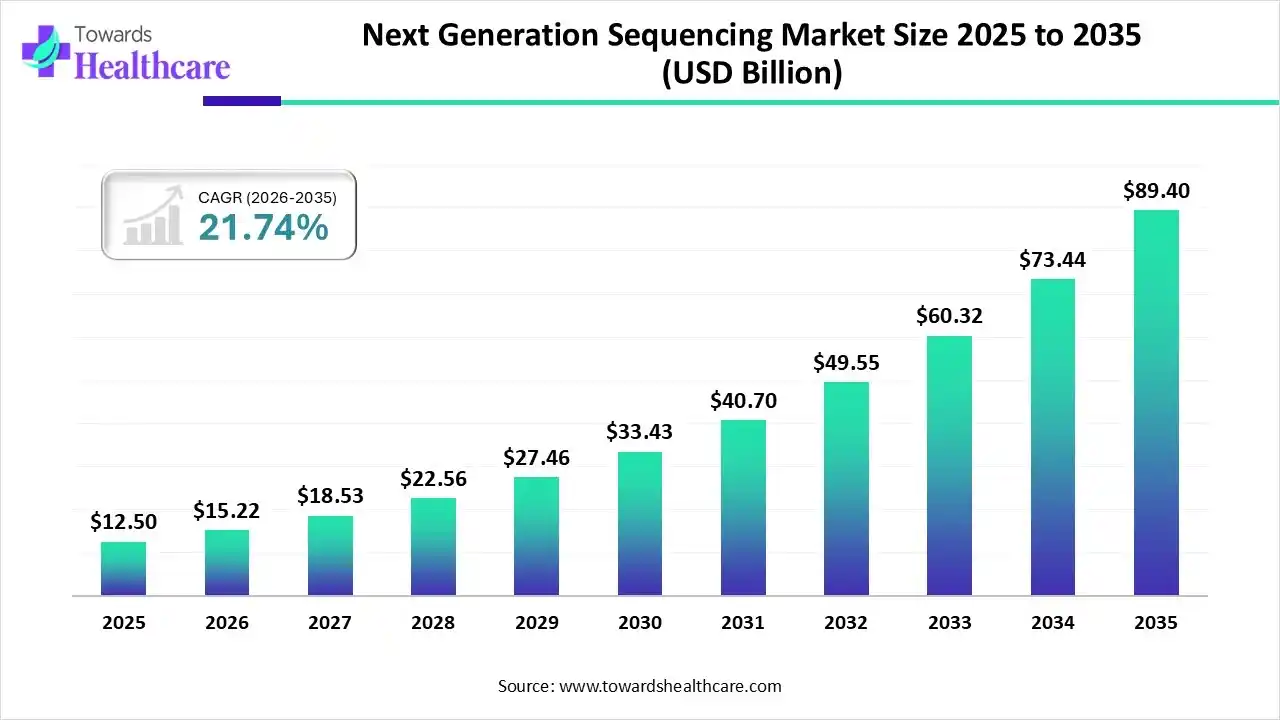
Download Free Sample: https://www.towardshealthcare.com/download-sample/5344
This is not just about numbers. It is about how we understand life itself.
What Makes NGS So Powerful?
NGS allows scientists to read DNA and RNA faster, deeper, and more accurately than ever before.
Unlike traditional sequencing methods, NGS does not just scratch the surface. It dives deep into genetic structures, helping researchers uncover hidden mutations and complex biological patterns.
That’s why labs, hospitals, and biotech firms are shifting toward NGS—it answers questions older technologies simply cannot.
Growth Drivers You Can’t Ignore
The rise of NGS is not accidental. Several strong forces are pushing it forward:
-
Disease diagnosis is becoming more precise
Doctors can now identify genetic mutations quickly, helping them make better treatment decisions. -
Demand for personalized medicine is rising
Patients no longer want generic treatments. NGS enables therapies tailored to individual genetic profiles. -
Research is moving faster than ever
Scientists can analyze massive genetic datasets in less time, accelerating discoveries.
This combination is turning NGS into a must-have technology across healthcare ecosystems.
Oncology Takes the Lead
Cancer research and treatment are at the heart of NGS adoption.
With 45% market share in applications, oncology dominates because cancer is fundamentally a genetic disease.
NGS helps detect mutations early, track tumor evolution, and guide targeted therapies. This shifts treatment from guesswork to precision.
Doctors are no longer just treating cancer—they are decoding it.
Consumables Quietly Dominate
While advanced machines often get the spotlight, consumables hold nearly 70% of the market.
These include kits, reagents, and sequencing materials used daily in labs.
Why do they dominate?
Because every test requires them. Every experiment depends on them. They create a recurring demand cycle that fuels steady revenue growth.
In simple terms, machines may start the process—but consumables keep it running.
Targeted Sequencing: The Smart Approach
Among technologies, target sequencing & resequencing lead with 40% share.
Instead of analyzing the entire genome, researchers focus only on specific regions of interest.
This approach delivers:
-
Higher accuracy in detecting rare mutations
-
Faster results with lower costs
-
Better data efficiency for clinical use
It is not about doing more—it is about doing what matters most.
Geography Tells a Strategic Story
The global spread of NGS adoption reveals different priorities:
-
North America leads
Strong infrastructure, high R&D investment, and early adoption give it a dominant edge. -
Asia-Pacific grows the fastest
Government initiatives, rising healthcare awareness, and expanding biotech sectors drive rapid growth. -
Europe maintains steady momentum
Research collaborations and regulatory frameworks support consistent expansion.
Each region plays a unique role in shaping the global NGS landscape.
Governments Are Now Taking Control
Public sector involvement is reshaping the future of genomic data.
India, for example, is working toward genomic independence by launching data frameworks and biological data centers. The goal is clear—build a strong, self-reliant genomic ecosystem.
Similarly, large-scale initiatives in countries like Canada aim to create massive genomic databases, opening new doors for research and innovation.
Governments are no longer just regulators—they are active participants.
AI Is Changing the Game
Artificial intelligence is becoming a powerful ally in NGS.
Handling massive genomic datasets manually is nearly impossible. AI simplifies this by:
-
Improving variant detection accuracy
-
Predicting genetic outcomes more effectively
-
Enhancing usability of clinical data systems
This integration is not optional—it is essential for scaling NGS applications.
The future of genomics is not just biological. It is computational.
Challenges That Still Exist
Despite its promise, NGS is not without obstacles.
Ethical concerns remain a major issue. Handling sensitive genetic data requires strict protocols and transparency.
Questions around data ownership, privacy, and interpretation continue to challenge researchers and policymakers.
Technology may move fast—but ethics must keep up.
Rare Diseases Open New Opportunities
NGS is proving to be a game-changer for rare disease diagnosis.
Millions of people worldwide suffer from conditions that are difficult to identify. Traditional methods often fail to provide clear answers.
NGS changes that by enabling:
-
Faster genetic diagnosis
-
Detection of complex mutations
-
Better understanding of multiple co-existing conditions
This is not just a market opportunity—it is a human breakthrough.
The Workflow That Drives Efficiency
In the NGS process, sequencing itself holds the largest share at 55%.
This stage is where the actual genetic decoding happens, making it the most critical part of the workflow.
Efficiency here directly impacts the speed and accuracy of results.
That’s why companies are investing heavily in improving sequencing technologies.
Academic Research Leads the Way
Academic institutions dominate the end-use segment with 40% market share.
Universities and research centers are at the forefront of innovation. They experiment, validate, and push boundaries.
Their work often becomes the foundation for commercial applications.
In many ways, the future of NGS starts in academic labs.
Access our exclusive, data-rich dashboard dedicated to the healthcare market – built specifically for decision-makers, strategists, and industry leaders. The dashboard features comprehensive statistical data, segment-wise market breakdowns, regional performance shares, detailed company profiles, annual updates, and much more. From market sizing to competitive intelligence, this powerful tool is one-stop solution to your gateway.
Access the Dashboard: https://www.towardshealthcare.com/access-dashboard
Checkout the Market Report Now at: https://www.towardshealthcare.com/checkout/5344
You can place an order or ask any questions, please feel free to contact us at [email protected]
Europe Region – +44 778 256 0738
North America Region – +1 8044 4193 44
APAC Region: +91 9356 9282 04
Visit Our Website: https://www.towardshealthcare.com
Find us on social platforms: LinkedIn | Twitter | Instagram | Medium