Life Science Consumables Market Demand Surges 5.44% CAGR Through 2034
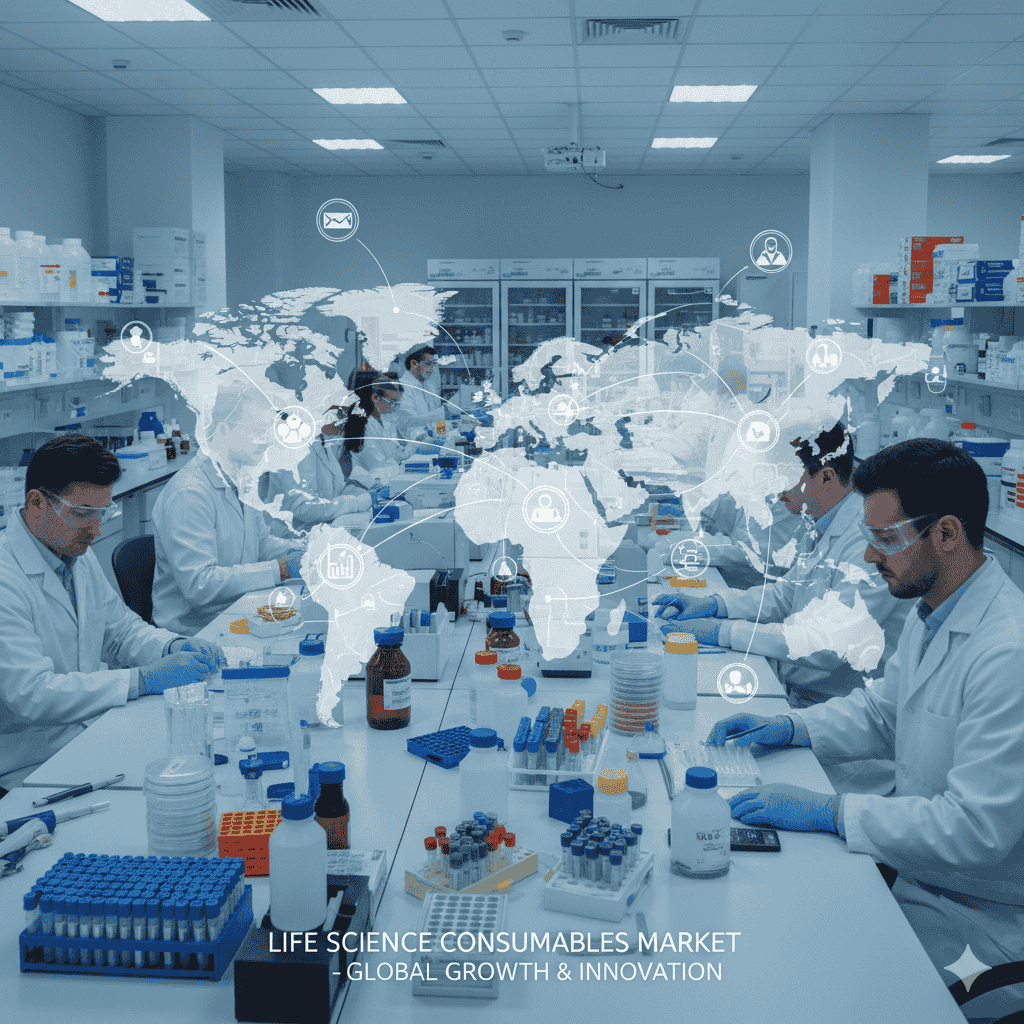
The global Life Science Consumables Market is projected to grow from USD 31.51 billion in 2025 to approximately USD 50.71 billion by 2034, expanding at a CAGR of 5.44%, driven by rising R&D, adoption of molecular diagnostics, and advanced cell & gene therapy research.
Download this Free Sample Now and Get the Complete Report and Insights of this Market Easily @ https://www.towardshealthcare.com/download-sample/5921
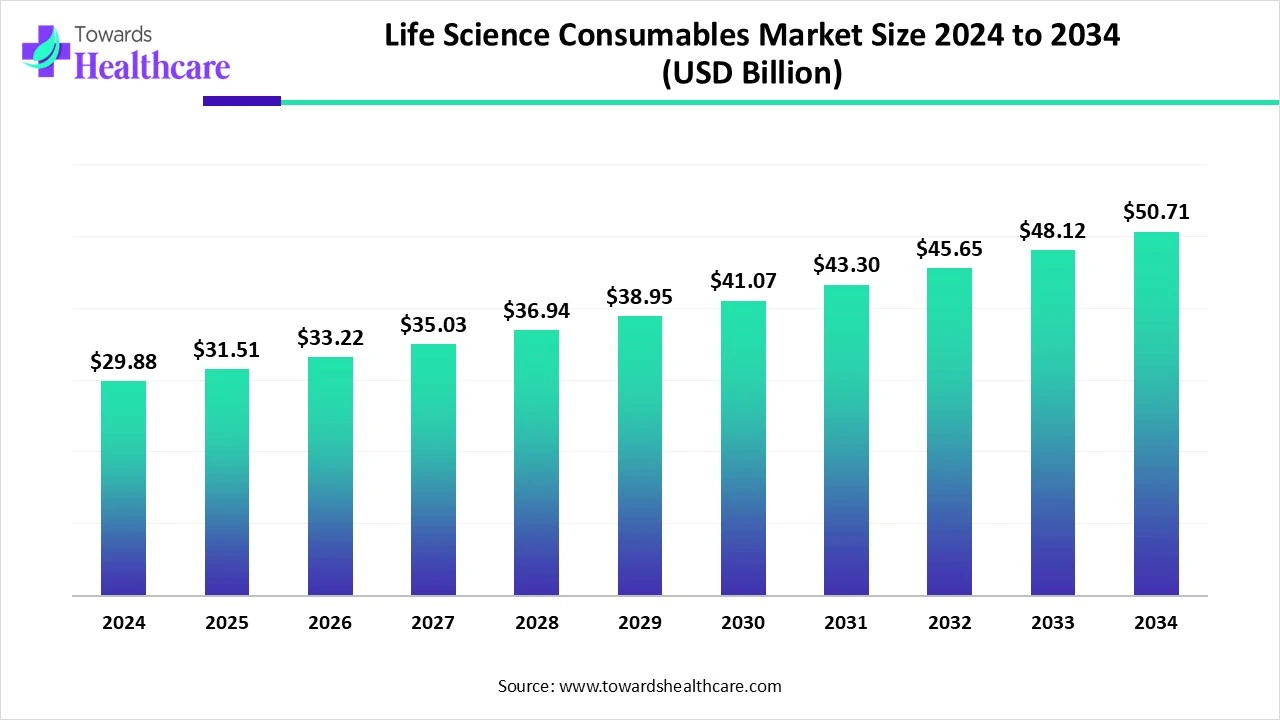
Table of Contents
ToggleMarket Size
Global Market Size (2024 – 2034)
●2024: USD 29.88 billion
●2025: USD 31.51 billion
●2034 (Projected): USD 50.71 billion
●CAGR (2025–2034): 5.44%
By Product Type (Revenue Share 2024)
●Reagents & Chemicals: 38%
Kits & Assays: Fastest-growing segment (sub-segment: Cell-based assay kits)
●Media (Cell culture, Microbial culture, Serum-free/Defined media): Significant growth due to rising cell & gene therapy research
●Labware (Tubes, Plates, Flasks, Beakers, Plasticware, Glassware, Filtration products): Essential for research reproducibility and contamination prevention
By Technology (Revenue Share 2024)
●Cell Culture Technology: 30%, driven by applications in drug development, biotechnology, and regenerative medicine
●Next-Generation Sequencing (NGS): Fastest-growing, crucial for genomic research and diagnostics
By End-User (Revenue Share 2024)
●Pharmaceutical & Biotechnology Companies: 45%
●Clinical & Diagnostic Labs: Fastest-growing segment
Market Trends
Rising R&D Investments
Cancer research funding in the US exceeds USD 7 billion/year, boosting demand for reagents, kits, and cell culture consumables.
AI Integration & Digital Technologies
AI is being used to optimize reagent design, predict assay performance, and detect contaminants.
Personalized Medicine
Custom consumables and reagents tailored to individual genetic profiles are increasing.
Emerging Market Expansion
Asia Pacific (China, India, Japan, South Korea) is experiencing the fastest CAGR due to cost-effective manufacturing and clinical trials.
Sustainable Products
Shift toward biodegradable and recyclable consumables in line with eco-friendly initiatives.
High Demand for Kits & Assays
Growth driven by cell-based assay kits used in drug discovery and preclinical studies.
Advances in Molecular Biology Tools
PCR/qPCR, nucleic acid purification, and gene-editing consumables are in high demand.
Collaborations & Partnerships
Increasing collaborations between research institutes, CROs, and biotech firms enhance market penetration.
Regulatory Support
FDA, EMA, and other regulatory bodies enforce standards, indirectly boosting demand for high-quality consumables.
Funding & Startups
Examples: Cipla’s USD 3 million (~Rs 26 crore) investment in Achira Labs; Stilla Technologies raised USD 26.5 million Series C funding.
AI Impact / Role in Life Science Consumables Market
In Silico Reagent Screening
AI enables digital filtering of reagent libraries before lab testing, reducing cost and time.
Optimized PCR Enzymes
Machine learning improves amplification efficiency and enzyme thermostability in PCR/qPCR kits.
Contaminant Detection
AI-based image analysis ensures batch consistency and prevents contamination in fluorescence probes.
Automated Lab Processes
Robotic and AI-driven pipetting and sample handling enhance reproducibility.
Personalized Reagents
Synthetic biology + AI allows creation of reagents based on patient genetic profiles.
Predictive Demand Analysis
AI forecasts consumable demand for labs, helping in inventory and supply chain optimization.
Enhanced Data Analysis
AI interprets NGS and proteomics results, guiding consumable usage and experiment design.
Cost Optimization
Reduces wastage of expensive reagents through simulation and predictive modeling.
Real-Time Quality Monitoring
Continuous AI monitoring detects deviations in reagents and labware performance.
Drug Discovery Acceleration
AI streamlines cell-based assays, preclinical toxicology kits, and molecular biology workflows.
Regional Insights
North America
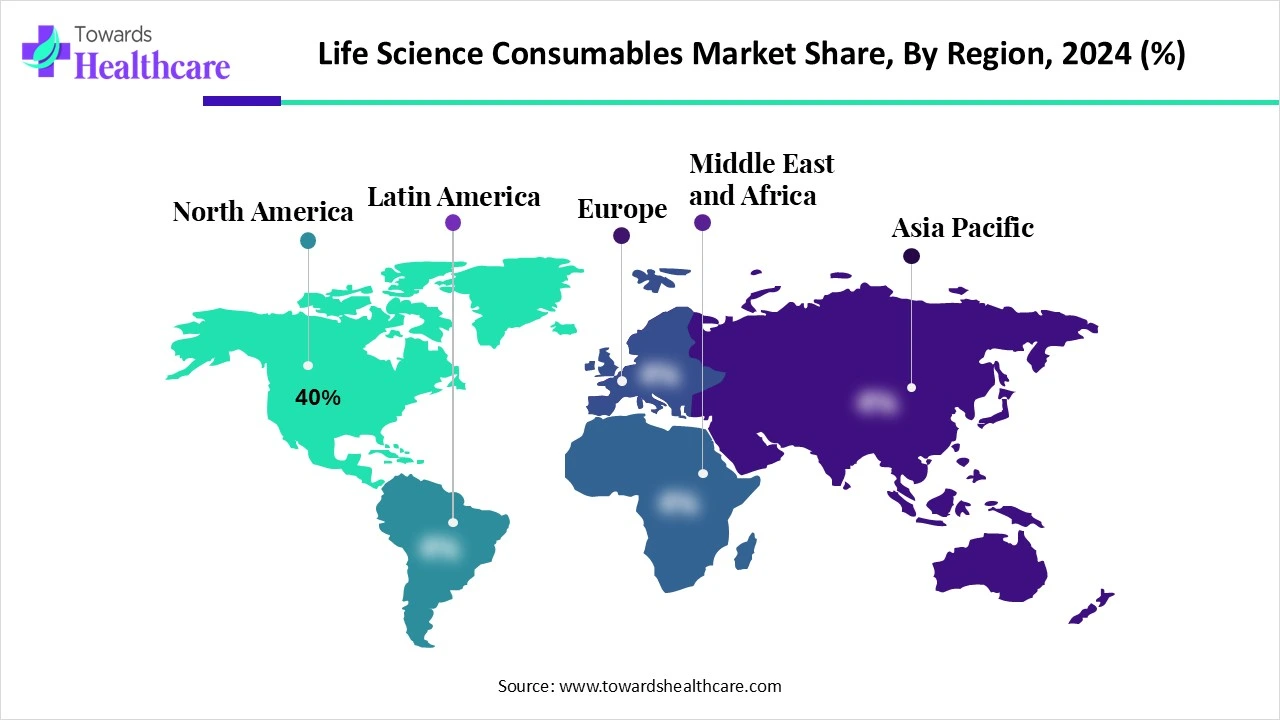
Market Share: Dominates with 40% of the global life science consumables market in 2024.
Key Drivers:
High adoption of advanced consumables: Pharmaceutical, biotechnology, and diagnostic sectors utilize cutting-edge reagents, kits, labware, and automation tools.
Robust R&D infrastructure: The U.S. hosts top-tier universities, research institutes, and private research centers driving innovation.
Major Life Science Hubs:
Boston: Home to over 30 universities, biotech startups, and pharmaceutical companies.
San Francisco: Concentration of biotechnology and genomics research firms.
San Diego: Known for biomedical research and regenerative medicine initiatives.
Trends:
Sustainability push: Increasing use of biodegradable and recyclable consumables in research labs.
Regulatory support: FDA and other regulatory bodies enforce quality standards, promoting the adoption of high-quality consumables.
Impact: North America’s dominance ensures high-quality research outputs and sets trends for global adoption of consumables and lab technologies.
Asia Pacific
Growth Rate: Fastest-growing region in the forecast period.
Key Drivers:
Entry of global companies: Multinationals are investing in China, India, and Japan, expanding local availability of high-quality consumables.
High clinical trial activity: Countries like China and India are preferred hubs for clinical trials due to cost-effectiveness and skilled labor.
Lower manufacturing costs: Enables production of consumables at competitive prices, increasing adoption in research labs.
Subregional Insights:
China:
14 million sq. ft R&D facilities being built in Beijing and Shanghai.
Aging population & rising health issues fuel demand for diagnostics and personalized medicine.
India:
Focus on innovative research and technological advancement in life sciences.
Rising investments from both government and private sectors enhance the growth trajectory of research consumables.
Impact: Asia Pacific’s rapid expansion provides a cost-effective manufacturing base and a growing consumer market for life science consumables.
Europe
Key Drivers:
High investment in R&D: Germany and the UK lead in pharmaceutical and biotech research.
Horizon Europe program: European Union initiative promoting innovation and cross-border research collaboration.
Collaborative research culture: Universities, research institutes, and private companies work together to accelerate product development.
Trends:
Adoption of sustainable and high-quality consumables driven by regulatory requirements.
Increased demand for molecular biology and cell therapy consumables due to strong research focus.
Impact: Europe provides a stable and advanced market for consumables, supporting innovation and regulatory-compliant products.
Canada
Market Strengths:
Robust R&D environment: Top academic institutions and research centers foster innovation.
Economic contribution: Pharmaceutical and medical manufacturing contributes USD 82.1 billion to GDP in 2023.
Trends:
Focus on precision medicine and biologics research increases demand for high-quality consumables.
Collaborations between private companies and academic institutions enhance innovation.
Impact: Canada’s life sciences market provides stability and high research quality, making it an attractive region for consumables suppliers.
China
Market Drivers:
Construction of 14 million sq. ft of R&D facilities in Beijing and Shanghai indicates massive infrastructure growth.
Aging population and rising health issues increase demand for clinical diagnostics and research consumables.
Trends:
Global companies entering China expand access to high-quality consumables.
Government support for life sciences R&D accelerates the market.
Impact: China’s growing healthcare needs and research infrastructure make it a major opportunity for consumables suppliers.
India
Market Drivers:
Strong focus on innovative research and adoption of modern lab technologies.
Government and private sector investment in life sciences is growing rapidly.
Trends:
Expansion of biotechnology parks and research hubs accelerates demand for reagents, kits, and cell culture media.
Rising clinical trial activity attracts foreign companies to supply consumables locally.
Impact: India is an emerging market offering growth potential for global and local life science consumables companies, combining low-cost operations with increasing demand.
Market Dynamics of Life Science Consumables
Drivers
Rising R&D in Genetics, Biotechnology, and Pharmaceuticals
Increasing global investment in R&D fuels demand for consumables like reagents, kits, media, and labware.
Examples: Molecular biology, genomics, proteomics, and cell biology research rely heavily on high-quality consumables.
Impact: Drives reproducibility, accuracy, and scalability in laboratory experiments, essential for drug discovery and diagnostic innovation.
Increasing Prevalence of Chronic Diseases (Cancer, Diabetes, etc.)
Chronic disease prevalence increases demand for targeted therapies and diagnostics.
Consumables are essential for:
Molecular diagnostics for early detection
Development of personalized medicine solutions
Impact: Sustained demand for reagents, assay kits, and lab media in pharmaceutical and clinical labs.
High Investment in Cell & Gene Therapies
Cell and gene therapy research requires specialized consumables: growth factors, cell culture media, and kits.
Rising investment in these advanced therapies drives consumption of high-purity, reproducible consumables.
Impact: Encourages innovation in cell-based assay kits and media optimization, supporting commercialization of new therapies.
Expanding Biopharmaceutical Production
Manufacturing biologics and novel therapies requires robust, contamination-free consumables.
Example: Sterile tubes, flasks, pipette tips, and filtration devices.
Impact: Ensures consistent quality and regulatory compliance for high-value biopharmaceutical products.
Increased Adoption of Molecular Diagnostics
Growing need for DNA/RNA testing, PCR, and next-generation sequencing increases consumable demand.
Impact: Boosts sales of PCR kits, nucleic acid extraction kits, and NGS consumables.
Restraints
Regulatory Challenges (FDA, EMA Compliance)
Life science consumables must meet strict standards from authorities like FDA (U.S.) and EMA (Europe).
Impact: Lengthy approval processes delay market entry for new products.
Time-Consuming Product Approvals
New kits, reagents, and assays require rigorous validation, testing, and documentation.
Example: PCR or cell-based assay kits require clinical validation to ensure accuracy.
Impact: Slows product launch cycles, limiting immediate revenue growth.
Higher Cost of Tests & Kits
Regulatory compliance, high-quality materials, and advanced technology increase production costs.
Example: Custom assay kits or high-purity reagents are expensive to produce and maintain.
Impact: Raises the price for end-users, potentially limiting adoption in cost-sensitive markets.
Dependence on Global Supply Chains
Importing specialized consumables can cause delays due to shipping, customs, or geopolitical issues.
Impact: Affects small labs and emerging markets that rely on imported high-quality consumables.
Opportunities
Eco-Friendly and Recyclable Consumables
Growing emphasis on sustainability drives demand for biodegradable plastics and recyclable labware.
Example: Pipette tips, cell culture plates, and tubes made from sustainable materials.
Impact: Supports corporate social responsibility and regulatory compliance, while reducing environmental footprint.
Customized Laboratory Solutions for Specific Research Needs
Tailored reagents, kits, and assay designs meet the unique needs of individual research projects.
Example: Custom qPCR kits or cell-based assay kits for specific cell types or pathways.
Impact: Enhances user experience, reduces experiment variability, and supports high-impact research.
Local Sourcing & Diversified Supply Chains
Companies investing in regional manufacturing to reduce international shipping risks and costs.
Impact: Ensures consistent supply of consumables, reduces lead times, and mitigates geopolitical or transport disruptions.
Adoption of Automation & High-Throughput Platforms
Integrating consumables with automated lab equipment increases efficiency and reduces errors.
Impact: Drives demand for consumables optimized for robotics and high-throughput screening.
Expansion into Emerging Markets
Growth in Asia Pacific, India, and China provides new opportunities for life science consumables.
Example: Rising number of clinical trials, research centers, and biotech firms.
Impact: Creates a large, cost-effective consumer base for reagents, kits, media, and labware.
Collaboration Between Academic & Industrial Research
Increased partnerships between universities and biotech/pharma companies drive demand for consumables.
Impact: Custom kits, reagents, and labware are needed for collaborative research projects, increasing market penetration.
Top 10 Companies
Thermo Fisher Scientific
Products: Reagents, labware, kits, media
Overview: Thermo Fisher Scientific is recognized as a global leader in laboratory consumables, supporting research across molecular biology, cell culture, diagnostics, and biopharma.
Strengths:
Wide product portfolio: Offers almost every type of consumable used in life sciences, from plasticware to advanced reagents.
Strong global distribution: Operations in over 50 countries, ensuring fast delivery and regional support.
Impact: Its comprehensive solutions support reproducible experiments, critical for drug discovery and diagnostics.
Merck KGaA (MilliporeSigma)
Products: Chemicals, reagents, cell culture media
Overview: A key player in molecular biology consumables, Merck KGaA provides essential reagents and media for cell culture and biopharmaceutical R&D.
Strengths:
High-quality standards: Products are designed to meet strict laboratory and regulatory requirements.
Global footprint: Supplies research institutions, hospitals, and biotech companies worldwide.
Impact: Their reagents and media ensure reliability in experiments and consistency in results, particularly in genomics and proteomics research.
Danaher Corporation
Products: Lab instruments, reagents, kits
Overview: Danaher is strong in biopharma and research consumables, combining instruments with essential lab consumables.
Strengths:
Advanced technology & innovation: Focus on integrating instruments with consumables for high-throughput research.
Global presence: Well-established channels in North America, Europe, and Asia.
Impact: Supports large-scale drug development and automated lab workflows, enhancing efficiency and reducing experimental variability.
Bio-Rad Laboratories, Inc.
Products: PCR/qPCR kits, assays, labware
Overview: Specializes in life science research and diagnostics, offering precision tools for molecular biology studies.
Strengths:
Precision tools: Provides highly reliable kits and reagents for nucleic acid amplification and protein analysis.
Research-focused: Offers products tailored to both basic research and clinical applications.
Impact: Enables reproducible molecular biology experiments, critical for diagnostics, biomarker discovery, and clinical studies.
Agilent Technologies
Products: Chromatography, spectroscopy, lab consumables
Overview: Known for high-performance analytical instruments, Agilent complements its equipment with consumables for accurate testing.
Strengths:
High-accuracy testing solutions: Ensures precision in chemical analysis, proteomics, and genomics workflows.
Strong instruments-consumables integration: Consumables are optimized for Agilent instruments, reducing errors and downtime.
Impact: Supports complex research workflows in pharma, food testing, and environmental labs with reliable analytical solutions.
QIAGEN N.V.
Products: DNA/RNA kits, assays
Overview: Leader in molecular diagnostics and sample preparation, particularly for nucleic acid analysis.
Strengths:
Advanced nucleic acid solutions: Efficient extraction, purification, and amplification kits.
Specialization in diagnostics: Products designed for clinical labs and research institutions.
Impact: Streamlines workflows for genomics research, genetic testing, and personalized medicine, reducing time and contamination risks.
PerkinElmer, Inc.
Products: Lab automation, consumables, detection systems
Overview: Provides research and clinical diagnostic tools, combining consumables with advanced detection technologies.
Strengths:
Innovative detection technologies: Fluorescence, chemiluminescence, and imaging systems integrated with consumables.
Automation-friendly: Supports high-throughput applications in diagnostics and life science research.
Impact: Enhances efficiency and precision in screening assays, clinical diagnostics, and genomics workflows.
Becton, Dickinson and Company (BD)
Products: Labware, plasticware, filtration products
Overview: A global leader in consumables and lab equipment, BD serves hospitals, research labs, and biotech companies.
Strengths:
Reliable & scalable production: Supplies consistently high-quality labware and filtration systems.
Global network: Ensures timely distribution and compliance with regulatory standards.
Impact: Critical for contamination-free experiments and high-quality sample handling in clinical and research labs.
Promega Corporation
Products: Assays, reagents, molecular biology kits
Overview: Focused on genomics and proteomics research, Promega delivers high-reliability tools for molecular biology.
Strengths:
High reproducibility: Products designed to provide consistent results across multiple labs.
Accuracy in assays: Trusted for cell-based and biochemical assays.
Impact: Facilitates drug discovery, protein analysis, and gene expression studies with robust and accurate consumables.
Roche Diagnostics
Products: Assay kits, reagents, clinical consumables
Overview: A leader in diagnostics and lab consumables, Roche provides comprehensive solutions for clinical and research labs.
Strengths:
Strong global presence: Distribution networks in major life science markets worldwide.
Extensive R&D pipeline: Continuously develops new reagents and kits to meet emerging needs.
Impact: Improves efficiency and reliability in clinical diagnostics, molecular testing, and life science research.
Latest Announcements
CN Bio – February 2025
Developed Human 24 DILI assay kit for preclinical toxicology
Enhances replication of drug-induced hepatotoxicity tests
Cipla – May 2024
Investment of Rs 26 crore in Achira Labs for point-of-care test kits
Acquired 27.27% voting rights
Stilla Technologies – February 2024
Closed $26.5 million Series C funding for digital PCR advancements
Recent Developments
Alamar Biosciences – February 2025
Released NULISAqpcrTM Custom Assay Development Kit for early illness detection
Partillion Bioscience – January 2025
Launched pre-orders for Nanovial Multicell Assay Antibody Discovery Kits
Segments Covered
By Product Type
Reagents & Chemicals: Essential for biological and biomedical research, these products are fundamental in advancing our understanding of biology, developing new medicines, and diagnosing diseases. BCC Research
Kits & Assays:
ELISA: Widely used for detecting and quantifying soluble substances.
PCR/qPCR: Crucial for DNA/RNA analysis and gene expression studies.
Cell-based assays: Important for drug discovery and toxicology testing.
Media:
Cell culture media: Supports the growth of cells in vitro.
Microbial media: Facilitates the growth of microorganisms for various applications.
Serum-free media: Used to cultivate cells without the need for animal-derived components.
Labware:
Plasticware: Includes tubes, plates, flasks, and beakers.
Filtration products: Essential for sample preparation and purification.
By Technology
Cell Culture Technology: Dominant in 2024, driven by its applications in drug development and regenerative medicine.
Next-Generation Sequencing (NGS): The fastest-growing segment, revolutionizing genomics and personalized medicine.
Other Technologies:
PCR/qPCR: Continues to be pivotal in genetic research and diagnostics.
Chromatography: Crucial for separating and analyzing compounds.
Spectroscopy: Used for identifying chemical structures and concentrations.
Flow Cytometry: Important for cell analysis and sorting.
ELISA: Remains a standard for immunoassays.
Electrophoresis: Essential for analyzing biomolecules.
By End-User
Pharmaceutical & Biotechnology Companies: Dominant sector, accounting for a significant share due to extensive R&D activities.
Clinical & Diagnostic Labs: Fastest-growing segment, driven by the increasing demand for diagnostic services.
Academic & Research Institutes: Key contributors to innovation and development of new technologies.
Contract Research Organizations (CROs): Play a vital role in outsourcing research and development services.
Food & Environmental Labs: Growing demand for testing and quality assurance.
By Region
North America: Leading in market share, supported by robust healthcare infrastructure and high R&D investments.
Asia Pacific: Fastest-growing region, with significant contributions from China and India.
Europe: Strong presence of pharmaceutical and biotechnology companies.
Latin America & MEA: Emerging markets with increasing adoption of laboratory technologies.
🇮🇳 India Specific Insights
Market Growth: India is witnessing rapid growth in the life sciences sector, with significant investments in biotechnology and pharmaceuticals.
Key Players: Companies like Agilent Technologies are expanding their presence in India, exemplified by the opening of a new biopharma center in Hyderabad. The Times of India
Government Initiatives: Supportive policies and initiatives like ‘Make-in-India’ are fostering innovation and manufacturing in the life sciences domain.
Top 5 FAQs
1 What is the projected size of the life science consumables market by 2034?
Expected to reach USD 50.71 billion, growing at a CAGR of 5.44%.
2 Which product type dominated the market in 2024?
Reagents & Chemicals (~38% revenue share)
3 Which technology is expected to grow the fastest?
Next-Generation Sequencing (NGS)
4 Which region dominates the market currently?
North America (40% market share, 2024)
5 Who are the top key players in the market?
Thermo Fisher Scientific, Merck KGaA, Danaher Corporation, Bio-Rad, Agilent Technologies, QIAGEN, PerkinElmer, BD, Promega, Roche Diagnostics
Access our exclusive, data-rich dashboard dedicated to the life sciences industry – built specifically for decision-makers, strategists, and industry leaders. The dashboard features comprehensive statistical data, segment-wise market breakdowns, regional performance shares, detailed company profiles, annual updates, and much more. From market sizing to competitive intelligence, this powerful tool is one-stop solution to your gateway.
Access the Dashboard: https://www.towardshealthcare.com/access-dashboard
Immediate Delivery Available | Buy This Premium Research @ https://www.towardshealthcare.com/price/5921
Become a valued research partner with us – https://www.towardshealthcare.com/schedule-meeting
You can place an order or ask any questions, please feel free to contact us at sales@towardshealthcare.com
Powering Healthcare Leaders with Real-Time Insights: https://www.towardshealthcare.com/healthcare-intelligence-platform
Europe Region – +44 778 256 0738
North America Region – +1 8044 4193 44
APAC Region: +91 9356 9282 04
Web: https://www.towardshealthcare.com
Find us on social platforms: LinkedIn | Twitter | Instagram | Medium | Pinterest
About the Author