Behind every successful organ transplant is far more than a surgeon and an operating room.
There are donor registrations, compatibility checks, waiting lists, transportation logistics, hospital coordination, laboratory reports, and strict regulatory compliance—all happening within a very limited time.
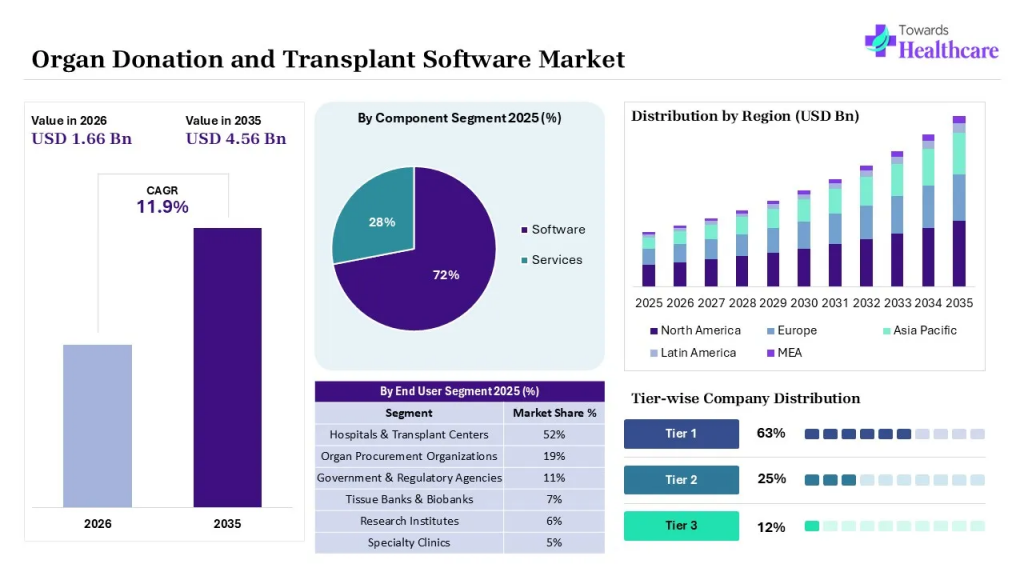
As transplant volumes continue to rise worldwide, healthcare organizations are increasingly relying on digital platforms that can coordinate every step with speed and accuracy. That is exactly why the global organ donation and transplant software market is expected to reach USD 1.66 billion in 2026, up from USD 1.48 billion in 2025, and is projected to grow to USD 4.56 billion by 2035, expanding at a CAGR of 11.9%.
Digital platforms are no longer optional, they are becoming part of life-saving healthcare infrastructure.
Rising Chronic Diseases Are Increasing the Need for Smarter Transplant Systems
Across the world, chronic kidney disease, liver failure, heart disease, and lung disorders continue to increase.
According to the World Health Organization (WHO), noncommunicable diseases account for nearly 43 million deaths every year, representing around 74% of global deaths. Kidney disease alone affects hundreds of millions of people worldwide, while demand for transplantation continues to exceed available donor organs.
Governments are therefore investing not only in increasing organ donation awareness but also in improving how organs are allocated.
Countries are modernizing national registries, digitizing donor databases, integrating hospital information systems, and using cloud platforms that reduce delays during organ allocation.
Patients Expect Faster, More Transparent Healthcare
Healthcare consumer expectations have changed dramatically over the last decade.
Patients and donor families increasingly expect:
- Real-time updates during transplant coordination
- Secure digital health records
- Faster matching between donor and recipient
- Reduced paperwork
- Better communication between hospitals
Healthcare providers share similar expectations.
Hospitals increasingly prefer cloud-based transplant platforms because they reduce administrative workload, improve regulatory compliance, and help clinicians make faster decisions.
Artificial intelligence is also beginning to improve compatibility scoring, while predictive analytics help transplant teams evaluate recipient outcomes before surgery.
Market Snapshot (2026)
| Category | Statistics |
|---|---|
| Global Market Size (2026) | USD 1.66 Billion |
| Forecast (2035) | USD 4.56 Billion |
| CAGR (2026–2035) | 11.9% |
| North America Market Share | 41% |
| Europe Market Share | 29% |
| Asia-Pacific Market Share | 21% |
| Latin America | 5% |
| Middle East & Africa | 4% |
| Software Segment | 72% |
| Cloud-Based Deployment | 69% |
| Hospitals & Transplant Centers | 52% |
| Kidney Transplant Applications | 44% |
Regional Leaders Continue to Shape Innovation
North America remains the largest market with 41% of global revenue, supported by mature transplant infrastructure, advanced healthcare IT adoption, strong regulatory oversight, and high healthcare spending.
Europe follows with 29%, driven by cross-border organ exchange programs and highly integrated transplant networks.
Asia-Pacific accounts for 21% and is expected to record the fastest long-term growth. Countries such as India and China are expanding transplant centers, investing in digital healthcare, and strengthening national health technology initiatives.
Latin America and the Middle East are also steadily modernizing transplant coordination systems through government-supported healthcare digitization.
Cloud Platforms and AI Are Becoming the New Standard
Nearly 69% of software deployments now use cloud infrastructure, allowing transplant teams to securely share information across hospitals, laboratories, procurement organizations, and regulatory agencies.
The software segment itself represents 72% of total market revenue, reflecting growing demand for specialized platforms that manage donor registration, recipient matching, waiting lists, compliance reporting, and post-transplant monitoring.
Among applications, organ allocation and matching holds the largest share at 24%, while hospitals and transplant centers account for 52% of end-user adoption.
Kidney transplantation continues to dominate software utilization, representing 44% of organ-specific applications because kidney transplants remain the most frequently performed transplant procedure globally.
Download Customized Sample Report of this Industry: https://www.towardshealthcare.com/insights/organ-donation-and-transplant-software-market-sizing
The Next Decade Will Be Defined by Connected Healthcare
The future of transplantation will depend as much on digital coordination as on medical innovation.
Cloud computing, artificial intelligence, predictive analytics, secure health information exchange, and national transplant registries are creating faster, safer, and more transparent organ allocation systems.
As governments continue expanding digital health infrastructure and hospitals prioritize workflow automation, organ donation and transplant software is expected to become one of the most important digital foundations supporting modern transplantation.
Ultimately, technology cannot create donor organs—but it can ensure that every available organ reaches the right patient at the right time, giving more people a second chance at life.
Access our exclusive, data-rich dashboard dedicated to the healthcare market – built specifically for decision-makers, strategists, and industry leaders. The dashboard features comprehensive statistical data, segment-wise market breakdowns, regional performance shares, detailed company profiles, annual updates, and much more. From market sizing to competitive intelligence, this powerful tool is one-stop solution to your gateway.
Access the Dashboard: https://www.towardshealthcare.com/access-dashboard
About Us
Healthcare WebWire is a part of Towards Healthcare Research & Consulting which is a global healthcare market research and consulting firm dedicated to helping businesses make informed decisions through reliable market intelligence and strategic insights. We serve pharmaceutical, biotechnology, medical device, AI in healthcare, cell and gene therapy, digital health, and life sciences organizations with in-depth market research, custom consulting, competitive analysis, and growth forecasts. Our team combines industry expertise with rigorous research to deliver clear, actionable insights that support market expansion, product strategy, investment decisions, and long-term business growth. From emerging innovations to established healthcare markets, we help organizations understand where the industry is today and where it’s headed tomorrow.
You can place an order or ask any questions, please feel free to contact us at [email protected]
Europe Region – +44 778 256 0738
North America Region – +1 8044 4193 44
APAC Region: +91 9356 9282 04
Visit Our Website: https://www.towardshealthcare.com
Find us on social platforms: LinkedIn | Twitter | Instagram | Medium