The world of medical research is quietly undergoing a transformation.
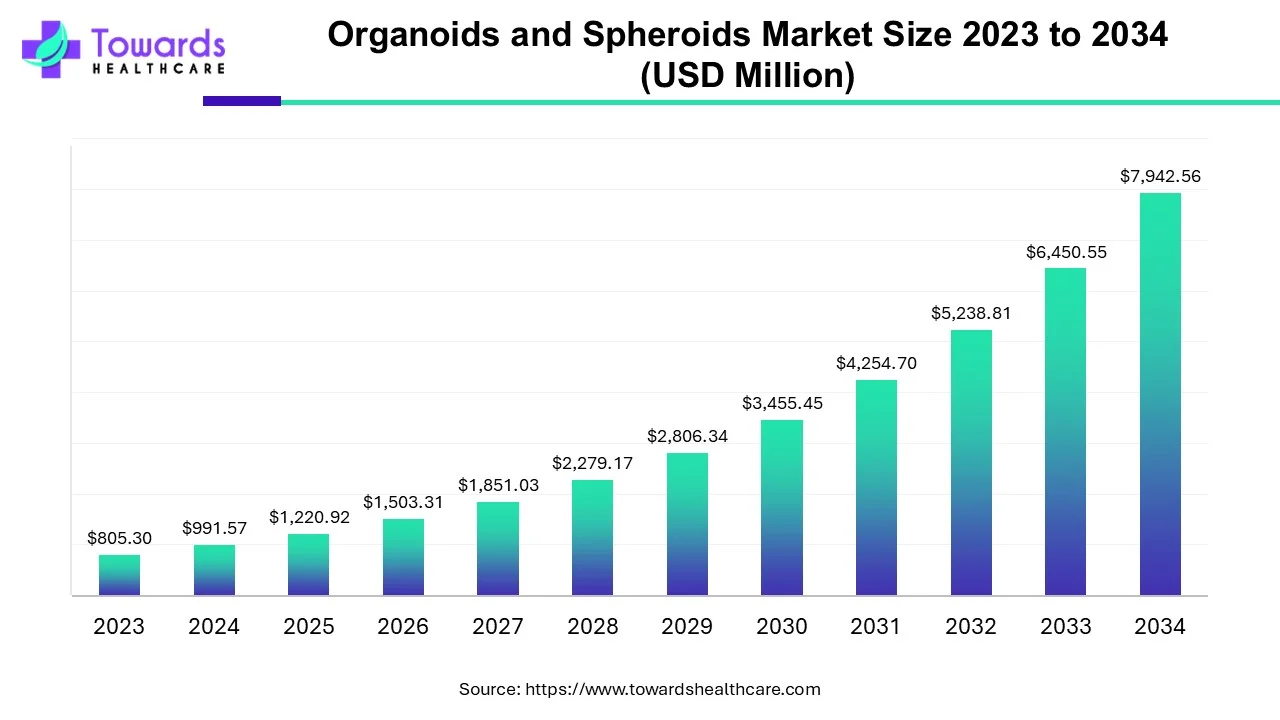
At the center of this shift lies the growing organoids and spheroids market, projected to surge from USD 1.5 billion in 2026 to nearly USD 9.77 billion by 2035.
This rapid growth, backed by a strong 23.13% CAGR, is not just about numbers.
It reflects a deeper shift toward smarter, faster, and more human-relevant healthcare solutions.
Download Free Sample: https://www.towardshealthcare.com/download-sample/5167
From Petri Dish to Living Models: A Scientific Leap
Traditional lab models are no longer enough to answer complex biological questions.
Researchers now demand systems that behave more like real human tissues.
This is where organoids and spheroids step in.
Spheroids are simple 3D clusters of cells, while organoids mimic actual organs like the liver, brain, or intestine.
These models don’t just grow in labs—they replicate real biological responses.
That makes them powerful tools for studying diseases and testing treatments with greater accuracy.
Why the Market Is Accelerating So Fast
The growth of this market is not random.
It is fueled by real-world challenges that demand better solutions.
One of the biggest drivers is the rising global burden of cancer.
As cases continue to increase, researchers need more reliable ways to study tumor behavior and test therapies.
At the same time, pharmaceutical companies want to reduce drug failure rates.
Organoids and spheroids help simulate human responses before clinical trials, saving both time and cost.
Key growth drivers include:
-
Rising demand for personalized medicine
-
Shift away from animal testing models
-
Rapid advancements in stem cell and 3D culture technologies
-
Increased investment in biomedical research
Together, these factors are pushing the industry toward a more predictive and patient-focused future.
Cancer Research Finds a New Battlefield
Cancer research has found a powerful ally in 3D cell models.
Spheroids, especially tumor spheroids, closely mimic the structure of real tumors.
This allows scientists to observe how cancer cells grow, interact, and respond to drugs.
It also helps in identifying treatments that minimize side effects.
Organoids take this a step further.
They can be grown from a patient’s own cells, enabling highly personalized drug testing.
This approach is changing how we understand cancer treatment.
Instead of “one-size-fits-all,” medicine is becoming tailored to individual patients.
When Space Meets Science: Research Beyond Earth
Innovation in this field is not limited to Earth.
Scientists are now taking organoid research into space to unlock new possibilities.
Microgravity conditions allow cells to grow differently, offering insights that are difficult to achieve on Earth.
These experiments aim to accelerate discoveries in cancer and neurological diseases.
Such bold initiatives highlight how critical organoid technology has become.
It is no longer just a lab tool—it is a frontier of scientific exploration.
The Hidden Challenge: When Growth Turns Against Itself
Despite its promise, the market faces technical limitations.
One of the biggest challenges is tissue necrosis in larger organoids and spheroids.
As these structures grow, their inner layers struggle to receive enough oxygen and nutrients.
This leads to cell death, limiting their effectiveness in long-term studies.
However, innovation is already addressing this issue.
Technologies like 3D bioprinting and microfluidics are improving nutrient delivery and structural design.
These advancements are not just solving problems.
They are expanding the potential of what these models can achieve.
AI + 3D Biology: A Game-Changing Combination
Artificial intelligence is adding a new dimension to organoid research.
It is helping scientists analyze complex biological data faster and more accurately.
AI-powered systems can process imaging data, predict drug responses, and optimize organoid development.
This reduces human error and speeds up decision-making.
At the same time, 3D culture systems are becoming more sophisticated.
They now replicate real tissue environments, making experiments more reliable.
This combination of AI and biology is creating a powerful innovation loop.
Each breakthrough feeds into the next, accelerating progress across the industry.
Where the Market Stands Today
Not all segments of this market grow at the same pace.
Some areas already dominate, while others show explosive future potential.
-
Spheroids currently lead the market with over 54% share
-
Organoids are expected to grow faster due to their complexity and precision
-
Developmental biology holds the largest application share
-
Regenerative medicine is emerging as the fastest-growing segment
These trends reveal a clear pattern.
The market is moving from basic models toward more advanced, application-specific solutions.
North America Leads, But Asia-Pacific Is Catching Up
Geographically, North America dominates the market with the largest revenue share.
Strong healthcare infrastructure and high research spending give it a competitive edge.
The United States, in particular, continues to lead in innovation and adoption.
Its focus on personalized medicine and advanced therapies drives consistent growth.
However, the Asia-Pacific region is rising بسرعة.
Countries like China, India, and Japan are investing heavily in research and technology.
This shift signals a more balanced global market in the future.
Innovation is no longer limited to one region—it is becoming a global effort.
The Rise of Regenerative Medicine
One of the most exciting applications of organoids lies in regenerative medicine.
Scientists are exploring ways to repair or replace damaged tissues using lab-grown models.
Organoids provide a realistic platform to study how organs develop and heal.
This opens doors to breakthroughs in treating chronic diseases and injuries.
From stem cell therapy to organ transplantation, the possibilities are expanding rapidly.
What once seemed futuristic is now becoming achievable.
A Glimpse Into the Future of Healthcare
The organoids and spheroids market is not just growing—it is evolving.
It reflects a shift toward precision, personalization, and predictive healthcare.
As technology continues to improve, these models will become even more accurate and accessible.
They will play a central role in drug discovery, disease modeling, and treatment planning.
The journey ahead is filled with challenges, but also immense potential.
And if current trends continue, organoids and spheroids could redefine how we understand and treat human health.
Access our exclusive, data-rich dashboard dedicated to the diagnostics sector – built specifically for decision-makers, strategists, and industry leaders. The dashboard features comprehensive statistical data, segment-wise market breakdowns, regional performance shares, detailed company profiles, annual updates, and much more. From market sizing to competitive intelligence, this powerful tool is one-stop solution to your gateway.
Access the Dashboard: https://www.towardshealthcare.com/access-dashboard
Checkout the Market Report Now at: https://www.towardshealthcare.com/checkout/5167
You can place an order or ask any questions, please feel free to contact us at sales@towardshealthcare.com
Europe Region – +44 778 256 0738
North America Region – +1 8044 4193 44
APAC Region: +91 9356 9282 04
Visit Our Website: https://www.towardshealthcare.com
Find us on social platforms: LinkedIn | Twitter | Instagram | Medium
About the Author