The personal protective equipment (PPE) market is no longer just a compliance requirement. It has evolved into a strategic pillar for healthcare systems, industrial operations, and even home-based care.
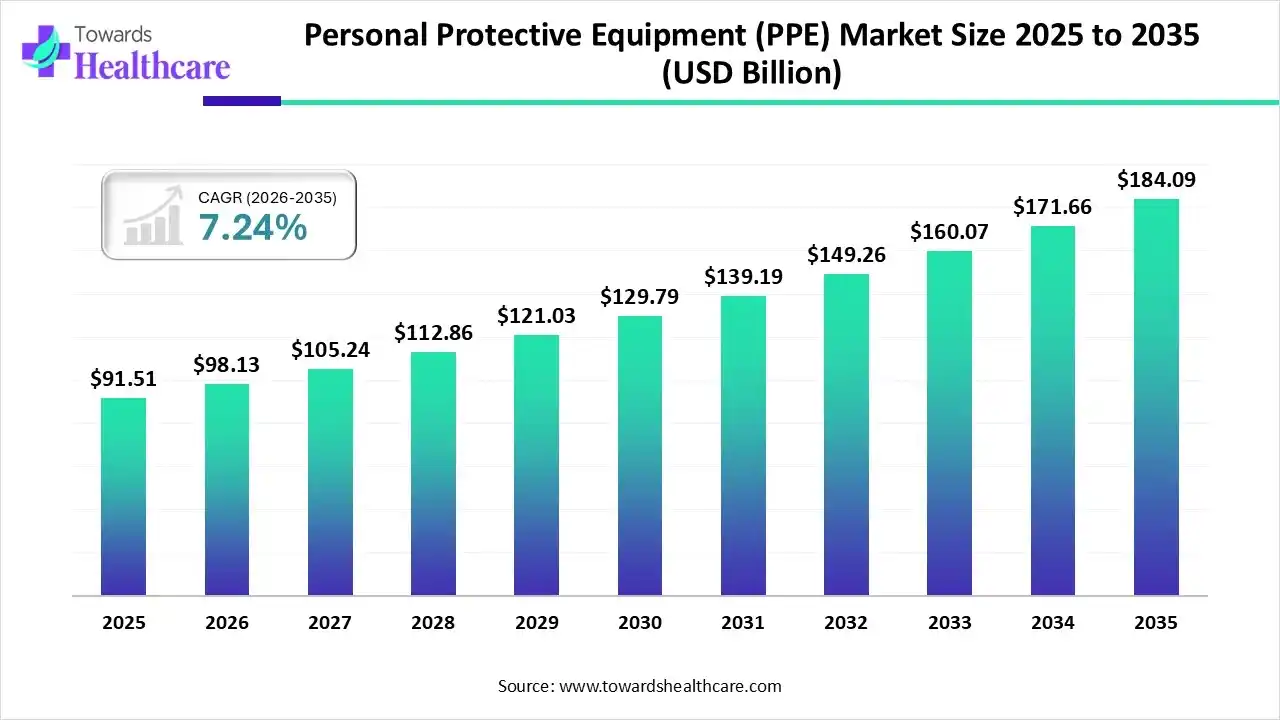
Valued at USD 98.13 billion in 2026, the market is projected to reach USD 184.09 billion by 2035. This steady rise at a CAGR of 7.24% reflects one simple reality; safety has become non-negotiable.
Download Free Sample: https://www.towardshealthcare.com/download-sample/5245
From hospitals to construction sites, PPE is now seen as the first line of defense, not the last resort. Organizations are investing not just to protect workers, but to ensure continuity, trust, and resilience.
From Basic Gear to Smart Protection
PPE has come a long way from simple gloves and masks. Today, it represents a sophisticated blend of material science, ergonomics, and technology.
Modern PPE protects against biological, chemical, electrical, and mechanical risks. But more importantly, it is becoming smarter and more adaptive.
We are witnessing a shift where protection is not just physical—it is intelligent, predictive, and personalized.
Key Market Signals You Shouldn’t Ignore
The PPE market is evolving rapidly, and several indicators highlight its direction:
-
Europe held a dominant 33% market share in 2025, showing strong regulatory enforcement
-
Asia-Pacific is emerging as the fastest-growing region due to industrial expansion
-
Hand protection led with a 40% share, proving basic safety still drives demand
-
Hospitals dominated end-use with 50%, driven by infection control priorities
These signals clearly show that while innovation is rising, foundational safety products still hold strong demand.
AI Is Redefining What Safety Looks Like
Artificial intelligence is quietly transforming the PPE industry. It is not just about manufacturing faster—it is about designing smarter protection systems.
AI helps create PPE that fits better, lasts longer, and performs more efficiently. It can analyze how workers use equipment and suggest improvements in real time.
Imagine a system that alerts a worker if they are not wearing safety gear correctly. Or a sensor that detects potential hazards before exposure happens. This is no longer futuristic—it is already in motion.
AI is also improving training. Healthcare workers can now receive real-time feedback while putting on or removing PPE, reducing the risk of contamination.
Healthcare Demand Is Driving the Core Growth
The rise in infectious diseases continues to push PPE demand globally. Hospitals remain the largest consumers due to constant exposure to biological risks.
Healthcare workers rely on PPE to prevent transmission through direct contact, droplets, and airborne particles. Even a small lapse can lead to large-scale infections.
The growing concern around hospital-acquired infections has forced stricter protocols. This has significantly increased the adoption of gloves, masks, gowns, and respirators.
At the same time, home healthcare is emerging as a new growth frontier. As more patients receive treatment at home, PPE is becoming essential beyond hospital walls.
Why Hand Protection Still Leads the Market
Despite technological advancements, gloves remain the most widely used PPE product.
They are simple, affordable, and highly effective in preventing contamination. Healthcare professionals depend on them during every patient interaction.
Disposable gloves, made from materials like latex, nitrile, and vinyl, dominate usage. Their single-use nature reduces infection risks and ensures hygiene standards.
This explains why the hand protection segment continues to hold a dominant 40% share in the market.
Respiratory Protection Is Gaining Momentum
While gloves lead, respiratory protection is growing at the fastest rate.
The demand for masks and respirators surged during global health crises and continues to remain high. People are now more aware of airborne risks than ever before.
Respirators, especially high-filtration masks, offer superior protection against microscopic particles. This makes them essential for healthcare workers and industrial employees.
As air quality concerns and infectious diseases rise, respiratory PPE will continue to see accelerated demand.
The Supply Chain Reality Check
The PPE market learned a hard lesson during global disruptions like pandemics.
Demand can spike overnight, but supply chains often fail to keep up. Shortages of raw materials like plastics and rubber create bottlenecks.
Geopolitical tensions and logistics issues further complicate distribution. This has forced companies to rethink their sourcing strategies and invest in local manufacturing.
Resilience is now a key focus. Companies are building flexible supply chains to avoid future disruptions.
Innovation Is Opening New Opportunities
Research and development are unlocking new possibilities in PPE design and functionality.
Manufacturers are focusing on comfort, durability, and user compliance. After all, even the best PPE fails if people are uncomfortable wearing it.
Some of the most promising innovations include:
-
Custom-fit PPE designed for different body types and genders
-
Advanced materials that improve breathability and reduce fatigue
-
Radiation-protective add-ons for healthcare workers exposed to imaging equipment
These innovations are not just improving safety—they are improving user experience.
Mergers and Acquisitions Are Reshaping the Market
The PPE industry is also witnessing strong consolidation. Companies are expanding their portfolios to offer complete head-to-toe protection solutions.
Strategic acquisitions are helping businesses strengthen their capabilities and enter new segments. This trend is creating more integrated and competitive market players.
As companies combine expertise, the focus is shifting toward delivering comprehensive safety ecosystems rather than standalone products.
Home Healthcare: The Silent Growth Engine
One of the most underestimated trends in the PPE market is the rise of home healthcare.
With aging populations and increasing chronic conditions, more patients are receiving care at home. This has created a new demand segment for PPE.
Caregivers and family members now require protective gear to handle medical situations safely. This includes gloves, masks, gowns, and face shields.
This shift is expanding the PPE market beyond traditional institutional settings.
The Future: Smarter, Safer, and More Human-Centric
The PPE market is moving toward a future where safety is proactive, not reactive.
Technology, especially AI, will continue to play a crucial role in predicting risks and preventing accidents. At the same time, human-centric design will ensure better adoption and comfort.
The focus will not just be on protection, but on creating a seamless experience for users.
In the coming years, PPE will not just protect lives—it will enhance the way people work, heal, and live.
Final Thought: Are We Truly Prepared?
The numbers clearly show massive growth potential. But the real question is whether industries are prepared to adapt.
Safety is no longer just about compliance—it is about responsibility, innovation, and long-term thinking.
The PPE market is not just growing. It is transforming. And those who understand this shift will lead the future of safety.
Access our exclusive, data-rich dashboard dedicated to the healthcare market – built specifically for decision-makers, strategists, and industry leaders. The dashboard features comprehensive statistical data, segment-wise market breakdowns, regional performance shares, detailed company profiles, annual updates, and much more. From market sizing to competitive intelligence, this powerful tool is one-stop solution to your gateway.
Access the Dashboard: https://www.towardshealthcare.com/access-dashboard
Checkout the Market Report Now at: https://www.towardshealthcare.com/checkout/5245
You can place an order or ask any questions, please feel free to contact us at sales@towardshealthcare.com
Europe Region – +44 778 256 0738
North America Region – +1 8044 4193 44
APAC Region: +91 9356 9282 04
Visit Our Website: https://www.towardshealthcare.com
Find us on social platforms: LinkedIn | Twitter | Instagram | Medium
About the Author