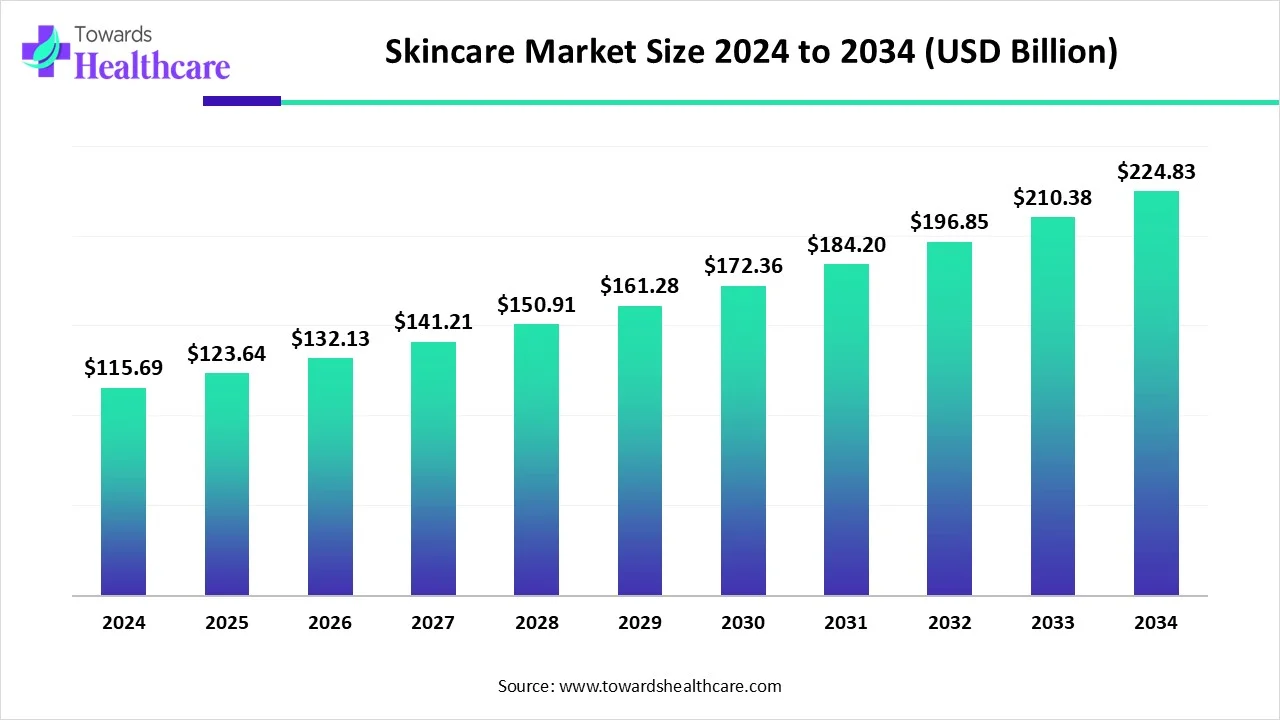
The global skincare market is a rapidly expanding industry, valued at USD 115.69 billion in 2024, projected to grow to USD 123.64 billion in 2025, and expected to reach USD 224.83 billion by 2034, registering a CAGR of 6.87%. Key growth is driven by rising consumer awareness of skin health, increasing disposable incomes, demand for natural and organic products, AI-driven personalization, and the rapid adoption of online retail channels. Asia Pacific dominates the market, while North America shows significant growth potential.
Download the free sample and get the complete insights and forecasts report on this market @ https://www.towardshealthcare.com/download-sample/5610
Market Size
Overall Market Size (2024–2034):
◉2024: USD 115.69 billion
◉2025: USD 123.64 billion
◉2034: USD 224.83 billion
◉CAGR: 6.87% (2025–2034)
Regional Contributions:
◉Asia Pacific: Largest market in 2024 due to large population, increasing urbanization, and rising per capita expenditure on personal care.
◉North America: High growth potential due to high disposable income, awareness of clean-label skincare, and luxury product demand.
Gender Segmentation:
◉Women: Largest market share in 2024 due to economic empowerment, increasing employment, and anti-aging product demand.
◉Men: Rapidly growing segment (2025–2034) as social perceptions evolve, and male consumers embrace self-care routines.
Product Segmentation (2024 Data):
◉Creams: Dominant due to versatility, easy application, and pharmaceutical-grade formulations.
◉Powders: Significant growth potential due to eco-friendliness, lightweight, portability, and preservative-free formulations.
Packaging Segmentation:
◉Tubes: Leading segment in 2024 for cost-efficiency, environmental safety, and precise dispensing.
◉Bottles (Glass): Expected high growth due to stability, barrier properties, and premium appeal, especially for anti-aging, whitening, and antioxidant products.
Distribution Channels:
◉Cosmetic Stores: Largest share in 2024 due to expert guidance and premium in-store experience.
◉Online Channels: Fastest-growing due to ease of access, wide variety, price comparison, and convenience.
Market Trends
Investment & Funding Trends:
◉KorinMi (May 2025): Pre-seed ₹3 crore for Korean skincare tailored to Indian customers. Focus: technology-driven, science-backed formulations.
◉Caldera + Lab (Oct 2024): $6M Series A for men’s sustainable, clean, and high-performance products.
◉Technological Trends:
◉AI & Machine Learning: Personalized skincare recommendations and predictive analytics.
◉Sustainability: Eco-friendly and organic ingredients rising in popularity.
Product Trends:
◉Creams remain dominant due to adaptability, semi-solid application, and multigenerational use.
◉Powders growing due to environmentally friendly composition, lightweight nature, and storage convenience.
Packaging Trends:
◉Tubes dominate due to cost-effectiveness, protection of active ingredients, and precise dispensing.
◉Bottles (glass) are rising due to premium branding, chemical stability, and anti-light properties.
Consumer Demographics & Behavior Trends:
◉Women’s skincare driven by higher discretionary income and anti-aging product demand.
◉Men’s skincare growth due to shift in self-care perception, social media influence, and male-targeted product lines.
◉Online channels rising as consumers prefer 24/7 access, convenience, and wider product choices.
Regional Market Trends:
◉Asia Pacific: Driven by affordability and increasing availability of skincare products.
◉North America: Rising e-commerce adoption, luxury product demand, and awareness of clean-label skincare.
◉Europe: High demand for cruelty-free, organic, and biotech-based skincare.
◉Latin America: Growth due to rising awareness, urbanization, and government support.
AI Impact in the Skincare Market
Personalized Product Formulation:
◉AI processes skin type, environmental conditions, and consumer habits to create customized creams, serums, and powders.
Predictive Customer Insights:
◉Predicts trends, seasonal skincare needs, and demographic-specific solutions.
Enhanced R&D:
◉Reduces time and costs in product development using simulations and formulation optimization.
Virtual Skin Analysis & Chatbots:
◉AI tools provide real-time skincare advice, driving online engagement and sales.
Supply Chain Optimization:
◉Predicts demand spikes for products (e.g., creams vs powders) and optimizes inventory management.
Trend Spotting:
◉Analyzes social media, online reviews, and consumer forums to forecast ingredient and packaging trends.
Regulatory Compliance Support:
◉AI can screen formulations against region-specific restrictions, such as California’s Toxic-Free Cosmetics Act.
Marketing & Personalization:
◉AI enables targeted campaigns, recommending products based on purchase history and skin type, boosting conversion rates.
Regional Insights
Asia Pacific
Market Drivers:
◉Fast urbanization, growing middle-class income, and increased skincare awareness.
Country Insights:
◉China: Second largest cosmetics market, increasing demand for professional and clinically-backed formulations.
◉South Korea: Leader in innovation, natural ingredients, and attractive packaging; strong online shopping penetration.
North America
Market Drivers:
◉High disposable income, luxury skincare adoption, e-commerce growth.
Country Insights:
◉USA: Demand for premium, clean-label skincare; social media drives purchasing decisions.
◉Canada: Strong preference for organic and ethical products; leading provinces are Ontario and Quebec.
Europe
Market Drivers:
◉Strong focus on sustainability, cruelty-free products, and biotech-based formulas (e.g., probiotics, plant-based retinol).
Country Insights:
◉France: Emphasis on professional advice and self-care; pharmacy plays a key role in consumer trust.
◉UK: Leader in clean beauty, microbiome-focused skincare; over 1,800 beauty companies driving innovation.
Latin America
Market Drivers:
◉Urbanization, rising incomes, government awareness campaigns, and social media influence.
Country Insights:
◉Mexico: Hub for cosmetic treatments; over 90 regulated cosmetic products.
◉Brazil: Second-highest cosmetic surgeries globally; ANVISA regulates cosmetics, hygiene, and perfumes.
Market Dynamics
Drivers
◉Rising interest in natural and organic products due to consumer awareness of chemical side effects.
◉Growing demand for eco-friendly and clean-label products.
Restraints
◉Regulatory restrictions: Stringent requirements in regions like California; banning harmful chemicals under acts like Toxic-Free Cosmetics Act.
Opportunities
Personalized skincare solutions: AI and tech-driven tailored solutions creating differentiation and brand loyalty.
◉Growing male skincare segment.
◉Online retail expansion and digital marketing innovations.
Top Skincare Companies
1. L’Oréal Professional (France)
Overview:
◉Global leader in skincare and cosmetics innovation.
◉Focuses on professional-grade formulations and luxury consumer products.
◉Operates in more than 150 countries with strong R&D and marketing presence.
Key Products:
◉Anti-aging creams and serums
◉Moisturizers and lotions
◉Specialty facial treatments
◉Hair and scalp skincare products
Strengths:
◉Strong R&D capabilities, continuously innovating in skincare science.
◉Well-established global distribution network for retail and professional channels.
◉Brand reputation for quality and luxury, trusted by consumers worldwide.
◉Ability to quickly adapt to emerging trends such as clean-label and sustainable products.
2. Unilever (UK)
Overview:
◉Multinational consumer goods company with a diverse personal care portfolio.
◉Skincare is part of a larger personal care and hygiene segment.
◉Strong emphasis on sustainability and natural ingredients.
Key Products:
◉Lotions and creams for daily use
◉Men’s skincare lines
◉Powders and specialty topical treatments
◉Eco-friendly and clean-label products
Strengths:
◉Extensive global supply chain, ensuring availability across multiple markets.
◉Focus on sustainable production and eco-friendly packaging.
◉Strong marketing and branding, leveraging heritage brands to expand consumer trust.
◉Ability to cater to both mass-market and premium consumers.
3. Procter & Gamble (P&G) (USA)
Overview:
◉Leading multinational consumer goods corporation.
◉Offers skincare as part of a broader personal care and grooming portfolio.
◉Operates in both mass-market and premium segments.
Key Products:
◉Creams and moisturizers
◉Facial treatments and serums
◉Anti-aging products
◉Lotions and powders
Strengths:
◉Global brand recognition with strong marketing campaigns.
◉Deep R&D capabilities, particularly in dermatology-backed skincare.
◉Ability to leverage multiple consumer channels, including online, retail, and supermarkets.
◉Strong product portfolio for diverse consumer demographics.
4. Estée Lauder Inc. (USA)
Overview:
◉Premium skincare and cosmetics company.
◉Focuses on high-performance, luxury skincare products with scientific backing.
◉Global footprint in department stores, specialty retailers, and online.
Key Products:
◉Serums and anti-aging creams
◉Facial moisturizers and powders
◉Eye creams and masks
◉Specialty treatments like whitening and antioxidant formulations
Strengths:
◉Strong luxury brand positioning, attracting high-income consumers.
◉Heavy investment in R&D for innovation in anti-aging and targeted skincare.
◉Extensive global distribution through exclusive counters and online platforms.
◉Ability to create premium consumer experiences in stores.
5. Beiersdorf AG (Germany)
Overview:
◉Pioneer in dermatologically-tested skincare.
◉Known globally for Nivea and other trusted brands.
◉Focus on dermatology-based formulations and consumer trust.
Key Products:
◉Creams and lotions (Nivea line)
◉Anti-aging and sun care products
◉Specialty creams for sensitive skin
◉Topical treatments for everyday skincare
Strengths:
◉Strong scientific credibility with dermatologist-tested formulations.
◉Extensive European market presence and growing global reach.
◉Trusted brand legacy, particularly in mass-market skincare.
◉Expertise in formulation innovation, particularly in creams and anti-aging products.
6. Shiseido Co., Ltd. (Japan)
Overview:
◉Major Asian skincare innovator with a global footprint.
◉Known for advanced technology-driven products and premium positioning.
◉Focus on blending science and traditional Japanese skincare concepts.
Key Products:
◉Anti-aging creams and serums
◉Moisturizers and lotions
◉Specialty skincare with natural ingredients
◉Powder-based skincare products
Strengths:
◉Advanced R&D capabilities, particularly in biotech and natural extracts.
◉Strong presence in Asia-Pacific luxury skincare markets.
◉Ability to blend cultural heritage with modern technology.
◉Focus on premium consumer experience and innovative packaging.
7. Coty Inc. (USA)
Overview:
◉Global beauty company with a strong focus on skincare, cosmetics, and fragrances.
◉Known for brand diversification and multiple market segments.
Key Products:
◉Lotions, creams, and serums
◉Skincare kits and sets
◉Specialty products for different age groups
◉Fragrance-infused skincare
Strengths:
◉Wide brand portfolio, appealing to multiple demographics.
◉Strong marketing and distribution capabilities.
◉Ability to target both mass-market and premium segments.
◉Strategic partnerships with retailers globally.
8. Natura & Co (Brazil)
Overview:
◉Focus on eco-friendly, natural, and organic skincare.
◉Known for sustainability and ethical sourcing.
◉Strong presence in Latin America and growing globally.
Key Products:
◉Creams and lotions
◉Organic skincare products
◉Specialty natural ingredient-based formulations
◉Eco-friendly packaging products
Strengths:
◉Commitment to sustainability and ethical production.
◉Strong brand trust in eco-conscious consumer segment.
◉Growing presence in international markets.
◉Ability to innovate in natural ingredient-based formulations.
9. Kao Corporation (Japan)
Overview:
◉Leading Asian personal care and skincare manufacturer.
◉Strong in daily-use skincare products and serums.
◉Focus on Asian consumer needs and innovation.
Key Products:
◉Creams, lotions, and serums
◉Anti-aging formulations
◉Facial treatments for sensitive and general skin types
Strengths:
◉Deep understanding of Asian skin types and climate-specific formulations.
◉Strong R&D and innovation focus.
◉High-quality mass-market and premium products.
◉Ability to integrate natural ingredients and scientific formulations.
10. Johnson & Johnson Services, Inc. (USA)
Overview:
◉Healthcare giant offering trusted skincare brands.
◉Focus on medical-grade and baby skincare.
◉Global distribution across retail, hospitals, and pharmacies.
Key Products:
◉Baby lotions and creams
◉Medical-grade topical treatments
◉Creams and powders for sensitive skin
Strengths:
◉Medical credibility; trusted by consumers and healthcare professionals.
◉Extensive global distribution network.
◉Strong brand trust and product efficacy.
◉Ability to target niche and mass-market segments.
11. Avon Products Inc. (UK)
Overview:
◉Direct-to-consumer beauty and skincare company.
◉Focuses on women’s skincare and cosmetic products.
◉Operates through direct sales representatives and online channels.
Key Products:
◉Lotions, creams, and serums
◉Anti-aging and moisturizing products
◉Specialty skincare sets
Strengths:
◉Extensive direct-sales network, building strong customer relationships.
◉Ability to reach consumers in remote areas through direct selling.
◉Strong brand loyalty and recognition among women.
◉Flexibility in customizing product offerings for local markets.
Latest Announcements
1. Pilgrim (March 2024)
◉Funding Raised: ₹200 crore through main and secondary investment rounds.
Purpose:
◉Expand offline presence in India.
◉Enhance R&D capabilities for innovative skincare solutions.
Focus:
◉Ingredient-driven formulations targeting specific skin concerns.
◉Development of unique, differentiated products to strengthen brand leadership.
Market Impact:
◉Expanding offline presence allows Pilgrim to compete in luxury and premium skincare retail.
◉Funding for R&D enables science-backed product innovation, increasing consumer trust.
◉Positions Pilgrim for regional market dominance in India, leveraging growing disposable income and premium skincare demand.
2. Unilever Ventures – RAS Luxury Skincare (Jan 2025)
◉Funding Raised: $5 million investment.
Purpose:
◉Expand retail presence in India via exclusive brand stores.
◉Strengthen technology, branding, and talent acquisition.
Strategic Goals:
◉Capture high-end luxury skincare segment in India.
◉Develop innovative products leveraging global Unilever expertise.
Market Implications:
◉Increased offline visibility to compete with international premium brands.
◉Enhanced technology adoption can lead to advanced formulations and consumer personalization.
◉Talent acquisition ensures innovative product development and faster market response.
3. Kult (May 2025)
◉Funding Raised: ₹170 crore.
◉Business Model: AI-driven personalized skincare solutions.
Purpose:
◉Expand product portfolio.
◉Hire additional staff to scale operations nationwide.
◉Increase nationwide footprint and market penetration.
Operational Targets:
◉Process 10,000+ orders daily by end of 2025.
◉Onboard 700+ high-end cosmetic products.
Market Impact:
◉Demonstrates high investor confidence in AI-powered personalized skincare.
◉Supports mass adoption of AI-customized skincare, addressing individual skin needs.
◉Strengthens online distribution, aligning with the fastest-growing sales channel globally.
Recent Developments
1. KorinMi
◉Focus: Science-backed Korean skincare tailored for Indian consumers.
◉Funding: ₹3 crore in pre-seed round.
Strategic Insights:
◉Leverages Korean skincare innovation while adapting products for Indian skin types.
◉Emphasis on technology-enabled product development.
Market Implication:
◉Opportunity to capture niche market of consumers seeking premium K-beauty products.
2. Caldera + Lab
◉Focus: Sustainable and clean-label skincare for men.
◉Funding: $6M Series A round from HighPost Capital, LLC.
Strategic Insights:
◉Addresses the rapidly growing male skincare segment.
◉Focus on sustainability and clean formulations aligns with environmentally conscious consumer trends.
Market Implication:
◉Can capture loyal male customer base seeking high-performance and eco-friendly products.
3. Kult
◉Focus: AI-based personalized skincare.
Operational Targets:
◉Handle 10,000+ daily orders.
◉Offer 700+ high-end products by end of 2025.
Strategic Insights:
◉Demonstrates scalability of AI technology in consumer skincare.
◉Enhances market differentiation with highly personalized product offerings.
4. Unilever Ventures & RAS Luxury Skincare
◉Focus: Expansion of brand stores and R&D in India.
Strategic Insights:
◉Targeting Indian premium skincare market, which is growing due to increasing disposable income and awareness of luxury products.
◉Combines offline presence and technological innovation to enhance customer experience.
Market Segments
A. By Product
Creams
◉Semi-solid formulation; versatile for daily care and therapeutic use.
◉Suitable for all ages; high adaptability to anti-aging, moisturizing, or whitening claims.
◉Dominates market due to ease of application and widespread acceptance.
Lotions
◉Lighter than creams; absorbs faster; ideal for everyday hydration.
◉Popular among mass-market and middle-income consumers.
◉Supports frequent use and broad distribution.
Powders
◉Eco-friendly and preservative-free; lightweight and easy to transport.
◉Increasing adoption due to sustainability and convenience.
◉Growing segment aligned with clean beauty and minimal packaging trends.
Sprays
◉Rapid absorption; convenient for on-the-go skincare.
◉Targeted for younger demographics seeking quick and hassle-free application.
Others
◉Includes masks, gels, oils, and specialty treatments.
◉Cater to niche concerns such as anti-aging, detoxifying, and brightening.
B. By Packaging Type
Tubes
◉Cost-effective, hygienic, and protects active ingredients.
◉Ideal for creams and gels, especially in mass-market and travel-sized products.
Bottles (Glass)
◉Premium perception; high stability against light, heat, and chemical reactions.
◉Favored for serums and high-value anti-aging products.
Jars
◉Traditional packaging; larger quantities; reusable.
◉Suitable for luxury creams and body care products.
Others
◉Includes sachets, eco-packaging, refillable systems.
◉Aligns with sustainability trends and minimalist consumer preferences.
C. By Gender
Women
◉Largest segment; drives anti-aging, whitening, and luxury product demand.
◉Influenced by social media, professional advice, and discretionary income.
Men
◉Growing rapidly; influenced by changing societal norms, self-care trends, and online influencers.
◉Products increasingly targeted and sustainable.
D. By Distribution Channel
Cosmetic Stores
◉Provides expert guidance, personalized experience, and premium touchpoints.
◉Preferred by high-end consumers seeking professional advice.
Online
◉Fastest-growing channel; offers convenience, variety, and price comparison tools.
◉Supports AI-driven personalized product recommendations.
Supermarkets/Hypermarkets
◉High accessibility and affordability; suitable for mass-market skincare products.
◉Supports bulk purchases and routine product consumption.
Others
◉Specialty stores, pharmacies, and department stores.
◉Niche channels for professional, organic, or prescription-based skincare.
E. By Region
Asia Pacific
◉Dominant market due to population size, urbanization, and growing disposable income.
◉China: Clinically-backed products, rising consumer sophistication.
◉South Korea: Innovative formulations, natural ingredients, high online sales.
North America
◉Fast-growing due to luxury skincare demand, disposable income, and e-commerce adoption.
◉USA: Premium products, clean-label demand, social media influence.
◉Canada: Organic and ethical products constitute 40% of the market.
Europe
◉Focused on sustainability, cruelty-free products, and biotech-based skincare.
◉France & UK: Premium, microbiome-focused, clean beauty trends.
Latin America
◉Growth driven by urbanization, rising incomes, social media influence, and government campaigns.
◉Brazil: High plastic surgery rate, ANVISA regulates skincare.
◉Mexico: Hub for cosmetic treatments, proximity to North American markets.
Middle East & Africa (MEA)
◉Emerging market; growth driven by luxury skincare demand, high disposable income, and urbanization.
Access our exclusive, data-rich dashboard dedicated to the healthcare market – built specifically for decision-makers, strategists, and industry leaders. The dashboard features comprehensive statistical data, segment-wise market breakdowns, regional performance shares, detailed company profiles, annual updates, and much more. From market sizing to competitive intelligence, this powerful tool is one-stop solution to your gateway.
Access the Dashboard: https://www.towardshealthcare.com/access-dashboard
Immediate Delivery Available | Buy This Premium Research @ https://www.towardshealthcare.com/price/5610
Become a valued research partner with us – https://www.towardshealthcare.com/schedule-meeting
You can place an order or ask any questions, please feel free to contact us at [email protected]
Powering Healthcare Leaders with Real-Time Insights: https://www.towardshealthcare.com/healthcare-intelligence-platform
Europe Region – +44 778 256 0738
North America Region – +1 8044 4193 44
APAC Region: +91 9356 9282 04
Web: https://www.towardshealthcare.com
Find us on social platforms: LinkedIn | Twitter | Instagram | Medium | Pinterest