Genomic targeted therapy has quietly changed the way many cancer medicines are being developed.
Instead of starting with a broad patient population and looking for a response later, drug developers can now begin with a genetic alteration and ask a much more practical question: which patients are most likely to benefit?
That change is important for US commercial-stage biopharmaceutical companies because genomic targets are now connected to real-world prescribing, diagnostic testing and commercial revenue, not just clinical research.
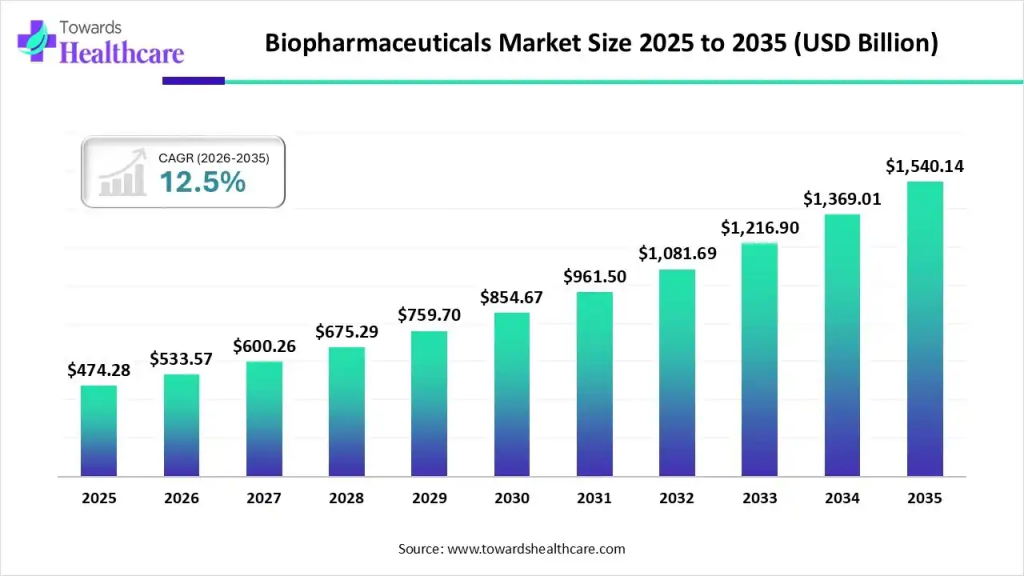
According to Towards Healthcare Research and Consulting, the global biopharmaceuticals market size was calculated at USD 474.28 billion in 2025, to reach USD 533.57 billion in 2026 is expected to be worth USD 1540.14 billion by 2035, expanding at a CAGR of 12.5% from 2026 to 2035.
KRAS Shows How Fast the Field Can Move
Few targets demonstrate this better than KRAS G12C.
For years, KRAS was considered one of the hardest cancer targets to drug. The situation changed with medicines such as Amgen’s LUMAKRAS (sotorasib) and Bristol Myers Squibb’s KRAZATI (adagrasib).
Amgen reported $363 million in 2025 LUMAKRAS sales, including $211 million in the US. The FDA also approved LUMAKRAS with Vectibix for previously treated KRAS G12C-mutated metastatic colorectal cancer in 2025.
Bristol Myers Squibb’s KRAZATI generated $205 million in 2025, according to the company’s latest reported figures. That number is smaller than some established oncology products, but it is significant because it comes from a therapy designed around a specific molecular alteration.
The bigger story is what happens after the first approval.
Once a company has a validated target, it can study combinations, additional tumor types and different stages of disease.
Lung Cancer Has Become a Blueprint for Precision Treatment
Non-small cell lung cancer is probably one of the clearest examples of how genomic information can change treatment decisions.
Today, physicians may look for alterations involving EGFR, ALK, ROS1, KRAS, HER2, MET, RET or NTRK, among others, before deciding which treatment pathway makes sense.
That creates a very different development model.
A drug does not necessarily need to work across every patient with lung cancer. It needs to work convincingly in the right molecularly defined group—and the diagnostic system needs to find those patients.
Pfizer’s LORBRENA (lorlatinib) is an example of this approach, targeting ALK-positive metastatic non-small cell lung cancer.
For developers, the lesson is straightforward: better molecular classification can create smaller but more clearly defined treatment populations.
We analyze your business, understand your challenges, and provide solutions built around your growth goals. Download customized sample now: https://www.towardshealthcare.com/download-sample/5012
Commercial Revenue Is Starting to Reflect the Science
The financial numbers show that genomic and biomarker-driven oncology is no longer a purely experimental area.
| Company | Therapy | Biological focus | Latest reported figure |
|---|---|---|---|
| Amgen | LUMAKRAS | KRAS G12C | $363M in 2025 |
| Bristol Myers Squibb | KRAZATI | KRAS G12C | $205M in 2025 |
| Merck | LYNPARZA | BRCA / DNA repair | $1.45B in 2025 |
| Merck | WELIREG | HIF-2α biology | $716M in 2025 |
| Merck | KEYTRUDA | Biomarker-guided oncology across indications | $31.68B in 2025 |
Figures are company-reported and represent different products and revenue structures, so they should not be treated as like-for-like comparisons.
Merck’s LYNPARZA alliance revenue reached $1.45 billion in 2025, up 11% from the previous year. The drug’s development is closely connected with DNA-repair biology and BRCA-related cancer treatment.
At the broader oncology level, Merck’s KEYTRUDA generated $31.68 billion in 2025, showing how biomarker-informed treatment can become part of a very large commercial franchise when evidence and indications continue to expand.
The Hard Part Starts After the First Approval
This is where the development landscape gets interesting.
Finding a mutation is only the first step. Cancer can adapt, develop resistance and activate alternative biological pathways.
So companies are increasingly asking what happens after the tumor stops responding.
That is pushing development toward combination treatments, next-generation inhibitors and therapies designed to address resistance mechanisms rather than simply repeating the same approach.
Diagnostics Are Becoming Part of the Drug Strategy
There is also a less visible part of the story: testing.
A targeted therapy cannot reach the right patient if the relevant genomic alteration is never identified.
For commercial-stage companies, this makes molecular diagnostics, next-generation sequencing, pathology infrastructure and companion diagnostics increasingly important.
The drug and the test are becoming part of the same treatment journey.
Where the Strongest Opportunity May Come From
The next competitive advantage may not belong to the company with the longest list of genomic targets.
It may belong to the company that can connect the entire chain, from target discovery and patient identification to clinical evidence, regulatory approval and physician adoption.
That is why companies such as Amgen, Bristol Myers Squibb, Pfizer and Merck deserve attention. Their programs show how genomic science is moving from highly specialized research into everyday treatment decisions.
The field is also becoming more demanding. A successful therapy now has to answer three questions clearly: Does the target matter? Can the right patient be identified? And can the treatment keep working as the disease changes?
For healthcare leaders, that is the real direction of genomic targeted therapy development.
The science is becoming more precise, but the commercial challenge is becoming broader. The winners will be the companies that can turn a molecular discovery into a complete, practical treatment pathway for the patient sitting in front of the physician.
Important Links
Get a dashboard built around your niche; with the exact data and insights you need. Email: us at [email protected]
About Us
Healthcare WebWire is a part of Towards Healthcare Research & Consulting which is a global healthcare market research and consulting firm dedicated to helping businesses make informed decisions through reliable market intelligence and strategic insights. We serve pharmaceutical, biotechnology, medical device, AI in healthcare, cell and gene therapy, digital health, and life sciences organizations with in-depth market research, custom consulting, competitive analysis, and growth forecasts. Our team combines industry expertise with rigorous research to deliver clear, actionable insights that support market expansion, product strategy, investment decisions, and long-term business growth. From emerging innovations to established healthcare markets, we help organizations understand where the industry is today and where it’s headed tomorrow.
You can place an order or ask any questions, please feel free to contact us at [email protected]
Europe Region – +44 778 256 0738
North America Region – +1 8044 4193 44
APAC Region: +91 9356 9282 04
Visit Our Website: https://www.towardshealthcare.com
Find us on social platforms: LinkedIn | Twitter | Instagram | Medium